
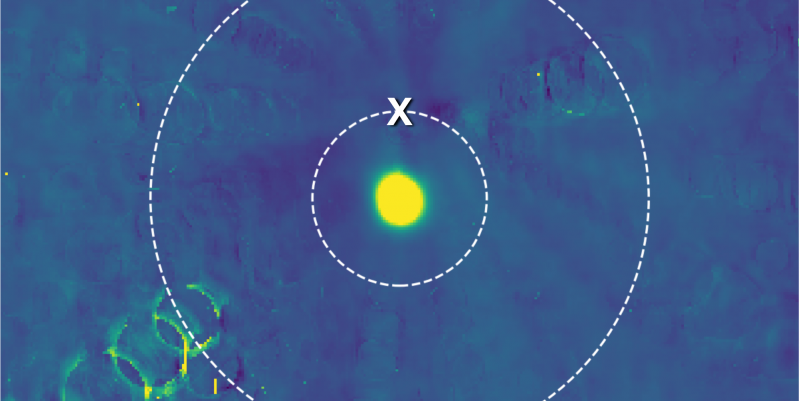
There are flashy ways to celebrate New Year’s Eve, and then there is NASA’s way: sending a piano-sized spacecraft to buzz an icy relic at the edge of the solar system while everyone on Earth stares at monitors, coffee cups, and the clock like it owes them money. That is exactly what happened when New Horizons headed for Ultima Thule, the distant Kuiper Belt object later officially named Arrokoth. After rewriting the Pluto story in 2015, the spacecraft kept going, because apparently one historic flyby was not enough.
The result was one of the boldest acts of robotic exploration ever attempted. On New Year’s Day 2019, New Horizons swept past a small world roughly a billion miles beyond Pluto, turning a faint smudge of light into a real place with shape, color, geology, and scientific attitude. For astronomers, the flyby was not just a cool sequel. It was a chance to inspect a primitive building block from the early solar system, a deep-frozen leftover from the era when planets were still under construction. For the rest of us, it was cosmic proof that humanity has a weird and wonderful habit of celebrating holidays by doing impossible things.
A New Year’s Countdown Unlike Any Other
By the time New Horizons targeted Ultima Thule, it had already built an impressive résumé. The spacecraft launched in January 2006, tore across the solar system, grabbed a gravity assist from Jupiter, and became the first mission to explore Pluto up close in July 2015. Most spacecraft would have retired after that with a respectable gold watch and a nice framed photo of Charon. New Horizons, on the other hand, got a new assignment.
That next target was a tiny object known at the time as 2014 MU69, nicknamed Ultima Thule by the mission team. It orbited in the Kuiper Belt, a vast region of icy bodies beyond Neptune. The object had been discovered by the Hubble Space Telescope in 2014, years after New Horizons had already left Earth, which makes the whole mission feel a bit like mailing a package and then choosing the address halfway through delivery.
The close approach came at 12:33 a.m. EST on January 1, 2019. New Horizons passed within about 2,200 miles of the object while racing through space at more than 32,000 miles per hour. That is not a gentle Sunday drive. It is a precision stunt performed in the dark, billions of miles away, with no joystick, no second chances, and no room for a wrong turn. Because the spacecraft had to keep its instruments pointed at the target during the encounter, mission control could not watch events unfold in real time. Everyone had to wait for a health signal to arrive hours later. Space exploration, as it turns out, is 10 percent fireworks and 90 percent extreme patience.
Why Ultima Thule Mattered So Much
At first glance, Ultima Thule did not sound like a headline-grabbing destination. It was small, dim, and absurdly far away. But that was exactly why scientists wanted it. This object belonged to a population of ancient bodies believed to have remained relatively unchanged since the solar system formed about 4.5 billion years ago. In other words, it was not just another rock. It was a time capsule.
Planets did not appear fully assembled like flat-pack furniture with missing screws. They formed through the slow clumping of dust, ice, and rock into larger and larger bodies called planetesimals. Most of those original building blocks were altered, shattered, melted, or recycled over time. But some objects in the outer solar system stayed cold and comparatively untouched. Ultima Thule was thought to be one of those rare holdouts, a preserved relic from the age when the planets were still learning how to be planets.
That made the New Horizons flyby scientifically priceless. By studying the object’s shape, color, composition, and structure, researchers could test ideas about how the solar system assembled itself. Did worlds grow through violent smashups, or by gentle mergers? Did the outer solar system preserve more original material than the inner one? Could a tiny Kuiper Belt object reveal something fundamental about how Earth, Mars, and even exoplanets around other stars came to be? Suddenly, this dim speck beyond Pluto looked a lot like a witness at the oldest crime scene in the neighborhood.
Threading a Needle in Deep Space
One of the most remarkable parts of the story is that New Horizons reached the target at all. Before the flyby, scientists knew frustratingly little about Ultima Thule. They had its orbit, rough color, approximate brightness, and hints about its shape. But they did not know everything they wanted to know about its rotation, exact profile, or whether dust or debris might complicate the pass. Alan Stern famously said the team had never gone to an object they knew less about. That is a thrilling sentence in a movie trailer and a mildly terrifying one in mission operations.
Navigation required exquisite precision. The target was tiny. The spacecraft was moving fast. The distance was ridiculous. Communications had a long delay. And the mission had to choreograph its observations in advance, because once the encounter began, the spacecraft would act on preloaded instructions. There was no cosmic equivalent of yelling, “Scoot left a little!” from Earth. The job was to trust the math, trust the engineering, and trust that seventeen layers of careful planning would survive one very unforgiving night.
They did. Hours after closest approach, New Horizons sent back confirmation that it had survived and stored the encounter data. The first real celebration happened not at the exact flyby moment, but when that signal reached Earth. That delayed applause is one of the most charming details in modern exploration. Even our greatest victories in deep space arrive late, like the universe has terrible holiday shipping.
What New Horizons Actually Found
From Blurry Blob to Cosmic Snowman
Before the closest images arrived, scientists floated possibilities. Maybe Ultima Thule looked like a bowling pin. Maybe it was actually two objects orbiting each other. Maybe it would surprise them completely. Naturally, it chose the funniest option: it looked like a snowman.
The early images revealed a contact binary, meaning two lobes that had once been separate objects and later merged. One lobe was larger, one smaller, and together they formed a distinctly double-lobed silhouette that instantly became one of the most memorable deep-space portraits of the decade. Later analysis refined the picture further, showing that the object was not simply a neat, round snowman but a more flattened and oddly shaped body than first assumed. Space, as always, refused to stay simple for more than five minutes.
The world also appeared reddish, consistent with other Kuiper Belt objects coated in complex organic materials altered by radiation over immense timescales. That red tint was not cosmetic trivia. It offered clues about chemistry, surface processing, and the kinds of compounds present in this distant environment. Even its “neck,” the bright area where the lobes meet, sparked questions about how material settled or accumulated after the merger.
A Gentle Collision, Not a Violent Wreck
One of the most exciting interpretations of the data was that the two lobes joined through a slow, gentle merger. This mattered a lot. If Arrokoth formed through a calm, low-speed union rather than a catastrophic crash, it supports models in which planetesimals can grow through relatively delicate accumulation in the early solar nebula. That may sound like a niche debate for people who own too many telescope stickers, but it is actually central to understanding how planets form at all.
In plain English, Arrokoth suggested that the early solar system may have built some of its worlds more like a careful snowball rolling downhill than a demolition derby in a gravel pit. That is a huge clue. It helps researchers reconstruct the physical conditions of the solar system’s infancy and offers a rare, direct look at one of the oldest preserved building blocks ever visited by a spacecraft.
From Ultima Thule to Arrokoth
The headline name “Ultima Thule” was the informal nickname used around the time of the flyby, and it certainly sounded dramatic, which is usually how you know scientists briefly let the literature majors into the room. The phrase roughly evoked a place beyond the known world, which fit the mission beautifully. But the nickname also drew criticism because of its later historical associations outside classical usage.
In November 2019, NASA announced the object’s official name: Arrokoth, a Powhatan/Algonquian word meaning “sky”. The name was chosen with the involvement and consent of Powhatan representatives and linked the mission to the Chesapeake Bay region, where key institutions behind the mission and Hubble operations are based. Today, Arrokoth is the correct official name, while Ultima Thule remains the historical nickname attached to the New Year’s flyby moment.
That distinction matters for good science writing. If you are discussing the event as it was known in real time, “Ultima Thule” makes sense in context. If you are discussing the object today, “Arrokoth” is the accurate official name. Think of it as the same cosmic celebrity, just with a better stage name and less baggage.
Why This Flyby Still Matters
New Horizons did more than bag another record. It expanded the meaning of planetary exploration. Pluto had already shown that distant worlds can be geologically rich, atmospherically interesting, and emotionally rude to anyone who assumed they would be boring. Arrokoth added a different lesson: sometimes the smallest, quietest worlds hold the deepest historical memory.
The flyby also demonstrated the value of long-term missions. This was not a quick victory assembled for social media clips. It took years of planning, a target discovered after launch, razor-thin navigation, and an extraordinarily slow return of data that stretched over many months. Modern audiences are used to instant everything. New Horizons offered a useful correction. Some of the best discoveries arrive one pixel, one packet, and one delayed signal at a time.
In scientific terms, the encounter helped support the idea that some Kuiper Belt objects are primordial survivors from the era of planet formation. In human terms, it reminded us that exploration does not end at the first finish line. Once Pluto was done, New Horizons kept going. Because beyond every “known world” is another map waiting to be drawn on.
The Human Experience of Watching New Horizons Reach the Edge of the Known
There is also something wonderfully emotional about the New Horizons encounter that does not fit neatly into a data table. Imagine the mood on Earth that night. Most people were busy with fireworks, countdowns, glitter, snacks, and at least one relative explaining cryptocurrency incorrectly. Meanwhile, in mission operations, scientists and engineers were spending New Year’s Eve waiting for a spacecraft millions of times farther away than the Moon to sneak past an object no human had ever seen up close. That contrast alone is cinematic.
The experience of following the flyby was a strange blend of celebration and helplessness. Everyone knew the spacecraft would make closest approach in the dark and in silence. There was nothing to do in that moment but trust what had already been programmed. That is the part of space exploration people do not always appreciate. At the decisive instant, human drama gives way to machine discipline. No one gets to improvise. No one gets to tap the brakes. The spacecraft is out there alone, doing exactly what its builders taught it to do years earlier.
And yet that helplessness is part of what made the event so gripping. It felt like sending a message into the void and waiting for the universe to text back. When the confirmation signal finally arrived and showed that New Horizons was healthy and had collected data, the reaction was not just professional satisfaction. It was relief, joy, laughter, and the kind of exhausted happiness that only appears after years of work survive a few impossible minutes.
For people watching from home, the mission delivered a different kind of thrill. It shrank the emotional distance to a place that was physically unimaginable. “A billion miles past Pluto” sounds abstract until you realize someone built hardware on Earth, launched it in 2006, guided it past Pluto in 2015, and then sent it onward to a second, smaller target for a New Year’s rendezvous in 2019. Suddenly that distant region no longer feels like an empty black boundary. It feels like a destination with timing, suspense, names, images, and stories.
That is why New Horizons resonated beyond the astronomy community. It told a very human story about curiosity that refuses to sit still. We did not need to visit Arrokoth for survival, commerce, or convenience. We went because we wanted to know what was there. We went because a faint speck in Hubble images bothered us in the best possible way. We went because unanswered questions are irresistible to our species, especially when they live at the edge of the map.
The experience also carried a subtle lesson in humility. Arrokoth is tiny by planetary standards, yet it forced some of the smartest people on Earth to admit how little they knew before arrival. That is not failure. That is exploration working properly. A mission is not successful because it confirms what we guessed; it is successful because it shows us what we missed. New Horizons did exactly that. It took a distant dot, turned it into a world, and reminded us that the universe is under no obligation to match our rough drafts.
So yes, New Horizons spent New Year’s exploring Ultima Thule. But what it really explored was the next chapter of human curiosity. The object was out there all along, cold and ancient and unbothered. We were the ones who changed. We looked farther, aimed better, waited longer, and learned more. That is the experience at the heart of the mission: not just seeing the frontier, but feeling it move.
Conclusion
The story of New Horizons and Ultima Thule is bigger than one headline-grabbing flyby. It is about momentum after success, patience in the face of distance, and the scientific power of studying ancient objects preserved in the deep freeze of the Kuiper Belt. The spacecraft’s New Year’s encounter transformed a blurry target into Arrokoth, a world that now helps scientists think more clearly about planet formation, planetesimals, and the architecture of the outer solar system.
Most of all, the mission proved that the phrase “beyond Pluto” is not the end of the story. It is where the next one begins. And if New Horizons taught us anything, it is that the solar system still has plenty of secrets left for anyone patient enough to chase them into the dark.












