
At an ordinary conference, a badge tells people your name, your company, and whether you accidentally wandered into the premium breakfast line. At a hacker conference, a badge may contain a microcontroller, cryptographic puzzles, infrared communications, a game console, or enough exposed copper to tempt someone holding a soldering iron.
The finest example of conference badge hacking, however, began with something remarkably simple: an almost empty printed circuit board. At the 2015 Hackaday Superconference, attendees received a badge made primarily from FR4 fiberglass, copper, and a collection of through-holes. It had no processor waiting to be reprogrammed, no screen demanding a game port, and no wireless radio quietly suggesting the obvious project.
That apparent limitation became its greatest feature. Attendees transformed the blank conference badge into radios, clocks, sound generators, interconnected sculptures, experimental circuits, and a high-voltage spark-gap demonstration. Instead of handing everyone the same technological destination, the organizers gave them a starting line and politely stepped out of the way.
Why the Simplest Badge Inspired the Wildest Hacks
A six-week compromise became a creative advantage
The 2015 Superconference badge was not originally conceived as a grand philosophical experiment. Organizers had roughly six weeks to move from an idea to hundreds of finished badges. With little time for elaborate electronics, the final product was essentially a shaped circuit board with mounting holes, solderable areas, and visual branding.
By traditional product-design standards, it looked unfinished. By hacker standards, it looked like permission.
That distinction matters. A feature-rich electronic conference badge often guides its owner toward a predictable family of projects. Give attendees a display and they will make animations. Give them a radio and they will experiment with signals. Give them a handheld gaming layout and someone will inevitably ask whether it can run Doom. This is less a criticism than a law of the universe.
A blank PCB creates no such gravitational pull. Participants must decide what the badge should become before worrying about how to build it. The design challenge begins with imagination rather than documentation.
The memorable projects were not variations of one idea
The resulting badge hacks covered an unusually broad range of electronics. Some attendees built AM radio receivers. Others produced clocks, audio devices, light displays, and electromechanical creations. One project connected multiple badges into something resembling a simple nervous system. Another pushed the concept toward spectacularly unnecessary voltage levels.
There was even discussion of a Tesla coil, because apparently wearing a rectangle of fiberglass around one’s neck does not automatically encourage restraint.
The projects varied in complexity, polish, and reliability. That diversity was precisely the point. A badge hack did not need to be a commercial product or even survive the trip home. It only needed to explore an idea, teach its builder something, or make the surrounding crowd say, “That is ridiculous,” in the most complimentary tone possible.
How Electronic Conference Badges Became a Hacker Tradition
DEF CON turned admission credentials into development boards
The culture surrounding electronic conference badges did not appear overnight. DEF CON played a major role in popularizing it when hardware designer Joe Grand created the conference’s first electronic badge in 2006. Instead of issuing a passive ticket, the event placed programmable electronics directly into the hands of thousands of security enthusiasts.
The early badge was designed as an accessible hardware platform. Its animated LEDs were entertaining, but the larger invitation was clear: inspect it, understand it, and make it do something its designer had not anticipated.
A badge-hacking contest encouraged participants to modify the hardware, rewrite firmware, or reinterpret the device entirely. One early winner used patterns generated by the badge’s LEDs to control a synthesizer. The badge had gone from identification card to musical instrument without asking anyone in the marketing department for approval.
Later DEF CON badges added processors, storage, infrared communication, microphones, displays, and puzzles. The badge became part development board, part collectible, part social experiment, and part electronic escape room.
DEF CON 17 produced a parade of glorious overengineering
The 2009 DEF CON badge included a microphone, a digital signal processor, and a full-color LED that responded to sound. Attendees used that foundation in dramatically different ways.
One participant turned the badge into a frequency meter using a fast Fourier transform. Another team connected a Geiger counter to generate random numbers from detected radiation and transmitted the results wirelessly. A group attached badges to motors beneath a balloon, creating a small blimp that attempted to move toward the loudest sound in the room.
The winning project used an array of bright LEDs mounted on a baseball cap as an experiment in interfering with facial-recognition systems. It was technically ambitious, visually memorable, and just theatrical enough to belong at DEF CON.
These projects demonstrated an essential feature of excellent badge hacking: the best result is rarely the one that merely adds more LEDs. A legendary hack changes the meaning of the original object.
What Makes a Conference Badge Hack Truly Great?
It uses the original badge as more than decoration
Attaching an entire development board to a badge can produce an impressive project, but the strongest hacks make meaningful use of the badge’s existing materials or capabilities. A microphone becomes a navigation sensor. An infrared port becomes a multiplayer interface. Copper traces become an antenna. A display becomes the terminal for an operating system nobody expected to see hanging from a lanyard.
The badge should participate in the project rather than serve as a very expensive mounting bracket.
It communicates its idea quickly
Conference demonstrations happen in noisy rooms filled with blinking objects and sleep-deprived engineers. A successful project needs a readable concept. “This badge is now a radio” is instantly understandable. So is “these badges cooperate like neurons” or “this balloon follows sound.”
A technically sophisticated modification may still struggle to attract attention if its behavior requires a 40-minute explanation and three diagrams drawn on a napkin. Elegance matters even when the soldering does not look elegant at all.
It creates conversation
The social function of electronic badges may be more important than their specifications. A strange circuit hanging from someone’s neck provides an easy reason to begin a conversation. People ask what it does, how it works, why one corner is scorched, and whether that smell is expected.
Badge hacking turns networking from a formal exchange of job titles into collaborative curiosity. Beginners receive help from experienced engineers. Firmware developers meet PCB artists. Security researchers suddenly discover they need advice from someone who understands analog filters.
It embraces failure without becoming dangerous
Many memorable badge projects are only partly functional. A clock may lose time. A speaker may sound as though it is trapped inside a soup can. A wireless feature may work perfectly until the demonstration begins.
That is acceptable. Hardware hacking is experimental by nature. Safety, however, is not optional. High-voltage circuits, radio transmitters, lithium batteries, sharp leads, hot components, and exposed conductors require thoughtful handling. Conference rules, legal radio limits, battery specifications, and equipment restrictions still apply, even when the project has an amusing name.
Badgelife Grows Beyond the Official Conference Badge
Unofficial badges turned PCBs into collectible art
As electronic badges became more popular, independent creators began producing their own. These unofficial badges combined circuit design with illustration, animation, games, cryptography, music, and elaborate social challenges. Some were sold to cover production costs, finance conference travel, or support charitable causes.
The movement became known as Badgelife. Collectors searched for limited editions, traded boards in conference hallways, and displayed entire collections of electronic art. At its most interesting, Badgelife resembles a hardware demoscene: creators work within strict limits of board area, power, manufacturing cost, and time while competing to produce something visually and technically distinctive.
A PCB is no longer hidden inside a beige plastic box. It becomes the artwork, user interface, conversation starter, and occasionally the punch line.
Small add-ons lowered the barrier to entry
The community also developed a shared connector convention commonly known as the Shitty Add-On standard, with the more family-friendly “Simple Add-On” name often used in mixed company. It allows small circuit boards to plug into larger compatible badges using standardized power and communication connections.
These miniature boards gave new designers a manageable entry point. Creating a complete electronic badge may require months of hardware development, firmware work, testing, sourcing, manufacturing, provisioning, and repair planning. Designing a small add-on with a few LEDs or a sensor is far less intimidating.
The result is an ecosystem in which a conference badge can wear its own tiny badge. This is objectively unnecessary and therefore entirely appropriate.
From Blank Fiberglass to FPGA Handhelds
The blank-slate philosophy did not prevent later conferences from producing sophisticated hardware. Instead, it highlighted the need for openness and expandability.
Later Hackaday Superconference badges included large LED arrays, cameras, analog experimentation tools, retrocomputing platforms, and field-programmable gate arrays. The 2019 badge resembled a handheld game system and used an ECP5 FPGA with an open RISC-V-based environment and a cartridge-style expansion connector. Hackers explored alternative processor cores, graphics experiments, games, and even Linux running with a framebuffer terminal.
These advanced badges offered enormous potential, but they also revealed the production burden behind conference hardware. Hundreds or thousands of devices must be assembled, programmed, tested, transported, distributed, documented, and supported. A minor design flaw can become a mountain of rework. A delayed component can threaten the entire event. One reversed connector may introduce several hundred people to the educational value of smoke.
The best badge designers therefore balance capability with accessibility. Useful documentation, exposed interfaces, expansion headers, open firmware, recovery methods, and readily available tools can matter more than raw processor speed.
How to Approach Your First Badge Hack
Begin with observation
Before connecting anything, study the board. Identify the power source, voltage rails, processor, programming interface, communication buses, test pads, buttons, LEDs, sensors, and expansion headers. Look for published schematics and official documentation. Use a multimeter rather than confidence alone; confidence is not calibrated and has terrible input protection.
Protect the original state
Back up existing firmware and storage whenever possible. Confirm that the badge has a recovery or bootloader mode before replacing its software. Record connector orientations, voltage levels, and configuration settings. A photograph of the untouched board can become surprisingly valuable after several wires have been added.
Choose one clear transformation
Start with a project that can be explained in one sentence. Turn the badge into a musical controller, environmental display, tiny game, radio receiver, wearable instrument, or collaborative light sculpture. A focused idea is easier to finish than a plan involving artificial intelligence, orbital communications, and “maybe a flamethrower.”
Build in layers
Test power first, then communication, then individual peripherals. Add features incrementally and verify each stage. Use current limiting during early experiments. Secure wires mechanically instead of trusting solder joints to withstand a crowded hallway. Keep spare connectors, batteries, and components nearby.
Share what you learn
Publish source code, diagrams, photographs, and notes about failures. Badge hacking is sustained by community knowledge. A modification that seems obvious to an experienced embedded engineer may provide someone else with their first successful hardware project.
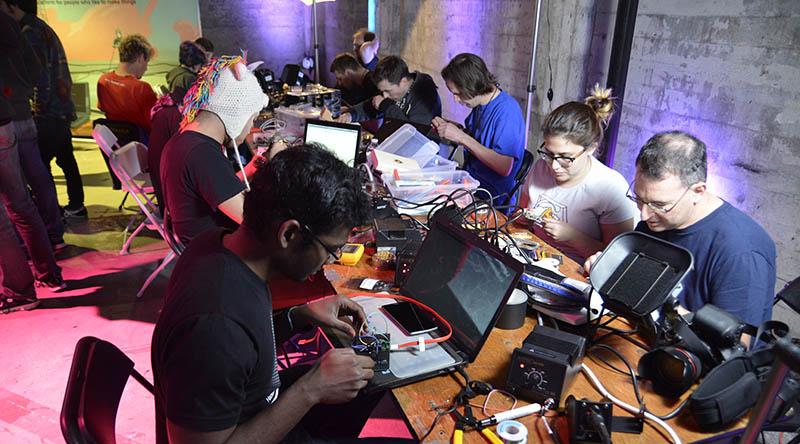
Experiences From the Conference Badge-Hacking Table
The following scenes represent the common experience reported across hardware conferences and badge workshops. They explain why badge hacking remains compelling even when the finished project would confuse every investor on a television pitch show.
The first twenty minutes are mostly careful staring
A newcomer approaches the hacking area carrying a badge, a USB cable, and the optimistic belief that the cable will solve everything. Around the table are soldering stations, microscopes, reels of components, tangled jumpers, and several people who appear to have packed complete laboratories into airline-approved luggage.
The beginner initially assumes everyone else knows exactly what to do. This impression lasts until a veteran engineer studies the schematic, scratches their head, and asks whether anyone has discovered why one test pad behaves strangely. The room immediately becomes less intimidating.
Someone locates the programming header. Another person confirms the voltage. A third finds a community repository containing starter code. Within minutes, the badge is no longer a mysterious product. It is a collection of understandable systems.
The soldering table becomes an accidental classroom
Badge hacking naturally produces small, temporary teams. One person understands firmware but has rarely soldered surface-mount components. Another can place a tiny resistor with surgeon-like precision but would rather not debug a communication protocol. A third person contributes a hot-glue gun, making them the project’s structural engineer.
Help is exchanged in practical fragments. Someone demonstrates how to tin a wire. Someone explains why an I2C bus needs pull-up resistors. Someone notices that the battery polarity is reversed before the lesson becomes more aromatic.
Unlike a formal workshop, the curriculum follows immediate problems. Every explanation has a visible purpose, and every mistake produces a memorable example.
Failure arrives loudly, silently, or five minutes before judging
The first test often does nothing. This is a surprisingly productive result because it narrows the possibilities to approximately everything.
The builder checks power, continuity, firmware, pin assignments, connector orientation, and the possibility that a component escaped onto the carpet. Eventually an LED flickers. The table celebrates as though a deep-space probe has begun transmitting.
Then the LED stops.
Conference badge hacking teaches emotional flexibility. A project may alternate between “completely dead,” “mostly fixed,” and “possessed” several times in one afternoon. The public nature of the process helps. Nearby hackers have seen the same failures and often recognize the symptoms. Nobody needs to pretend that hardware development is a smooth montage accompanied by energetic music.
The best demonstration is rarely the most polished
During show-and-tell, some participants present carefully engineered systems with clean enclosures and documented code. Others hold together a circuit with tape, jumper wires, and an agreement not to breathe too aggressively.
Both can delight the audience.
A modest project with a clever concept often receives more enthusiasm than an enormously complicated build with no visible personality. A badge that makes one funny sound at exactly the right moment can become more memorable than a technically superior display rendering thousands of particles.
The audience also appreciates honest explanations. Saying, “I attempted four designs, three failed, and the remaining one works when held at this angle,” captures the experimental spirit better than pretending the result was inevitable.
The badge keeps teaching after the conference ends
At home, the modified badge may become a permanent display piece, a development platform, a parts donor, or the beginning of a larger project. Code is cleaned up. Schematics are redrawn. Temporary wires are replaced with a custom expansion board. A hack assembled in six frantic hours becomes a polished open-source project months later.
Even an unfinished badge retains value. It carries the history of decisions, mistakes, conversations, and discoveries made during the event. The scratches and crooked components are not defects; they are a laboratory notebook written in solder.
This afterlife separates electronic conference badges from ordinary promotional gadgets. A plastic pen advertises an organization until it runs out of ink. A hackable badge may introduce someone to embedded programming, PCB design, digital logic, radio, analog electronics, or a community of collaborators.
Conclusion: The Best Badge Is an Invitation
The best conference badge hacking you’ve ever seen did not require the most expensive processor or the longest feature list. It emerged from an almost blank piece of circuit-board material that refused to tell its owner what to build.
That simplicity encouraged AM radios, clocks, audio experiments, interconnected systems, spark gaps, and wonderfully impractical ideas. Earlier DEF CON projects and later Badgelife creations proved the same broader principle: people become more inventive when hardware is understandable, accessible, and deliberately unfinished.
A great electronic conference badge is therefore not merely a product. It is an invitation to investigate. Its exposed pads say, “Connect something.” Its firmware says, “Rewrite me.” Its empty space says, “You decide.”
And somewhere nearby, a hacker is already asking whether it can fly, play music, boot Linux, communicate with six other badges, or produce an amount of voltage that will make the event organizer reconsider next year’s contest rules.
Note: This article synthesizes information from 13 reputable U.S.-based technical reports, event archives, project guides, and maker publications, including Hackaday, WIRED, DEF CON community archives, Grand Idea Studio, SparkFun, Make:, Vice/Motherboard, Crowd Supply, Adafruit, Ponoko, and Tom’s Hardware. External source links and automated content-reference elements were intentionally omitted for publication.











