
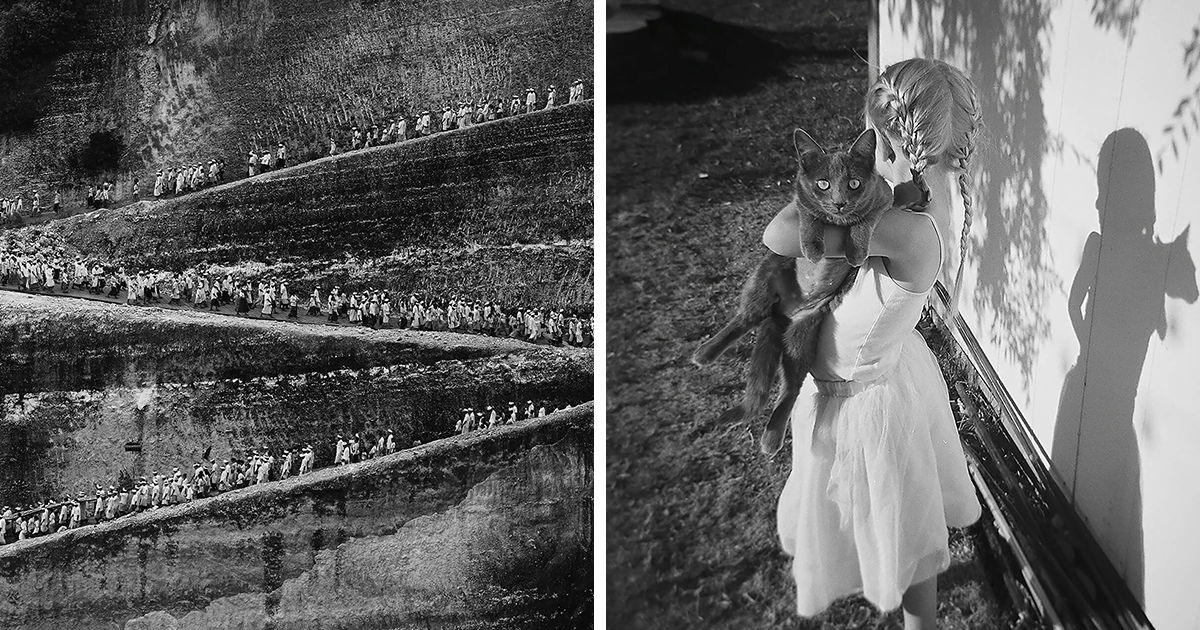
Color may flirt with the eye, but black and white photography goes straight for the soul. It removes the fireworks and leaves the bones: light, shadow, shape, timing, texture, mood, and that tiny human detail that makes an image refuse to leave your mind. A red dress becomes a slice of silver. A blue sky becomes a dramatic ceiling. A wrinkled face becomes a landscape with better storytelling than most novels.
This curated article explores 25 types of beautiful black and white images inspired by photographers from around the world, from American wilderness masters and European street photographers to Japanese experimental artists, documentary legends, portrait specialists, and quiet observers of everyday life. Instead of treating beauty as one narrow thing, we look at how monochrome photography can make a mountain feel sacred, a city corner feel cinematic, and a stranger’s glance feel like a secret you were trusted to keep.
Whether you love fine art photography, street photography, landscape photography, documentary images, or emotional portraiture, these examples show why black and white images remain timeless in a world where every phone can produce a rainbow before breakfast.
Why Black And White Photography Still Feels So Powerful
Black and white photography is not simply color photography with the color removed. At its best, it is a different language. It asks viewers to read contrast instead of hue, gesture instead of decoration, atmosphere instead of obviousness. A good monochrome image can feel elegant, gritty, romantic, lonely, funny, or monumental without needing a single bright shade to wave for attention.
Great photographers use black and white to simplify the frame. The technique helps emphasize leading lines, facial expressions, weather, architecture, silhouettes, negative space, and dramatic light. It also adds a feeling of timelessness. A modern subway photo can suddenly feel like a scene from a 1940s film noir, minus the trench coat and suspicious saxophone music.
25 Beautiful Black And White Images From Around The World
1. A Yosemite Valley Storm Clearing Over Granite Cliffs
Ansel Adams helped define the grandeur of black and white landscape photography. His images of Yosemite and the American West show how clouds, cliffs, snow, trees, and mist can become a full orchestra of gray tones. The beauty lies in precision: deep shadows, glowing highlights, and a sense that nature has paused just long enough to let the camera breathe.
2. A Migrant Mother Holding Her Children During Hard Times
Dorothea Lange’s Depression-era documentary work proved that black and white photography can carry social weight. A weary face, a protective arm, and children turned away from the camera can say more about struggle than a page of statistics. The image style is beautiful not because poverty is beautiful, but because compassion, dignity, and truth can be.
3. A Man Leaping Over A Paris Puddle
Henri Cartier-Bresson’s street photography made the “decisive moment” famous. Imagine the instant a man’s heel floats above wet pavement, his reflection waiting below like a second actor. In black and white, the scene becomes rhythm: a jump, a mirror, a fraction of a second caught before ordinary life lands again.
4. A Tokyo Street Glowing With Grit And Grain
Daido Moriyama’s high-contrast street images show another kind of beauty: rough, restless, and electric. His black and white photographs often feel like the city was printed directly onto your nerves. Grain, blur, harsh light, and tight framing create a visual pulse that suits postwar streets, neon nights, stray dogs, and human movement.
5. A Hollywood Star Lit Like A Myth
Classic black and white glamour photography turned actors into icons. Strong studio lighting, sculpted cheekbones, glossy hair, and dramatic shadows made portraits feel larger than life. The trick was not just photographing a beautiful person; it was building a small universe where every highlight knew exactly where to stand.
6. A Quiet Prague Window In Winter
Josef Sudek’s poetic images of Prague and his studio window remind us that black and white photography does not need spectacle. A fogged pane, a vase, falling light, or a garden beyond glass can become deeply moving. His work suggests that stillness has a personality, and it is probably wearing a wool coat.
7. A Jazz Musician Bent Over A Saxophone
Black and white jazz photography thrives on atmosphere. Smoke, sweat, spotlight, and shadow wrap around the musician like another instrument. A saxophone’s metal surface turns into liquid silver, while closed eyes and bent posture reveal the private work of making sound visible.
8. A Child Running Through A Narrow Alley
Street photographers across the world have found magic in children at play. In monochrome, a running child becomes pure motion: flying elbows, blurred shoes, laughter suggested by posture. The alley walls turn into theater curtains, and the viewer becomes the lucky person who happened to look at the exact right time.
9. A Face Against A Plain White Background
Richard Avedon’s portrait style showed how powerful simplicity can be. A plain background removes excuses. No fancy chair, no scenic sunset, no decorative plant fighting for attention. Just the subject, the camera, and every wrinkle, stare, smirk, or guarded silence that makes a portrait unforgettable.
10. A Lone Tree Standing In Snow
Minimalist black and white landscape photography can make a single tree feel monumental. Snow erases clutter, branches draw ink-like lines, and the sky becomes a pale field of quiet. It is the kind of image that makes viewers whisper for no clear reason, as if the tree is taking a nap.
11. A Worker Framed By Industrial Architecture
Industrial black and white images use steel, smoke, ladders, beams, and machines as graphic elements. A worker placed within this geometry becomes both individual and symbol. The beauty comes from tension: human softness inside a world of hard angles, bolts, and shadows.
12. A Desert Road Vanishing Into Heat
In color, a desert road may be about blue sky and orange sand. In black and white, it becomes a study in distance. The road narrows, the horizon trembles, and the empty space feels almost musical. It is loneliness with excellent composition.
13. A Surreal Photogram Made Without A Camera
Experimental artists such as Man Ray expanded black and white photography beyond traditional camera work. Photograms and rayographs use objects, light, and sensitized paper to create mysterious forms. Circles, hands, glass, and shadows become dream logic. The result feels less like a photograph of the world and more like a postcard from the subconscious.
14. A Market Vendor Waiting At Dawn
Across Asia, Africa, Europe, and the Americas, photographers have used black and white images to capture markets before the day fully wakes up. A vendor arranging fruit, a hand counting coins, a tarp sagging after rain: these small details turn commerce into human theater.
15. A Mountain Village Wrapped In Fog
Fog is a gift to monochrome photographers because it simplifies everything it touches. Rooflines fade. Trees become silhouettes. People walking through mist appear almost mythical. A mountain village in black and white can feel like memory itself, slightly blurred but emotionally sharp.
16. A Dancer Frozen Mid-Leap
Dance photography in black and white celebrates line, muscle, and timing. Without color, the body becomes a drawing made of light. A dancer suspended in the air gives the camera one glorious problem: how to make weightlessness look believable before gravity files a complaint.
17. A City Reflection In Rainy Pavement
Rain turns streets into mirrors, and black and white photography knows exactly what to do with that. Umbrellas, headlights, windows, and shoes become doubled in shimmering gray. The real city and the reflected city compete for attention, which is wonderful because both are photogenic.
18. A Weathered Fisherman Looking Toward The Sea
Portraits of fishermen, farmers, shepherds, and craftspeople often work beautifully in monochrome because texture carries the story. Skin, rope, nets, wool, wood, and water all become readable surfaces. The image honors labor without turning it into a costume.
19. An Empty Movie Theater Glowing From The Screen
Hiroshi Sugimoto’s long-exposure theater images show how black and white photography can make time visible. An entire film becomes a glowing white rectangle, while the theater’s architecture waits in darkness. It is cinema compressed into one silent frame, which is both elegant and a little magical.
20. A Protest Crowd Seen From Above
Documentary photographers use black and white to clarify emotion in public history. Signs, faces, raised hands, police lines, and packed streets become patterns of urgency. The absence of color can make the message feel less tied to one moment and more connected to a larger human fight.
21. A Woman Standing In Harsh Window Light
Window light is one of black and white photography’s oldest friends. It can carve a face gently or dramatically, depending on the angle. A portrait made with one strong window can feel intimate, cinematic, and honest, as if the subject has stepped halfway out of a dream.
22. A Bird Crossing A Blank Sky
Sometimes the most beautiful black and white image is nearly empty. A bird against a pale sky, a tiny shape in a vast field of light, can create surprising emotional force. The composition whispers, “Look carefully,” and the viewer obeys.
23. A Night Street With One Bright Shop Window
Night photography in black and white is pure drama. A shop window becomes a stage, pedestrians become silhouettes, and the pavement catches scraps of light. The result can feel lonely, romantic, suspicious, or all three, which is basically the official mood board of midnight.
24. A Family Portrait On A Front Porch
Vernacular and documentary family portraits often become powerful with time. A porch, a Sunday shirt, a baby’s serious stare, a grandmother’s steady hand: black and white lets these details breathe. The image becomes less about fashion and more about belonging.
25. A Seascape Split Between Water And Sky
A black and white seascape can be almost abstract. Water, horizon, and sky reduce the world to bands of tone. The simplicity invites patience. You do not just look at the image; you settle into it, the way you settle into the sound of waves.
What Makes These Black And White Images So Beautiful?
Contrast Creates Drama
Contrast is the heartbeat of black and white photography. Bright highlights and deep shadows can create power, mystery, or elegance. Low contrast, on the other hand, can feel soft, dreamy, or nostalgic. Great photographers understand that contrast is not just technical; it is emotional.
Texture Replaces Color
When color disappears, texture steps forward like an understudy who has been waiting years for opening night. Stone, skin, fabric, smoke, rain, sand, and metal become more noticeable. This is why monochrome photography works so well for portraits, landscapes, street scenes, and documentary subjects.
Timing Turns Ordinary Scenes Into Art
Many beautiful black and white images are built on timing. A hand reaches, a bird crosses, a child jumps, a stranger looks back, a cloud opens. The photographer’s job is to catch the moment before it evaporates. Easy? Absolutely not. Worth it? Every time.
Composition Guides The Eye
Lines, shapes, frames, reflections, and negative space become especially important in monochrome. Without color to guide attention, composition must do more work. This is why strong black and white images often feel clean, deliberate, and surprisingly modern.
Experience Notes: How To See The World Like A Black And White Photographer
Spending time with black and white photography changes the way you look at everyday life. At first, you may search for “pretty” scenes: dramatic clouds, old buildings, interesting faces, maybe a cat sitting in a window because cats understand personal branding. But after a while, you begin noticing something deeper. You stop asking, “What color is this?” and start asking, “Where is the light going?”
That shift matters. A sidewalk at noon might look boring in color, but in black and white the same scene can become a sharp pattern of shadows from fire escapes, bicycles, tree branches, and passing legs. A rainy afternoon that looks gray and inconvenient to everyone else can look like a free special-effects department to a photographer. Reflections appear in puddles. Umbrellas become graphic circles. Headlights glow like small moons. Suddenly bad weather is not a problem; it is a collaborator with a dramatic personality.
One of the best experiences related to black and white images is learning to slow down. In a world of quick snapshots, monochrome rewards patience. You might stand on a corner for ten minutes waiting for the right person to walk through a patch of light. You might photograph the same window every morning until the shadows finally fall the way you imagined. You might take twenty pictures of a simple chair before discovering that the best image is not about the chair at all, but about the triangle of light beside it.
Black and white photography also teaches humility. The camera does not care that you traveled far, woke up early, or wore uncomfortable shoes in the name of art. If the light is flat, the composition messy, or the moment weak, the image will politely refuse to be interesting. That is not failure; it is training. Every missed shot makes you sharper. Every almost-good frame teaches you what to watch next time.
For beginners, a useful exercise is to set your camera or phone preview to black and white for a full day. Do not worry about creating a masterpiece. Look for contrast, silhouettes, reflections, strong lines, weathered textures, and expressive gestures. Photograph your kitchen sink, your street, your coffee cup, your own shadow, the hand of someone you love. The point is not to make life look old-fashioned. The point is to notice structure and emotion without color doing all the heavy lifting.
The deeper pleasure is that black and white images make ordinary things feel worth studying. A staircase becomes architecture. A wrinkled shirt becomes landscape. A quiet face becomes a story. The world does not become less colorful; it becomes more readable. And once you learn to see that way, you may find beauty waiting in places you used to hurry past.
Conclusion
The most beautiful black and white images taken by photographers from all over the world are not beautiful for one single reason. Some are majestic, like mountains under storm clouds. Some are intimate, like a tired mother’s hand or a child’s blurred run through an alley. Some are experimental, grainy, minimalist, glamorous, political, or quietly domestic. Together, they prove that monochrome photography is not a limitation. It is a magnifying glass for emotion.
Black and white photography continues to matter because it removes distractions and leaves us with the essentials: light, shadow, form, timing, texture, and feeling. In the right hands, a grayscale image can be louder than color, softer than memory, and more timeless than a trend. That is why photographers around the world keep returning to itand why viewers keep stopping in front of it, suddenly quiet, completely caught.












