
Every November in the UK, the red poppy starts appearing everywhere: on coats, sweaters, uniforms, TV presenters, and the lapels of people who suddenly become very serious about floral accessories. But unlike your average fashion trend, this one is not about style points. It is about remembrance, reflection, and respect.
If you have ever wondered how to wear a Remembrance Day poppy properly, you are not alone. People ask the same questions every year: Which side does it go on? Does the leaf need to point a certain way? Can you wear it on a bag? Is there a poppy police department handing out citations? Thankfully, no. The truth is simpler, more human, and a lot less fussy than social media likes to pretend.
This guide walks through the meaning of the red poppy, the etiquette around wearing it in the UK, and the 12 practical steps that help you wear one respectfully. Whether you are attending a Remembrance Sunday service, marking Armistice Day, or just want to get it right without disappearing into an internet rabbit hole, this guide has you covered.
Why the Remembrance Day poppy matters
The red poppy is one of the most recognized symbols of remembrance in the UK. Its meaning traces back to the First World War and the image of poppies growing across battle-scarred land in Flanders. The symbol became closely linked to John McCrae’s poem In Flanders Fields, then evolved into a public act of remembrance and fundraising in the years after the war.
Today, wearing a red poppy in the UK honors those who died in service, acknowledges veterans and serving personnel, and supports the wider Armed Forces community. In other words, it is a small symbol carrying a very large emotional backpack.
That is why wearing a poppy is less about rigid rules and more about intention. You are not trying to pass a dress-code exam. You are showing respect.
How to Wear a Remembrance Day Poppy (UK): 12 Steps
Step 1: Understand what the poppy represents
Before pinning anything to your jacket, take a second to understand why people wear it. In the UK, the red remembrance poppy symbolizes memory, sacrifice, and support for the Armed Forces community. It is commonly worn during the remembrance period leading up to Armistice Day on November 11 and Remembrance Sunday.
That context matters because it shapes how you wear it. A poppy is not just a seasonal decoration. It is a public sign of reflection and gratitude. Once you understand that, the etiquette starts to make a lot more sense.
Step 2: Get your poppy from a trusted source
In the UK, many people get their poppies through Royal British Legion collectors, local stores, schools, community events, or remembrance displays. You can also choose a reusable enamel pin or other official remembrance merchandise if that suits you better.
When possible, choose a poppy that supports the cause directly. The symbol and the donation go hand in hand. It is a small gesture, but small gestures are often the ones that stick.
Step 3: Pick the type of poppy you want to wear
Not all poppies look exactly the same anymore. The classic paper poppy is still the familiar favorite, but reusable pins, brooches, and other alternatives are widely available. In recent years, the Royal British Legion has also introduced a plastic-free paper poppy that can be recycled after the remembrance period.
If you want the traditional look, go with the standard lapel poppy. If you want something sturdier for repeated use, an enamel pin is a practical choice. If you are clumsy with pins and have previously stabbed yourself in the name of remembrance, a reusable pin may be your best ally.
Step 4: Wear it during the remembrance period
People in the UK usually begin wearing poppies in late October or early November, around the launch of the Poppy Appeal, and continue through Remembrance Sunday and Armistice Day. There is no universal law saying you must start on one exact day, but the remembrance period is generally the lead-up to November 11.
If you are wondering when to stop wearing it, many people remove their poppy after Remembrance Sunday or Armistice Day. Others keep it on a little longer. Again, this is not a flower with a parking permit. The key is to wear it sincerely, not mechanically.
Step 5: Place it on the left side if you want to follow common tradition
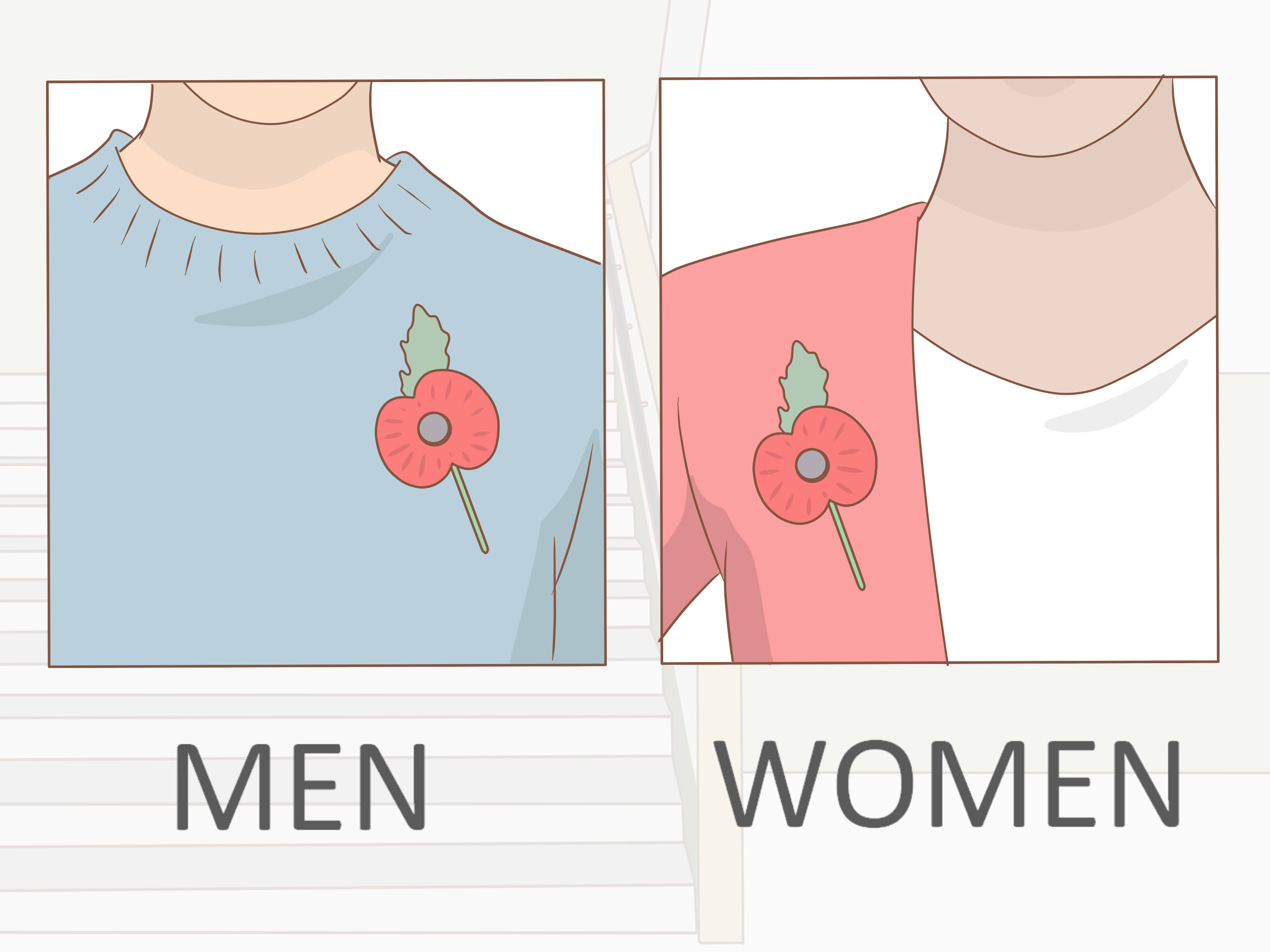
Here is the question everybody asks: which side do you wear a Remembrance Day poppy on in the UK? The common traditional choice is the left side, often on the left lapel, because it sits close to the heart.
That said, the most important thing to know is that there is no official “correct” side according to Royal British Legion guidance. Wearing a poppy is a personal choice, and how you wear it is also a personal choice. So yes, left side is the usual custom, but no, this is not an emergency if yours lands slightly off-center.
Step 6: Pin it securely and neatly
A poppy should be visible, secure, and tidy. Most people attach it to a coat lapel, jacket, blazer, cardigan, or sweater. You can also place it in a buttonhole if the design allows. If you are wearing a scarf or a heavier winter coat, make sure it is pinned in a way that will not fall off by lunchtime.
If you are using the paper version, take a little extra care. These poppies are symbolic, but they are not indestructible. Rain, wind, seatbelts, backpacks, and the general chaos of daily life can bend them into something that looks less like remembrance and more like a rough craft project.
Step 7: Do not obsess over the leaf angle
One of the biggest myths around poppy etiquette is that the leaf must point to 11 o’clock, or that the petal placement carries hidden official meaning. This debate returns every year with the reliability of holiday fruitcake.
In practice, there is no formal rule requiring a certain leaf position. If your poppy has a leaf, place it in a way that looks natural and secure. That is enough. Remembrance is the point, not botanical geometry.
Step 8: Match your poppy to the setting
For everyday wear, a poppy on your coat or sweater is perfectly appropriate. For formal events, such as a memorial service, church event, school ceremony, or Remembrance Sunday observance, it is often worn on a blazer, dress coat, or other polished outerwear.
If you are in uniform, part of an organization, or wearing medals, follow the dress guidance for that setting. The general public can keep it simple: visible, respectful, and not dangling from a zipper like a forgotten keychain from 2009.
Step 9: Wear it with respect, not as a fashion gimmick
This may sound obvious, but it matters. A poppy can be stylish in a subtle way, but it should not be treated like a novelty accessory. Avoid sticking it somewhere silly just to be ironic or attention-grabbing.
Respect also means resisting the urge to judge everyone else. Since wearing a poppy is a personal choice, the best etiquette is not to lecture strangers about theirs. Nothing says “I missed the point” quite like turning remembrance into a lapel audit.
Step 10: Replace a damaged poppy if needed
If your paper poppy becomes crushed, bent, or torn, replace it. A fresh poppy looks neater and avoids the slightly tragic effect of a petal clinging on for dear life. This is especially worth doing if you are attending a formal ceremony or public event.
If you prefer not to keep replacing a paper poppy, switch to a reusable enamel version. It is durable, practical, and a good option for people who want to wear a poppy every year without rebuilding it from scratch.
Step 11: Pair the symbol with the spirit of remembrance
Wearing the poppy is meaningful, but it is even more meaningful when connected to remembrance itself. Observe the two-minute silence. Attend a local service if you can. Pause for a moment on November 11. Talk to children about why the symbol matters. Support veterans’ causes in ways that go beyond one pin in November.
The poppy is not meant to be empty ritual. It is a prompt to remember real people, real losses, and the long aftershocks of conflict. Even a brief pause can turn the gesture from routine into something genuine.
Step 12: Recycle or store it responsibly
At the end of the remembrance season, do not just toss your poppy into a random drawer full of dead batteries, mystery keys, and pens that no longer write. If you have a recyclable paper poppy, recycle it according to current guidance and remove the pin for reuse. If you have a reusable pin or brooch, store it somewhere safe for next year.
This final step may seem small, but it closes the loop respectfully. A symbol of remembrance should not end its journey under a pile of takeout menus and expired coupons.
Common questions about poppy etiquette in the UK
Is there a correct side to wear a poppy?
Traditionally, many people wear it on the left side, close to the heart. But there is no official right-or-wrong rule. Personal choice is central to modern poppy guidance.
Do men and women wear it differently?
Not really. The placement may vary slightly depending on clothing, but the same basic idea applies: wear it visibly and respectfully.
Can you wear a poppy on a bag or hat?
You can, especially if lapel placement is awkward, but clothing near the upper chest remains the most common and recognizable choice. If you do place it elsewhere, keep it tasteful.
Can children wear poppies?
Yes. Many schools take part in remembrance activities, and wearing a poppy can be a simple way to introduce children to the meaning of remembrance in an age-appropriate way.
Do you have to wear one?
No. Wearing a poppy is voluntary. The symbol carries the most meaning when it is chosen freely, not worn because someone felt pressured into it.
Extra reflections and experiences related to wearing a Remembrance Day poppy
The first time many people wear a Remembrance Day poppy in the UK, they worry about getting it wrong. They stand in front of a mirror, turning the flower slightly left, then slightly right, as if they are cracking a code. That uncertainty is common, especially for visitors, younger people, or anyone who did not grow up around remembrance customs. What usually happens next is reassuring: once the poppy is on, the deeper meaning quickly becomes more important than the exact angle.
For some people, the experience is tied to school assemblies, chilly November mornings, and the sudden silence of a room full of students who normally struggle to stop whispering for six consecutive seconds, let alone two minutes. For others, it is linked to family memory. A grandfather’s service photo comes out of a drawer. A relative mentions a name usually left unspoken for most of the year. The poppy becomes less like a public badge and more like a tiny red doorway into family history.
There is also the everyday experience of wearing a poppy in public. You notice how often other people are wearing one too: the cashier at the grocery store, the commuter in the train station, the teacher at pickup, the person hurrying through the rain with coffee in one hand and a briefcase in the other. It creates a quiet feeling of shared observance. No one needs to make a speech. The symbol does a lot of the talking on its own.
Some people remember the awkward side of it too. The paper poppy slips off a coat at the worst possible moment. The pin pokes a finger. The petals get flattened by a seatbelt. A child asks, very loudly and very publicly, “Why are you wearing a flower when it is cold outside?” And yet those small, imperfect moments are part of the tradition as well. They make remembrance feel lived-in rather than staged.
One especially meaningful experience is attending a remembrance ceremony while wearing a poppy for the first time. The sound of the Last Post, the collective stillness, the sight of wreaths, the bowed heads, the names remembered aloud; all of that can give new weight to an object that at first seemed simple. After that, many people stop asking whether the leaf should point a certain way and start understanding why the symbol endures at all.
Even for those without a direct family connection to military service, wearing a poppy can still feel deeply personal. It can be an act of solidarity, gratitude, or reflection. It can also be a reminder that remembrance includes not only the past, but the people still living with the consequences of war today. That is one reason the poppy continues to matter. It links memory with support, ceremony with compassion, and history with present-day responsibility.
Conclusion
If you want the simplest possible answer to how to wear a Remembrance Day poppy in the UK, here it is: wear it with respect. The left side is the common tradition, but there is no strict official rulebook. Choose a poppy that suits you, wear it during the remembrance period, keep it neat, and let the symbol point back to what matters most: remembrance itself.
In a world that loves to overcomplicate simple gestures, the poppy remains refreshingly clear. It is not about perfection. It is about memory, gratitude, and a willingness to pause. And for one small flower pinned to a coat, that is doing quite a lot of heavy lifting.












