
Choosing an air conditioner should be easy. You measure the room, pick the shiniest box, plug it in, and enjoy polar-bear-level comfort, right? Not quite. Buying the wrong AC unit can leave you with a room that feels like soup, an electric bill that bites, or a machine that roars like a lawn mower with emotional problems.
The good news: once you understand air conditioner size, efficiency ratings, room conditions, installation requirements, and the different types of cooling systems, the decision becomes much less mysterious. This expert guide explains how to choose an air conditioner that fits your space, budget, climate, and patience level. Whether you are cooling a bedroom, apartment, garage, home office, or an entire house, the right unit should do three things well: cool effectively, control humidity, and operate efficiently without turning your home into an airport runway.
Why Choosing the Right Air Conditioner Matters
An air conditioner is not just a cold-air machine. It removes heat, reduces humidity, filters some airborne particles, and helps maintain a comfortable indoor temperature. When properly sized and installed, it can make summer feel civilized. When poorly chosen, it can waste energy, short-cycle, fail to dehumidify, or run nonstop while still losing the battle against July.
The biggest mistake buyers make is assuming that bigger is better. In air conditioning, bigger is often just louder, more expensive, and strangely worse. An oversized AC may cool the room quickly, but it can shut off before removing enough moisture. The result is a space that feels cool but clammy, like a basement wearing cologne. An undersized unit has the opposite problem: it runs constantly, struggles on hot afternoons, and may never reach the thermostat setting.
Step 1: Decide Which Type of Air Conditioner You Need
Before comparing brands or smart features, choose the right category. Air conditioners are not one-size-fits-all, and the best option depends on your home layout, whether you own or rent, your windows, ductwork, budget, and how many rooms you need to cool.
Window Air Conditioners
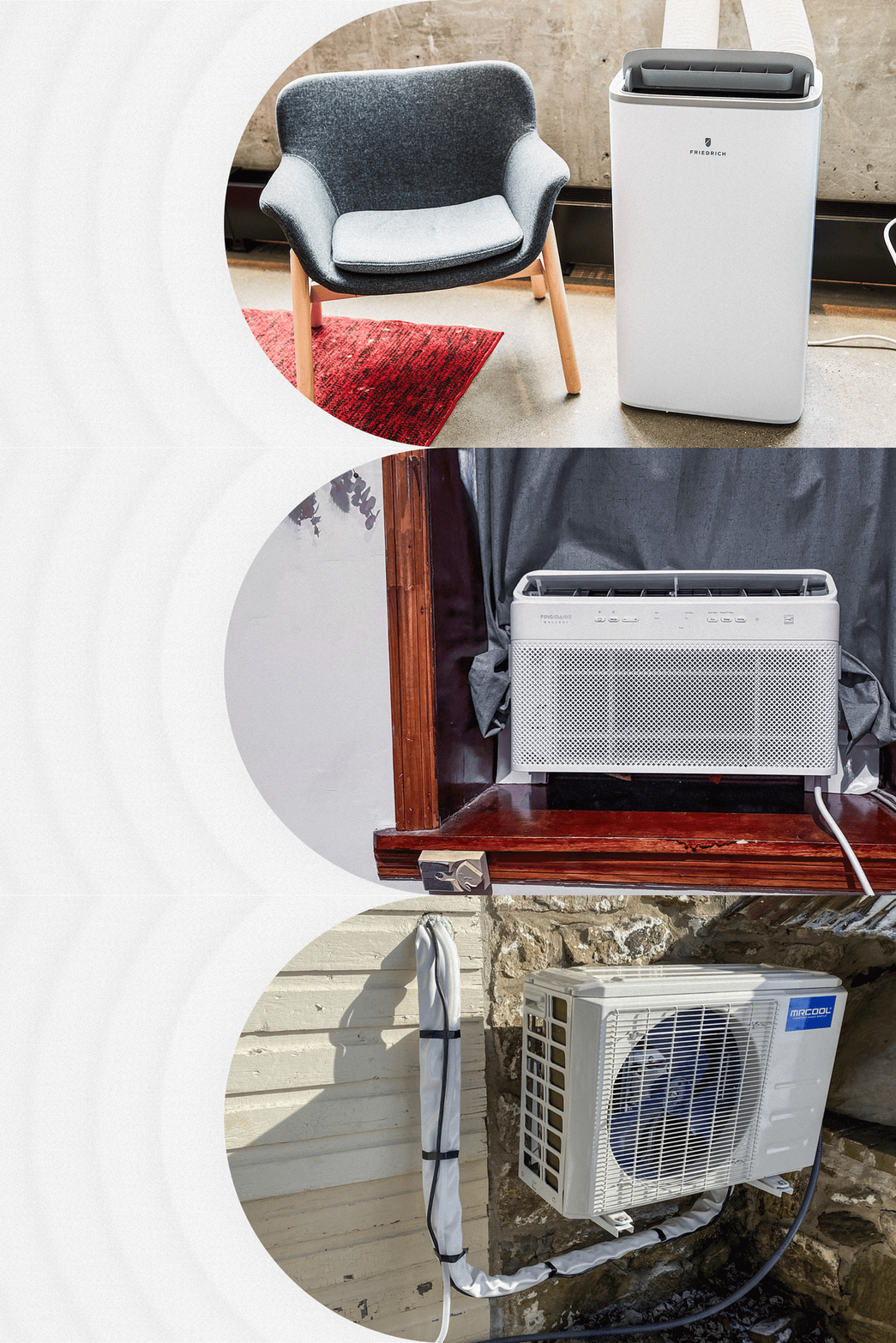
A window air conditioner is usually the best choice for cooling a single room efficiently. It sits in a window, vents heat outdoors, and delivers strong cooling for bedrooms, offices, studios, and living rooms. Window units are often more efficient than portable air conditioners because the hot components are outside the room instead of sitting indoors like a sweaty guest who refuses to leave.
Choose a window AC if you have a compatible window, permission to install it, and a room that can be closed off. Look for a secure mounting kit, insulating side panels, a washable filter, a digital thermostat, and quiet operation if the unit will be near a bed or desk.
Portable Air Conditioners
Portable air conditioners are useful when a window unit is not allowed or not practical. They roll from room to room and vent hot air through a hose installed in a window kit. They are convenient, but they are often less efficient than window units with the same advertised BTU rating.
If you choose a portable AC, consider a dual-hose model when possible. A single-hose unit can create negative pressure that pulls warm outdoor air into the room through gaps and leaks. That means the AC works harder, and your electric meter starts doing cardio.
Ductless Mini-Split Air Conditioners
A ductless mini-split is a strong option for older homes without ductwork, additions, garages, workshops, guest rooms, or homeowners who want zoned comfort. Mini-splits include an outdoor compressor and one or more indoor air handlers. Many models are heat pumps, meaning they can cool in summer and heat in winter.
Mini-splits cost more upfront than window or portable units, and they usually require professional installation. However, they are quiet, efficient, and excellent for targeted cooling. If you want comfort without a window box or duct renovation, this category deserves serious attention.
Central Air Conditioning
Central air is designed to cool an entire home through ductwork. It is the right choice when you want consistent whole-house comfort and already have suitable ducts, or you are planning a major HVAC upgrade. Central AC systems are more expensive than room units, but they can deliver better comfort across multiple rooms when properly designed and installed.
The key phrase is “properly designed.” A central AC system should be sized with a professional load calculation, not by guessing, copying the old unit, or using the ancient contractor spell known as “one ton per however many square feet feels right.”
Step 2: Calculate the Right AC Size
Air conditioner size is measured in BTUs, or British Thermal Units, per hour. A BTU rating tells you how much heat the unit can remove from a space. For central systems, capacity is often measured in tons, where one ton equals 12,000 BTUs per hour.
For room air conditioners, a common starting point is about 20 BTUs per square foot. That means a 300-square-foot room may need roughly 6,000 BTUs before adjustments. However, square footage is only the beginning. Ceiling height, sunlight, insulation, climate, windows, appliances, and occupancy all affect cooling load.
Quick BTU Guide for Room Air Conditioners
| Room Size | Suggested Cooling Capacity |
|---|---|
| 100 to 150 sq. ft. | 5,000 BTUs |
| 150 to 250 sq. ft. | 6,000 BTUs |
| 250 to 300 sq. ft. | 7,000 BTUs |
| 300 to 350 sq. ft. | 8,000 BTUs |
| 350 to 400 sq. ft. | 9,000 BTUs |
| 400 to 450 sq. ft. | 10,000 BTUs |
| 450 to 550 sq. ft. | 12,000 BTUs |
| 550 to 700 sq. ft. | 14,000 BTUs |
Adjust the estimate based on real room conditions. If the room is heavily shaded, you may reduce capacity by about 10 percent. If it gets strong sun, increase capacity by about 10 percent. If more than two people regularly use the room, add about 600 BTUs for each additional person. If the unit is cooling a kitchen, add around 4,000 BTUs because ovens, stoves, and refrigerators are tiny heat factories with appliance warranties.
Step 3: Understand Efficiency Ratings
Efficiency ratings help you compare how much cooling you get for the electricity used. Higher efficiency usually means lower operating costs, although the purchase price may be higher. The main ratings you will see depend on the type of air conditioner.
CEER for Room Air Conditioners
Room air conditioners often use CEER, or Combined Energy Efficiency Ratio. CEER accounts for cooling efficiency while the unit is running and energy used in standby mode. When comparing two similar window AC units, the one with the higher CEER is generally the better energy performer.
SEER2 and EER2 for Central AC and Heat Pumps
Central air conditioners and heat pumps use SEER2 and EER2 ratings. SEER2 measures seasonal efficiency over a range of conditions, while EER2 reflects efficiency under hotter, more demanding conditions. Think of SEER2 as the average fuel economy sticker and EER2 as how the system behaves when summer shows up wearing boxing gloves.
Do not buy on efficiency rating alone. A high-efficiency unit that is badly sized or poorly installed can still disappoint. Efficiency works best as part of a complete decision: correct capacity, proper installation, sealed ducts, good airflow, and smart operation.
Step 4: Check the EnergyGuide Label
The yellow EnergyGuide label is not decoration. It shows estimated energy use and operating cost, helping you compare similar models. Use it to evaluate the long-term cost of ownership, not just the sticker price. A cheaper air conditioner may cost more over time if it burns extra electricity every summer.
When comparing units, look at the estimated yearly energy cost, efficiency rating, capacity, and whether the model is ENERGY STAR certified. ENERGY STAR certified products meet stricter efficiency criteria, which can be especially valuable if you run the AC often or live in a hot climate.
Step 5: Think About Humidity, Not Just Temperature
Comfort is not only about the thermostat number. Humidity plays a huge role. A room at 74°F with high humidity can feel sticky, while the same room with lower humidity feels crisp and comfortable. This is why proper sizing matters so much.
An oversized air conditioner may satisfy the thermostat quickly but fail to run long enough to remove moisture. A properly sized unit runs longer cycles, which improves dehumidification. In humid climates, features like variable-speed compressors, inverter technology, and dedicated dry modes can help maintain comfort without freezing the room into a meat locker.
Step 6: Match the Unit to Your Electrical Setup
Before buying, check the unit’s voltage, amperage, and plug type. Smaller room AC units often use a standard 115-volt household outlet, while larger models may need a dedicated circuit or a 230/240-volt outlet. Do not assume your old outlet can handle a bigger unit. Electrical optimism is not a home improvement strategy.
For central AC, ductless systems, and large window units, professional electrical work may be required. Always follow manufacturer requirements and local code. If the unit trips breakers, dims lights, or makes the outlet warm, stop using it and consult a qualified electrician or HVAC professional.
Step 7: Consider Noise Level
Noise matters, especially in bedrooms, nurseries, home offices, and apartments with thin walls. Manufacturers often list sound levels in decibels. Lower numbers mean quieter operation. Inverter window units and mini-splits are often quieter because they can adjust compressor speed instead of constantly blasting on and off.
If possible, read reviews that mention sound quality, not just decibel numbers. Some units are technically quiet but produce rattles, hums, or high-pitched fan noise. A gentle whoosh is fine. A metallic buzz that sounds like a trapped robot bee is not.
Step 8: Look for Useful Features, Not Gimmicks
Smart features can be genuinely helpful, but only if they solve real problems. Wi-Fi control is useful if you want to cool the room before arriving home. A programmable timer helps reduce waste. Eco mode can save energy by cycling the compressor and fan more efficiently. Sleep mode may gradually adjust temperature overnight for comfort and savings.
Other features worth considering include washable filters, filter-cleaning reminders, remote controls, adjustable louvers, dehumidify mode, auto restart after power outages, and a clear digital thermostat. Skip features that sound impressive but do not match how you live. Your AC does not need to be smarter than your laptop; it needs to cool the room reliably.
Step 9: Plan for Installation
A good air conditioner can perform badly if installed poorly. Window units should be secure, slightly angled according to the manufacturer’s instructions for drainage, sealed around the sides, and supported when required. Gaps around the unit let hot air sneak in, which is rude but common.
Portable units need a tight window vent kit and the shortest practical exhaust hose. Long, twisted hoses reduce efficiency because they radiate heat back into the room. For mini-splits and central systems, hire experienced installers who calculate load, verify refrigerant charge, test airflow, inspect ducts, and confirm drainage.
Step 10: Ask for a Manual J Load Calculation for Whole-Home Systems
If you are buying central air conditioning or a ducted heat pump, request a Manual J load calculation. This professional sizing method considers insulation, windows, orientation, air leakage, local climate, ceiling height, home layout, and more. It is far more accurate than choosing equipment based only on square footage.
Also ask whether the contractor uses Manual S for equipment selection and Manual D for duct design. These standards help ensure the system is not just the right size on paper but also able to move air properly through the home. A great condenser connected to bad ductwork is like putting a racehorse in roller skates.
Step 11: Understand Refrigerant Changes
New air conditioners increasingly use lower-global-warming-potential refrigerants such as R-32 or R-454B instead of older high-GWP options. This does not mean your current system must be replaced immediately. Existing systems can usually continue to be serviced, but buyers should understand that new equipment and replacement parts may be affected by updated refrigerant rules over time.
When buying a new central AC or heat pump, ask the contractor which refrigerant the system uses, whether technicians are trained to service it, and how parts availability is handled. This is especially important for long-term ownership, warranty service, and future maintenance costs.
Common Air Conditioner Buying Mistakes
Mistake 1: Buying the Biggest Unit You Can Afford
More BTUs do not automatically mean better comfort. Oversizing can cause short cycling, uneven cooling, poor humidity control, and higher wear on the equipment.
Mistake 2: Ignoring the Room’s Real Conditions
A sunny top-floor bedroom needs more cooling than a shaded basement office of the same size. Room shape, ceiling height, windows, insulation, and heat-generating electronics all matter.
Mistake 3: Choosing Portable When a Window Unit Would Work Better
Portable units are convenient, but window units often cool more efficiently. If your window and building rules allow it, a window AC may deliver better performance for the money.
Mistake 4: Forgetting Maintenance
Dirty filters, blocked coils, clogged drains, and leaky ducts reduce performance. Choose a unit with easy filter access and keep a realistic maintenance schedule.
Mistake 5: Hiring Based Only on the Lowest Bid
For central AC or mini-splits, installation quality can matter as much as the brand. A low price is not a bargain if the contractor skips load calculations, airflow testing, sealing, or proper commissioning.
Expert Buying Checklist
- Measure the room or home accurately before shopping.
- Choose the right AC type: window, portable, ductless, or central.
- Match BTU capacity to square footage and room conditions.
- Look for ENERGY STAR certification and strong efficiency ratings.
- Check voltage, outlet type, and circuit requirements.
- Compare noise levels if the unit will be used for sleeping or work.
- Prioritize useful features such as timers, washable filters, and eco mode.
- Seal gaps during installation to prevent warm air leaks.
- For whole-home systems, require a Manual J load calculation.
- Ask about warranty, refrigerant type, parts availability, and service support.
Real-World Experiences: What Buyers Learn After Living With an AC
One of the most common lessons homeowners learn is that comfort is personal. A person who works from home in a south-facing office may need stronger, quieter cooling than someone who only uses a room at night. The “right” air conditioner is not just a number on a box; it is the unit that fits your daily routine.
For bedrooms, noise often becomes the deciding factor after the first week. Many buyers focus on BTUs and price, then discover that a loud compressor can interrupt sleep every time it cycles on. Inverter window units and ductless mini-splits often receive better long-term satisfaction because they ramp up and down smoothly instead of jolting awake like a startled raccoon.
Apartment renters often learn that installation rules matter as much as performance. Some buildings do not allow standard window units, while others require brackets or limit where units can be installed. In those cases, a portable AC may be the only practical option. Still, sealing the vent panel carefully makes a major difference. A poorly sealed portable setup can let hot air leak back in, making the unit work harder and the room cool slower.
Homeowners replacing central AC often learn another lesson: the old unit size is not always the right new unit size. Homes change. Windows get replaced, insulation improves, additions are built, ducts leak, and weather patterns feel less polite than they used to. Replacing a 3-ton system with another 3-ton system without a load calculation may repeat old mistakes. A reputable contractor should measure, inspect, calculate, and explain the recommendation clearly.
Another practical experience is that humidity can make or break satisfaction. In humid regions, buyers sometimes regret choosing an oversized unit because the house cools quickly but still feels damp. A properly sized system, especially one with variable-speed operation, may feel more comfortable at a slightly higher thermostat setting because it removes moisture more effectively.
Budget also looks different after ownership begins. A cheap unit with weak efficiency may seem attractive in the store, but if it runs daily for months, operating cost becomes part of the real price. The smartest purchase is usually not the cheapest or the most expensive. It is the unit with the best balance of correct size, efficiency, reliability, quiet operation, and serviceability.
Finally, maintenance is where good intentions go to hide. Washable filters sound simple because they are simple, yet many people forget them until airflow drops. A clean filter helps the unit breathe, cool, and dehumidify properly. Keep the outdoor side of window units clear, do not block supply or return vents, and schedule professional service for central and ductless systems. An air conditioner is not a “set it and forget it” appliance. It is more like a houseplant with a compressor: ignore it long enough, and it will become dramatic.
Conclusion
Choosing the right air conditioner comes down to fit. Fit the unit to the room, fit the capacity to the cooling load, fit the efficiency to your operating budget, and fit the installation to your home. Start with the type of system you need, calculate the right BTU capacity, compare CEER, SEER2, and EER2 ratings, and do not overlook humidity control, noise, electrical requirements, and maintenance access.
For a single room, a well-sized window air conditioner is often the most efficient and affordable choice. For rooms without compatible windows, a portable AC can work if installed carefully. For additions, older homes, and zoned comfort, ductless mini-splits are efficient and quiet. For whole-home cooling, central air conditioning can be excellent, but only when sized and installed by a qualified contractor using proper load calculations.
The best air conditioner is not the one with the biggest BTU number or the flashiest app. It is the one that keeps you cool, controls humidity, respects your electric bill, and does not sound like it is preparing for takeoff. Choose wisely, and summer becomes much less sweaty.












