
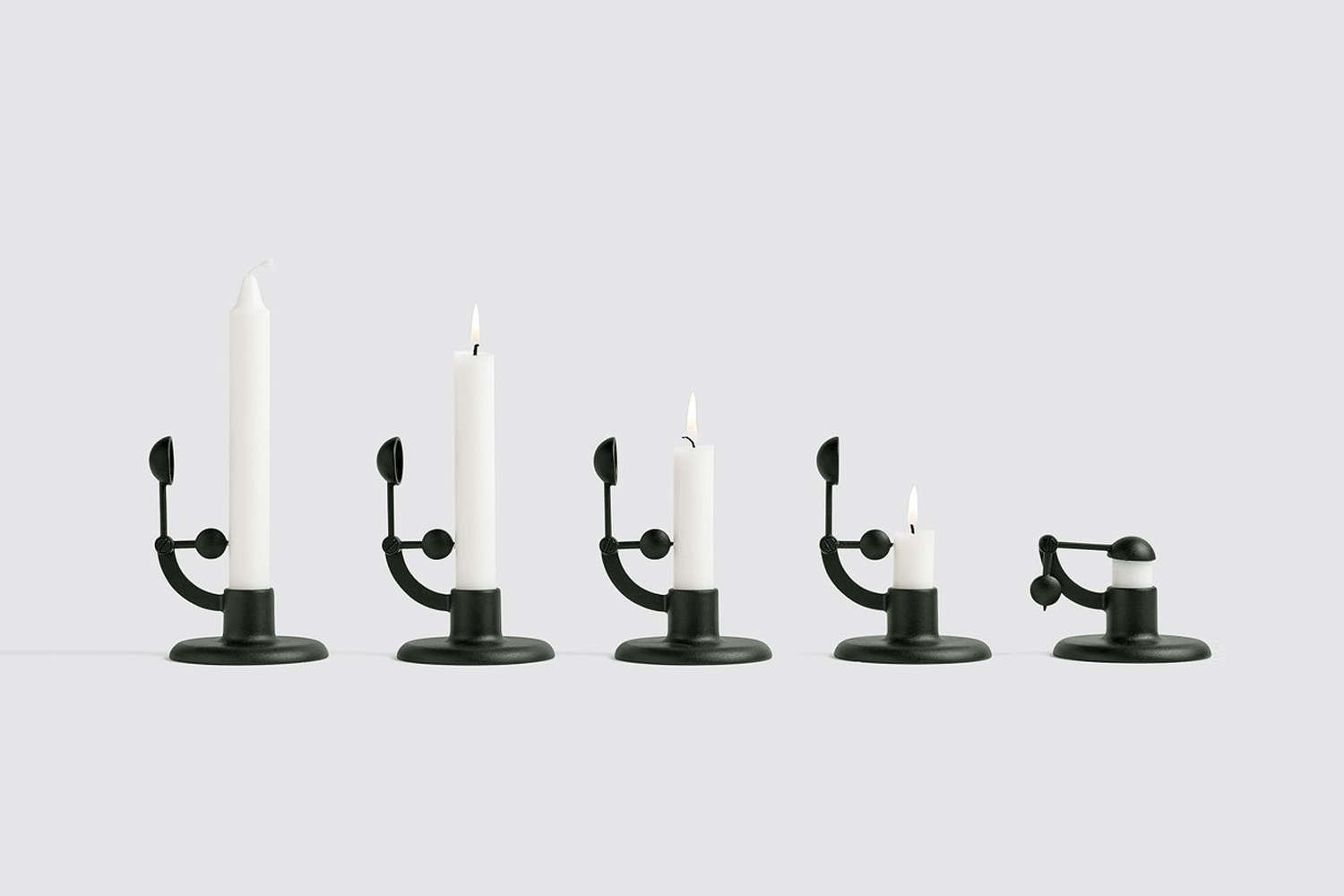
Some design objects whisper. Some shout. And then there is the self-extinguishing candlestick from HAY, which waits quietly on the table like a tiny black stagehand, lets the candle perform its glowing little opera, and thenat exactly the right dramatic momentdrops the curtain.
Officially known as the Moment candleholder, this small but clever object was designed by Norwegian designer Lars Beller Fjetland for HAY. It belongs to that rare category of home accessory that makes people lean across the dinner table and ask, “Wait, what does that thing do?” Then, after you explain it, they immediately want to see it in action. It is part candleholder, part kinetic sculpture, part safety-minded dinner guest who knows when the party has gone on long enough.
The idea is simple, almost suspiciously simple: as a taper candle burns down, a small weighted arm is released, allowing a snuffer to swing over the flame and put it out before the wick burns to the bitter end. No scorched nub. No digging wax out of the base with a butter knife. No awkward moment where you realize the candle is still burning after everyone has moved to the kitchen to discuss dessert, gossip, or both.
What Is the HAY Moment Self-Extinguishing Candlestick?
The HAY Moment candlestick is a compact, minimalist candleholder designed to extinguish a taper candle automatically when the flame reaches a low point. Its form is circular, low, and dark, with an upright socket for the candle and a small mechanical arm that holds a domed snuffer. The design looks modern, but the spirit behind it is old-world and wonderfully analog.
Beller Fjetland has explained that the inspiration came from seeing a 19th-century candle extinguisher in Oslo. Instead of recreating the antique object with all its decorative fuss, he stripped the idea down to its essentials: candle, weight, arm, gravity, flame. The result is a modern candleholder that feels like it could sit comfortably in a Copenhagen apartment, a Brooklyn brownstone, a cabin in the woods, or the lair of a very design-conscious wizard.
A tiny machine with no battery, no app, and no nonsense
The beauty of the Moment candleholder is that it does not try to be “smart” in the tech-world sense. There is no Bluetooth connection. No companion app. No firmware update arriving at 2 a.m. to improve “flame management performance.” The mechanism works through physical contact and gravity. You insert a taper candle, set the needle or arm into the wax, and light the candle. As the wax melts down to the contact point, the support disappears. The weighted arm moves, the snuffer drops, and the flame is deprived of oxygen.
That is the entire trick. And that is why it is so satisfying. In a home full of screens, chargers, passwords, and blinking lights, this candlestick performs one useful act with quiet confidence. It is low-tech, but not low-effort. It is simple, but not simplistic.
Why This Candlestick Became an Object of Desire
Good design often solves a problem so neatly that the problem suddenly seems obvious. The HAY self-extinguishing candlestick solves several small annoyances at once. It prevents the candle from burning completely into the holder. It reduces wax mess. It adds a layer of protection against forgetfulness. And it turns the final minutes of a candle’s life into a little performance.
Most candleholders are passive. They hold. They behave. They look pretty. The Moment candleholder, however, does something. It has timing. It has suspense. It has a finale. That makes it memorable in a way few tabletop accessories are. A vase can be beautiful, but it rarely makes guests cheer unless someone accidentally knocks it over and catches it midair.
The drama of a flame meeting its final act
There is something oddly charming about watching a taper candle burn lower and lower while a tiny mechanical snuffer waits nearby. The object creates anticipation. You know what will happen, but you do not know the exact second it will happen. It is like watching toast in a toaster, except more elegant and with less chance of breakfast disappointment.
This is where Moment earns its name. It is about time, not just light. It reminds you that a candle is not merely décor; it is a slow countdown. Every flame has a lifespan. Every dinner party has a natural ending. Every person who says, “I’ll just have one more tiny slice of cake,” is probably lying. The candlestick understands all of this and remains politely silent.
The Design Language: Scandinavian Minimalism with a Wink
HAY is known for playful, contemporary design that makes everyday objects feel fresher without turning them into museum pieces you are afraid to touch. The Moment candleholder fits neatly into that philosophy. It is practical, accessible in spirit, and visually restrained, but it also has a sly sense of humor. It looks serious until it moves. Then you realize it has been waiting the whole time to make its point.
The dark finish gives it a strong silhouette, and its low circular shape helps it feel stable on a tabletop. It does not compete with the candle; it frames it. The mechanism is visible enough to be understood, but not so exaggerated that the piece becomes a gadget. That restraint matters. A self-extinguishing candlestick could easily become a novelty item. Moment avoids that fate by being genuinely handsome.
Small size, big personality
One reason the design works is scale. This is not a giant candelabrum demanding a velvet cape and a stormy castle. It is a compact home accessory that can live on a dining table, mantel, desk, or bedside table. Its small footprint gives it flexibility, while the mechanical arm gives it personality. It has the presence of a design object without needing the square footage of a sculpture garden.
In styling terms, it pairs beautifully with simple taper candles, matte ceramics, linen napkins, wood furniture, and glassware. It can make a minimalist table feel warmer, or give a maximalist table one calm black anchor. It is also a great conversation piece for people who like clever design but do not want their home to look like a showroom where everyone is afraid to sit down.
Function First: How the Self-Extinguishing Mechanism Helps
The Moment candleholder is not a substitute for responsible candle use. No candlestick, no matter how clever, should be treated as permission to leave an open flame unattended. Fire-safety organizations consistently recommend keeping candles in stable holders, placing them away from flammable materials, and blowing them out before leaving a room or going to bed.
That said, the self-extinguishing feature addresses a very real habit: people often let taper candles burn too far down. When a candle reaches the base, leftover wax can harden inside the holder. That creates a cleaning job and may make the next candle sit unevenly. With Moment, the snuffer acts before the candle disappears into a wax puddle of regret.
Less mess, less waste, more control
Anyone who has owned traditional candlesticks knows the ritual. First, you admire the candlelight. Then you forget about it for a few minutes. Then you notice the flame has traveled dangerously low. Later, you are excavating wax from the socket with whatever tool is closest: a butter knife, a chopstick, a pen cap, possibly your dignity.
A self-extinguishing candleholder helps preserve the holder and makes cleanup easier. It also supports a better candle-burning habit by encouraging users to think about the end point before lighting the wick. In that sense, Moment is not only a product; it is a small behavioral nudge. It says, “Enjoy the glow, but let us not turn the table into a wax crime scene.”
Why HAY Was the Right Home for This Design
HAY has built its reputation on democratic design: objects that are thoughtfully made, visually lively, and suited to real daily life. The brand’s catalog includes furniture, lighting, storage, textiles, tableware, and home accessories, many created in collaboration with international designers. Moment fits that ecosystem because it transforms a humble domestic object into something more considered.
The best HAY products often carry a sense of cheerful practicality. They are useful, but they do not feel dull. They are modern, but not icy. They understand that a home is not a showroom; it is where people eat pasta on the couch, lose keys, stack books, host friends, and occasionally pretend one candle counts as “setting the mood.”
A design collectible with everyday roots
Because some retailers now list the Moment candleholder as unavailable, it has gained a certain collectible charm. That does not mean it should be locked away like a fragile relic. In fact, part of its appeal is that it was designed for use. It is the kind of object that becomes more enjoyable when it participates in the ordinary rhythm of the home.
Design lovers often talk about “timelessness,” but Moment makes that idea literal. It measures time through wax, flame, and gravity. It asks you to notice the passing of minutes. In a culture that rewards speed, that is almost radical. A candlestick telling you to slow down? Honestly, rude but correct.
Styling Ideas for the HAY Self-Extinguishing Candlestick
Moment is easiest to style when you let its mechanism remain visible. Avoid crowding it with tall flowers, oversized branches, or a centerpiece so large guests need binoculars to make eye contact. Give the candlestick a little breathing room and let the moving arm be part of the table’s visual story.
For a modern dinner table
Place one or two Moment candleholders along the centerline of a table with neutral taper candles. Pair them with stoneware plates, stainless flatware, and linen napkins. The matte black form adds contrast, while the flame softens the setting. This is ideal for a dinner that says, “I cook thoughtfully,” even if the main course arrived in a delivery bag five minutes before guests did.
For a quiet reading corner
Use the candlestick on a side table with a stack of books and a ceramic cup. The self-extinguishing feature adds ritual to a reading session, though you should still extinguish the candle before leaving the room. The object feels particularly suited to slow evenings: a novel, a blanket, a candle, and the faint hope that nobody texts you a question requiring emotional labor.
For a mantel or shelf
On a mantel, Moment works well as a single sculptural accent. Combine it with framed art, small bowls, or a low vase. Avoid placing it under low shelving or near paper decorations. It may be a clever candleholder, but it is still holding actual fire, not a metaphor with good branding.
What to Consider Before Buying One
If you find a HAY Moment candleholder through a retailer, resale marketplace, or design shop archive, inspect the condition carefully. The arm should move smoothly, the snuffer should align properly over the candle position, and the base should sit flat. Since the mechanism is the main event, a damaged or stiff arm would defeat the purpose.
Also consider candle fit. Taper candles vary in diameter, wax composition, and burn behavior. A candle that is too loose, too soft, or irregularly shaped may not interact with the mechanism as intended. Always test the setup while present, and never assume the self-extinguishing feature replaces common-sense safety.
Best for design lovers, candle people, and clever-gadget skeptics
This is a wonderful object for people who appreciate mechanical elegance. It is also a thoughtful gift for someone who loves Scandinavian design, unusual home accessories, candlelit dinners, or objects that quietly do one thing extremely well. It may not be the right choice for someone who wants a colorful centerpiece or a scented-candle jar with a label that says “Autumn Cashmere Library,” but for the design-curious, it hits a sweet spot.
The Safety Conversation: Helpful, Not Magical
It is tempting to describe the self-extinguishing candlestick as a safety product, but that needs nuance. It can help prevent a candle from burning too low, and that is useful. However, candle safety still depends on human behavior. Candles should remain at least a foot away from anything that can burn, sit on stable heat-resistant surfaces, and be extinguished before you leave or sleep.
Think of Moment as a smartly designed backup habit, not a babysitter. It is a seat belt, not a chauffeur. It adds control to the final stage of a taper candle, but it does not eliminate the responsibilities that come with an open flame. The best way to enjoy it is to use it attentively, admire the mechanism, and still blow out the candle before your attention wanders elsewhere.
Why This Object Still Feels Fresh
Years after its debut, the HAY Moment candleholder still feels relevant because it answers a modern craving for tangible, understandable design. We are surrounded by products that hide their workings. Phones, speakers, thermostats, and kitchen gadgets perform invisible calculations behind glossy surfaces. Moment is the opposite. Its logic is right there in front of you.
You can see the arm. You can see the candle. You can understand the trigger. When it works, it delivers the small pleasure of cause and effect. That makes it emotionally satisfying in a way many more complicated products are not. It also makes the object feel honest. It is not pretending to revolutionize your life. It is simply here to hold a candle and know when enough is enough.
Personal Experience: Living With the Idea of a Self-Extinguishing Candlestick
The first time you encounter a self-extinguishing candlestick, your reaction is probably not calm appreciation. It is more likely a small, delighted “Oh!” followed by an immediate need to explain it to someone else. That is the strange power of Moment. It takes one of the oldest domestic ritualslighting a candleand adds a tiny plot twist.
Imagine setting the table for a relaxed dinner at home. Nothing too formal: roasted vegetables, a loaf of bread, a salad that looks healthier than it actually is because there is a heroic amount of cheese involved. You place the HAY candlestick near the center, insert a taper, set the mechanism, and light the wick. At first, nobody notices. People are busy pouring drinks, finding the good fork, and pretending not to check their phones.
Then someone asks about the little arm beside the candle. You explain that it will put the candle out by itself when the flame burns low. The table immediately becomes divided into two groups: the believers and the skeptics. The believers nod as if Scandinavian design has once again solved civilization. The skeptics squint at the mechanism like it owes them money.
As dinner continues, the candle becomes a quiet shared focus. Not in an obsessive way, but in the background. People glance at it between stories. The flame lowers. The wax softens. The mechanism waits. This is where the object creates an experience larger than its size. It makes time visible. It gives a room a gentle countdown that nobody has to announce.
And when the snuffer finally drops, it feels absurdly satisfying. There is a tiny movement, a soft finish, and the flame is gone. No smoke drama, no frantic blowing, no wax splatter. The table gets a small finale. Someone laughs. Someone says, “That is actually brilliant.” Someone else asks where to buy one, and you become, for five minutes, the kind of person who knows about excellent candleholders. Enjoy this status. It may not last.
In everyday use, the experience is less theatrical but still pleasant. The candlestick encourages a slower relationship with lighting. You do not simply jam a taper into a holder and forget it. You prepare it. You set the arm. You become aware of the candle’s shape, height, and burn path. The ritual is quick, but it makes the act feel intentional.
That intentionality is the real luxury. The object is not luxurious because it screams price or rarity. It feels special because it asks you to pay attention. A candle already changes the mood of a room; Moment changes the mood of using a candle. It turns the final inch of wax into a design event.
There is also a practical satisfaction. If you have ever cleaned stubborn wax from a narrow candlestick socket, you understand the appeal immediately. Hardened wax has the personality of a bad roommate: sticky, inconvenient, and somehow always there when guests arrive. By stopping the burn before the candle collapses into the holder, the self-extinguishing mechanism helps keep the experience tidier.
Still, the best way to live with a piece like this is not to treat it as a miracle device. Use it with care. Keep it away from curtains, books, napkins, pets, and enthusiastic toddlers. Stay nearby while the candle burns. Let the mechanism delight you, but do not outsource your common sense to a weighted arm, no matter how beautifully designed it may be.
Ultimately, the HAY self-extinguishing candlestick is memorable because it combines usefulness with poetry. It is a reminder that good design does not always need to be loud, digital, or oversized. Sometimes it is a small black object on a table, waiting patiently beside a flame, ready to do one perfect thing at precisely the right moment.
Conclusion: A Small Object With a Brilliant Ending
The HAY Moment self-extinguishing candlestick is more than a clever candleholder. It is a study in timing, restraint, and analog intelligence. Designed by Lars Beller Fjetland, it revives an old idea and gives it a modern silhouette, proving that innovation does not always require a screen or a charging cable.
Its appeal lies in the balance between beauty and behavior. It looks refined on a table, but it also performs. It reduces wax mess, adds a safety-minded function, and transforms the end of a candle into a small domestic spectacle. For lovers of Scandinavian design, clever home accessories, and objects with a sense of humor, this candlestick remains a true object of desire.
Just remember: even the smartest candlestick is still dealing with fire. Use it responsibly, enjoy the glow, and let Moment do what it does bestbring the evening to a graceful close.













