
Note: This article is written for web publication in standard American English and is based on real developments in magnetic skyrmion research, thin-film ferromagnets, spintronics, and room-temperature skyrmion motion.
Tiny Magnetic Whirlpools Just Took a Big Step Forward
Magnetic skyrmions sound like something a science-fiction villain would keep in a glowing jar, but they are very real, very small, and very exciting. In simple terms, a magnetic skyrmion is a nanoscale swirl in the magnetic orientation of atoms. Imagine a microscopic whirlpool, except instead of water spinning down a drain, atomic spins twist into a stable pattern inside a magnetic material. That tiny spin tornado could one day help power faster, denser, and more energy-efficient electronic devices.
The latest reason researchers are paying close attention is the demonstrated creation and control of magnetic skyrmions in a ferromagnetic film. More specifically, scientists have shown that skyrmions can be generated and moved at room temperature in a van der Waals ferromagnet called Fe3GaTe2, often shortened to FGaT. That detail matters because “room temperature” is the magical phrase every emerging device technology wants on its résumé. Nobody wants a future memory chip that only behaves nicely while sitting in a cryogenic spa.
This development is important for spintronics, a field that uses not only the charge of electrons but also their spin. Conventional electronics is like asking electrons to carry packages. Spintronics asks them to carry packages while also wearing tiny orientation badges. Magnetic skyrmions may become movable information carriers, meaning they could represent bits of data while using less energy than some existing memory technologies.
What Are Magnetic Skyrmions?
A magnetic skyrmion is a topological spin texture. That phrase can feel like it escaped from a graduate physics exam, so let’s unpack it. “Spin texture” means the magnetic directions of atoms form a pattern. “Topological” means the pattern has a kind of mathematical robustness. In practice, this makes skyrmions surprisingly stable for something so tiny. They behave like particle-like objects even though they are not particles in the ordinary sense.
Many researchers describe skyrmions as magnetic vortices or magnetic bubbles. The center of the skyrmion points one way, the surrounding spins gradually rotate, and the outer region points another way. Because the spin pattern is wound up, it cannot be erased casually. To destroy it, the system must overcome an energy barrier. In engineering terms, that stability is not just cute; it is useful.
Why Stability Matters
Data storage needs stable states. If a bit flips accidentally because the material had a bad day, your computer is not going to politely apologize before corrupting a file. Skyrmions are attractive because they may be small, stable, movable, and controllable. Those four adjectives are basically the dating profile of a next-generation memory technology.
Skyrmions can also move when pushed by electric currents, magnetic fields, voltage-controlled effects, thermal gradients, or optical pulses, depending on the material system. That versatility has made them a major topic in materials science, condensed matter physics, and nanoscale device research.
The Ferromagnetic Film Breakthrough
The recent demonstration focused on Fe3GaTe2, a two-dimensional van der Waals ferromagnet. Van der Waals materials are layered crystals whose sheets are held together by relatively weak forces. Graphite is the familiar household celebrity of this family; peel it thin enough and you eventually meet graphene. In the magnetic world, layered materials offer researchers a clean platform for studying and engineering spin behavior.
FGaT is especially interesting because it shows ferromagnetic behavior around room temperature and has strong perpendicular magnetic anisotropy. In normal-person language, the material prefers its magnetization to point out of the plane of the film. That preference helps stabilize the magnetic patterns needed for skyrmions.
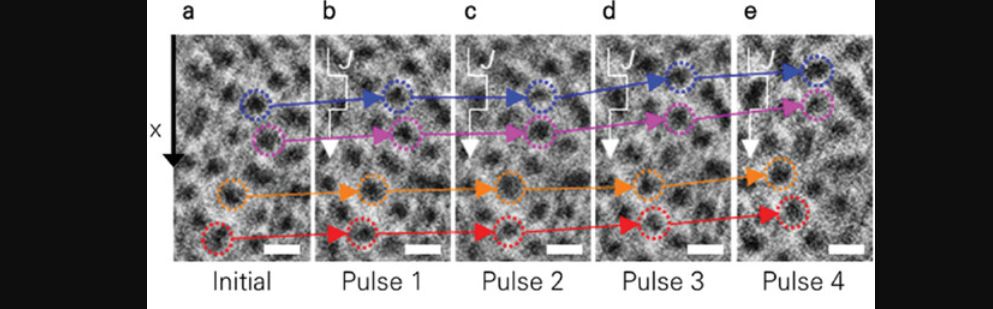
In the demonstrated work, researchers used electrical pulses together with an applied magnetic field to generate skyrmions in an FGaT film. Then, with a short current pulse, they directly observed skyrmion motion. The motion occurred at room temperature and required a notably low current density compared with many earlier skyrmion systems. That is a big deal because high currents create heat, and heat is the obnoxious roommate of nanoscale electronics.
How the Skyrmions Were Seen
You cannot exactly look at a skyrmion with a drugstore magnifying glass. The team used high-resolution magnetic transmission soft X-ray microscopy to visualize the spin textures. This technique can image magnetic structures with nanoscale detail, allowing researchers to see how skyrmions form and move after electrical stimulation.
Direct observation matters. In emerging physics, indirect signals are useful, but seeing the object move is more convincing. It is the difference between hearing scratching in the wall and finally catching the raccoon wearing a tiny burglar mask.
Why Fe3GaTe2 Is Getting So Much Attention
For years, one of the big hurdles in magnetic skyrmion research was temperature. Many early skyrmion systems worked only at low temperatures or under carefully tuned magnetic fields. That was scientifically fascinating but technologically inconvenient. A commercial device that requires exotic cooling is not automatically impossible, but it is much harder to sell unless it does something truly spectacular.
FGaT changes the conversation because it belongs to the growing class of two-dimensional magnetic materials that can operate closer to practical conditions. Researchers have reported room-temperature or above-room-temperature skyrmion behavior in Fe3GaTe2-based systems, including skyrmion lattices, skyrmion phases, and current-driven skyrmion motion. The material is not ready to leap into your laptop tomorrow, but it gives scientists a better playground for testing device ideas.
Room Temperature Is Not a Small Detail
Room-temperature operation means a technology can, at least in principle, work in normal environments. That does not automatically make it manufacturing-ready, but it removes a major barrier. For skyrmion-based memory, logic, and neuromorphic computing, room-temperature stability is one of the key milestones.
The FGaT demonstration also matters because the skyrmions moved under ultra-low current density. In device engineering, lower current usually means lower power consumption and less heat. Since skyrmions are often proposed for low-energy spintronic devices, showing motion with reduced current is exactly the kind of progress the field needs.
How Skyrmion Creation and Control Actually Work
Creating a magnetic skyrmion is not like printing a dot on paper. It requires tuning a delicate balance between magnetic exchange interactions, anisotropy, dipolar effects, temperature, defects, film thickness, and sometimes the Dzyaloshinskii-Moriya interaction, usually called DMI because physicists enjoy saving syllables for emergencies.
DMI often appears in systems where inversion symmetry is broken, such as at interfaces between magnetic and nonmagnetic layers with strong spin-orbit coupling. This interaction favors twisted spin arrangements, making it one of the important ingredients behind chiral skyrmions. In some van der Waals magnets, skyrmion formation can also depend on crystal structure, defects, thickness, strain, and field-cooling history.
Electrical Pulses
Electrical pulses can generate local heating, spin torque, or changes in magnetic configuration. In the FGaT work, the researchers connected current-induced generation with a feasible thermal mechanism. Carefully applied pulses can help transform stripe-like magnetic domains into skyrmion textures. Too weak, and nothing happens. Too strong, and you may disturb the system more than intended. Like making pancakes, timing and heat matter.
Magnetic Fields
Magnetic fields can stabilize skyrmions by favoring certain spin orientations. In many experiments, a perpendicular field helps convert labyrinth-like magnetic stripes into skyrmion bubbles or skyrmion lattices. The long-term goal, however, is often to minimize or eliminate the need for external magnetic fields, because nobody wants every future memory chip to travel with its own laboratory magnet.
Current-Driven Motion
Once skyrmions exist, moving them is the next challenge. Electric current can push skyrmions along a track, which is why people imagine skyrmion racetrack memory. Data could be encoded as the presence or absence of skyrmions and moved through a nanowire-like device. In a perfect world, the skyrmions would glide obediently like tiny magnetic shopping carts. In reality, defects, pinning, heating, and the skyrmion Hall effect complicate the ride.
The Skyrmion Hall Effect: The Sideways Problem
The skyrmion Hall effect is one of the field’s most famous headaches. When a skyrmion moves under current, it may drift sideways instead of traveling perfectly straight. That sideways motion can push skyrmions toward device edges, where they may be annihilated. For racetrack memory, this is not ideal. A data bit that yeets itself into the wall is not a reliable data bit.
Researchers are investigating several ways to reduce this problem. Ferrimagnetic systems, antiferromagnetic systems, synthetic antiferromagnets, improved track design, defect engineering, and material optimization may help guide skyrmions more cleanly. The FGaT result adds another valuable platform to this effort because it offers room-temperature skyrmion motion in a layered ferromagnet with low current requirements.
Potential Applications: Why Should Anyone Outside a Lab Care?
The most discussed application is next-generation memory. Magnetic skyrmions could act as nanoscale bits in racetrack memory, where information moves along a strip rather than being stored in fixed transistor cells. Since skyrmions can be very small, this approach could potentially support high storage density.
Another exciting area is logic computing. Skyrmions can interact with each other and with device geometries, which creates possibilities for logic gates. Instead of moving electrons through conventional circuits alone, future devices might process information using controlled magnetic textures. That sounds exotic, but so did the transistor once.
Neuromorphic Computing
Skyrmions may also be useful for neuromorphic computing, which aims to imitate some features of biological neural networks in hardware. Because skyrmion number, position, and motion can be tuned gradually, skyrmion devices may represent analog-like states instead of simple binary on/off states. This makes them interesting for artificial synapses and energy-efficient pattern recognition systems.
Magnetic Sensors and Hybrid Devices
Skyrmion-hosting materials may also influence magnetic sensors, oscillator devices, probabilistic computing, and hybrid spintronic systems. The path from laboratory discovery to product is long, but the menu of possible applications keeps expanding.
What Makes This Demonstration Different?
The key difference is the combination of room-temperature operation, direct imaging, current-induced generation, and low-current motion in a two-dimensional van der Waals ferromagnet. Previous work has shown skyrmions in many materials, including multilayer thin films, chiral magnets, and ferrimagnetic systems. But each platform has trade-offs. Some need low temperatures. Some need strong fields. Some require high currents. Some are difficult to integrate into device structures.
FGaT does not solve every problem, but it checks several important boxes. It is thin, layered, magnetic near room temperature, and compatible with the broader world of van der Waals heterostructures. That means it may eventually be stacked with other two-dimensional materials to create novel spintronic devices.
Another important detail is the role of defects. In conventional materials, defects can pin skyrmions and prevent smooth motion. The van der Waals gap in layered materials may reduce certain defect-related problems, helping skyrmions move at lower current. That is not a guarantee of perfect devices, but it is an encouraging clue.
The Challenges Still Ahead
Every breakthrough headline needs a reality check, preferably before the hype train leaves the station wearing sunglasses. Magnetic skyrmions are promising, but practical skyrmion electronics still face major challenges.
Reliable Writing and Deleting
Future devices must create skyrmions exactly where needed, move them without losing them, read them accurately, and delete them on command. That full cycle must work billions of times with low error rates. A lab demonstration is an essential step, but engineering a reliable commercial memory architecture is much harder.
Material Uniformity
Thin-film devices require consistent materials over large areas. A few beautiful flakes in a research setup are not the same as wafer-scale manufacturing. Researchers must learn how to grow or transfer high-quality FGaT and related materials with repeatable properties.
Heat and Power
Even low-current devices produce heat. Since skyrmion stability depends on temperature, engineers must control Joule heating carefully. A material that hosts skyrmions at room temperature may still struggle if a device heats up during operation.
Readout
Seeing skyrmions with X-ray microscopy is excellent for research, but consumer electronics need compact electrical readout. Magnetoresistance effects, Hall signals, and tunnel junction architectures are possible routes, but they need refinement.
Why This Is Good News for Spintronics
Spintronics has already changed technology through magnetic memory and read-head devices, but skyrmions represent a more adventurous frontier. They offer a way to treat magnetic textures as mobile, controllable information carriers. The FGaT demonstration suggests that layered ferromagnets may help bring skyrmionics closer to realistic operating conditions.
That does not mean skyrmion laptops are coming next Tuesday. It means the physics is becoming more controllable, the materials are becoming more practical, and the experimental toolbox is becoming sharper. In advanced materials research, that is how revolutions usually begin: not with fireworks, but with a nanoscale object moving when and where scientists tell it to.
Additional Experiences and Practical Reflections on Magnetic Skyrmion Research
Anyone following magnetic skyrmion research quickly learns that the field has a charming habit of making simple goals difficult. “Create a tiny magnetic swirl and move it” sounds straightforward until you realize the swirl depends on film thickness, temperature, magnetic history, current density, defects, imaging method, and the mood of the universe before coffee. That complexity is frustrating, but it is also what makes the topic so rich.
One practical lesson from skyrmion experiments is that materials are never passive backgrounds. In ordinary gadget talk, people often focus on the device concept first: memory, logic, sensor, synapse. In skyrmion research, the material is the main character. A tiny change in composition or layer thickness can decide whether the film forms stripes, bubbles, isolated skyrmions, a skyrmion lattice, or nothing worth celebrating. Fe3GaTe2 is exciting because it gives researchers a material platform where room-temperature behavior is possible, but even then, careful control is everything.
Another experience from this field is that imaging is half the battle. If you cannot see the spin texture clearly, you may end up arguing with indirect measurements like a detective trying to solve a mystery from footprints alone. Magnetic transmission soft X-ray microscopy, Lorentz transmission electron microscopy, magnetic force microscopy, and related techniques each reveal different parts of the story. Direct imaging of skyrmion motion is powerful because it turns an abstract claim into observable behavior. There it is: the little magnetic donut moved.
The FGaT demonstration also reminds us that “low power” is not just a marketing phrase. At nanoscale dimensions, heat can ruin the party quickly. High current densities may move skyrmions, but they can also warm the film, alter magnetic phases, or damage device reliability. Demonstrating motion with ultra-low current density therefore feels less like a small optimization and more like a necessary step toward serious engineering.
There is also a useful humility in skyrmion work. The more researchers learn, the more they discover that stability and mobility are in tension. A skyrmion must be stable enough to store information but mobile enough to be moved on demand. If it is pinned too strongly, it refuses to budge. If it moves too easily, it may wander, deform, or vanish at an edge. The ideal skyrmion device needs the discipline of a marching band and the agility of a squirrel, which is a tall order for a magnetic texture only nanometers wide.
From an industry perspective, the most realistic attitude is cautious optimism. Magnetic skyrmions are not a finished product, but they are no longer just a beautiful theoretical sketch. The demonstration of creation and control in a ferromagnetic film shows that researchers are learning to command these spin structures under increasingly practical conditions. That is how early-stage technologies mature: one controlled motion, one better material, one cleaner image, and one lower current pulse at a time.
For readers who enjoy watching future technology take shape, skyrmions are worth following. They sit at the intersection of physics, materials science, nanofabrication, and computing. They are tiny enough to be almost ridiculous, stable enough to be useful, and strange enough to keep scientists entertained for years. If tomorrow’s memory devices end up using magnetic whirlpools as data carriers, we can all agree on one thing: the future has excellent taste in weird physics.
Conclusion
The demonstration of creating and controlling magnetic skyrmions in a ferromagnetic film marks a meaningful advance for spintronics and nanoscale magnetic devices. By generating and moving skyrmions in Fe3GaTe2 at room temperature, researchers showed that van der Waals ferromagnets can support practical skyrmion operations under conditions closer to real-world electronics.
The work does not instantly deliver commercial skyrmion memory, but it strengthens the foundation. It proves that these nanoscale magnetic whirlpools can be manipulated in a promising thin-film material while using relatively low current. That combination matters for energy efficiency, device integration, and future computing architectures.
Magnetic skyrmions still face hurdles, including reliable writing and deletion, edge losses, material scalability, thermal management, and compact readout. Yet the direction is clear. The more researchers learn to create, steer, stabilize, and detect skyrmions, the closer we get to a new class of spintronic technologies. For now, the tiny magnetic whirlpool has moved another step out of the physics lab and toward the hardware imagination.











