
“`
Some dogs walk into a room and politely introduce themselves. A Golden Retriever walks in, smiles with its whole face, offers you an invisible friendship contract, and possibly brings you a sock. But while the breed is famous for its sunny personality, identifying a true Golden Retriever takes more than spotting a yellow dog with a wagging tail.
Golden Retrievers are one of America’s most recognizable dog breeds, loved for their golden coats, athletic build, gentle temperament, and “I am emotionally available for snacks and fetch” energy. Still, many breeds and mixes can look similar at first glance. Labrador Retrievers, Flat-Coated Retrievers, Irish Setters, Great Pyrenees mixes, and Goldendoodles can all create a moment of canine confusion.
This guide breaks the process into four practical ways to identify a Golden Retriever: examine the coat, study the body shape, observe the head and expression, and pay attention to behavior. By the end, you will be better equipped to tell whether that friendly golden blur at the park is a Golden Retriever, a close cousin, or just a very enthusiastic mystery floof.
1. Look Closely at the Golden Coat
The most obvious clue is right there in the name: Golden Retriever. The breed is known for a dense, water-repellent double coat that ranges from light cream to rich golden and darker reddish gold. The color should look naturally golden rather than pure white, black, chocolate, merle, or sharply patched.
A Golden Retriever’s coat is not just about color. Texture matters. Adult Goldens usually have medium-length fur with feathering on the chest, belly, backs of the legs, underside of the tail, and sometimes around the neck. This feathering gives the breed that soft, flowing look, as if the dog has just stepped out of a shampoo commercial and is pretending not to know it.
Check for a Double Coat
A Golden Retriever has a protective outer coat and a softer undercoat. This double coat helped the breed work as a hunting and water-retrieving dog in cold, wet conditions. If you run your hand through the coat, you may notice that it feels thicker than it looks. During shedding season, you may also notice the coat on your couch, your sweater, your car seat, your coffee cup, and somehow your phone charger.
The outer coat can be straight or slightly wavy, but it should not be tightly curled like a Poodle’s coat. A Golden Retriever puppy may not show full adult feathering right away. Young puppies often have fluffier, shorter coats, and the longer adult coat develops gradually over time. So, if you are identifying a puppy, look at more than fur alone.
Know the Normal Golden Shades
Golden Retrievers may appear in several shades, including light golden, medium golden, and dark golden. Some people casually use terms like “English cream” or “red Golden,” but these are descriptions of shade or style, not separate breeds. A very pale Golden can still be a Golden Retriever, and a darker reddish Golden can also be purebred if the dog comes from documented Golden Retriever lines.
Be cautious of anyone marketing a Golden Retriever as “rare” only because of coat color. Responsible identification should focus on overall breed traits, health, structure, temperament, and documentation, not just a fancy color label that sounds like it belongs on a latte menu.
2. Examine the Body Shape and Size
Golden Retrievers are medium-to-large sporting dogs. They were developed to retrieve game on land and in water, so their bodies are athletic, balanced, and strong without looking bulky or clumsy. A Golden should look like a dog that could happily hike, swim, play fetch, nap under the table, then repeat the schedule tomorrow with terrifying enthusiasm.
Adult males are typically larger than females. A male Golden Retriever often stands around 23 to 24 inches at the shoulder and weighs about 65 to 75 pounds. Females are usually around 21.5 to 22.5 inches tall and weigh about 55 to 65 pounds. Individual dogs can vary, especially depending on age, diet, activity level, and genetics, but these ranges provide a useful starting point.
Look for a Balanced, Athletic Build
A Golden Retriever should have a sturdy frame, deep chest, strong neck, level back, and muscular legs. The breed is not supposed to look delicate, overly tall, short-legged, or barrel-shaped. A healthy Golden gives the impression of power with friendliness attached.
The tail is another clue. A Golden Retriever’s tail is usually thick at the base, feathered, and carried level with the back or with a gentle upward curve. It should not curl tightly over the back like a Spitz-type breed. When excited, the tail often becomes a golden windshield wiper, sweeping the air with impressive dedication.
Compare Goldens With Similar Breeds
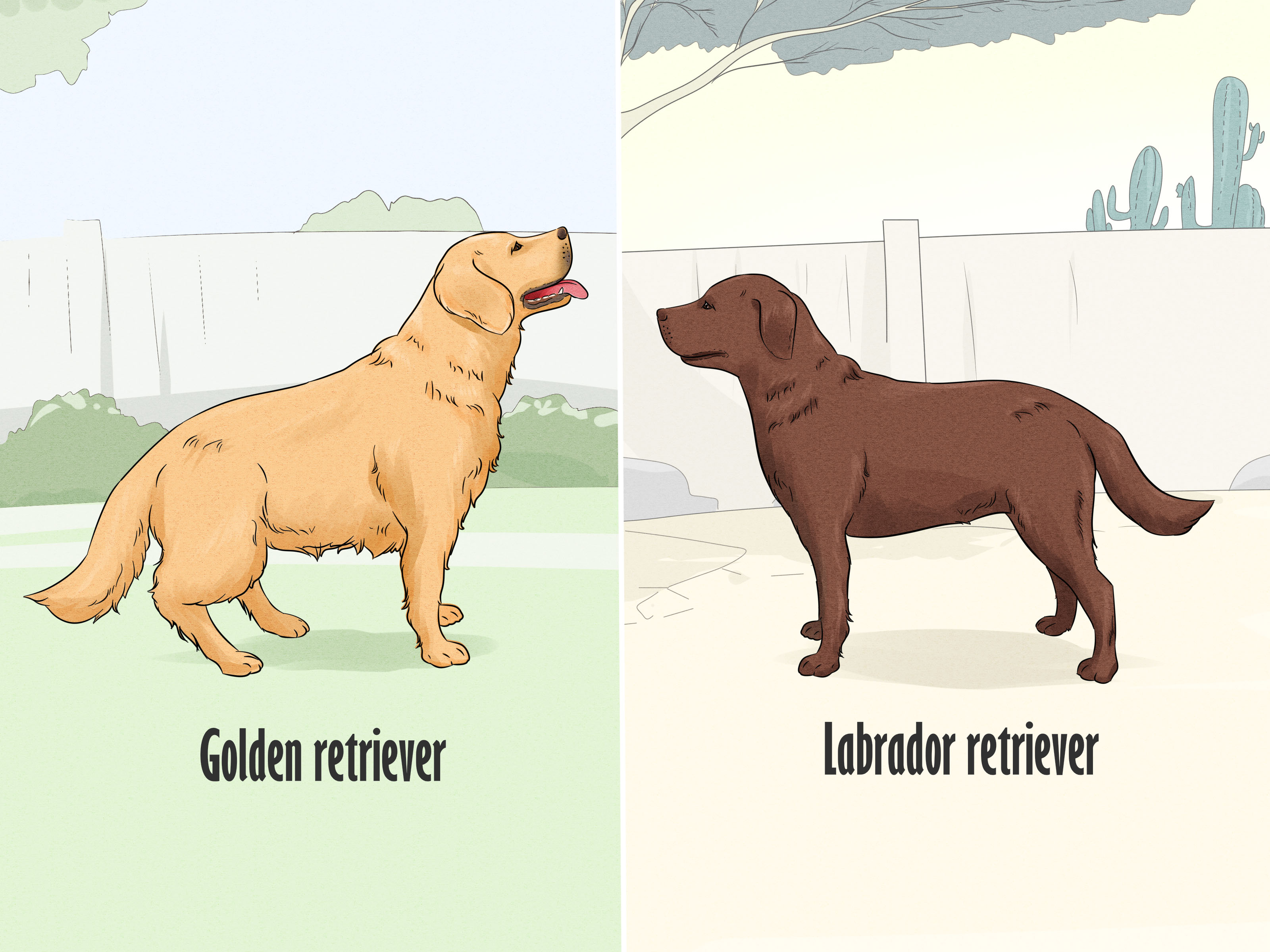
Golden Retrievers are sometimes confused with Labrador Retrievers. Labs usually have shorter, denser coats with less feathering, a more “otter-like” tail, and a broader, smoother outline. Goldens generally have longer coats and more visible feathering.
They may also be confused with Goldendoodles, especially when the coat is light and fluffy. A Goldendoodle, however, often has a curlier or shaggier coat, a different head shape, and more variation in size because it is a cross between a Golden Retriever and a Poodle. Some Goldendoodles look very Golden-like, while others look like teddy bears who discovered espresso.
Irish Setters can share a reddish-gold color, but they are usually taller, leaner, and more elegant in outline, with a narrower head and deeper red coat. Flat-Coated Retrievers have a similar sporting-dog shape but are most commonly black or liver-colored, not golden.
3. Study the Head, Ears, Eyes, and Expression
A true Golden Retriever has one of the most recognizable expressions in the dog world: soft, friendly, alert, and slightly hopeful that you are holding a tennis ball. The head should look broad and cleanly shaped, with a defined stop between forehead and muzzle. The muzzle is strong and fairly wide, not pointy or narrow.
Notice the Eyes
Golden Retriever eyes are typically medium to dark brown, set well apart, and shaped to create a gentle, intelligent expression. The look should be friendly and confident, not sharp, suspicious, or overly timid. Of course, every dog can have a weird photo angle. Even the most noble Golden can look like a confused potato if caught mid-sneeze.
The breed’s expression is part of what makes it so beloved. A Golden usually appears approachable and engaged, with a natural softness that matches its personality. This does not mean every Golden will instantly love every person or dog, but the breed standard values a kindly, trustworthy temperament.
Check the Ears
Golden Retrievers have relatively short drop ears that fall close to the cheeks. The front edge of the ear is set behind and slightly above the eye. When pulled forward gently, the ear should roughly reach the eye area, not extend dramatically beyond it like a hound’s ear.
Long, low-set ears may suggest another breed influence. Very upright ears also point away from Golden Retriever type. A Golden’s ears add to that sweet, attentive look, especially when the dog hears a treat bag being opened from three rooms away.
Look at the Nose and Mouth
A Golden Retriever usually has a black or brownish-black nose, though some noses lighten slightly in colder weather or with age. The mouth should be strong but gentle-looking, fitting the breed’s history as a retriever with a “soft mouth,” meaning the dog was bred to carry game without damaging it.
Many Goldens naturally enjoy carrying things. Toys, shoes, towels, leaves, mail, and objects of mysterious origin may all become “treasures.” While this habit is not proof by itself, it supports the bigger picture when combined with coat, structure, and temperament.
4. Observe the Temperament and Behavior
Golden Retrievers are famous for being friendly, eager to please, intelligent, and people-oriented. They are often described as gentle family dogs, reliable companions, and enthusiastic workers. The breed is commonly used in service work, therapy work, search and rescue, obedience, field activities, and other jobs that require trainability and cooperation.
Behavior is not as precise as physical structure because training, socialization, health, and environment all influence how a dog acts. Still, temperament can help identify a Golden Retriever when paired with the other signs.
Look for Social Confidence
A typical Golden Retriever is friendly and interested in people. Many are outgoing with strangers, patient with children, and playful with other dogs. They often enjoy being included in family activities and may follow their humans from room to room like cheerful, furry interns.
However, friendliness should not be confused with perfect manners. Young Goldens can be exuberant. They may jump, mouth, wiggle, or attempt to greet guests as if every visitor is a long-lost royal cousin. Training helps shape that happy energy into polite behavior.
Watch for Retrieving Instinct
The word “Retriever” is not decorative. Many Golden Retrievers love fetch, carrying toys, swimming, and games that involve bringing things back. Some will retrieve a ball until your arm files a formal complaint. Others prefer carrying a toy when excited, almost as if they need a security blanket with squeakers.
Because the breed was developed as a sporting dog, many Goldens need regular exercise and mental activity. A calm Golden in the house is often the result of proper movement, play, training, and routine. Without enough stimulation, a bored Golden may invent hobbies, such as sock relocation or backyard archaeology.
Notice Trainability
Golden Retrievers are usually eager learners. They respond well to reward-based training and often enjoy working with people. Their intelligence and desire to cooperate are major reasons they perform well in assistance roles, therapy work, and dog sports.
That said, a Golden Retriever is not born knowing household rules. Puppies need consistent training, socialization, and patience. A Golden may be smart enough to learn “sit” quickly and also smart enough to learn that one specific drawer contains snacks. Intelligence is a gift; supervision is the receipt.
Bonus Identification Tips for Puppies
Identifying a Golden Retriever puppy can be trickier than identifying an adult. Puppies have softer features, shorter coats, and less developed feathering. Their adult color may deepen or lighten slightly as they mature. The best clues are parentage, breeder documentation, body proportions, ear shape, coat texture, and personality.
If you are adopting from a shelter or rescue, the label “Golden Retriever mix” may be an educated guess. Mixed-breed dogs can be wonderful companions, but visual identification is not always accurate. DNA testing can provide more information, though even DNA results should be viewed alongside the dog’s actual traits and health needs.
Common Mistakes When Identifying a Golden Retriever
The first common mistake is assuming that every golden-colored dog is a Golden Retriever. Coat color alone is not enough. Many breeds and mixes can have golden or cream fur.
The second mistake is assuming that a short-haired golden dog must be a young Golden. It might be a Labrador Retriever, a mixed breed, or a Golden with unusual coat presentation. Look for feathering, head shape, tail carriage, and overall structure.
The third mistake is believing that all Golden Retrievers are perfectly calm. Mature Goldens are often gentle and steady, but puppies and adolescents can be energetic, goofy, and extremely committed to the sport of greeting. A hyper young dog can still be a Golden Retriever; it may simply be operating on puppy software.
The fourth mistake is relying on internet labels like “mini Golden Retriever” or “rare white Golden” without asking questions. Responsible identification should include health records, pedigree information if available, and a realistic understanding of breed traits.
How to Confirm a Golden Retriever’s Breed
If you need more than a visual guess, ask for documentation. For a purebred Golden Retriever, registration papers from a recognized kennel club, breeder records, and parent information are helpful. Health clearances are also important when buying from a breeder, especially for hips, elbows, eyes, and heart concerns commonly monitored in the breed.
For rescue dogs or uncertain backgrounds, a veterinary exam and DNA test can help. A vet can also evaluate whether the dog’s weight, coat, joints, ears, and skin are healthy. This matters because identifying the breed is interesting, but caring for the dog in front of you is the real prize.
Experience-Based Notes: What Real-Life Goldens Teach You
After spending time around Golden Retrievers, one thing becomes obvious: they are not subtle dogs. They announce joy with their entire body. A Golden does not merely wag its tail; it starts a full-body celebration that can clear a coffee table if the table is foolish enough to stand nearby. This is one of the first real-world clues people notice. A Golden Retriever often has a warm, open, socially optimistic style that feels different from more reserved breeds.
At the dog park, Goldens are often the ones carrying something. It might be a tennis ball, a stick, a toy, or a random object that has been promoted to toy status by executive decision. Their retrieving instinct is not just a historical footnote. It appears in everyday life. Many Goldens like to greet people with a toy in their mouth, as if presenting a business card that squeaks.
Another practical experience is the coat test. If you pet an adult Golden and your hand disappears into a soft but substantial coat, you are probably dealing with a true double-coated retriever. The feathering on the legs and tail is especially useful. In sunlight, the coat often shows different golden tones, from pale cream highlights to deeper amber shading. A Labrador may share the friendly expression, but the shorter coat and different tail usually reveal the difference quickly.
Golden Retrievers also tend to have a distinct “kindly” face. Their eyes are expressive without looking intense. Their ears frame the face softly. Their mouth often rests in a relaxed, slightly smiling shape. Of course, a dog’s expression can change with mood, health, and training, but Goldens frequently have that approachable look that makes strangers say, “Can I pet your dog?” before remembering they should ask first.
In family settings, Goldens often want to be involved. They may lie under the kitchen table, follow someone folding laundry, supervise homework, or sit nearby during movie night. This people-focused nature is a major identification clue, but it also comes with responsibility. A Golden Retriever is not a decorative rug with paws. The breed needs companionship, exercise, grooming, and training.
One humorous but useful experience: Golden Retrievers are professional food detectives. Many have strong appetites, so a Golden that watches snack preparation with scientific concentration is not unusual. This does not identify the breed by itselfplenty of dogs appreciate cheese with spiritual intensitybut combined with the right coat, build, expression, and retrieving behavior, it fits the pattern.
Grooming experience also teaches a lot. Goldens shed. They shed politely, enthusiastically, seasonally, and sometimes for reasons known only to the moon. Regular brushing reveals the dense undercoat and helps prevent mats behind the ears, under the legs, and around feathered areas. If a dog has a long golden coat but lacks the typical undercoat or feathering pattern, it may be a mix or a different breed.
The best real-life advice is to identify the whole dog, not one feature. A Golden Retriever is a package: golden double coat, athletic sporting build, broad friendly head, drop ears, feathered tail, people-loving personality, trainability, and a strong chance of believing fetch is a legally binding activity. When those traits appear together, you are probably looking at a Golden Retriever. When only one or two traits appear, keep investigating.
Conclusion
Identifying a Golden Retriever is part observation, part breed knowledge, and part resisting the temptation to shout “Golden!” at every yellow dog with a happy face. Start with the coat, then check the size and structure, study the head and expression, and observe the temperament. A true Golden Retriever usually combines a golden double coat, balanced athletic body, gentle face, friendly confidence, and a natural love of people, play, and retrieving.
Whether you are choosing a puppy, identifying a rescue dog, writing a breed profile, or simply trying to win an argument at the dog park, these four methods will help you make a smarter call. And remember: even if the dog turns out to be a Golden mix, you may still have a world-class companion with a gold-medal heart and a sock-management hobby.
Note: This article is based on established Golden Retriever breed standards, veterinary breed guides, and reputable dog-care information. It is intended for educational identification purposes and should not replace professional advice from a veterinarian, responsible breeder, or qualified rescue organization.











