
Note: This article is an original editorial synthesis based on real information about NASA’s Deep Space Network, deep-space communications, interplanetary mission support, radio science, and emerging optical communications technology. It contains no copied passages or embedded source links.
Most of us complain when a video call freezes from the next room. NASA, meanwhile, is trying to hold a conversation with spacecraft near Mars, Jupiter, asteroids, the edge of the solar system, and beyond. That is not “bad Wi-Fi.” That is serious DX.
In radio slang, DX means long-distance communication. Amateur radio operators use the term when they reach a faraway station across oceans or continents. NASA’s Deep Space Network, often shortened to DSN, takes that idea and launches it into another league. The DSN is the giant, planet-spanning communications system that allows robotic spacecraft to phone home from deep space. It listens for faint signals, sends commands, measures spacecraft positions, supports science investigations, and quietly makes modern planetary exploration possible.
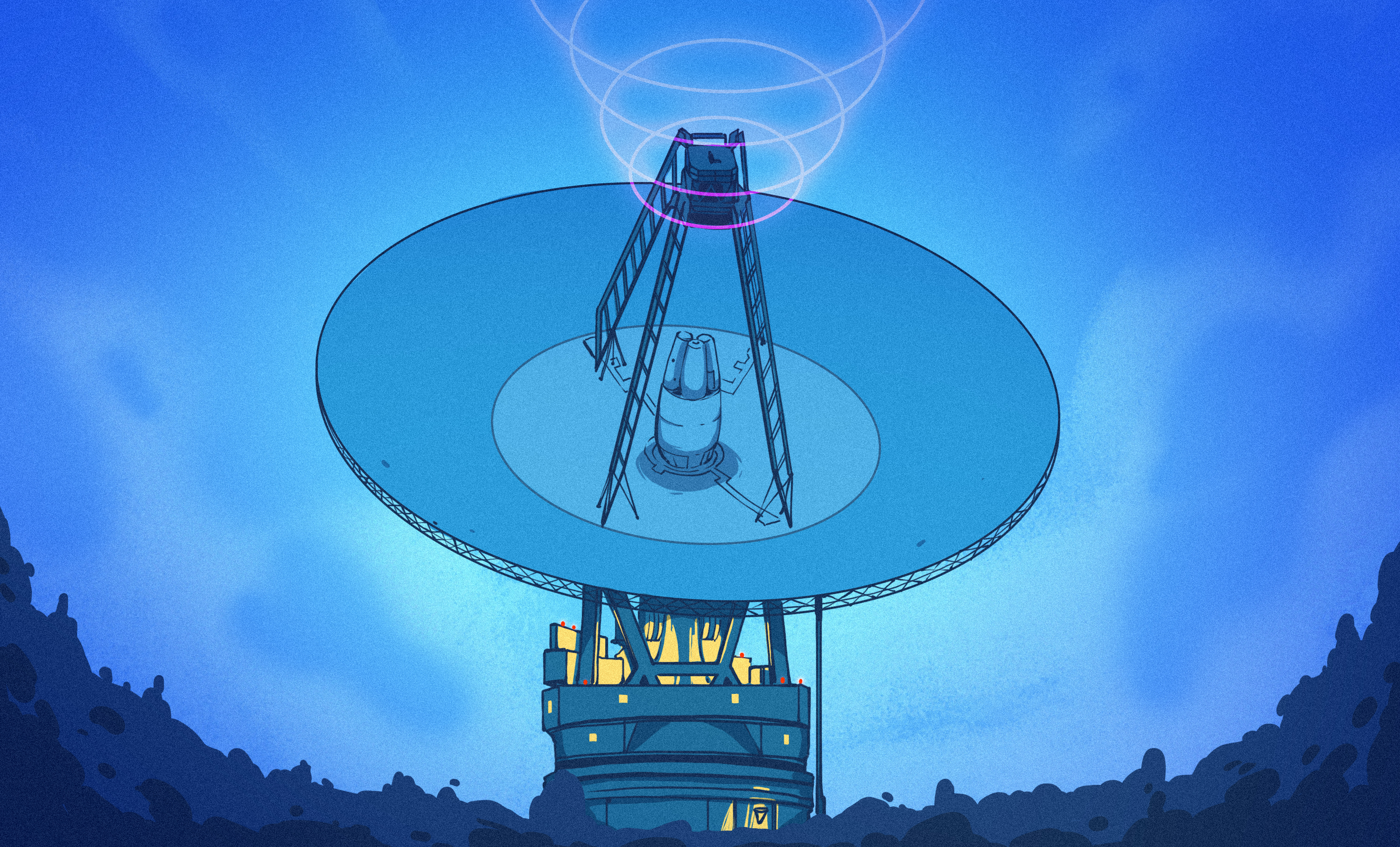
The Deep Space Network is not one dish in a dramatic desert photo, although the photos are excellent and make every antenna look like it is waiting for a movie soundtrack. It is a coordinated global network of huge radio antennas located near Goldstone, California; Madrid, Spain; and Canberra, Australia. These three complexes are spaced roughly one-third of the way around Earth from one another, which means that as our planet rotates, at least one complex can usually “see” a spacecraft that needs attention.
Without the DSN, many of the most famous space missions would be silent metal birds flying through the dark. With it, Earth receives images from Mars rovers, data from asteroid missions, health reports from spacecraft, and whispers from the Voyager probes as they continue their historic journeys into interstellar space. The Deep Space Network is the switchboard of the solar system, except the callers are robots, the hold music is physics, and the customer service department has to deal with light-time delays measured in minutes or hours.
What Is the Deep Space Network?
The Deep Space Network is NASA’s international array of large radio antennas used to communicate with spacecraft beyond Earth orbit. It is managed by NASA’s Jet Propulsion Laboratory in Southern California and supports missions across the solar system. Its work includes receiving telemetry, sending commands, tracking spacecraft locations, collecting science data, and supporting radio astronomy and radar observations.
In plain English, the DSN is how NASA says, “Are you still alive out there?” and how a spacecraft replies, “Yes, and I found something interesting.”
The system uses enormous parabolic dish antennas, including 70-meter giants and multiple 34-meter antennas. These dishes gather incredibly weak radio signals that have traveled millions or even billions of miles. A spacecraft transmitter may use only a modest amount of power, but by the time its signal reaches Earth, it can be unimaginably faint. The DSN’s job is to pull that delicate signal out of cosmic noise, Earth-based interference, and the general static of the universe.
Why Three Deep Space Network Sites Matter
The DSN’s three-site layout is one of its smartest design choices. Earth rotates once every 24 hours, and a single ground station would lose sight of a spacecraft as the planet turned. By placing major antenna complexes in California, Spain, and Australia, NASA created a relay of visibility. When a spacecraft sets below the horizon at one site, another site can often pick it up.
Goldstone, California
The Goldstone Deep Space Communications Complex sits in California’s Mojave Desert. It is part of the U.S. side of the network and has supported a long list of planetary missions. Its dry, remote location helps reduce interference, and its large antennas are iconic symbols of deep-space exploration.
Madrid, Spain
The Madrid Deep Space Communications Complex provides coverage from Europe and helps bridge the handoff between Goldstone and Canberra. Its antennas support spacecraft across many mission phases, from routine tracking to critical events when every bit matters.
Canberra, Australia
The Canberra Deep Space Communication Complex gives the DSN its Southern Hemisphere reach. This is especially important for spacecraft whose positions in the sky favor southern viewing. Canberra’s large antennas have played a major role in communicating with distant missions, including the Voyager spacecraft.
Together, these sites form a planetary-scale listening network. It is like having three extremely patient friends standing around the world with huge metal ears, waiting for a spacecraft to whisper, “I made it.”
How the DSN Talks to Spacecraft
Deep-space communication is a two-way process. The DSN sends commands to spacecraft through uplink transmissions, and spacecraft send information back through downlink transmissions. Commands might tell a spacecraft to adjust its orientation, run an instrument, perform a maneuver, update software, or transmit stored data. Downlink data can include engineering telemetry, scientific measurements, images, radar observations, and health reports.
This sounds simple until distance barges in wearing boots. Radio signals travel at the speed of light, which is fast but not instant. A message to Mars can take several minutes one way, depending on where Earth and Mars are in their orbits. A command sent to a spacecraft near the outer planets can take much longer. For Voyager, the delay is measured in many hours for a round trip.
That means there is no joystick driving in deep space. Engineers do not steer a rover or spacecraft like a remote-control car. They plan, simulate, send instructions, wait, and then receive confirmation later. Space operations are less “live action video game” and more “chess by postcard, except the postcard is a radio wave and the chessboard is moving around the Sun.”
The Antennas: Big Dishes With Big Responsibilities
The most recognizable DSN hardware is the giant dish antenna. These dishes are shaped to collect and focus radio waves onto sensitive receivers. Bigger antennas collect more signal, which is critical when communicating with distant spacecraft. The famous 70-meter antennas are massive, but the network also relies heavily on 34-meter antennas that can be used individually or, in some cases, coordinated together.
Modern DSN operations are not just about size. They also depend on sensitive receivers, powerful transmitters, advanced signal processing, accurate timing, cryogenic systems, precision pointing, and careful scheduling. A huge dish that points slightly wrong is just a very expensive sculpture. The DSN must point with extraordinary accuracy because spacecraft appear as tiny targets in the sky.
For distant missions, the received signal can be so faint that engineers must use sophisticated techniques to lock onto it. The system has to know where the spacecraft should be, what frequency it is using, how fast it is moving relative to Earth, and how the signal will shift because of the Doppler effect. The same physics that makes an ambulance siren change pitch as it passes you also affects deep-space radio signals, only NASA’s version involves planets, probes, and math that politely asks everyone to sit down.
What the DSN Actually Sends Back to Earth
The Deep Space Network is often described as a communications system, but the word “communications” understates its value. The DSN brings back the raw material of discovery.
Images and Science Data
When a Mars rover sends a panorama of an ancient riverbed, the DSN is part of the path that brings those pixels to Earth. When a spacecraft studies an asteroid’s surface, samples a planet’s magnetic field, or measures particles in space, the DSN helps deliver those findings to scientists.
Telemetry and Spacecraft Health
Telemetry tells mission teams how a spacecraft is doing. Is the battery healthy? Are the instruments warm enough? Did the maneuver work? Is the spacecraft pointing correctly? Telemetry is the spacecraft’s medical chart, diary, and dashboard all at once.
Tracking and Navigation
The DSN also supports navigation. By measuring signal timing, frequency shifts, and other characteristics, engineers can determine a spacecraft’s position and velocity with remarkable precision. This is essential for course corrections, planetary flybys, orbital insertions, and landings.
Radio Science
Sometimes the radio signal itself becomes a scientific tool. As a spacecraft signal passes through a planet’s atmosphere, rings, or plasma environment, tiny changes in the signal can reveal temperature, density, composition, or other properties. In this case, the DSN is not only a telephone; it is also a scientific instrument.
Why the Deep Space Network Is Under Pressure
The DSN has a popularity problem. More missions want to use it than the network can easily support. NASA and international partners operate many spacecraft, and the demand for antenna time has grown as missions produce more data and travel to more destinations.
Every spacecraft wants attention, but antenna time is limited. A Mars orbiter may need routine passes. A rover may need data relay support. A spacecraft approaching an asteroid may require more frequent contact. A mission performing a critical maneuver may need priority. A distant probe may require a large antenna because its signal is extremely weak. The result is a scheduling puzzle that would make a wedding planner cry into a spreadsheet.
NASA has reported that DSN demand can exceed supply by significant margins at times. That does not mean the network is failing. It means the network is valuable, heavily used, and increasingly stretched by the success of space exploration. More spacecraft, more ambitious science, higher-resolution instruments, and future human exploration all increase pressure on the system.
Upgrades: Keeping the Solar System on the Line
NASA has been upgrading the Deep Space Network to handle growing demand and aging infrastructure. These improvements include refurbishing major antennas, adding newer 34-meter antennas, modernizing electronics, improving transmitters and receivers, and increasing flexibility across the network.
One major challenge is that old hardware can still be mission-critical. You cannot casually unplug a giant antenna when it is one of the few systems capable of reaching a distant spacecraft. Maintenance must be planned carefully, because taking an antenna offline can affect mission schedules. When the network is already busy, even necessary repairs become a balancing act.
Future DSN strategy is likely to involve a mix of larger antennas, arrays of smaller antennas, smarter scheduling, improved automation, better signal processing, and new communications technologies. The goal is not simply to build bigger dishes forever. The goal is to create a more capable, flexible, and resilient deep-space communications ecosystem.
Optical Communications: Lasers Join the Conversation
Radio communication has been the backbone of deep-space exploration for decades, but NASA is also testing optical communications. Instead of using radio waves, optical systems use lasers to transmit data. The potential advantage is huge: laser communications can carry much more data than traditional radio systems under the right conditions.
NASA’s Deep Space Optical Communications demonstration, carried aboard the Psyche mission, showed that laser signals could transmit data across distances comparable to deep-space mission ranges. That matters because future spacecraft may collect far more data than older radio systems can comfortably return. High-resolution images, advanced instruments, and eventual human missions to Mars will all demand bigger data pipelines.
However, lasers are not magic space fiber internet. Optical links require extremely precise pointing. Weather and clouds can interfere with ground reception. Radio remains more reliable in many conditions and will continue to be essential. The future is likely not “radio versus laser,” but “radio plus laser,” with each technology used where it performs best.
Famous Missions That Depend on the DSN
The Deep Space Network has supported an extraordinary range of missions. Mars rovers and orbiters rely on it. Jupiter and Saturn missions have used it. Asteroid missions need it. Lunar missions, solar missions, and outer solar system missions all depend on deep-space communication infrastructure.
The Voyager probes are perhaps the most poetic example. Launched in 1977, they continue to communicate from far beyond the planets. Their signals are faint, their computers are ancient by modern standards, and yet the DSN still listens. In a world where a three-year-old phone can feel outdated, Voyager’s continued operation is both humbling and slightly embarrassing for consumer electronics.
Mars missions offer a more everyday example of DSN importance. Rovers on the surface often send data to orbiters, which then relay information to Earth. The DSN receives that data and sends commands back through the mission operations chain. Every image of a dusty Martian hill has a communications story behind it.
Why Serious DX Matters to Everyone
The Deep Space Network may sound like a niche NASA tool, but its impact reaches far beyond mission control. It enables planetary science, climate-related space observations, asteroid studies, heliophysics, astrophysics, and technology demonstrations. It helps humanity understand where we came from, how planets evolve, and what hazards or opportunities exist beyond Earth.
It also represents a powerful idea: exploration is not only about launching spacecraft. It is about staying connected to them. A mission does not truly become science until its data returns home. The DSN is the bridge between a spacecraft’s experience and human understanding.
That bridge is fragile in ways most people never see. A spacecraft can be healthy, its instruments can work perfectly, and its target can be fascinating, but without communications, its discoveries remain locked away. The DSN turns distant events into knowledge.
The Human Side of Deep-Space Communication
Behind every DSN pass is a team of engineers, operators, planners, mission specialists, software experts, and scientists. They coordinate antenna time, monitor signals, troubleshoot anomalies, and support critical mission events. Their work is often invisible because success looks quiet. A clean data downlink does not explode on television. It just arrives.
That quiet reliability is one of the DSN’s greatest achievements. When a spacecraft lands, flies by a planet, enters orbit, or wakes from safe mode, the public sees the dramatic moment. The DSN team sees the signal behavior, the timing, the link margin, the antenna schedule, and the tiny details that determine whether Earth hears the spacecraft at all.
Space exploration has many glamorous machines: rockets, rovers, orbiters, landers, telescopes. The Deep Space Network is less flashy but just as essential. It is the backstage crew making sure the cosmic concert has a sound system.
Experience Section: What Serious DX Feels Like From Earth
To appreciate the Deep Space Network, imagine standing under a desert sky near one of its giant antennas. The dish moves slowly, almost calmly, as if it has all the time in the world. It does not look frantic. It does not look like a machine fighting distance, radiation, orbital mechanics, and weak signals. It looks patient.
That patience is the emotional core of serious DX. Deep-space communication is not loud. It is not instant. It is not dramatic in the usual Hollywood sense. It is disciplined listening. A spacecraft may be hundreds of millions of miles away, sending a signal that arrives after a long delay and reaches Earth with barely any strength left. Yet the DSN waits, points, receives, decodes, and turns that faint trace into meaning.
For people who enjoy radio, astronomy, engineering, or space exploration, the DSN has a special kind of magic. Amateur radio operators know the thrill of making a difficult contact across great distance. Shortwave listeners know the satisfaction of catching a faint station through noise. Astronomers know the patience required to gather light that has crossed enormous emptiness. The DSN combines all of those feelings, then scales them up to the solar system.
There is also something wonderfully human about the way the network operates. We launch spacecraft knowing they will become lonely machines. They will fly through cold, dark regions no person has visited. They will survive dust, radiation, thermal stress, software faults, aging hardware, and the brutal indifference of space. Then, from Earth, we keep calling.
Sometimes the experience is routine. A scheduled pass begins, the antenna locks onto the signal, telemetry flows, and the spacecraft reports that everything is normal. That routine is beautiful because it means the system works. Other times, the mood is tense. A spacecraft may be in safe mode. A maneuver may have just completed. A landing sequence may be underway. During those moments, a signal is not just data. It is relief.
The Deep Space Network also teaches humility. We live in a culture that expects instant answers, instant downloads, and instant reactions. Deep space says, “Please wait.” Mars says, “Your message will arrive in several minutes.” The outer solar system says, “Pack a lunch.” Interstellar space says, “Patience is not optional.” The DSN accepts these rules and works within them.
One of the most powerful experiences connected to the DSN is watching live network activity through public tools that show which antennas are communicating with which spacecraft. At first, it looks technical: dish numbers, signal directions, frequencies, data rates. Then it starts to feel personal. A dish in Canberra may be talking to a Mars mission. Goldstone may be receiving from a spacecraft near an asteroid. Madrid may be tracking a probe far from Earth. Suddenly, the solar system feels connected by invisible threads.
For writers, educators, students, and space fans, that realization is unforgettable. The Deep Space Network is not an abstract system hidden behind NASA walls. It is an active, living infrastructure that turns distant exploration into shared human experience. Every image from another world has traveled through a chain of engineering decisions, orbital geometry, radio waves, ground stations, servers, scientists, and public curiosity.
Serious DX is not just about distance. It is about care. It is about building tools strong enough to hear almost nothing and smart enough to know that almost nothing may contain the next discovery. It is about refusing to let spacecraft vanish into silence. It is about keeping a conversation going across darkness.
The next time a space image appears online, it is worth pausing before scrolling. Somewhere, a spacecraft collected that data. Somewhere, a dish on Earth turned toward a precise patch of sky. Somewhere, a weak signal arrived. And somewhere, the Deep Space Network did what it has done for decades: it listened carefully, translated patiently, and helped humanity hear from the universe.
Conclusion
The Deep Space Network is one of the most important systems in space exploration, even though it rarely gets the spotlight. It is NASA’s long-distance communications backbone, a global network of giant antennas that allows spacecraft to send home science, images, health updates, and navigational information from across the solar system. It supports legendary missions, enables new discoveries, and faces growing pressure as humanity sends more spacecraft to more destinations.
As the future brings higher data demands, lunar exploration, Mars ambitions, asteroid missions, and optical communications, the DSN will continue to evolve. Radio antennas will remain essential, laser systems will add new capabilities, and smarter scheduling will become increasingly important. Serious DX is only getting more serious.
But at its heart, the story remains simple and wonderful: we send machines into the dark, and the Deep Space Network helps them find their way back to us with a whisper.












