
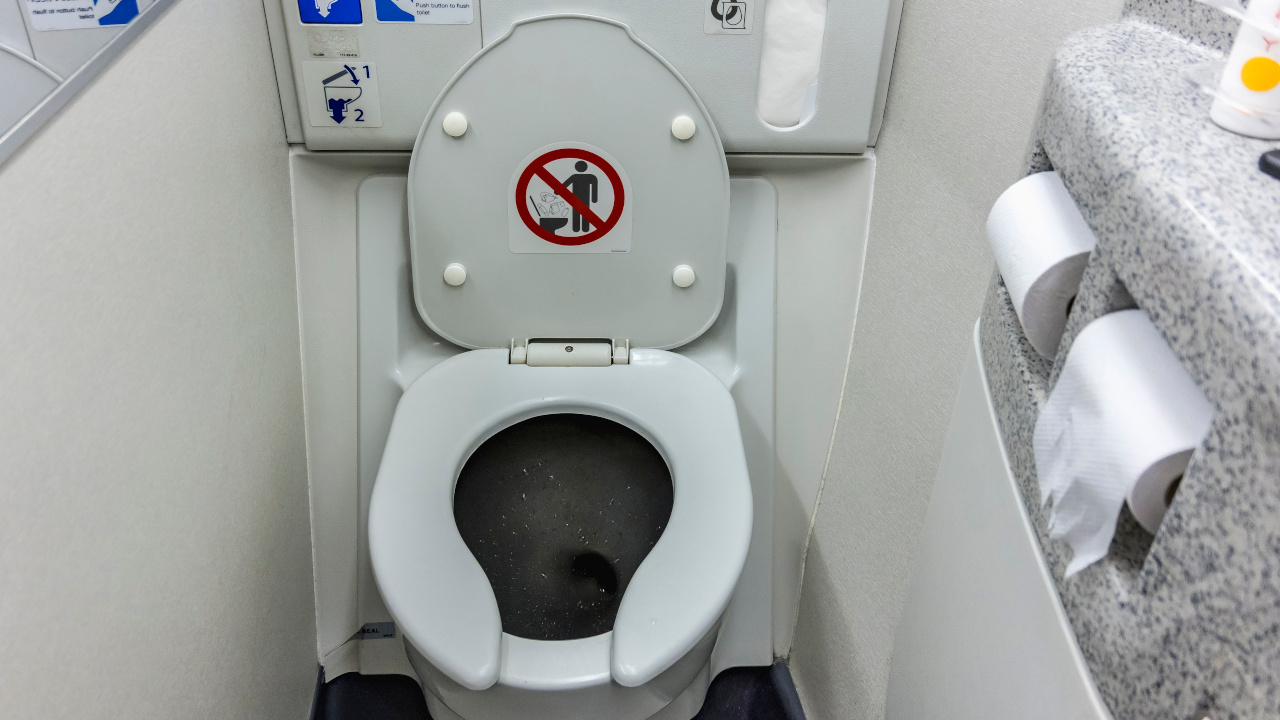
There are many glamorous parts of flying: the wing slicing through clouds, the sunset over the horizon, the tiny bag of pretzels that somehow feels like a luxury item at 35,000 feet. Then there is the less poetic reality: hundreds of passengers, several hours in the air, and a very small bathroom with a flush button that sounds like it is trying to open a portal to another dimension.
Welcome to the surprisingly sophisticated world of handling human waste in the sky. Whether we are talking about commercial airplanes, private jets, or spacecraft, waste management is not an afterthought. It is a safety system, a sanitation system, an engineering puzzle, and occasionally, a comedy routine with a seat belt sign.
Modern aircraft lavatories do not simply drop waste into the clouds, despite what many nervous passengers have imagined. Airplane toilets use vacuum systems, sealed holding tanks, chemical deodorants, careful ground servicing, and strict maintenance routines. In space, where gravity refuses to help, the challenge becomes even stranger: airflow replaces gravity, urine may become drinking water, and astronauts train for bathroom use with the seriousness of a pilot practicing emergency procedures.
This article explores how human waste is collected, stored, serviced, cleaned, and sometimes recycled in the sky and beyond. It is a topic that sounds silly at first, but the deeper you go, the more impressive it becomes. Aviation sanitation is one of those invisible systems that only gets attention when it fails, clogs, leaks, smells, or creates a delay that makes everyone suddenly appreciate plumbing.
Why Waste Management Matters Above the Clouds
On the ground, bathrooms rely on gravity, plumbing networks, and municipal wastewater systems. On an airplane, none of that is available. The lavatory must work inside a pressurized cabin, during turbulence, at high altitude, with limited water, limited space, and a strict weight budget. It also has to handle steady use by passengers who may be tired, anxious, dehydrated, over-caffeinated, or unfamiliar with how delicate aircraft systems can be.
Every pound on an aircraft matters. Carrying large amounts of flush water would add weight and increase fuel use. Allowing waste to move freely would be a sanitation nightmare. Relying on conventional home-style plumbing would be impractical because airplanes change angle, pressure, and acceleration. So aviation engineers developed a different solution: the vacuum toilet system.
Human waste management in aviation protects passengers, crew, maintenance workers, aircraft structures, and people on the ground. A properly serviced lavatory reduces odor, prevents contamination, supports passenger comfort, and helps flights operate on schedule. A badly maintained system can cause clogs, leaks, unpleasant cabin conditions, equipment damage, or delays. In other words, the humble airplane toilet is not humble at all. It is a tiny pressure-powered sanitation machine with a very important job.
How Airplane Toilets Actually Work
The loud roar after pressing the flush button is not the aircraft throwing anything into the sky. It is the sound of a vacuum system doing its work. Modern commercial airplane toilets use differential pressure and suction to pull waste from the bowl into sealed waste tanks. The bowl is often coated or designed so that waste does not cling to the surface, and only a small amount of liquid is needed compared with a household toilet.
The Vacuum Flush System
When a passenger presses flush, a valve opens briefly at the bottom of the toilet bowl. The aircraft’s vacuum system rapidly pulls waste through narrow pipes into a holding tank. At cruising altitude, the pressure difference between the cabin and the outside environment helps create the suction. On the ground or at lower altitudes, pumps or vacuum generators can support the system.
This approach has several advantages. It uses much less water, saves weight, allows flexible pipe routing, and works even when the aircraft is climbing, descending, banking, or bouncing through choppy air. The system is also fast, which is helpful when there are 200 passengers and only a few lavatories. The downside is that the pipes are not designed for random objects. Toilet paper belongs there. Diapers, wipes, plastic cups, sanitary products, jewelry, food wrappers, and mystery pocket items do not.
Where the Waste Goes
After flushing, waste travels into sealed holding tanks inside the aircraft. These tanks remain closed during flight. Pilots do not have a button marked “dump toilet tank,” and airlines are not casually sprinkling the countryside with passenger leftovers. That myth has had a long life, probably because it is both horrifying and weirdly easy to believe.
The truth is more ordinary and far more sanitary. When the aircraft lands, ground crews service the lavatory system using a specialized lavatory truck or cart. These vehicles are sometimes nicknamed “honey wagons,” which is generous branding for a job that deserves hazard pay and applause.
The Role of Blue Juice
Aircraft lavatory systems commonly use a chemical liquid often called “blue juice.” It helps deodorize the waste tank, control bacteria, reduce odor, and support sanitation. The blue color is not just for dramatic effect, although it does make the system look as if it were designed by someone who believed all unpleasant liquids should resemble windshield washer fluid.
After a lavatory tank is emptied on the ground, the system may be rinsed and recharged with water and disinfecting concentrate. This helps prepare the aircraft for the next flight. The exact products and processes depend on the aircraft, airline procedures, airport rules, and maintenance requirements.
Blue juice is also part of the story behind “blue ice,” a rare aviation issue that occurs when lavatory fluid leaks from an aircraft, freezes at altitude, and later breaks off during descent. This is not normal operation. It is a maintenance problem, not a secret disposal strategy. FAA guidance has addressed lavatory drain valve and cap maintenance because leaks can create hazards for aircraft and property on the ground.
What Happens After Landing
Once an aircraft reaches the gate or a service area, lavatory servicing begins as part of the turnaround routine. Ground crews locate the aircraft’s lavatory service panel, connect a waste hose to the drain outlet, open the waste valve, and transfer the contents into the waste tank of the service truck. Then the tank may be rinsed, drained again, and recharged with water and lavatory chemical.
The waste removed from aircraft is not handled casually. Airports and service providers must manage it through proper disposal pathways, often connecting to sanitary sewer systems or approved waste receiving stations. Environmental rules vary by airport and local jurisdiction, but the basic principle is the same: keep waste contained, protect workers, prevent spills, and keep the ramp from becoming the world’s least charming water park.
Ground Crew Safety
Lavatory service workers face real occupational risks. Aircraft waste can contain pathogens, and accidental spills can expose workers to bacteria, viruses, and parasites. Proper personal protective equipment, hose handling, spill response, cleaning, and training are essential. The job may not get much attention from passengers, but it is one of the behind-the-scenes tasks that keeps air travel functional.
Ground handling teams must also prevent cross-contamination. Waste hoses and potable water hoses must never be confused, mixed, or stored carelessly. Equipment needs to be cleaned and maintained. Caps, valves, and seals must be secured after servicing. A small mistake in lavatory servicing can create big consequences later in the flight schedule.
Why Airplane Toilets Get Clogged
Aircraft lavatories are compact, efficient, and unforgiving. The pipes are narrower than many passengers assume, and the system is designed for human waste and approved toilet paper. When passengers flush objects that do not belong in the toilet, the result can be a clog, a disabled lavatory, or a maintenance delay.
Common troublemakers include baby wipes, diapers, paper towels, sanitary products, plastic packaging, food items, and small personal objects. Even items marketed as “flushable” at home may not be suitable for aircraft systems. A clogged airplane toilet is not just inconvenient. On long-haul flights, losing multiple lavatories can become a serious operational issue.
In extreme cases, blocked or damaged lavatories can contribute to diversions, delays, or aircraft being taken out of service for repairs. For passengers, the lesson is simple: if it did not come from your body or the approved toilet paper dispenser, do not flush it. The trash bin is not decorative. It is there to save everyone from a very expensive plumbing incident at altitude.
Cleaning Airplane Bathrooms Between Flights
Airplane bathrooms are cleaned by cabin cleaning crews, flight attendants, or technical operations teams depending on the airline, airport, and flight schedule. Short turnarounds may involve restocking supplies, wiping surfaces, removing trash, and checking function. Overnight cleaning is usually more thorough, with disinfecting of surfaces, floors, sinks, handles, and toilet areas.
CDC guidance for aircraft cabins emphasizes practical infection-control steps when illness or contamination is suspected, including protective equipment, cleaning contaminated areas, handling waste safely, and washing hands. In normal operations, airlines focus on visible cleanliness, odor control, supply restocking, and lavatory usability. During public health events, cleaning and disinfection procedures may become more detailed and targeted.
The future may include more touchless fixtures and automated disinfection. Aircraft manufacturers have explored concepts such as ultraviolet lavatory sanitizing systems, touch-free faucets, automatic lids, and improved odor control. These ideas are not just about passenger comfort. They reduce contact with high-touch surfaces and may help crews maintain cleaner cabins during tight turnarounds.
Human Waste in Space: The Next-Level Bathroom Challenge
If airplane waste management is tricky, space waste management is a full-blown engineering circus. In microgravity, waste does not fall. It floats. That single fact turns ordinary bathroom design into a mission-critical problem.
Space toilets use airflow to guide urine and feces into the correct collection systems. Astronauts use restraints, handholds, foot loops, funnels, hoses, and carefully designed seats. The goal is not luxury. The goal is containment. In a spacecraft, one escaped droplet or floating solid is not a joke; it is a contamination risk in a sealed habitat where everything is shared, recycled, and mission-critical.
NASA’s Modern Space Toilet
NASA’s Universal Waste Management System was developed to improve comfort, reliability, mass, volume, and usability for different crew members. It uses airflow to capture waste and is designed for use on the International Space Station and deep-space missions. It also supports better integration with water recovery systems, especially for urine processing.
On the International Space Station, water is too valuable to waste. Systems can recover water from urine, sweat, humidity, and even breath moisture. The result may sound unappetizing at first, but the purified water is processed to strict standards. Space travelers do not have the luxury of being squeamish. When resupply is expensive and limited, yesterday’s coffee may eventually become tomorrow’s coffee. Circle of life, but make it orbital.
What Aviation and Space Toilets Teach Us
Handling human waste in the sky teaches a surprisingly profound lesson: civilization depends on unglamorous systems working correctly. Airplanes need sealed tanks, reliable valves, trained ground crews, safe chemicals, and passenger cooperation. Spacecraft need airflow, filters, collection bags, processors, storage canisters, and recycling systems. In both cases, sanitation is part of safety.
These systems also show how engineering responds to constraints. Remove gravity, reduce water, restrict space, limit maintenance access, and add hundreds of users, and suddenly the toilet becomes a masterpiece of problem-solving. The best waste system is the one passengers never think about because it works quietly in the background. Or loudly, in the case of the aircraft vacuum flush, which announces itself like a dragon clearing its throat.
Practical Tips for Passengers
Passengers can help aircraft lavatory systems work better with a few simple habits. Use the toilet only for its intended purpose. Flush only approved toilet paper. Put wipes, diapers, sanitary products, cups, wrappers, and anything else in the trash. Close the lid if instructed. Wash or sanitize your hands. Keep the space reasonably clean for the next person. And if something looks broken, leaking, clogged, or unsafe, tell the crew instead of hoping the laws of physics will sort it out.
It is also wise to use the lavatory before the final descent if you know you will need it. During turbulence, taxi, takeoff, and landing, passengers may be required to remain seated. On long flights, do not wait until the last possible second and then sprint toward the restroom as if competing in the Olympic 100-meter dash with socks on.
The Environmental Side of Sky-High Sanitation
Airports increasingly think about waste as part of broader environmental management. Aircraft lavatory waste is one stream among many, alongside terminal trash, food waste, maintenance waste, deicing fluids, and wastewater from airport facilities. Good waste management requires separation, containment, proper disposal, worker training, and spill prevention.
In aviation, reducing water use also has environmental benefits because lighter aircraft burn less fuel. Vacuum toilets help by using far less liquid than traditional systems. In spaceflight, recycling becomes even more important. NASA’s water recovery work is not only about convenience; it is essential for long-duration missions where carrying all needed water from Earth would be impractical.
Future aircraft and spacecraft may use smarter sensors, better tank monitoring, more efficient disinfectants, improved waste treatment, and advanced recycling. The goal is simple: make sanitation safer, lighter, cleaner, and more reliable. It may not sound as thrilling as supersonic flight or moon landings, but without waste management, neither air travel nor space exploration would remain pleasant for long.
Experiences Related to Handling Human Waste In The Sky
Anyone who travels often eventually develops a relationship with the airplane lavatory. Not a close relationship, hopefully, but a respectful one. The first experience is usually the sound. You press the button, step back, and suddenly the toilet produces a roar so aggressive it feels personal. For a split second, every passenger wonders the same thing: “Was that supposed to happen?” Yes, it was. That thunderclap is the vacuum system doing exactly what engineers designed it to do.
On a short domestic flight, the lavatory may feel like a mild inconvenience. On a long-haul flight, it becomes a tiny shared survival chamber. People queue in socks. Someone brushes their teeth with the determination of a mountaineer. A parent attempts a diaper change in a space roughly the size of a coat closet. A flight attendant knocks politely because someone has been inside long enough to write a novel. The airplane bathroom becomes a reminder that human biology did not consult the route map.
Frequent flyers learn small rituals. They avoid touching surfaces more than necessary. They use a paper towel on the door handle. They check for turbulence before making the trip. They never flush anything questionable. They understand that a lavatory out of service on a full flight can change the mood of an entire cabin faster than a delayed beverage cart.
For crew members, the experience is more operational than emotional. Flight attendants monitor lavatories throughout the flight, restock supplies when possible, check for smoke, respond to messes, and manage passenger expectations when a bathroom is unavailable. Their job requires tact. There are few diplomatic challenges quite like explaining to a cabin of sleepy travelers that one of three lavatories is closed and everyone should plan accordingly.
Ground crews have the least glamorous experience and arguably the most important one. When passengers leave, lavatory service workers connect hoses, empty tanks, rinse systems, recharge chemicals, and make sure the next flight starts fresh. They work in heat, cold, rain, jet noise, tight schedules, and sometimes unpleasant conditions. Most travelers never see them, but every comfortable flight depends on their work.
Astronauts take the experience to another level. Space toilet training is real because mistakes in microgravity are not easily forgiven. Using the bathroom in orbit requires positioning, airflow, equipment familiarity, and patience. There is no casual “I’ll figure it out when I get there” approach. In space, even the bathroom has a checklist.
These experiences reveal the same truth from different altitudes: waste management is invisible until it becomes urgent. The passenger wants a clean lavatory. The crew wants a functioning system. The mechanic wants a clog-free line. The airport wants safe disposal. The astronaut wants everything to go exactly where it should. When all those goals are met, nobody applauds. But perhaps they should. Handling human waste in the sky is one of aviation’s quiet miracles, wrapped in stainless steel, blue chemical, vacuum pressure, and a surprising amount of human cooperation.
Conclusion
Handling human waste in the sky may not be the topic airlines feature in glossy commercials, but it is one of the systems that makes modern flight possible. Airplane lavatories rely on vacuum technology, sealed tanks, chemical treatment, careful cleaning, and trained ground servicing. Spacecraft go even further, using airflow, specialized collection systems, and water recovery technology to keep astronauts healthy in closed environments.
The next time you hear the dramatic roar of an airplane toilet, remember that it is not chaos. It is engineering. It is sanitation science. It is environmental management. It is also a friendly reminder not to flush a diaper, a wipe, or your unlucky lip balm. The sky is beautiful, but it has rules.













