
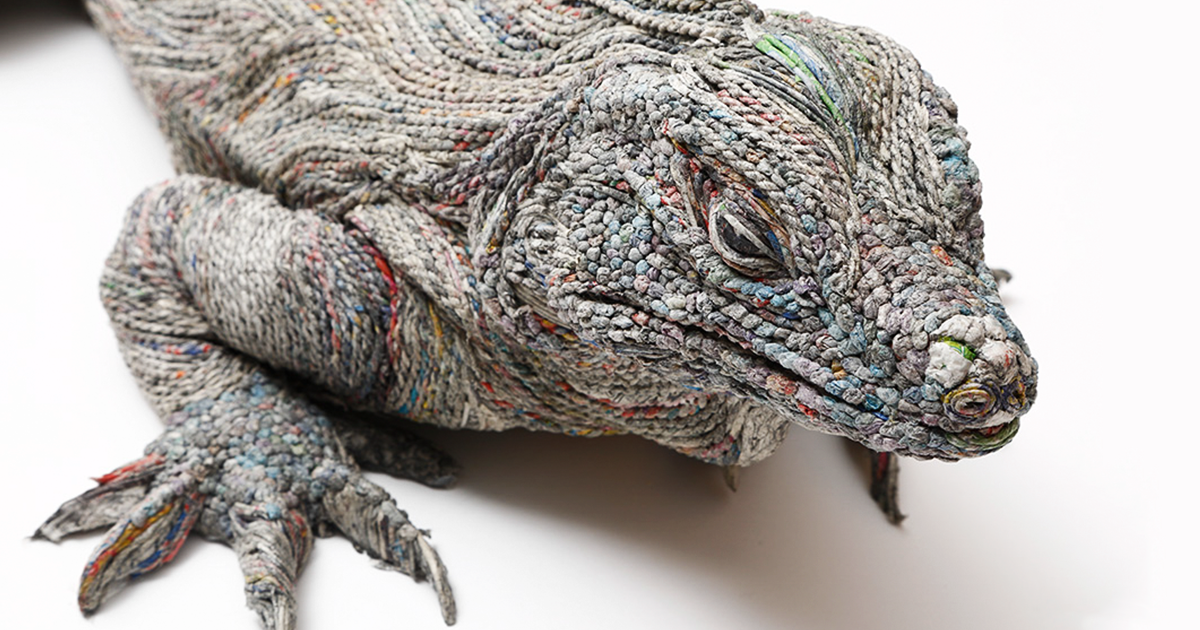
Most of us look at yesterday’s newspaper and see old headlines, crossword crumbs, and maybe a coffee stain shaped suspiciously like Florida. Japanese artist Chie Hitotsuyama sees something else entirely: fur, scales, wrinkles, shells, whiskers, and the quiet pulse of wildlife. By tightly rolling, twisting, wetting, and binding discarded newspaper, she creates incredibly realistic animal sculptures that look less like “paper craft” and more like animals paused mid-breath.
Her work is the kind of art that makes you lean closer, then lean even closer, then politely apologize to the sculpture because you accidentally invaded its personal space. From red-faced Japanese macaques and heavy rhinoceroses to iguanas, sea turtles, rabbits, dugongs, walruses, and gorillas, Hitotsuyama transforms a humble, throwaway material into life-sized creatures with astonishing texture and presence.
The title may sound like internet magic“Japanese Artist Tightly Rolls Newspaper To Create Incredibly Realistic Animal Sculptures”but the story behind the work is deeper than a viral gallery. It is about patience, recycling, craftsmanship, animal dignity, and the strange emotional power of giving old news a second life.
Who Is Chie Hitotsuyama?
Chie Hitotsuyama is a Japanese paper artist from Shizuoka, Japan, whose career began in illustration before she moved into three-dimensional sculpture. Her connection to paper is not casual. She grew up around a family-run paper strip manufacturing plant, and her grandfather operated a paper mill. In other words, some people inherit jewelry; Hitotsuyama inherited an intimate understanding of paper, machinery, texture, and repetition.
That background matters. Her sculptures are not quick recycled-paper decorations or weekend craft projects, although they may make your glue stick feel suddenly underqualified. They are labor-intensive works made by hand, often at life scale, using old discarded newspapers formed into paper strings. These strings become the surface of the animal, one tiny decision at a time.
Hitotsuyama co-founded Hitotsuyama Studio with creative director Tomiji Tamai. The studio is located in Fuji, Shizuoka, in a former warehouse connected to her family’s paper-making history. That setting gives the work a poetic circularity: paper once manufactured for daily use returns as sculpture, memory, and meditation.
How Rolled Newspaper Becomes Realistic Animal Sculpture
The technique sounds simple until you imagine doing it for three months without turning into a human paper shredder. Hitotsuyama cuts old newspaper into strips, wets the paper, rolls and twists it into dense cords, then binds those pieces together with glue. The body of the sculpture is also shaped from newspaper, and the surface is built gradually, much like drawing with thousands of curled paper lines.
Step 1: Choosing Newspaper for Color and Texture
Newspaper is not just gray. It contains black ink, colored ads, photographs, comics, and subtle tonal changes. Hitotsuyama uses those printed variations to create shading, contour, and gradation. A red area of print may help suggest the face of a Japanese macaque. Darker ink can deepen shadows around folds, eyes, or muscular forms. Lighter areas can soften the curve of a belly or the worn texture of a shell.
This is where her process becomes especially clever. She is not hiding the newspaper. She is using its everyday visual noise as artistic pigment. The newsprint becomes fur. The headlines become skin. The advertisements become animal anatomy. Yesterday’s supermarket coupon may be tomorrow’s rhinoceros wrinkle. Art is wild like that.
Step 2: Rolling, Twisting, and Binding
Each strip is rolled tightly, often while damp, so it becomes more flexible and sculptural. The rolled pieces can be thick or thin depending on the form she wants to create. Short, dense rolls can mimic scales. Longer twisted cords can describe fur, muscles, or wrinkles. By changing the thickness, angle, and direction of the paper strings, she creates an animal surface that feels alive instead of flat.
Look closely at one of her iguanas and the paper strips behave like reptile scales. Look at a macaque and the same material becomes shaggy hair. Look at a rhinoceros and the paper turns heavy, folded, and ancient. It is the same material, but the handling changes the species. That is the difference between craft and mastery.
Step 3: Building Life-Sized Presence
Many of Hitotsuyama’s animals are built at or near real-life scale. That matters because scale changes the viewer’s emotional response. A tiny rhino might be cute. A life-sized rhino made from discarded newspaper asks a different question: What do we throw away, and what do we fail to protect?
Some of her larger sculptures can take two to three months to complete. The time involved is visible in the final work. You can sense the patience in the surface, as if every paper roll is a small vote for attention in a world that usually scrolls past everything in three seconds.
Why Animals Are at the Center of Her Art
Hitotsuyama’s animal sculptures are not chosen merely because animals look impressive in galleries, although yes, a paper gorilla has a strong “please stop and stare” effect. Her interest in wildlife is rooted in empathy. One important turning point came after she encountered a rhinoceros during a trip connected to NGO work in Africa. The story of poaching and animal vulnerability became part of her artistic motivation.
Her first sculptural animal was a rhinoceros, and that origin story helps explain why her work feels so respectful. She is not making cartoon versions of animals. She studies them as beings with weight, habits, exhaustion, dignity, and survival instincts. Her animals sleep, slump, stare, crouch, and rest. They are not trophies. They are neighbors from the larger planet we keep forgetting we share.
That philosophy is one reason the sculptures feel emotionally convincing. The realism is not only technical; it is moral. Hitotsuyama seems interested in the ordinary lives of animalstheir eating, sleeping, moving, and enduring. She uses painstaking detail to say: look carefully, because life is here.
Why Newspaper Is the Perfect Material
Newspaper is fragile, temporary, and deeply connected to human behavior. It records what we argue about, celebrate, sell, fear, and forget. Then it is tossed aside. That cyclecreated, read, discardedmakes newspaper a surprisingly powerful material for sculptures about life, death, memory, and rebirth.
In the United States, paper remains one of the most recycled materials, with millions of tons recovered each year. Yet even with strong recycling systems, paper still carries the feeling of disposability. Hitotsuyama interrupts that pattern. Instead of letting old newspapers disappear into bins, she slows them down and turns them into animals that demand attention.
The symbolism is beautifully layered. Animals in nature are vulnerable. Newspaper is vulnerable. Both can be ignored, damaged, replaced, or forgotten. But in her hands, the fragile material becomes strong. The discarded becomes dignified. The ordinary becomes almost sacred.
The 11 Pics: What Makes These Sculptures So Captivating?
A gallery of 11 pictures of Hitotsuyama’s work is not just eye candy for art lovers. It is a tour through technique, patience, and visual surprise. Each animal demonstrates a different solution to the same challenge: how can rolled newspaper imitate nature?
1. The Rhinoceros
The rhinoceros is one of the most powerful examples of Hitotsuyama’s paper sculpture technique. Its mass, folds, and quiet heaviness show how newspaper can become monumental. The sculpture feels ancient and calm, like it knows something humans forgot around the time we invented push notifications.
2. Japanese Macaques
Her macaques are especially striking because of the facial color and hair texture. The rolled paper creates a dense, furry surface, while selected areas of colored print help suggest the natural red tones of the face. The result is expressive without becoming sentimental.
3. Iguanas and Lizards
Reptiles are perfect subjects for her method. The small, repeated paper forms echo scales, ridges, and armored skin. An iguana made from newspaper sounds impossible until you see how the material’s stiffness becomes a feature rather than a flaw.
4. Sea Turtles
Sea turtles bring out another side of the technique. Their shells require pattern, weight, and curvature. Hitotsuyama’s paper rolls can build that surface in a way that feels both protective and delicate, a reminder that even armored animals are vulnerable.
5. Dugongs, Walruses, and Marine Life
Marine animals allow the paper to behave like soft skin, folds, and rounded bodies. These works often feel gentle and slightly melancholic. They are not action poses. They are studies in presence, as if the animal has just settled into the room and everyone should lower their voice.
6. Gorillas and Larger Mammals
Large mammals show off the structural ambition of the work. The size alone is impressive, but the emotional tone is what lingers. A gorilla made of newspaper could easily become a gimmick. Hitotsuyama’s version feels observant, patient, and alive.
Recycled Art Without the “Look, I Recycled!” Megaphone
One of the best things about Hitotsuyama’s work is that it does not shout. Some recycled art announces its material first and its meaning second. Her sculptures do the opposite. At first, you see the animal. Then you notice the paper. Then you realize the two ideas are inseparable.
This subtlety makes the environmental message stronger. The work does not lecture the viewer with a clipboard and a frown. It seduces the viewer with beauty, then lets the material whisper: I used to be trash.
That is an effective model for eco-conscious art. It proves that sustainability does not have to look rough, preachy, or unfinished. Recycled materials can be refined. Waste can become wonder. A newspaper can become a rhino. Your junk drawer is suddenly looking nervous.
Why This Art Went Viral
Hitotsuyama’s newspaper animal sculptures became widely shared online because they deliver the perfect combination of surprise and sincerity. The concept is instantly understandable: artist turns newspaper into realistic animals. The visuals are immediately impressive. But the longer you look, the more substance appears.
Viral art often succeeds because it can be understood in a glance. Lasting art succeeds because it rewards a second glance. Hitotsuyama’s work does both. A viewer can enjoy the “wow” factor in three seconds, then spend minutes studying the texture, construction, and emotional restraint.
The work also taps into a common internet pleasure: seeing an everyday object used in an extraordinary way. We love transformations. Cardboard becomes architecture. Bottle caps become murals. Newspaper becomes wildlife. These transformations make creativity feel accessible, even when the skill level is clearly high enough to make the rest of us quietly close our craft drawer.
The Deeper Meaning: Memory, Survival, and Rebirth
Newspapers are containers of human memory. They report disasters, politics, sports victories, celebrity mishaps, local events, recipes, obituaries, and weather forecasts that were wrong but delivered with confidence. Once printed, they begin aging immediately. Their value changes from urgent to outdated almost overnight.
By using newspaper to sculpt animals, Hitotsuyama gives that temporary material a longer life. She also creates a powerful contrast between human time and animal time. A newspaper may be discarded in a day, but the animal forms she creates suggest ancient patterns of survival. Fur, shells, horns, scales, and bodies carry evolutionary histories far older than any headline.
That contrast gives the sculptures their emotional force. They are made from human noise, yet they produce silence. They are made from information, yet they become presence. They are made from disposable paper, yet they ask to be preserved.
What Artists and Creators Can Learn From Chie Hitotsuyama
Hitotsuyama’s work offers several lessons for artists, designers, crafters, and anyone trying to make meaningful things in a world full of cheap materials and short attention spans.
Use Limitations as a Creative Engine
She does not need rare marble, bronze, or expensive synthetic materials to create impact. Her limitationold newspaperbecomes her signature. The restricted material forces invention. Instead of asking, “What can I buy?” the work asks, “What can this material become?”
Respect the Subject
The animals are realistic because she observes them carefully. This is a lesson for any creative field. Whether you are writing, painting, sculpting, designing, or photographing, the quality of attention matters. You cannot fake observation forever. Eventually, the rhino knows.
Let Process Carry Meaning
The slow process is part of the message. Rolling thousands of newspaper strips by hand reflects patience and care. The method is not separate from the meaning; it is the meaning. That is why the sculptures feel so different from mass-produced decor.
Experiences and Reflections: Seeing Newspaper Animals With New Eyes
There is a particular kind of wonder that happens when familiar materials stop behaving. A newspaper is supposed to fold, crinkle, stain your fingers, and disappear into a recycling bin. It is not supposed to stare back at you as a monkey, hunker down as a rhino, or stretch into the curved body of a sea turtle. That surprise is part of what makes Chie Hitotsuyama’s sculptures so memorable.
Imagine standing in front of one of these works in a quiet gallery. From across the room, the animal reads as solid and complete. You notice posture first: the tired dignity of a large mammal, the alert stillness of a reptile, the softness of an animal at rest. Then you step closer and the illusion breaks opennot in a disappointing way, but in a thrilling one. The surface is not fur or skin. It is hundreds, maybe thousands, of rolled newspaper pieces arranged with almost obsessive care.
That close-up moment changes how you look at ordinary objects afterward. A stack of old newspapers no longer seems like clutter. It becomes potential texture. The colored ad section becomes possible shading. The black-and-white columns become possible muscle, wrinkle, or feather. Even the awkward coupons and sports pages suddenly seem useful. Creativity, apparently, has no respect for junk mail boundaries.
There is also something calming about the labor behind the sculptures. In a fast digital culture, where images are swiped away before the brain has fully arrived, Hitotsuyama’s process feels almost rebellious. It demands time. It rewards repetition. It suggests that slowness is not failure; sometimes slowness is how meaning enters the room.
For viewers, the experience can be oddly personal. The animals are not posed like museum specimens. They feel like living beings caught in ordinary moments. A resting animal reminds us that wildlife is not always dramatic. Animals do not exist only when they are sprinting across documentaries or roaring in movie trailers. They sleep. They wait. They heal. They endure. Hitotsuyama’s sculptures honor that quiet reality.
The recycled material deepens that feeling. Newspaper carries human stories, but in her hands it becomes animal form. This reversal feels almost corrective. Human headlines are temporary, noisy, and often self-important. The animal body is quieter and older. By turning human news into wildlife, the artist seems to ask whether we can pay attention to lives beyond our own headlines.
For anyone who makes art, writes stories, decorates a home, teaches children, or simply wants to live with more imagination, her work offers a generous challenge: look again. The materials around you may be more alive than you think. The thing you planned to discard may still have another chapter. Not everything used up is useless. Sometimes it is just waiting for someone patient enough to roll it, twist it, glue it, and believe it can become a rhinoceros.
Conclusion
Chie Hitotsuyama’s rolled newspaper animal sculptures prove that realism does not always require traditional materials and that recycling can be more than a practical habit. It can be poetry with glue on its fingers. By transforming discarded newspapers into lifelike animal sculptures, she connects family history, environmental awareness, craftsmanship, and compassion for wildlife.
Her work is visually stunning, but its staying power comes from something deeper. These sculptures remind us that fragile things can carry strength, that old stories can take new shapes, and that art can make us care without shouting. In a world where yesterday’s news is usually forgotten, Hitotsuyama gives it a body, a face, and a heartbeat.
Note: This article is based on synthesized public information about Chie Hitotsuyama, Hitotsuyama Studio, her recycled newspaper sculpture process, exhibition history, and broader paper recycling context. Source links are intentionally not included to keep the publishing copy clean.












