
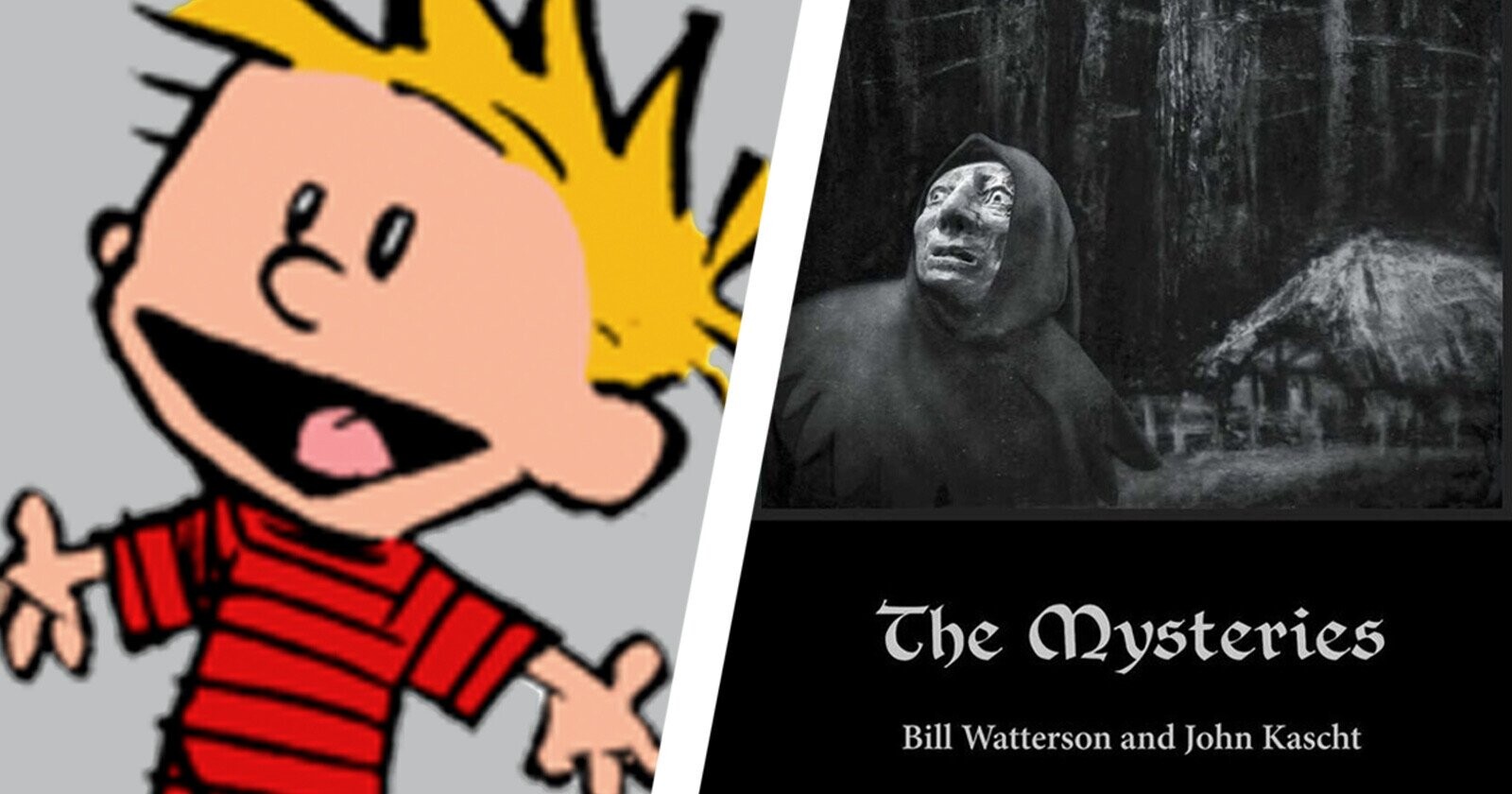
Bill Watterson is back, which is the kind of sentence that makes lifelong Calvin and Hobbes fans sit up so fast they nearly knock over their coffee, their book stack, and possibly one emotionally significant stuffed tiger. But before anyone starts digging through the attic for a red wagon and a cardboard transmogrifier, let’s be clear: Watterson has not revived Calvin and Hobbes. He has not launched a daily strip, announced a movie, or licensed Hobbes plushies to invade mall kiosks like soft orange ambassadors of capitalism.
Instead, Watterson returned with something stranger, quieter, darker, and very much on his own terms: The Mysteries, an illustrated fable for grown-ups created with acclaimed caricaturist John Kascht. Published by Andrews McMeel in October 2023, the book marked Watterson’s first major new published work in nearly three decades. For a creator famous not only for genius but also for disappearing with almost superhuman discipline, that alone qualifies as cultural thunder.
The excitement around Watterson’s return says as much about readers as it does about the book. Calvin and Hobbes ended on December 31, 1995, after a 10-year run that began on November 18, 1985. In newspaper time, that is ancient history. In emotional time, however, Calvin is still six, Hobbes is still real when he needs to be, and the woods are still waiting under a clean blanket of snow. Watterson’s return matters because he never treated art like content. He treated it like a promise.
Why Bill Watterson’s Return Feels So Big
In modern pop culture, “back” usually means a reboot, sequel, streaming adaptation, collectible cup, or a suspiciously expensive limited-edition hoodie. Watterson’s version of “back” is more mysterious. That is fitting, because his reputation has always been built on restraint. He walked away from one of the most beloved comic strips in American history at the height of its power, refused most merchandising opportunities, and protected the integrity of his characters with the intensity of Calvin guarding a snow fort.
That refusal became part of the legend. Many classic comic characters became lunch boxes, toys, TV specials, and theme-park photo opportunities. Calvin and Hobbes did not. There were no official Saturday morning cartoons, no fast-food tie-ins, no stuffed Hobbes dolls stacked in toy aisles. The result is that the strip remained unusually pure in the public imagination. Readers encountered it primarily as comics: ink, timing, imagination, and the miracle of a tiger who is both toy and best friend.
So when news arrived that Watterson had collaborated on a new book, fans reacted with a mixture of joy, curiosity, and nervousness. Would it be funny? Would it feel like Calvin and Hobbes? Would it explain where Watterson had been? Would it contain at least one wagon ride into philosophical danger? The answer to most of those questions is no, and that is exactly why The Mysteries is interesting.
What Is The Mysteries?
The Mysteries is a short, illustrated fable written by Bill Watterson and illustrated in collaboration with John Kascht. It is not a traditional comic strip collection. It is not a children’s adventure. It is not a nostalgic victory lap. The book is compact, visually intense, and deliberately strange. It tells of a kingdom troubled by forces called mysteries. A king sends knights to capture them, hoping that knowledge will bring safety. What follows is less a plot-heavy adventure than a meditation on fear, discovery, control, progress, and what human beings lose when they think every unknown thing can be pinned down like a bug in a display case.
The phrase “fable for grown-ups” fits because the book uses the simplicity of fairy-tale structure to ask grown-up questions. What do we do with the unknown? Do we respect it, study it, exploit it, or bulldoze it into a parking lot with excellent lighting? Can discovery make us wiser, or can it simply make us more confident while we remain just as foolish, only now with better machines?
The mood is far darker than Calvin and Hobbes. The humor, when it appears, is dry and uneasy. Instead of a child and tiger debating morality from a sled, we get a world that feels medieval, mythic, and faintly doomed. There are kings, knights, shadowy figures, odd faces, and images that look as though they crawled out of an old legend after spending a few nights in a modern anxiety dream.
Bill Watterson and John Kascht: An Unusual Collaboration
The partnership between Watterson and John Kascht is one of the most fascinating parts of the project. Kascht is widely respected for his caricature work, known for faces that can be funny, unsettling, deeply human, and occasionally so precise they seem to know what the subject had for breakfast. Watterson, meanwhile, is known for elegant cartooning, expressive brushwork, and a rare ability to move from slapstick to philosophy without making either one wear a necktie.
For The Mysteries, the two artists reportedly worked together for years in unusually close collaboration. Rather than dividing tasks neatly, they created images together through a process that pushed both away from their familiar methods. That matters because the art does not look like standard Watterson and does not look like ordinary caricature either. It feels constructed, sculptural, ghostly, and handmade. The images have the texture of something discovered in a locked room rather than designed in a conference call.
This collaborative method also reflects the subject of the book. A story about mystery was made through a mysterious process. Two established artists chose uncertainty over efficiency. In a world obsessed with speed, productivity, and “just ship it” culture, Watterson and Kascht apparently took the scenic route through the fog. Somewhere, Calvin’s dad is probably calling that character-building.
Why This Is Not a Calvin and Hobbes Sequel
The biggest misunderstanding about Watterson’s return is the assumption that “Bill Watterson is back” means “Calvin and Hobbes are back.” They are not. And honestly, that may be for the best. Calvin and Hobbes ended beautifully because it understood when to leave. Its final image sent the characters into possibility rather than exhaustion. Dragging them back decades later for a brand extension would feel less like magic and more like someone putting a barcode on a snowflake.
The Mysteries belongs to the same creator, but it comes from a different season of life. Calvin and Hobbes explored childhood imagination, friendship, family, school, boredom, nature, consumer culture, and the cosmic injustice of bedtime. The Mysteries looks at civilization from a colder distance. It asks what happens when wonder becomes conquest. It is less about being a kid in the woods and more about being a species that keeps congratulating itself while wandering toward the edge of the map.
That difference may disappoint readers who wanted the old warmth. But it also proves that Watterson did not return to imitate himself. He returned with a new artistic problem. That is braver than nostalgia. Nostalgia is easy money. Mystery is harder. Mystery asks the reader to participate.
The Legacy of Calvin and Hobbes
To understand why Watterson’s new work attracted so much attention, you have to understand the cultural weight of Calvin and Hobbes. The strip followed Calvin, a wildly imaginative six-year-old, and Hobbes, his tiger companion, whose reality depended on perspective. To Calvin, Hobbes was alive: witty, loyal, pouncing, occasionally smug. To adults, Hobbes was a stuffed animal. The strip never overexplained the contradiction, which is exactly why it worked.
Watterson blended visual comedy, literary intelligence, philosophical play, and emotional honesty. One strip could be about snowman mayhem. Another could be about mortality, environmental destruction, or the absurdity of school systems. Calvin’s fantasy alter egosSpaceman Spiff, Stupendous Man, Tracer Bullet, and othersturned ordinary childhood frustrations into operatic adventures. A cardboard box became whatever the story required: time machine, duplicator, transmogrifier, or proof that children understand innovation better than most corporate strategy decks.
The strip also expanded what newspaper comics could look like. Watterson fought for flexible Sunday layouts at a time when newspapers often preferred strips that could be chopped into standardized formats. His larger Sunday pages used space as part of the storytelling. Landscapes opened up. Dinosaurs thundered. Snowy hills rolled. Quiet moments breathed. The art asked readers to slow down, even when Calvin was doing the opposite.
Watterson’s Anti-Merchandising Stand Still Matters
One of the reasons Watterson remains so admired is his long resistance to licensing Calvin and Hobbes for merchandise. This was not a small decision. The strip was hugely popular, and licensing could have generated enormous revenue. But Watterson believed that turning the characters into products would damage the spirit of the work. He wanted readers to meet Calvin and Hobbes in the comic itself, not as plastic objects, animated mascots, or promotional decorations.
That stance feels almost radical today. We live in an entertainment economy where every beloved character is expected to become a universe, and every universe is expected to become a spreadsheet with action figures. Watterson chose absence. He made less available, and somehow that made the work feel more present.
This is also why his return is so compelling. Watterson has never seemed eager to feed the machine. When he appears, it is because he has something specific to make. That makes The Mysteries feel less like a product launch and more like a rare message from a distant cabin where the ink bottles are dusty, the standards are high, and nobody is asking about synergy.
How Fans Responded to Watterson’s Comeback
Fan reaction to Watterson’s return was intense because many readers have a personal relationship with Calvin and Hobbes. People remember reading the collections under blankets, clipping strips from newspapers, discovering jokes they were too young to understand, and later returning as adults to find that the strip had grown with them. That is one of Watterson’s tricks: he wrote childhood without talking down to children and wrote adult concerns without crushing the childlike wonder.
The Mysteries challenged that affection. Some readers admired its ambition, atmosphere, and refusal to pander. Others found it too brief, too gloomy, or too distant from the comic voice they loved. Both reactions make sense. A slim fable cannot carry the same emotional furniture as a decade-long comic strip. It is not supposed to. Reading The Mysteries while expecting Calvin’s snowmen is like ordering pancakes and receiving a black-and-white medieval prophecy. Intriguing? Yes. Breakfast? Not exactly.
Still, the debate proves that Watterson remains culturally alive. People did not shrug. They cared. In an age when attention evaporates quickly, a quiet book from a private cartoonist generated real discussion because the trust built by Calvin and Hobbes has not disappeared.
The Themes of The Mysteries: Fear, Knowledge, and Control
At its core, The Mysteries is about humanity’s uneasy relationship with the unknown. Fear drives the kingdom to capture what it does not understand. That impulse is familiar. Human beings name things, measure things, categorize things, and then feel safer because the wildness has a label. Sometimes that process leads to medicine, science, art, and genuine progress. Sometimes it leads to arrogance dressed in a lab coat.
The book does not argue against knowledge. Watterson is too subtle for that. Instead, it questions the assumption that knowledge automatically produces wisdom. A society can learn how something works and still misunderstand what it means. It can reduce mystery without increasing humility. It can build towers, screens, engines, and systems while becoming less connected to awe.
This is where The Mysteries quietly echoes Calvin and Hobbes. Calvin often turned the everyday world into something larger. A walk in the woods could become an expedition. A cardboard box could violate several laws of physics before lunch. The old strip protected wonder. The new fable warns what may happen when wonder is treated as an enemy to defeat.
Why Watterson’s Return Works Best on His Own Terms
The most Watterson-like thing about The Mysteries is that it does not behave like a comeback designed by fans. It does not flatter nostalgia. It does not answer old questions. It does not bring Hobbes back for one last pounce. It simply appears, strange and self-contained, and asks to be considered as its own work.
That may be frustrating, but it is also admirable. Artists with beloved early work often face a trap: repeat the old magic and be accused of playing it safe, or try something new and be accused of betrayal. Watterson chose the second risk. He made a book that feels like a late-career meditation rather than a crowd-pleasing reunion tour.
In that sense, “Bill Watterson is back” is true, but only if we understand what kind of return this is. He is not back as a nostalgia merchant. He is back as an artist still suspicious of easy answers. The tiger is not on the cover, but the seriousness about imagination remains.
Experiences Related to Bill Watterson’s Return
For many readers, hearing that Bill Watterson had returned created a very specific kind of emotional whiplash. First came excitement: the creator of Calvin and Hobbes had made something new. Then came caution: wait, what exactly is it? Then came the strange adult realization that wanting an artist to return and wanting an artist to return unchanged are two very different wishes. That experience is familiar to anyone who has revisited a childhood favorite and discovered that the work stayed still while they changed.
Reading Watterson as a child often feels like being given permission to take imagination seriously. Calvin’s world is ridiculous, but it is never meaningless. His dinosaurs, spaceships, monsters, snowmen, and heroic alter egos are comic exaggerations of real feelings: boredom, frustration, curiosity, loneliness, defiance, and joy. A child may laugh at the chaos. An adult may notice the loneliness under the noise, the tenderness behind Hobbes’s teasing, or the quiet patience of parents who are clearly one cereal-box explosion away from needing a vacation.
That is why The Mysteries can feel surprising. It does not recreate the cozy rhythm of the strip. It offers a colder experience: more like standing in a museum at closing time, staring at a strange painting while the guard politely hints that you should wrap up your existential crisis. The book is brief, but it lingers. Its images invite rereading because they do not behave like illustrations that merely explain the text. They deepen the unease. They make the reader slow down.
There is also a practical experience many fans share: returning to the old Calvin and Hobbes books after reading about Watterson’s comeback. Suddenly the collections feel different. The jokes are still funny, but the craft becomes more visible. You notice the line work, the timing, the panel shapes, the way Hobbes’s body language can shift a scene, the way a final panel can turn a gag into a small philosophical grenade. You also notice how rare it is for a popular work to remain unexploited. No official flood of toys. No rebooted streaming series. No cinematic universe in which Hobbes gets an origin story and a post-credit scene.
The experience of Watterson’s return is therefore not just about one new book. It is about remembering what artistic boundaries look like. It is about seeing a creator refuse to become a brand manager for his own legacy. It is about accepting that an artist who once gave readers a magical world does not owe them a permanent address there. Sometimes the best thing a beloved creator can do is leave the door closed until there is a genuinely new reason to open it.
And maybe that is the most Calvin-and-Hobbes lesson possible. The world is more interesting when not everything is explained, packaged, sequelized, and placed neatly on a shelf. Some mysteries should remain mysteries. Some tigers should stay partly imaginary. Some artists should be allowed to wander off into the woods and return only when they have found something worth showing us.
Conclusion
Bill Watterson’s return with The Mysteries is not the comeback many fans imagined, but it may be the comeback that best fits him. Instead of reviving Calvin and Hobbes, he created a spare, haunting, adult fable with John Kascht that explores fear, knowledge, progress, and the danger of believing that every mystery exists merely to be conquered. It is unusual, imperfect, memorable, and stubbornly uninterested in easy nostalgia.
That stubbornness is exactly why Watterson still matters. He reminds readers that art can be popular without becoming disposable, beloved without becoming overexposed, and mysterious without apologizing for it. Calvin and Hobbes may not be back, but the creative integrity behind them has returned in a new form. For fans, that is enough reason to pay attentionand maybe to go exploring again.
Note: This article is based on publicly available information from reputable publishing, literary, arts, comics, and news sources. It is written as original editorial content for web publication.












