
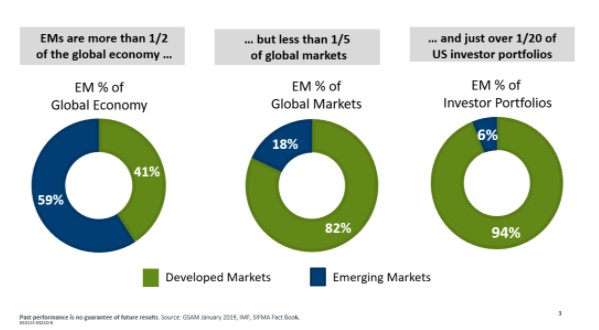
For years, emerging markets were the part of the portfolio conversation that showed up, smiled politely, and then got ignored while everyone crowded around U.S. mega-cap tech. It was a rough social scene. But markets have a funny habit of making the obvious trade feel crowded and the ignored trade feel interesting again. That is exactly why emerging markets are back in the spotlight.
The case for emerging markets is not some chest-thumping claim that every developing economy is magically fixed, every government is competent, and every stock is a bargain. That would be adorable, but no. The real argument is more nuanced and, frankly, more compelling. Emerging markets offer a mix of lower valuations, improving corporate quality, stronger long-term growth potential, and a wider set of return drivers than many investors realize. In a world where diversification had started to feel like a decorative slogan, emerging markets are forcing investors to remember what the word actually means.
If you want the cleanest version of the bullish thesis, it goes something like this: the U.S. market has been dominant, but also expensive and concentrated; many emerging markets look cheaper, more diversified by sector and country, and better positioned to benefit from structural trends such as digitization, domestic consumption growth, supply-chain shifts, semiconductor demand, and selective monetary easing. That does not mean emerging markets are easy. It means they may be worth the trouble.
Why Emerging Markets Are Back in the Conversation
The renewed interest in emerging markets is not just about chasing performance. It is also about what investors are trying to escape. After years of heavy concentration in a narrow slice of U.S. equities, many portfolios started to look less like balanced investment plans and more like fan clubs with brokerage access. That kind of concentration can work beautifully until it does not.
Emerging markets offer a different setup. They are not one country, one sector, or one macro story. They include technology exporters, commodity producers, manufacturing hubs, rising consumer economies, reform stories, and turnaround candidates. Some benefit from global trade. Some benefit from domestic demand. Some benefit when the dollar weakens. Some benefit when investors decide they want earnings growth without paying premium prices for it.
That variety matters. The strongest case for emerging markets today is not that they are uniformly better than developed markets. It is that they broaden a portfolio’s opportunity set at a time when many investors are reconsidering whether paying top-shelf prices for already-loved assets is the only rational life choice.
The Bull Case Starts With Valuation
Cheap is not a strategy, but price still matters
One of the simplest arguments for emerging markets is also one of the most durable: starting valuations matter. Not every cheap market becomes a great investment, but expensive markets have a bad habit of demanding perfection. Emerging markets, by contrast, often begin from a place of lower expectations. That can be frustrating in the short run and powerful in the long run.
When expectations are low, a company or country does not need to perform miracles to surprise investors. It may only need to be slightly less disappointing than feared. That is not the most glamorous engine of returns, but it has funded plenty of market rallies over the years.
This is especially important in a global market environment where valuation gaps between parts of the U.S. market and many international markets remain wide. Investors do not need emerging markets to become perfect. They only need the discount to narrow, earnings to hold up, or capital to rotate toward places where the price being paid is not already assuming a glorious future with no potholes.
Valuation plus reform is better than valuation alone
The smarter version of the EM argument does not stop at “these stocks are cheap.” It asks why they are cheap and whether anything is changing. In several emerging economies, investors have seen better balance-sheet discipline, governance improvements, capital return policies, productivity upgrades, digital financial adoption, and more credible monetary frameworks than the stereotypes would suggest.
That does not erase risk. It does, however, create the possibility that some markets deserve to trade less like permanent problem children and more like maturing capital markets. When investors realize that the fundamentals improved while the narrative stayed gloomy, that is often when repricing begins.
Growth Is Still a Big Deal
Demographics, urbanization, and rising consumption are not fake trends
Emerging markets still matter because growth still matters. Many of these economies have younger populations, expanding middle classes, rising rates of financial inclusion, and more room to increase productivity. That is not a promise of straight-line returns, but it is a real backdrop for earnings growth over time.
Think about what that looks like in practice. More households join the banking system. More commerce moves online. More businesses digitize payments. More families buy insurance, smartphones, appliances, travel, and health care. More local brands scale. More infrastructure gets built. The market is not just buying GDP; it is buying the corporate earnings that can emerge from these transitions.
India is often the headline example because it combines scale, demographics, formalization, capital investment, and a growing domestic market. But the opportunity set is broader than one country. Southeast Asian economies continue to benefit from manufacturing shifts and domestic consumption growth. Latin America can offer value in sectors tied to banks, commodities, and reforms. Parts of Eastern Europe, the Middle East, Africa, and Latin America each present highly selective stories shaped by policy, resources, and trade linkages.
Supply-chain realignment changed the map
Another major tailwind is the ongoing reconfiguration of supply chains. Global companies have spent years thinking harder about resilience, redundancy, geopolitics, and production footprints. That has helped put more attention on countries that can serve as manufacturing alternatives, logistics nodes, or raw-material suppliers.
This trend does not mean every factory shift becomes an investment jackpot. It does mean the global economy is no longer organized around one neat assumption that production will always follow the cheapest historical path. Emerging markets that can attract capital, labor, and industrial capacity may benefit for years, not just quarters.
Emerging Markets Are Not Just “China and Vibes”
The rise of country dispersion
One reason emerging markets frustrated investors in the past is that the asset class was often discussed as if it were a single trade. It is not. It is a collection of countries with different inflation paths, political systems, monetary policies, export profiles, governance standards, and sector exposures. Treating all of that as one blob is a great way to sound confident at lunch and confused by dinner.
China still matters because of its size, index weight, manufacturing power, and policy influence. But investors have become much more willing to think in terms of emerging markets ex China, regional allocations, or active country selection. That shift is healthy. It allows investors to express views more precisely instead of buying everything and hoping the strongest stories outrun the weakest ones.
Taiwan and South Korea remain central because of their roles in the semiconductor and technology supply chain. India is often viewed as a structural domestic-demand story. Brazil can appeal when valuations are low and macro conditions stabilize. Mexico has attracted interest from investors focused on supply-chain proximity and industrial realignment. Indonesia and Vietnam often enter the conversation because of manufacturing potential and consumption growth. The point is not that every one of these markets wins at once. The point is that emerging markets offer multiple independent cases, not one fragile thesis.
The Dollar Matters More Than Most People Think
No discussion of emerging markets is complete without the U.S. dollar walking onstage like the lead actor who was definitely told this was an ensemble cast. Dollar strength can pressure emerging-market assets by tightening financial conditions, hurting local currencies, and making dollar-denominated debt harder to service. A softer dollar often does the opposite: it relieves pressure, improves return translation for U.S.-based investors, and can support capital flows back into emerging-market assets.
That is one reason the outlook for emerging markets is often tied to the global rate cycle and the path of the dollar. If the dollar is no longer relentlessly strong and global growth remains reasonably stable, emerging markets have more room to breathe. They do not need a perfect macro backdrop. They just need fewer headwinds than they faced during the years when U.S. exceptionalism and dollar strength were steamrolling everything in sight.
There Is More Than One Way to Own the Theme
Equities get the headlines, but debt deserves a seat at the table
When people say “emerging markets,” they usually mean stocks. Fair enough. Equities are where the dramatic stories live. But emerging-market debt can also be part of the case. Local-currency bonds, sovereign debt, and corporate debt can benefit from higher yields, improving inflation trends, and easing cycles in some countries.
For investors who want exposure but do not love the roller-coaster reputation of EM equities, debt can offer a different risk-and-return profile. Of course, this comes with its own complications: currency swings, liquidity issues, sovereign risk, and policy surprises. Emerging markets are generous, but they are not handing out free dessert.
Active management can make more sense here
Emerging markets are also one of the few places where active management still has a particularly persuasive pitch. Why? Because the opportunity set is less uniform. Accounting standards, governance, liquidity, state ownership, index concentration, and political risk vary widely. An active manager who can avoid weak institutions, challenge bad narratives, and identify improving businesses may have more room to add value than in highly efficient large-cap U.S. markets.
That does not mean passive investing is wrong. A broad index can still be a useful tool. But emerging markets are one of the rare corners of investing where “maybe someone should actually look under the hood” feels less like heresy and more like common sense.
The Real Risks, Because This Is Not a Fairy Tale
The bullish case for emerging markets is real, but so are the risks. Political instability can hit quickly. Currencies can move hard and erase local gains for foreign investors. Corporate governance can disappoint. Commodity exposure can cut both ways. Trade disputes and geopolitical conflict can change the rules mid-game. Liquidity can dry up at exactly the moment everyone remembers they hate volatility.
China remains a major point of debate. Some investors see value and policy support; others see structural growth challenges, property-sector baggage, and geopolitical complications. That disagreement alone explains why many allocators are no longer satisfied with a simple cap-weighted EM story.
And then there is the behavioral risk. Emerging markets often demand patience right before delivering headlines that make patience feel like a personality disorder. The path is rarely smooth. There are drawdowns, narrative reversals, and dramatic overshoots in both directions. Anyone who buys emerging markets expecting emotional serenity should probably also buy a trampoline expecting stillness.
What a Smart Emerging-Markets Thesis Looks Like
The best case for emerging markets is not “they will beat the U.S. next quarter.” That is a trading slogan pretending to be a thesis. A smarter case sounds more like this: emerging markets offer exposure to faster-growing economies, improving corporate ecosystems, lower starting valuations, and distinct return drivers at a time when many developed-market allocations remain expensive and concentrated.
That thesis also accepts that selectivity matters. Country dispersion matters. The dollar matters. China matters. Sector composition matters. Governance matters. In other words, the right way to think about emerging markets is not as a monolith but as a toolbox.
Some investors will want a broad allocation. Some will prefer EM ex China. Some will favor active managers. Some will emphasize debt over equities. Some will target specific structural winners such as semiconductor supply chains, digital finance, industrial exporters, or domestic consumer champions. All of those are valid approaches, as long as the investor understands what they own and why they own it.
Experience: What Investors Learn After They Actually Live With Emerging Markets
One of the most useful lessons from real-world experience with emerging markets is that they teach humility faster than almost any asset class. Investors often begin with a grand macro story: demographics, growth, reform, digitization, the rising middle class, the future of everything. Then the market reminds them that a brilliant five-year thesis can still have a miserable nine-month stretch. That gap between being right eventually and being comfortable today is where a lot of emerging-markets education happens.
Another experience investors learn is that headlines can be both essential and deeply misleading. A scary political event, a central-bank surprise, or a sudden currency drop can create the impression that an entire region is uninvestable. But once you spend time with the asset class, you realize emerging markets are rarely moving for one reason alone. Under the surface, some businesses keep compounding, some banks keep gaining share, some exporters keep executing, and some consumer companies keep growing even while the macro narrative is setting itself on fire in public. The lesson is not to ignore headlines. It is to avoid confusing a dramatic headline with a complete investment conclusion.
Experience also teaches that country selection matters much more than beginners expect. Many new investors buy “emerging markets” thinking they purchased a coherent category. In reality, they bought a collection of different political systems, industries, currencies, and capital-market structures. After living through a few cycles, investors stop asking whether emerging markets are good or bad and start asking much better questions: Which countries are improving? Which markets are cheap for good reasons? Which sectors are actually driving earnings? Which governments are supporting capital formation rather than suffocating it? That shift from broad label to precise diagnosis is one of the biggest upgrades in investor thinking.
There is also a practical lesson about temperament. Emerging markets can be rewarding, but they are rarely rewarding on demand. Investors who size positions too aggressively often discover that volatility feels much more philosophical when it is happening to someone else. The experienced approach is usually more balanced: own enough to matter, but not so much that every election, tariff rumor, or currency move turns into a personal crisis. Emerging markets tend to punish both neglect and obsession. They ask for a middle ground that is patient, informed, and realistic.
Finally, long-term experience with emerging markets teaches something broader about investing itself: the best opportunities often come from places that are messy, debated, and inconvenient. By the time a market feels obvious, beloved, and emotionally easy, a lot of the upside may already be reflected in the price. Emerging markets rarely offer that kind of comfort. What they offer instead is possibility: the chance to buy growth that is not fully priced, diversification that is not purely theoretical, and exposure to economic change before it becomes consensus. That is why investors keep coming back. Not because emerging markets are simple, but because they are not. And sometimes the most interesting opportunities in a portfolio come from the parts that refuse to fit neatly into a slogan.
Conclusion
The case for emerging markets is not built on blind optimism. It is built on comparison. Compared with some expensive and concentrated parts of developed markets, emerging markets offer broader diversification, lower starting valuations, and more ways to benefit from structural global change. Compared with the old caricatures, many emerging economies now feature deeper capital markets, stronger institutions, better corporate discipline, and more varied growth engines than investors give them credit for.
Will emerging markets outperform in a straight line? Of course not. This is investing, not a movie montage. But for investors willing to be selective, patient, and valuation-aware, the asset class deserves more than a passing glance. It deserves a real conversation. And maybe that is the true case for emerging markets: not that they are perfect, but that they are finally too interesting to ignore.












