
Note: This article is based on real public technical reporting, open-source project documentation, chip specifications, and Minecraft server information. Source links are intentionally omitted for clean web publishing.
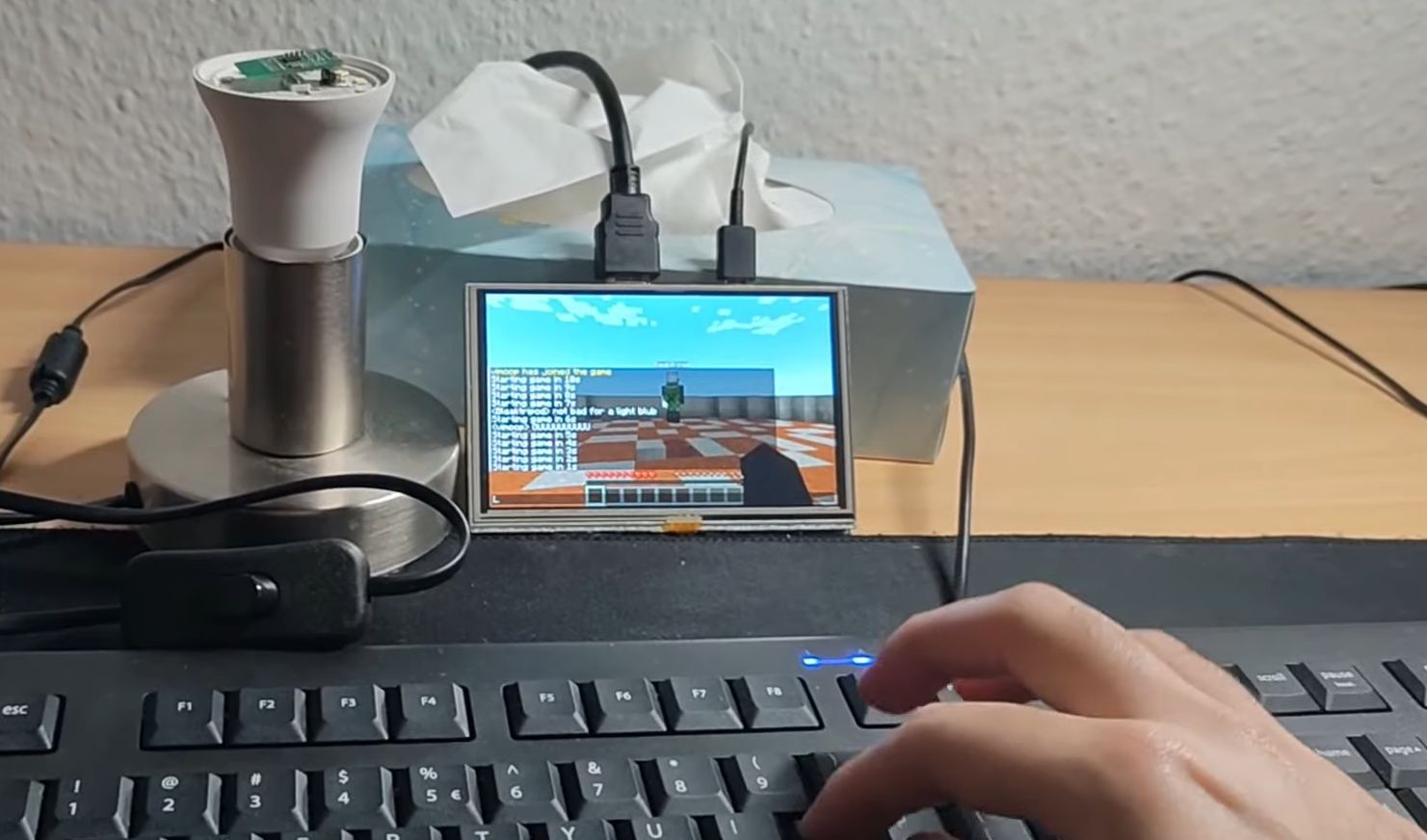
Every so often, the internet gives us a project that sounds less like engineering and more like a dare spoken at 2:13 a.m. “Can we run a Minecraft server on a WiFi light bulb?” is exactly that kind of sentence. It has no business being practical, and yet it is technically possible. Better still, it is the sort of tiny-computer wizardry that makes embedded developers grin, server admins squint, and ordinary people look suspiciously at the lamp in the corner.
The short answer is yes: a minimalist Minecraft server can run on the hardware inside a cheap smart LED bulb. The longer answer is much more interesting. It involves a tiny RISC-V microcontroller, very little RAM, a stripped-down server implementation, a lot of optimization, and the kind of patience normally reserved for speedrunners, watchmakers, and people who assemble flat-pack furniture without crying.
Running a Minecraft server on a WiFi light bulb is not about replacing your dedicated server, your Realm, or your friend’s suspiciously loud basement computer. It is about proving that modern “ordinary” devices contain surprisingly capable computers. A smart bulb may look like a simple gadget that changes colors when you shout at a voice assistant, but inside it is a networked microcontroller with wireless communication, flash storage, GPIO pins, and enough processing power to do something wonderfully ridiculous.
Yes, a WiFi Light Bulb Can Be a Minecraft Server
The project that made this idea famous used a cheap smart bulb built around a Bouffalo Lab BL602 microcontroller. This chip is not a desktop processor, not a Raspberry Pi, and definitely not the kind of machine Mojang had in mind when Minecraft Java server files were created. It is a low-cost WiFi and Bluetooth microcontroller meant for Internet of Things devices.
Still, the BL602 has some interesting muscle for its size. It uses a 32-bit RISC-V core running up to 192 MHz, includes around 276 KB of RAM, and has 128 KB of ROM, with support for external flash storage. It also supports 2.4 GHz WiFi and Bluetooth Low Energy 5.0. In normal life, that is enough to connect a bulb to your router, receive commands, dim LEDs, and pretend your living room is a nightclub. In hacker life, that is apparently enough to ask, “But can it host a block game?”
The answer depends on what kind of Minecraft server you mean. A normal vanilla Minecraft Java server is far too large and demanding for a microcontroller like this. It expects a much richer environment, far more memory, file storage, Java runtime support, and enough CPU headroom to track chunks, entities, mobs, players, lighting, world generation, redstone, and all the tiny disasters players create when they discover TNT.
So the trick is not to cram a full modern Minecraft server into a bulb. The trick is to build a tiny server that speaks enough of the Minecraft protocol to let players connect and interact with a very limited world. That is where a lightweight implementation such as Ucraft enters the story.
The Secret Ingredient: A Tiny Minecraft Server
Ucraft is a lightweight Minecraft server implementation written in C for machines with very limited resources. Instead of trying to behave like a full vanilla server, it focuses on the minimum required features. Think of it as Minecraft server espresso: tiny, intense, and definitely not meant to hydrate a village.
The reported binary size is impressively small: roughly 46 KB without authentication support and about 90 KB with authentication included. Memory usage can vary depending on connected players, but the project has been shown operating within a tiny heap budget compared with conventional Minecraft server setups. In worst-case examples, the server can stay under roughly 70 KB of heap usage with several players connected.
That is the kind of number that makes modern software blush. Many websites need more memory just to load a cookie banner that nobody wanted. Here, a server capable of letting Minecraft clients join a simplified game world is squeezed into a footprint small enough to fit inside hardware originally designed to turn LEDs on and off.
What Makes This Possible?
1. The Minecraft Protocol Can Be Selectively Implemented
A Minecraft client does not necessarily require the server to simulate every feature of the full game. It needs the server to communicate correctly enough to log in, receive world data, send movement updates, and handle basic interactions. By supporting a narrow slice of the protocol, a tiny server can appear “real enough” to the client.
This is similar to building a tiny theater set. From the audience’s seat, it looks like a castle. Walk behind it, and you discover it is mostly plywood, two ropes, and someone named Greg holding a fog machine. Ucraft does not need infinite terrain, villages, Nether portals, redstone computers, raids, dolphins, or your cousin’s 4,000-item storage system. It only needs the pieces required for a controlled, simplified experience.
2. The World Is Small and Purpose-Built
A full Minecraft world is massive. Chunks must be stored, loaded, generated, and updated. Mobs need AI. Blocks can change. Players can build, break, fall, drown, burn, and occasionally insist that the creeper “came out of nowhere.” A WiFi bulb cannot manage all of that.
Instead, a light-bulb Minecraft server works best with a tiny predesigned map and simple minigame mechanics. A game like TNT Run is a good fit because it does not require a huge world. Players move around, blocks disappear, and the server tracks enough state to keep the game playable. The smaller the rule set, the happier the bulb.
3. C Is Leaner Than a Full Java Stack
The official Minecraft Java server depends on Java and assumes far more memory and operating system support than a bare microcontroller can provide. A compact C implementation can be compiled much smaller and tailored directly to the target platform.
That matters because embedded systems live under strict constraints. Every byte has a job. Every allocation must be justified. There is no comfortable “just add more RAM” button. On a smart bulb, optimization is not a performance luxury; it is the difference between a server and a blinking paperweight.
4. Modern IoT Chips Are Stronger Than They Look
Smart bulbs, plugs, sensors, and other IoT devices often contain microcontrollers that are far more capable than people expect. A WiFi-enabled chip must handle networking, encryption, firmware updates, timing, device control, and communication with cloud or local services. That means even cheap devices may include processors that would have looked impressive in older computing eras.
This is why the project feels funny but not magical. The bulb is not “just a bulb.” It is a small connected computer attached to a light source. Once you expose the board, connect to the chip, and replace the intended firmware with your own software, the device becomes a tiny general-purpose machine.
How the Build Works at a High Level
Before anyone grabs a screwdriver and attacks a lamp: smart bulbs can contain dangerous mains-voltage components. Opening one is not a beginner project. It can shock you, damage equipment, start a fire, or turn a relaxing weekend into a visit from someone wearing rubber gloves and a concerned expression. Only trained hobbyists who understand electronics safety should attempt this kind of hardware work.
At a high level, the build follows a familiar embedded-hacking pattern. First, the smart bulb is opened carefully to reveal the internal circuit board. The microcontroller module is identified, along with serial pins or debugging pads. Then wires are soldered to create a usable interface, often through a USB-to-serial adapter. This allows the developer to communicate with the chip, flash firmware, monitor output, and verify that the board is alive.
Once communication is working, the lightweight Minecraft server is compiled for the target architecture. Because the BL602 uses RISC-V, the code must be built with the correct toolchain and linked for the microcontroller environment. Networking support must be configured so the device can join WiFi and listen for Minecraft client connections.
Finally, the Minecraft client connects to the bulb’s IP address like it would connect to any other server. From the client’s perspective, the experience is strange but recognizable. From the bulb’s perspective, life has taken a dramatic turn.
What Can You Actually Do on a Light-Bulb Server?
This is not a server for survival multiplayer, giant farms, mods, plugins, shaders, or 40 players building a replica of Chicago. A WiFi light bulb Minecraft server is more like a technical demo with playable features. It can host small minigames, simple maps, and limited interactions.
You should expect tight limits on world size, player count, block updates, authentication options, and game mechanics. There may be no mobs, no dynamic world generation, no complex inventory behavior, and no plugin ecosystem. You are not installing economy plugins, land claims, or a moderation bot named “SteveGuard3000.”
But that is exactly why the project is fascinating. The goal is not to create the best Minecraft server. The goal is to create the least likely Minecraft server that still works. It is the difference between driving a truck across the country and teaching a toaster to roll three feet. One is useful. The other is unforgettable.
Why This Project Matters
At first glance, running Minecraft on a WiFi bulb looks like a novelty. It is funny, impressive, and deeply unnecessary. But it also highlights several important technology lessons.
Embedded Systems Are Everywhere
The modern home is full of hidden computers. Bulbs, thermostats, cameras, speakers, doorbells, plugs, and appliances all contain processors and network stacks. Many people think of them as simple products, but they are really specialized computers with sensors, radios, firmware, and security responsibilities.
When someone turns a smart bulb into a Minecraft server, it becomes easier to understand how much computing power sits quietly around us. That awareness matters for both creativity and security. If a bulb can run a tiny game server, it can also run buggy firmware, expose network services, or become part of a larger security problem if poorly designed.
Minimal Software Is Powerful
Modern software often grows large because hardware allows it. Desktops and cloud servers have gigabytes of memory, fast CPUs, and generous storage. Embedded projects remind developers that lean code still matters. When the target has only a few hundred kilobytes of RAM, waste becomes visible.
A tiny Minecraft server encourages smart design choices: avoid unnecessary allocations, simplify state, use compact data structures, reduce protocol scope, and test memory use carefully. Those lessons apply far beyond novelty projects. They matter in firmware, medical devices, satellites, industrial controllers, and battery-powered sensors.
Open-Source Experimentation Pushes Boundaries
Projects like this thrive because people publish code, document failures, share build notes, and let others inspect the process. Open-source experimentation turns a weird idea into a learning resource. Even if most readers never run Minecraft on a bulb, they may learn about RISC-V, serial debugging, embedded networking, memory optimization, or protocol design.
Practical Limits and Real Risks
A WiFi light bulb server is impressive, but it is not practical hosting. It has limited compute power, limited memory, limited storage, and questionable durability for continuous workloads. Smart bulbs are designed for lighting duty cycles, not for acting as tiny public servers. Heat, power stability, wireless reliability, and firmware crashes are real concerns.
Security is another major issue. Exposing experimental IoT firmware to the open internet is a bad idea unless you deeply understand the risks. A hacked-together Minecraft server should stay on a controlled local network. Strong WiFi security, network segmentation, and careful firewall rules are not optional if you enjoy peace, privacy, and not explaining to your router why a lamp is accepting inbound traffic.
There is also the matter of legality and safety. Opening commercial electronics can void warranties and create electrical hazards. Repurposing a smart bulb board should be treated as an electronics lab project, not a casual craft. The safest route is to study the concept, use a development board with similar hardware, and leave mains-powered bulb surgery to people with the right tools and training.
Could You Build Something Similar?
Yes, but the smarter starting point is not an actual light bulb. A BL602 development board, ESP32 board, or other WiFi-enabled microcontroller is a much safer way to experiment. You can learn the same lessons without cracking open mains-powered hardware.
Start by learning how microcontrollers connect to WiFi, how serial flashing works, and how embedded build systems compile firmware. Then explore lightweight network servers. A tiny web server is a good first milestone. After that, study how game protocols work and why memory management matters. By the time you reach a Minecraft-like protocol project, you will have a better chance of debugging problems without blaming the moon.
If your goal is to run a normal Minecraft server for friends, use a proper machine. A small desktop, VPS, Raspberry Pi-class board, or managed Minecraft hosting plan will provide a far better experience. If your goal is to learn, experiment, and make people say, “Wait, the server is inside the lamp?” then the smart-bulb concept is a brilliant playground.
Experience Notes: What Running Minecraft on a Bulb Teaches You
The experience of working with a project like this is less like setting up a normal game server and more like negotiating with a very talented grain of rice. On a regular Minecraft server, you worry about view distance, player slots, backups, plugins, CPU usage, and whether someone built a lag machine disguised as a sheep farm. On a light-bulb server, you worry about whether a few extra kilobytes will cause the entire idea to collapse.
One of the first lessons is humility. On modern computers, developers often solve problems by adding libraries. Need authentication? Add a package. Need logging? Add a package. Need configuration parsing, JSON handling, compression, and a dashboard with rounded buttons? Add several packages and maybe a dark mode toggle. Embedded development laughs at this behavior. A WiFi bulb does not care about your convenience. It wants small code, predictable memory, and no nonsense.
The second lesson is that networking is expensive. Sending data over WiFi feels normal on a laptop, but on a microcontroller, every packet has cost. Buffers consume RAM. Connections require state. Protocol handling requires careful parsing. A Minecraft client expects a server to respond in specific ways, and if those responses are late, malformed, or too large, the experience falls apart. Suddenly, “just send the world data” becomes a serious engineering task.
The third lesson is that constraints can make a project more creative. A normal server invites big ideas: huge worlds, fancy plugins, automated farms, custom mobs, and elaborate rules. A bulb server forces the opposite question: what is the smallest fun thing this can do? That question leads naturally to compact minigames, tiny arenas, limited block sets, and predictable player actions. Instead of building everything, you build only what matters.
There is also a strange joy in watching a familiar game connect to absurd hardware. The Minecraft client does not know it is talking to a light bulb. It simply sees a server. That disconnect is hilarious. Somewhere, a polished gaming PC is rendering the world while the server-side brain is a tiny chip that was supposed to control brightness levels. It is like entering a luxury hotel and discovering the front desk is run by a hamster with a clipboard.
Projects like this also change how you look at smart devices. After seeing a bulb host a Minecraft server, every connected gadget becomes suspiciously interesting. A smart plug is not just a plug. A thermostat is not just a thermostat. A cheap sensor is not just a sensor. Each one is a small computer with a job, a network connection, and potential beyond its factory firmware. That realization is exciting, but it also encourages caution. Powerful little devices need thoughtful software, updates, and security.
The biggest takeaway is simple: impractical projects can be extremely useful. Nobody needs a production Minecraft server inside a light bulb. But building one teaches embedded programming, hardware inspection, protocol design, networking, optimization, and security awareness in a memorable way. It turns abstract engineering lessons into a story people actually remember. And in technology, memorable lessons are valuable. Especially when they glow.
Conclusion
Running a Minecraft server on a WiFi light bulb is ridiculous in the best possible way. It is not a replacement for real hosting, and it is not something beginners should attempt with mains-powered hardware. But as a demonstration of embedded computing, minimalist software design, and hacker creativity, it is fantastic.
The project proves that a smart bulb is more than a glowing accessory. Inside that ordinary shell is a tiny connected computer capable of joining a network, running custom firmware, and, with enough cleverness, hosting a simplified Minecraft experience. The result is funny, technically impressive, and surprisingly educational.
Most people will never play Minecraft from a lamp. That is fine. The real value is the reminder that constraints can inspire better engineering. When you have only a tiny processor, a sliver of memory, and a device that was born to illuminate a hallway, every byte matters. And when those bytes become a playable game server, even the creepers should applaud.












