
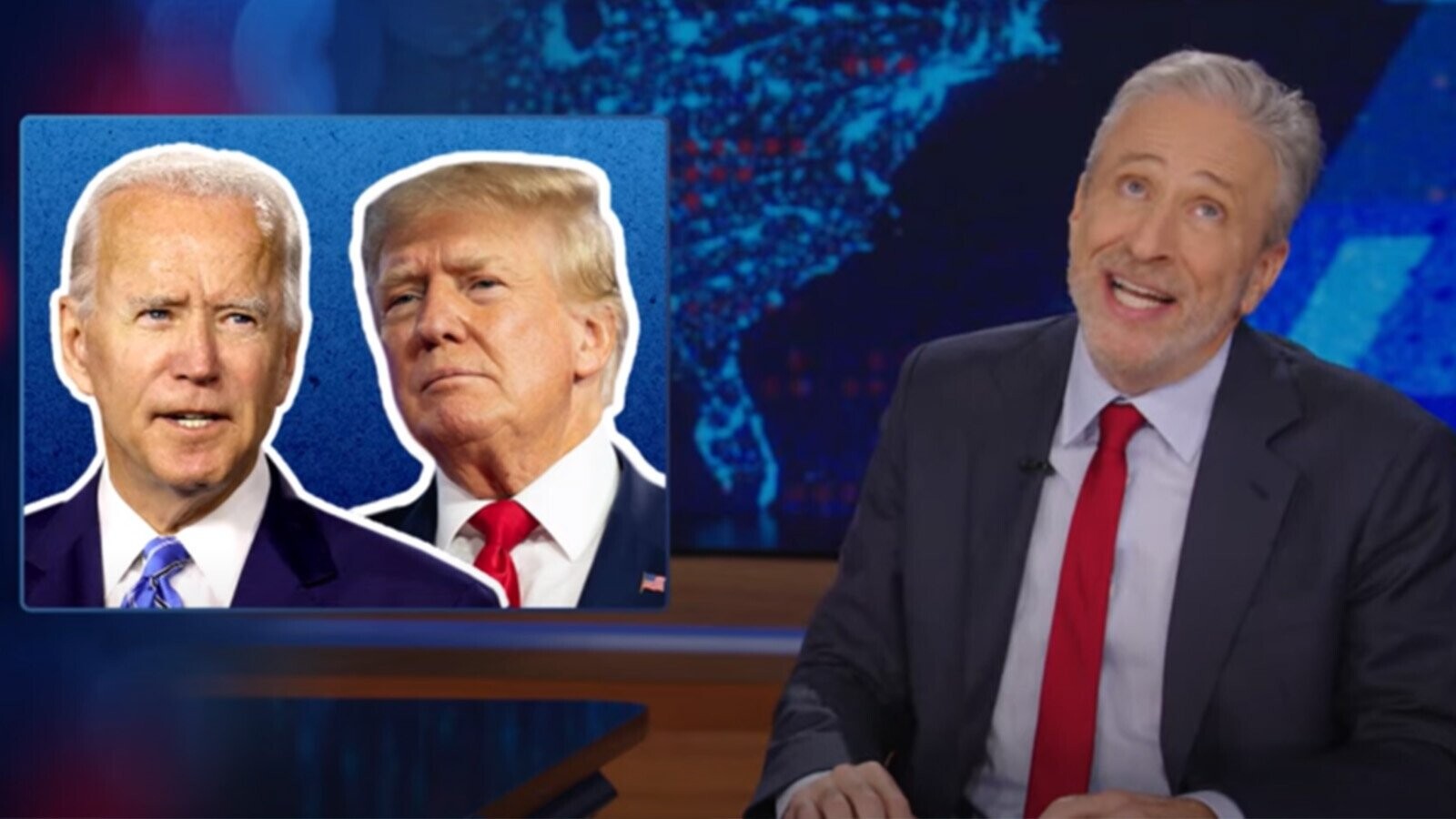
Jon Stewart returned to The Daily Show in February 2024 with the energy of a man who had left the office for nine years, checked the news, and decided the country had accidentally reheated the same political casserole. His comeback episode did not waste time pretending the 2024 presidential race was a bold new chapter in American democracy. Instead, Stewart walked straight into the most obvious, uncomfortable, and very wrinkly subject in the room: the age of the two men then dominating the race, President Joe Biden and former President Donald Trump.
The segment’s funniest proposed title, “Indecision 2024: Antiques Roadshow,” landed because it turned a national anxiety into a punchline. The joke was not simply “old people are old.” That would be lazy, and also rude to everyone’s grandfather who still fixes his own lawn mower. Stewart’s sharper point was that American voters were being asked to treat age-related concerns as impolite dinner conversation, even when the candidates were competing for the most demanding job on Earth.
In classic Stewart style, the monologue mixed mockery, exasperation, and a tiny splash of civic panic. He roasted Biden’s verbal stumbles, Trump’s memory lapses, the media’s nervous framing, and even his own grizzled face. The result was not just a nostalgic return of a famous late-night host. It was a reminder that political satire works best when it says out loud what millions of viewers have been muttering into their coffee.
Jon Stewart’s Return Was Built for a Strange Election Year
Stewart originally hosted The Daily Show from 1999 to 2015, a run that helped turn the Comedy Central program into one of America’s most influential political comedy institutions. After Trevor Noah left the anchor desk in 2022, the show moved through guest hosts and rotating correspondents while the late-night landscape changed around it. Cable audiences had shrunk, social media clips had become the new watercooler, and political comedy had to compete with real headlines that often sounded like rejected sketch ideas.
Comedy Central brought Stewart back as a Monday host and executive producer for the 2024 election cycle, with correspondents handling the rest of the week. That limited format made sense. Stewart did not need to reclaim every night; he needed a weekly platform big enough to cut through the noise. His first night back proved why the network wanted him in the chair. The episode drew major attention, strong ratings, and the kind of online discussion that late-night shows now need to survive.
The comeback also arrived at a moment when voters were not exactly floating on a cloud of democratic enthusiasm. At the time of Stewart’s return, the presidential race seemed headed toward a Biden-Trump rematch. Biden was 81. Trump was 77. Both men had already spent years under intense public scrutiny, and both were facing questions about stamina, judgment, and the future of American leadership. In other words, the campaign felt less like a fresh contest of ideas and more like a sequel nobody remembered ordering.
Why “Indecision 2024: Antiques Roadshow” Was the Perfect Joke
The phrase “Indecision 2024: Antiques Roadshow” worked because it compressed an entire political mood into four words. The old Daily Show “Indecision” branding has long been used to satirize presidential campaigns, but this version added a museum-label twist. It suggested that the 2024 race was not merely familiar; it was collectible, fragile, possibly valuable, and definitely something someone should handle with gloves.
Stewart cycled through joke titles for the election coverage, including bawdy and blunt alternatives, before landing on the antiques line. The audience response made it clear: that was the one. It captured the absurdity of watching the country debate the future through candidates who seemed pulled from America’s political storage unit.
But beneath the joke was a serious argument. Stewart was not saying that older people cannot lead. American history has plenty of examples of older public figures making consequential decisions. His point was narrower and more uncomfortable: when candidates show signs that worry voters, the answer cannot be to scold the voters for noticing. Democracy is not a dinner party where everyone politely ignores the chandelier falling into the soup.
The Segment Roasted Biden, Trump, and the Voter Guilt Machine
One reason the monologue sparked debate was that Stewart criticized both Biden and Trump, though not as identical figures. He made room for a distinction that often gets flattened in partisan arguments: Trump’s legal troubles, public conduct, and record of norm-breaking were not equivalent to Biden’s age problem. At the same time, Stewart argued that Trump’s dangers did not magically make Biden immune from scrutiny.
That balance was the core of the segment. Stewart’s target was not only the candidates. It was the political habit of telling citizens that any criticism of “your side” is a gift to the other side. For Stewart, that logic is corrosive. It asks voters to act less like citizens and more like brand managers protecting a fragile product launch.
His comedy turned that frustration into something viewers could laugh at without pretending it was harmless. He showed clips, pulled faces, paused for effect, and let the discomfort breathe. That pause has always been one of his best tools. Stewart can deliver a punchline, but he can also sit in the silence afterward, letting the audience realize the joke is wearing steel-toed boots.
Aging Became the Campaign Issue Nobody Could Escape
The age issue was already simmering before Stewart returned, but his monologue helped crystallize it in popular culture. Biden’s supporters often argued that his record mattered more than his presentation. Trump’s supporters often brushed off his verbal detours as humor, exaggeration, or vintage Trump chaos. Yet voters across the political spectrum were seeing clips, hearing speeches, and wondering whether America’s leadership pipeline had become a retirement community with nuclear codes.
Stewart’s comeback did not invent those concerns. It gave them a memorable frame. The “Antiques Roadshow” gag was funny because viewers did not need a political science degree to understand it. They only needed a television, an internet connection, or a passing familiarity with the feeling of watching national politics and whispering, “Really? These are the finalists?”
Later events in 2024 made the segment feel even more significant. Biden eventually exited the race after months of mounting pressure and public concern about his ability to campaign effectively. That does not mean Stewart caused the shift; comedy rarely moves history by itself. But the monologue reflected a real pressure point in American politics. It was less a prophecy than a weather report: storm clouds already visible, umbrella strongly recommended.
Why the Monologue Felt Familiar and New at the Same Time
For longtime fans, Stewart’s return felt like opening a drawer and finding a favorite old jacket that still fits, even if the sleeves smell faintly of 2004. The desk, the timing, the skeptical eyebrow, the weary moral clarityit was all there. His first line back leaned into the idea that he had simply paused mid-thought nearly a decade earlier.
Yet the world he returned to was not the same. The media ecosystem had changed dramatically since 2015. TikTok, YouTube Shorts, podcasts, newsletters, streaming platforms, partisan influencers, and algorithmic outrage had all reshaped how people consume politics. In Stewart’s first era, The Daily Show often mocked cable news for turning politics into theater. By 2024, politics had become theater, backstage gossip, fan fiction, live reaction video, and merch drop all at once.
That made the comeback risky. Nostalgia can be comforting, but it can also be a trap. A returning host cannot simply perform the greatest hits while the house burns down in a new architectural style. Stewart’s strongest choice was to address the obvious immediately. He did not begin with a safe victory lap. He began with the central absurdity of the election cycle and dared the audience to laugh at something many people were afraid to discuss plainly.
The Debate Over “Bothsidesism”
Not everyone loved the segment. Some viewers argued that criticizing Biden and Trump in the same monologue risked creating false equivalence. That criticism was predictable, especially in a high-stakes election year. When one candidate is widely seen by opponents as a threat to democratic norms, jokes about the other candidate’s age can feel, to some viewers, like helping the wrong team.
But Stewart’s argument was more nuanced than a simple “both sides are the same” shrug. He explicitly treated Trump as uniquely troubling while still insisting that Biden’s weaknesses mattered. That distinction is important. Political comedy loses its value when it becomes a campaign brochure with better lighting. If satire cannot question the candidate it prefers, it turns into public relations wearing a funny hat.
The strongest defense of Stewart’s approach is that democracy depends on scrutiny, not cheerleading. Voters are allowed to weigh threats, flaws, risks, records, and realities all at once. They can believe one candidate is far worse and still ask whether the other candidate is fit for the job. Adults do this kind of thinking every day. It is called choosing the least chaotic plumber after both estimates make your eye twitch.
How Stewart Used Self-Mockery to Sharpen the Point
One of the best moments in the return episode came when Stewart turned the age joke on himself. He acknowledged his own gray hair and weathered appearance, joking about what time had done to his face. That self-mockery mattered because it prevented the segment from becoming a cheap roast of elderly people. Stewart was not standing outside the aging process throwing tomatoes. He was inside the same human condition, waving from the produce aisle.
By making himself part of the joke, he lowered the cruelty and raised the honesty. The point was not that age is shameful. The point was that age is visible, relevant, and sometimes politically important. A person can respect older citizens while still asking whether an octogenarian president should be expected to carry the physical, mental, and emotional burden of the presidency.
This is where Stewart’s comedic instincts still shine. He understands that a joke lands harder when the comedian accepts some of the blast radius. His own gray hair became a prop, a confession, and a shield. He was telling the audience: yes, time comes for all of us. Now, about the two men trying to run the country.
The Ratings Proved People Still Wanted Stewart’s Voice
Beyond the jokes, Stewart’s return mattered because it showed that legacy late-night comedy could still create a major cultural moment. His first episode back delivered one of The Daily Show’s strongest audiences in years across Comedy Central and related platforms. Clips traveled quickly online, proving that the modern late-night victory is not just the live broadcast; it is the afterlife of the monologue.
That matters for SEO, media analysis, and entertainment culture because Stewart is no longer just a television host. He is a shareable political event. A strong Daily Show segment can become a YouTube clip, a headline, a reaction thread, a podcast topic, and a family group-chat argument before lunch the next day. In 2024, that is the real distribution model: broadcast once, ricochet forever.
The audience response also suggested that many viewers missed a particular kind of political comedy: skeptical but not empty, angry but not joyless, funny but not allergic to seriousness. Stewart’s best work has always lived in that zone. He can make a goofy face at a bad news clip, then pivot into a sincere argument about civic responsibility. It is a difficult blend to imitate, which is why so many imitators end up with either the sermon or the smirk, but not both.
Why the Segment Still Matters After the 2024 Race Changed
Because Biden later left the 2024 race, Stewart’s original monologue now plays differently than it did on premiere night. At the time, it looked like a direct roast of an inevitable Biden-Trump rematch. In hindsight, it also looks like an early cultural marker of a campaign pressure point that would eventually reshape the Democratic ticket.
That does not make the segment outdated. If anything, it makes it more useful as a snapshot of the political mood. Before official decisions changed, before party strategy shifted, before the election narrative moved into its next chapter, Stewart captured the weird exhaustion of voters staring at the same two names and wondering how a country of more than 300 million people had narrowed its options to a rerun.
The “Antiques Roadshow” line remains memorable because it was never only about Biden or Trump. It was about a political system that often rewards familiarity over renewal, incumbency over imagination, and donor-approved safety over public excitement. The joke pointed at age, but the deeper target was stagnation.
Experience Section: Watching “Antiques Roadshow” Politics in Real Time
Watching Stewart’s return felt a little like seeing an old fire alarm reinstalled in a building that had somehow become even more flammable. There was comfort in the familiar rhythm of The Daily Show, but also a strange realization: the country had changed, the media had changed, the audience had changed, and yet the political class still seemed determined to prove that reboot culture had escaped Hollywood and moved into Washington.
The experience of following that moment online was almost as revealing as the episode itself. Some viewers were thrilled to have Stewart back. They treated the monologue like a long-awaited house call from the nation’s favorite sarcastic doctor. Others were irritated, especially those who felt any criticism of Biden helped Trump. That split reaction made the segment feel bigger than a normal late-night bit. It became a test of what voters believed political comedy was supposed to do.
From a viewer’s perspective, the most striking part was not that Stewart made jokes about age. Everyone had already heard age jokes. The striking part was that he framed voter discomfort as legitimate. He gave permission for people to say, “This worries me,” without immediately being sorted into a partisan penalty box. That is why the segment traveled so widely. It put language around a private concern.
There was also an odd emotional layer to seeing Stewart himself older. His gray hair was not a distraction; it was part of the text. The man roasting America’s aging political leadership was visibly aging too, and he knew it. That made the segment funnier and more human. He was not pretending to be young, hip, or algorithmically optimized. He looked like someone who had seen enough election cycles to know when the machine was making a noise it should not be making.
For writers, editors, and media watchers, the episode offered a useful lesson: the best topical comedy does not chase every headline. It identifies the pressure point everyone feels but cannot quite phrase. Stewart did that with “Indecision 2024: Antiques Roadshow.” The phrase was silly, but it carried analysis. It suggested that the race was not merely old in years; it was old in ideas, habits, personalities, and institutional imagination.
The segment also showed why satire remains valuable in a fragmented media environment. A straight news report can tell viewers that voters are concerned about candidate age. A poll can quantify it. A panel can debate it until everyone’s soul leaves the studio. But one well-built joke can make the issue unforgettable. That is the power of political comedy when it is done well: it does not replace reporting, but it gives public anxiety a memorable shape.
In the end, Stewart’s return was not just a comeback. It was a mirror with studio lighting. The audience laughed, but the reflection was not entirely flattering. America saw two aging political giants, a nervous media class, a divided electorate, and a returning comedian old enough to joke about his own wrinkles while still asking the sharpest question in the room: why does the future keep arriving in such familiar packaging?
Conclusion
Jon Stewart’s “Indecision 2024: Antiques Roadshow” monologue worked because it combined comedy with a civic gut check. It was funny, yes, but it was not disposable. By roasting Biden, Trump, the media, voters, and himself, Stewart turned the oldest-looking campaign in modern memory into a larger critique of political stagnation. His return to The Daily Show proved that satire can still cut through noise when it is specific, honest, and willing to make everyone just uncomfortable enough to pay attention.
The segment remains one of the defining late-night moments of the 2024 cycle because it did what strong political comedy should do: it named the absurdity without pretending the stakes were small. The antiques joke made people laugh, but the real punchline was the system that made the joke possible.
Note: This is an original SEO article synthesized from public reporting, media coverage, and episode commentary. It is written for publication without source links or copied source text.











