
Picture this: you are sitting by the window, sipping ginger ale, pretending the tiny pretzels are a legitimate meal, when a drone wanders into the flight path like a very expensive mosquito with propellers. What happens next? Does the airplane explode? Does the drone bounce off like a tennis ball? Does the pilot say, “Well, that was rude,” and keep cruising?
The real answer is more technical, less Hollywood, and much more important. A drone strike on an airplane can range from a scary but survivable event to serious structural damage, depending on the size of the drone, the speed of impact, the part of the aircraft hit, and whether the drone gets swallowed by an engine. Modern airplanes are tough, but drones are not birds. They contain dense motors, lithium batteries, cameras, metal parts, and rigid frames. In other words, they are flying bricks with Wi-Fi.
This article breaks down what really happens when a drone strikes an airplane, why aviation experts take the risk seriously, and what pilots, regulators, drone operators, and passengers should understand about this growing airspace safety issue.
Why Drone Strikes Matter More Than Most People Think
Airplanes are built to handle harsh conditions: heavy rain, hail, turbulence, lightning, and bird strikes. But drones create a different kind of impact problem. A bird is mostly water and soft tissue. A drone is a bundle of hard components moving at high relative speed. When a small unmanned aircraft system hits a manned aircraft, the collision is not just about weight. It is about energy, stiffness, shape, and where that energy goes.
Drone sightings near airports remain a serious concern. The FAA receives more than 100 reports of drone sightings near airports each month, and unauthorized drone operations around airplanes, helicopters, and airports can lead to fines or criminal charges. The reason is simple: pilots cannot reliably see and avoid a small drone in time, especially during takeoff and landing, when aircraft are lower, slower, busier, and closer to populated areas.
The Physics: Small Drone, Big Impact
A consumer drone may weigh only a few pounds, which sounds harmless until speed joins the party. Impact energy increases rapidly as velocity rises. A two-pound drone hitting an aircraft at highway speed is one thing. That same drone meeting a fast-moving airplane can deliver thousands of joules of energy into a small area.
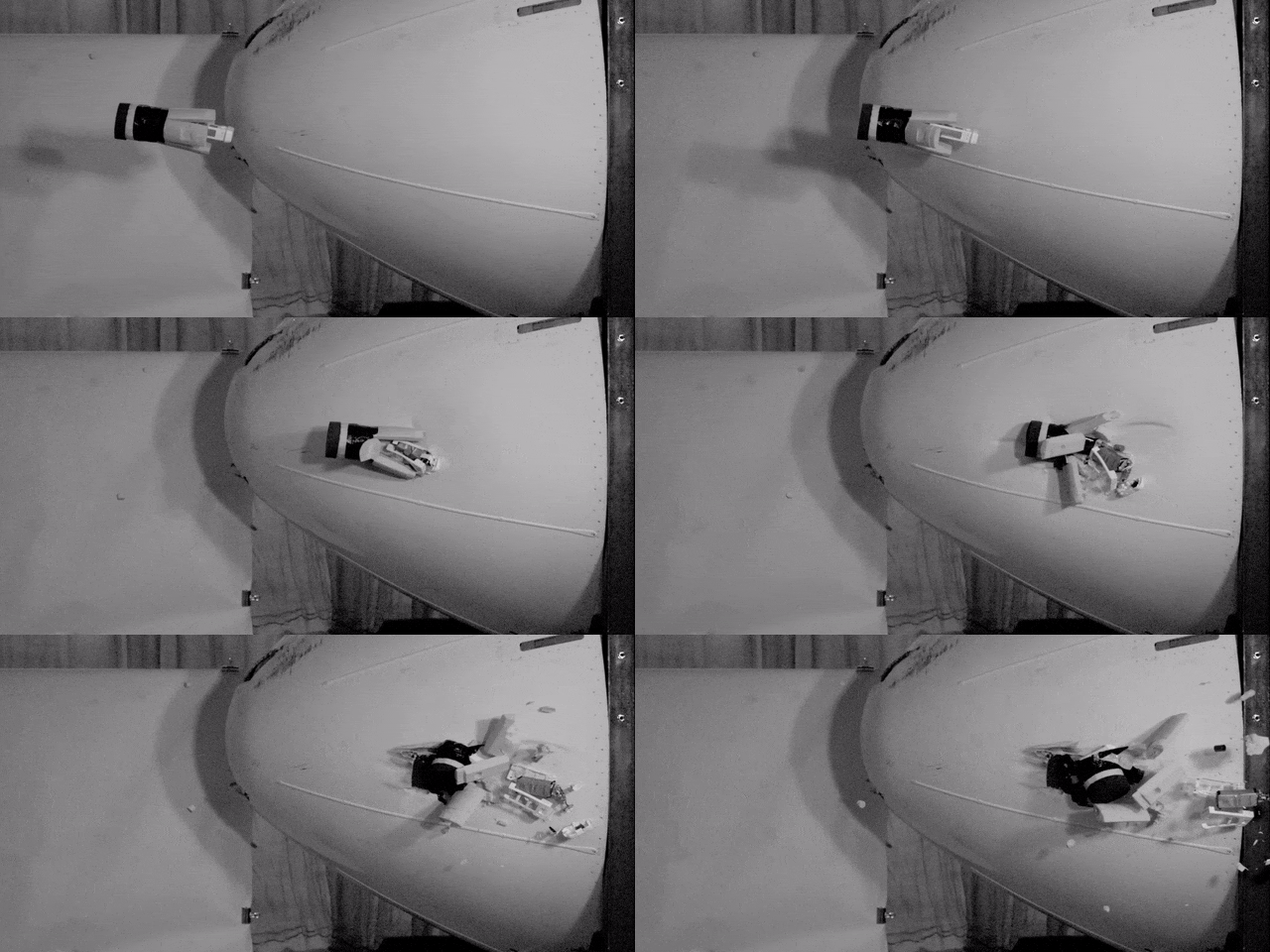
For example, a drone-aircraft collision around 238 mph can create an impact far more violent than dropping the drone on a table or bumping it into a tree. At that speed, motors, batteries, and camera modules can behave like compact projectiles. Instead of spreading out like a bird strike, drone parts may concentrate force into a wing leading edge, windshield, stabilizer, or engine inlet.
What Happens to the Drone?
The drone almost always loses. Dramatically. A drone that hits an airplane is usually destroyed, shattered, or shredded. Propellers snap, arms break, batteries rupture, plastic housings fragment, and electronic parts scatter like confetti at the world’s worst birthday party.
But “the drone gets destroyed” does not mean “the airplane is fine.” A hammer also gets damaged if you smash it hard enough, but your drywall still has a new skylight. The dangerous part is how much of the drone’s energy transfers into the aircraft before the drone disintegrates.
What Happens to the Airplane?
The result depends heavily on the strike location. Some parts of an airplane can tolerate damage better than others. Aircraft designers plan for known hazards, but drone strikes create combinations of dense components and unusual impact patterns that are still being studied.
1. Wing Damage
A wing strike may dent the leading edge, puncture the skin, damage internal ribs, or affect structural components. In one widely discussed controlled test, researchers launched a small quadcopter into the wing of a Mooney aircraft at high speed. The drone penetrated the leading edge and damaged the main spar, while a similarly weighted simulated bird did not penetrate as deeply.
That matters because the wing is not just a big metal shelf holding fuel and dreams. It is a carefully engineered structure that creates lift and carries major flight loads. Minor skin damage may be manageable, but damage to internal load-bearing structures can require immediate inspection, repair, and grounding.
2. Windshield Damage
Aircraft windshields are designed to be strong, especially on commercial airplanes. They must resist weather, pressure differences, and impacts. Still, a drone strike to the windshield is not something any pilot wants on the day’s menu.
A windshield hit can cause cracking, scratching, delamination, or localized damage. In severe cases, it could reduce visibility or compromise cockpit protection. Research simulations have suggested that impact angle matters a lot. A drone hitting at a shallow angle may deflect, while a more direct hit could transfer more energy into the windshield structure.
3. Tail and Stabilizer Damage
The horizontal and vertical stabilizers help keep the airplane controllable. They are smaller than the main wings and can be vulnerable to concentrated impact damage. Studies of drone-aircraft collision severity have found that impacts to stabilizers can be significant, especially when rigid drone components strike thin structures at high speed.
If a drone damages a stabilizer, pilots may notice unusual handling, vibration, control issues, or warning indications. Even if the airplane remains flyable, the aircraft would likely require urgent inspection after landing.
4. Engine Ingestion
This is the nightmare scenario: the drone goes into the engine. Jet engines are tested against bird ingestion, but drones are not birds. They contain motors, magnets, circuit boards, batteries, screws, and other stiff materials. When those parts enter a spinning engine, they can damage fan blades, compressor stages, sensors, or internal surfaces.
An engine may continue running after ingesting debris, or it may lose power, vibrate, surge, or shut down. Commercial aircraft are designed with redundancy, so a twin-engine jet can fly on one engine, but an engine failure during takeoff or landing is still a serious emergency. For smaller single-engine aircraft, the risk is even more obvious: one engine means no backup engine waiting politely in the wings.
Are Drone Strikes the Same as Bird Strikes?
No. They may look similar in headlines, but the mechanics are different. Bird strikes have been studied for decades, and aircraft certification standards account for certain bird impact scenarios. Birds are relatively soft, deformable, and water-rich. Drones are stiff, angular, and full of dense parts.
This is why researchers are cautious about assuming bird-strike data automatically applies to drone strikes. A bird may splatter across a surface, spreading energy. A drone motor may punch into one spot. A lithium battery may create extra fire risk if crushed or damaged. A camera module may act like a small hard projectile. In short, a goose is biology. A drone is hardware with an attitude problem.
Real-World Examples of Drone-Aircraft Collisions
Confirmed drone-aircraft collisions are still relatively rare compared with bird strikes, but they have happened. In 2017, a U.S. Army UH-60M Black Hawk helicopter collided with a privately operated DJI Phantom 4 drone near Staten Island, New York. The helicopter received minor damage, the drone was destroyed, and investigators found that the drone pilot had flown beyond visual line of sight and failed to see and avoid the helicopter.
Another example involved firefighting aircraft. Unauthorized drones near wildfire operations are especially dangerous because firefighting planes and helicopters fly low, fast, and under intense workload. A drone collision can ground a critical aircraft, delay firefighting efforts, and put crews and communities at risk. In these situations, the drone is not just an aviation hazard; it is also an obstacle to emergency response.
What Pilots Do After a Suspected Drone Strike
If pilots suspect a drone strike, they treat it seriously. The exact response depends on aircraft type, phase of flight, damage indications, and weather, but the process usually includes a few key steps.
First, Fly the Airplane
Pilots are trained to prioritize aircraft control. Even if something hits the airplane, the immediate job is to keep flying safely. That may sound obvious, but in aviation, obvious things are written down because panic is not a checklist item.
Second, Assess the Damage
The crew checks instruments, engine indications, flight controls, pressurization, vibration, and warning systems. If the aircraft feels normal and all systems look stable, they may continue to a suitable landing airport. If there are abnormal indications, they may declare an emergency and land as soon as practical.
Third, Notify Air Traffic Control
Pilots report suspected drone strikes or close encounters to air traffic control. This helps warn other aircraft, triggers investigation, and may lead to temporary restrictions or law enforcement response in the area.
Fourth, Inspect the Aircraft
After landing, maintenance crews inspect the aircraft carefully. A tiny dent can hide internal damage. Technicians may remove panels, inspect engine components, check control surfaces, and examine composite or metal structures for cracks, punctures, delamination, or hidden deformation.
Why Takeoff and Landing Are the Most Dangerous Times
Drone strikes are especially concerning near airports because aircraft are low enough to share airspace with drones. During cruise flight at 35,000 feet, a consumer drone is not supposed to be anywhere nearby. During approach or departure, however, aircraft may pass through altitudes where drones can easily fly.
Takeoff and landing are also busy phases of flight. Pilots are managing speed, configuration, navigation, air traffic instructions, weather, terrain, and runway alignment. Adding a hard-to-see drone to the equation is like throwing a bowling ball into a ballet performance. Technically, everyone may survive, but nobody is going to thank you.
How Regulations Reduce the Risk
Drone rules exist because the sky is not an empty playground. In the United States, drone operators must follow airspace restrictions, avoid manned aircraft, and receive authorization before operating in controlled airspace near many airports. Recreational flyers and certificated remote pilots can use FAA-approved tools such as B4UFLY and LAANC to understand where they may fly.
Remote ID also plays a growing role. It acts like a digital license plate for drones, helping authorities identify the drone and control station when a drone appears to be flying unsafely or where it is not allowed. Remote ID does not physically stop a drone from hitting an airplane, but it improves accountability. Accountability is not glamorous, but neither are accident reports.
Can Technology Stop Drone Strikes?
Technology helps, but there is no magic force field around airports. Drone detection systems may use radar, radio-frequency sensors, optical cameras, acoustic tools, or data networks. Some systems can identify drone activity, track movement, and help security teams respond. Counter-drone systems may be used in limited settings, but they are legally complex because jamming or disabling aircraft can create its own safety risks.
Geofencing can also help by warning or limiting drone operations near restricted areas. However, geofencing depends on manufacturer implementation, accurate databases, operator compliance, and the type of drone being used. A homemade drone, modified drone, or noncompliant aircraft may ignore those digital boundaries completely.
What Drone Operators Must Remember
Most drone pilots are responsible. They use drones for photography, inspections, mapping, agriculture, public safety, and recreation. The problem is that one careless flight near an airport can create a real aviation hazard. A drone pilot may see a wide-open sky. A pilot in a cockpit may see a sudden flash of plastic and metal at the worst possible moment.
Drone operators should keep the aircraft within visual line of sight, stay below allowed altitude limits, check airspace before flying, avoid airports and emergency response areas, comply with Remote ID rules, and yield to all manned aircraft. If a helicopter or airplane appears nearby, the drone should descend or move away immediately. The drone does not have right-of-way. The airplane wins. Always.
What Passengers Should Know
For passengers, the key point is balance. Drone strikes are serious, but they are not a reason to fear flying. Commercial aviation is built on layers of safety: pilot training, aircraft design, air traffic control, maintenance inspections, reporting systems, and regulation. A drone strike can cause damage, but modern aircraft and crews are prepared to handle abnormal situations.
The bigger concern is prevention. The safest drone strike is the one that never happens. As drone use expands for delivery, filming, emergency services, infrastructure inspection, and hobby flying, safe integration into the national airspace becomes more important. The future may include more automated traffic management, better detect-and-avoid systems, stronger enforcement, and clearer public education.
Experience-Based Insights: What This Topic Teaches Us About Sharing the Sky
Anyone who has watched a drone lift off for the first time understands the appeal. There is a little thrill when the rotors spin up, the aircraft rises smoothly, and the camera suddenly sees the world from above. A backyard becomes a landscape. A beach becomes a postcard. A roof inspection becomes less ladder-related, which is always a win for human ankles.
But that same feeling of freedom can trick people into forgetting that the sky is already occupied. Airspace is invisible, so it feels empty. There are no painted lanes, no stop signs floating at 300 feet, no polite traffic lights blinking over the neighborhood. Yet helicopters may be transporting patients, police aircraft may be searching an area, small airplanes may be practicing approaches, and commercial jets may be descending toward a runway. The absence of road markings does not mean the absence of rules.
One practical lesson from drone safety discussions is that distance is deceptive. A helicopter can seem far away until it is not. An airplane on approach may look slow from the ground, but it is still covering distance quickly. A drone pilot staring at a phone screen may lose awareness of sound, direction, and altitude. That is why visual line of sight matters. The drone’s camera is not a substitute for situational awareness; it is just a tiny flying TV show.
Another important experience is how quickly a harmless flight can become complicated. A drone launched for sunset photos near a park might drift toward controlled airspace. A battery warning might force an unexpected return path. Wind at 200 feet may be stronger than wind at ground level. A pilot may climb higher “just for a better angle” and accidentally enter a risky altitude band. None of these choices requires bad intentions. They require only small mistakes stacked together.
Airplane pilots think in layers of safety because aviation has learned, sometimes painfully, that accidents rarely come from one single error. Drone pilots can borrow the same mindset. Before takeoff, ask: Am I allowed to fly here? What airspace am I in? Are there airports, heliports, hospitals, stadiums, wildfires, or temporary flight restrictions nearby? Can I keep the drone in sight the whole time? What will I do if I hear or see an aircraft? If the answer is “I’ll figure it out,” that is not a plan. That is a blooper reel waiting for dramatic music.
The best drone operators build habits. They check maps before flying. They keep altitude conservative. They avoid airport approach paths. They land immediately when manned aircraft appear. They do not chase aircraft, emergency vehicles, or wildfire smoke columns. They understand that a drone is not a toy once it enters shared airspace. It may be fun, useful, and beautifully engineered, but it is still an aircraft.
For communities, the experience is also about trust. People are more comfortable with drones when operators are visible, responsible, and respectful. A drone buzzing near an airport, over a crowd, or above an emergency scene creates public fear and regulatory pressure. A drone used safely for mapping storm damage or inspecting a bridge shows why the technology matters. The difference is not the machine. It is the judgment behind the controller.
So what really happens when a drone strikes an airplane? Physics happens. Maintenance happens. Reports happen. Investigations happen. Sometimes the aircraft lands safely with minor damage. Sometimes the damage could be much more serious. But before all of that, a decision happens on the ground. Someone chooses where, when, and how to fly. That choice is the first safety system, and unlike a jet engine or radar array, it fits comfortably between two ears.
Conclusion
A drone strike is not automatically catastrophic, but it is never casual. Drones can damage wings, windshields, stabilizers, and engines because they contain dense, rigid components that behave differently from birds during impact. The most dangerous locations are near airports, emergency operations, and low-altitude flight paths where manned aircraft and drones can cross paths.
The good news is that prevention works. Responsible drone flying, airspace authorization, Remote ID compliance, better detection systems, and stronger public awareness can dramatically reduce the risk. The sky has room for drones and airplanes, but only if everyone respects the rules. A drone may be small, but at aircraft speeds, small can still hit very hard.












