
Note: This article is based on current, real public information from reputable entertainment, biography, culture, and audience-research sources, rewritten in original language for web publication.
Pete Davidson is not the kind of celebrity who looks like he was assembled in a luxury branding laboratory. He does not enter pop culture like a marble statue wearing sunglasses. He enters more like your funniest friend’s older cousin who accidentally became famous, forgot to iron his hoodie, and somehow ended up standing next to the most photographed people on Earth.
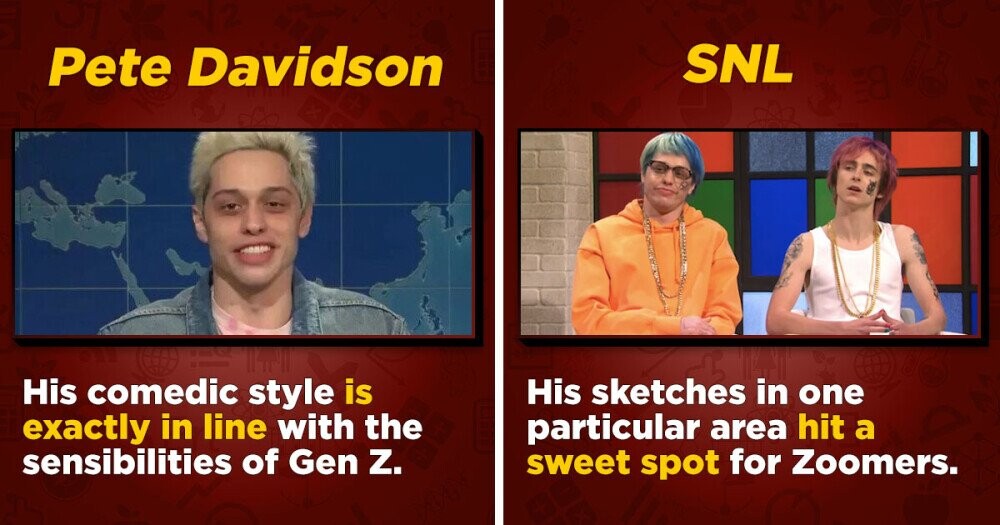
That, strangely enough, is the magic. For Gen Z, or “Zoomers,” Pete Davidson represents a very specific kind of modern fame: messy but self-aware, vulnerable but funny, famous but allergic to acting too polished. In an era when influencers rehearse spontaneity and celebrities can sound like press releases wearing human skin, Davidson’s appeal is that he often seems incapable of pretending life is neat. Zoomers, raised on TikTok edits, meme cycles, therapy vocabulary, chaotic group chats, and public oversharing, understand that language fluently.
The question is not simply, “Why is Pete Davidson popular?” It is bigger than that. Why does a comedian from Staten Island, best known for Saturday Night Live, semi-autobiographical comedy, tattoos, tabloid attention, and extreme self-deprecation, connect so strongly with a generation trained to detect fake energy from three scrolls away? The answer sits at the intersection of authenticity, humor, emotional honesty, anti-glamour style, and the internet’s strange love for people who look like they have survived both fame and a very long CVS receipt.
Who Is Pete Davidson to Zoomers?
Pete Davidson first became widely known as a cast member on Saturday Night Live, joining the show in 2014 when he was only 20. That detail matters. He was young enough to feel closer to the audience than to the institution. While SNL has long been a launching pad for polished comedy giants, Davidson arrived with a different rhythm. He was loose, casual, sometimes awkward, and often funniest when he seemed to be explaining himself rather than performing a perfectly built character.
For older viewers, that could read as undercooked. For younger viewers, it felt familiar. Davidson’s comedy often has the texture of a late-night conversation after everyone has stopped pretending they are doing fine. He talks about embarrassment, family, fame, anxiety, dating, growing up, and poor decisions with the tone of someone who knows the joke is partly on him. That is a very Zoomer-friendly format. Gen Z does not need every performer to look untouchable. In fact, untouchable can feel suspicious. They prefer someone who looks reachable, readable, and slightly surprised to be included.
The Anti-Gloss Celebrity
One major reason Zoomers love Pete Davidson is that he feels like the opposite of manufactured celebrity perfection. His public image is not built around flawless styling, luxury wellness routines, or inspirational captions about “grindset energy.” He built a brand out of being funny, anxious, blunt, and visibly human. In a culture overloaded with curated perfection, that is refreshing.
Zoomers grew up watching people turn every meal, outfit, opinion, vacation, breakup, and skin-care shelf into content. They know when someone is selling a persona. Davidson’s persona, by contrast, looks almost aggressively unpolished. The oversized clothes, the sleepy expression, the awkward interviews, the “I cannot believe this is my life either” energyall of it works because it rejects the usual celebrity rulebook.
That does not mean the Pete Davidson image is not still an image. Every famous person becomes a symbol eventually. But his symbol is unusual: he stands for imperfection as a public language. He is not aspirational in the traditional sense. Most people do not look at him and think, “I want his exact life.” They think, “He seems like he would understand my worst Tuesday.” For Gen Z, that may be more powerful than glamour.
Authenticity Is the Main Character
If there is one word that explains Pete Davidson’s Gen Z appeal, it is authenticity. Zoomers are often described as authenticity-obsessed, and for good reason. This generation has grown up surrounded by filters, brand deals, algorithmic fame, and carefully optimized personalities. Because everything online can be staged, realness becomes valuable. Not perfect realness. Not inspirational realness. Awkward, complicated, “I probably should not have said that but at least it sounded human” realness.
Davidson fits that demand because he rarely seems interested in protecting a shiny myth. His best-known projects repeatedly turn his own life into material. The King of Staten Island, the 2020 film he co-wrote and starred in, drew from his upbringing, his Staten Island roots, and the loss of his firefighter father. Bupkis, his Peacock comedy series, pushed that autobiographical mode further, presenting a heightened, fictionalized version of his life with absurdity, family tension, fame anxiety, and emotional chaos all tangled together.
That kind of storytelling lands with Zoomers because it feels less like celebrity worship and more like emotional translation. Davidson does not package pain as a polished TED Talk. He turns it into jokes, scenes, discomfort, and strange little moments that make people laugh before they realize they are also feeling something. That emotional whiplash is basically Gen Z’s native dialect.
He Makes Vulnerability Funny Without Making It Corny
One of Davidson’s strongest qualities is his ability to talk about heavy subjects without sounding like he is auditioning to become a motivational poster. He has publicly discussed mental health, treatment, sobriety, grief, insecurity, and the pressure of being watched. Importantly, he often frames those subjects through comedy rather than moral instruction.
This matters because Gen Z has helped normalize more open conversations about mental health. However, Zoomers are also allergic to fake-deep branding. They do not want every celebrity to turn vulnerability into a dramatic candlelit monologue. Davidson’s style is less “I have overcome everything” and more “I am working on it, and yes, this is extremely weird.” That feels more believable.
His tattoo-removal journey is a good example. For years, Davidson’s tattoos were part of his image. More recently, he has spoken about removing many of them as part of a personal reset. The story resonated not because tattoo removal is automatically profound, but because it became a visible metaphor for growth. Zoomers understand reinvention. They change usernames, aesthetics, platforms, career goals, and identities in public. Watching a celebrity literally erase old versions of himself is almost too on the nosebut in a way that works.
The “Relatable Chaos” Effect
Pete Davidson’s fame is also powered by what might be called relatable chaos. He has been connected to major pop culture moments, high-profile relationships, film projects, comedy specials, and tabloid storms, yet he often appears less like a celebrity mastermind than a guy who wandered into the group photo and became the headline.
That odd contrast is part of the fascination. Davidson can appear in blockbuster franchises, voice animated characters, lead personal comedy projects, date famous people, and still give off the energy of someone who might forget where he parked. His celebrity does not feel smooth. It feels accidental, or at least unstable in an entertaining way.
Zoomers love that because the internet itself is chaotic. A person can be beloved on Monday, dragged on Tuesday, turned into a meme on Wednesday, and rediscovered as “underrated actually” by Friday. Davidson’s career has moved through that same weather system. He has been praised, mocked, defended, overanalyzed, and memed. Instead of destroying his appeal, the noise has become part of it.
He Understands the Meme Economy
Some celebrities become memes against their will. Pete Davidson seems built for meme survival. His face, outfits, posture, dating history, self-deprecating jokes, and unpredictable career turns all function beautifully in the fast-moving language of internet humor. He does not need to be explained in a 14-part thread. A photo of him looking tired next to a glamorous celebrity already tells a story.
For Zoomers, memeability is not a small thing. It is cultural currency. A celebrity who can be turned into a joke without becoming only a joke has rare staying power. Davidson occupies that sweet spot. People laugh at the absurdity around him, but many also root for him. He can be the punchline and the protagonist at the same time.
That balance is hard. If a celebrity takes themselves too seriously, memes can feel cruel. If they do not take anything seriously, they can seem empty. Davidson’s self-awareness protects him. He often gets to the joke before everyone else does. That is a survival skill in Gen Z culture, where the fastest way to lose the room is to act like you do not know what people are saying about you.
The Staten Island Factor
Another underrated piece of the Pete Davidson appeal is geography. Staten Island is not usually presented as Hollywood’s most glamorous origin story. Davidson has leaned into that. His Staten Island identity gives his comedy a local, grounded, slightly outsider flavor. He is from New York, but not the shiny Manhattan fantasy version. He represents bridge-and-ferry New York: specific, working-class adjacent, funny, loud, and full of personality.
The King of Staten Island made that identity central. The film did not simply use Staten Island as a backdrop; it treated place as character. That rootedness helps Davidson stand apart from celebrities whose origin stories feel sanded down by publicists. Zoomers, who often value niche identity and hyper-specific references, respond to people who come from somewhere recognizable rather than “content mansion, Los Angeles, internet.”
There is also something charming about a celebrity who does not fully detach from his hometown mythology. Davidson’s Staten Island persona makes him feel less like a floating brand and more like a person with history, family, habits, and baggage. In other words: a human being. Imagine that. Hollywood may need to sit down and recover from the concept.
Comedy That Feels Like a Group Chat
Davidson’s humor often feels conversational rather than theatrical. He is not always building elaborate joke machines. Sometimes he is just telling the truth in a way that makes the room laugh because everyone recognizes the discomfort. That style fits the group-chat era. Zoomers are used to comedy that sounds like a voice note, a chaotic caption, a TikTok confession, or a friend saying the quiet part out loud at 1:13 a.m.
His stand-up specials, including Alive from New York and Turbo Fonzarelli, lean heavily on personal storytelling. Not every joke lands for every viewer, and Davidson has plenty of critics. But even criticism contributes to the larger point: his comedy is personality-driven. People are not just responding to punchlines. They are responding to a comedic identity.
That identity says, “I know this is ridiculous. I know I am ridiculous. Let us continue anyway.” For a generation trying to survive economic stress, social pressure, online judgment, and future uncertainty, that tone can feel oddly comforting.
He Is Not the Traditional Heartthroband That Helps
One of the most discussed parts of Davidson’s cultural presence is his unexpected heartthrob status. On paper, he does not fit the old Hollywood template. He is not presented as perfectly sculpted, mysterious, and untouchable. His appeal is softer, stranger, and more personality-based. He comes across as funny, emotionally available, self-aware, and unthreatened by looking uncool.
That lines up with a broader shift in what younger audiences find attractive. The old model of hyper-polished masculinity has lost some of its power. Many Zoomers are more interested in humor, emotional openness, individual style, and “vibes” than in traditional status symbols. Davidson became a symbol of that shift, whether he asked for the job or not.
The internet’s obsession with his dating life often reduces this to a joke, but there is a real cultural point underneath. Davidson challenges the idea that desirability must look one specific way. His appeal suggests that being funny, open, relaxed, and a little odd can be more magnetic than looking like a cologne advertisement who learned three feelings for awards season.
Fame Has Not Fully Swallowed Him
Zoomers also respond to Davidson because fame has not made him seem completely unreachable. Even after years of major projects, celebrity friendships, high-profile relationships, and media attention, he still gives off a strangely grounded energy. He appears aware of how absurd fame is. He does not always appear comfortable with it. That discomfort makes him more interesting.
In Bupkis, Davidson explored the emotional weirdness of being famous for both your work and your personal life. The show’s premise worked because the real Pete Davidson is already a public contradiction: successful but uneasy, beloved but criticized, open but overexposed. Gen Z knows what overexposure feels like on a smaller scale. Even ordinary young people now manage public identities through social media. Davidson’s celebrity version of that pressure feels extreme, but not alien.
He is famous in a way that mirrors the internet age: partly career, partly personality, partly gossip, partly meme, partly confession. Zoomers do not separate those categories as cleanly as older media once did. They understand that modern fame is a messy feed, not a tidy résumé.
His Career Keeps Expanding Without Losing the Core
Davidson’s post-SNL career has moved across stand-up, film, television, animation, and action-comedy. He co-wrote and starred in The King of Staten Island, created and starred in Bupkis, released Netflix comedy specials, voiced Petey in Dog Man, and joined larger movie projects including the upcoming action-comedy How to Rob a Bank. That range matters because it shows ambition beyond being “that guy from the internet.”
At the same time, the center of his appeal remains consistent. Whether he is playing a fictionalized version of himself, doing stand-up, or showing up in a broader ensemble, audiences bring the Pete Davidson context with them. His personal mythology follows him into the work. For some actors, that would be limiting. For Davidson, it is the brand engine.
Zoomers like artists who feel continuous across platforms. Davidson’s comedy, interviews, roles, and public persona all seem to come from the same emotional neighborhood. He does not feel like one person on stage and a totally different person in culture. That consistency makes the public feel like they “get” him, even though, of course, no audience truly knows a celebrity.
Why Zoomers Defend Him
Pete Davidson is not universally loved. No celebrity is, especially not one who lives this close to the meme furnace. Some people find his humor too casual. Some think his fame outweighs his work. Some are exhausted by the attention around his personal life. But Zoomer affection for Davidson often includes a defensive streak because he represents something they value: the right to be unfinished.
That is the deeper reason he connects. Davidson is not selling the fantasy that healing is linear, adulthood is graceful, or fame solves insecurity. He is publicly evolving, sometimes awkwardly. He makes mistakes. He changes his look. He talks about starting fresh. He moves from project to project trying to shape a career that is not only defined by gossip. In a culture obsessed with instant judgment, that unfinished quality can feel almost rebellious.
Zoomers, perhaps more than any generation before them, have had their growth documented. Old posts, old opinions, old photos, old aestheticseverything can be archived and resurfaced. Davidson’s public reinvention speaks to that anxiety. He is proof that a person can be known for one version of themselves and still try to become another.
The Pete Davidson Formula: Funny, Flawed, and Familiar
So why do Zoomers love Pete Davidson? Because he combines several traits that define modern likability: authenticity, vulnerability, humor, meme fluency, emotional messiness, and a refusal to appear overly manufactured. He is not perfect, and that is precisely the point.
He turns awkwardness into a performance style. He turns biography into comedy. He turns public scrutiny into material. He turns reinvention into something visible. His appeal is not based on being the coolest person in the room. It is based on seeming like the person in the room most likely to admit the room is weird.
For Gen Z, that is a gift. They do not need every celebrity to be a superhero. Sometimes they want someone who looks tired, tells the truth sideways, makes a joke before the silence gets too heavy, and reminds everyone that becoming an adult is less of a glow-up montage and more of a buffering screen with occasional snacks.
Experience Section: What the Pete Davidson Effect Feels Like Online
To understand Pete Davidson’s appeal, imagine the experience of being a young fan scrolling through social media after school, during lunch, or while pretending not to hear someone ask for help unloading groceries. You see the usual celebrity content: perfect faces, perfect lighting, perfect vacations, perfect captions about gratitude posted from a balcony larger than your apartment. Then, suddenly, Pete Davidson appears. He looks like he came from a gas station run, a comedy club, and an emotional breakthrough all in the same afternoon. The contrast is funny before anyone says a word.
That is part of the experience. Davidson interrupts the polished feed. He makes fame feel less like a museum display and more like a strange accident that happened to a guy with good timing and a talent for saying uncomfortable things out loud. For Zoomers, who spend so much time watching people perform perfection, that interruption can feel like relief. It is the digital equivalent of someone opening a window in a room full of expensive perfume.
There is also the experience of recognition. Many young people know what it feels like to joke about stress because the alternative is staring into space like a haunted printer. Davidson’s humor taps into that instinct. He does not always offer solutions; he offers recognition. When he jokes about insecurity, family, fame, or trying to become a better version of himself, the joke often works because it carries a small emotional receipt. You laugh because you have purchased a similar feeling before.
Another experience is the group-chat effect. Pete Davidson is easy to talk about. People can debate whether he is underrated, overexposed, charming, chaotic, talented, lucky, misunderstood, or all of the above before breakfast. His public image creates conversation. A friend sends a clip. Another sends a meme. Someone says, “I get it.” Someone else says, “I do not get it at all.” Ten messages later, everyone is discussing modern masculinity, celebrity branding, tattoos, therapy, and why funny people are dangerous in a good way. That is not just fandom; that is cultural usefulness.
For many Zoomers, liking Pete Davidson is not about believing he is flawless. It is about liking the permission he represents. Permission to be funny without being polished. Permission to change. Permission to talk about hard things without turning them into a brand seminar. Permission to look a little confused and still keep going. In a world where everyone is encouraged to optimize themselves into a clean, searchable identity, Davidson’s appeal is that he remains difficult to optimize.
That is why the Pete Davidson effect lasts. He is not merely a comedian, actor, former SNL cast member, or tabloid regular. He is a mood: vulnerable chaos with punchlines. And for Zoomers, that mood feels very, very familiar.
Conclusion
Pete Davidson’s popularity with Zoomers is not random. It reflects a generational shift in what audiences find relatable, attractive, and worth rooting for. Gen Z is less impressed by untouchable celebrity perfection and more drawn to public figures who seem honest, self-aware, emotionally fluent, and funny about their flaws. Davidson’s career, from SNL to The King of Staten Island, Bupkis, stand-up specials, voice work, and film roles, has turned his own life into a strange but compelling comedy map.
He is not beloved because he has everything figured out. He is beloved because he clearly does notand he keeps showing up anyway. That is the secret sauce. Pete Davidson gives Zoomers a celebrity who feels less like a distant idol and more like a human notification: awkward, honest, funny, occasionally chaotic, and impossible to ignore.











