
Every workshop has that one tool that quietly becomes the “extra hand” you did not know you needed. Sometimes it is a clamp. Sometimes it is a bench dog. Sometimes it is the slightly suspicious brick you keep using as a weight even though you own actual tools. The Work IQ Vise is trying to be something more useful than all of those: a multi-axis, articulating bench vise designed for makers, woodworkers, DIY repair people, hobby mechanics, crafters, and anyone tired of rotating their entire body around a stubborn workpiece like a confused satellite.
This review looks at the Work IQ Vise through a maker’s lens. Not just “does it clamp?”because yes, that is the minimum required to call something a vise without being laughed out of the garage. The better questions are: Does it hold securely? Is the rotating ball-and-socket base more than a gimmick? Is it worth the higher price compared with a traditional fixed bench vise? And who should actually buy it?
The short answer: the Work IQ Vise is a clever, versatile, medium-duty workholding system that shines when you need positioning flexibility. It is not a replacement for a giant fabrication vise, but for a maker bench, woodworking station, home repair setup, or garage workspace, it earns its space surprisingly quickly.
What Is the Work IQ Vise?
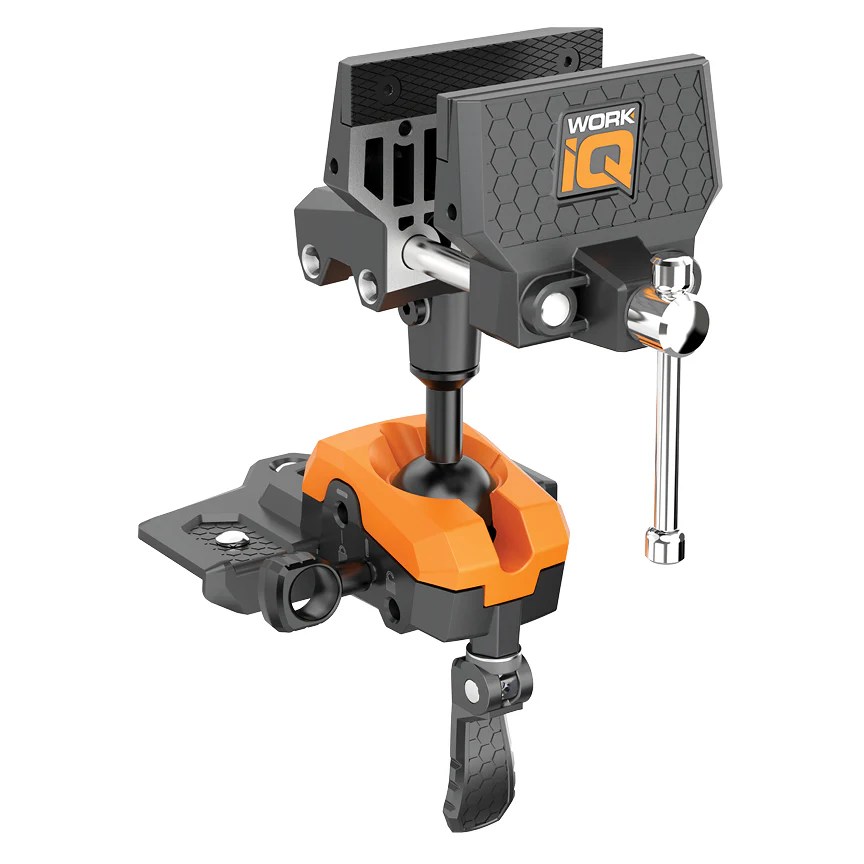
The Work IQ Vise is a bench-mounted vise built around a multi-axis articulating ball-and-socket base. Instead of holding your workpiece in one fixed upright position, it allows the jaws to rotate, tilt, lay forward, and lock into different working angles. That means you can bring the work to your hands instead of bending, twisting, crouching, or inventing new yoga poses with names like “Frustrated Plumber at Midnight.”
Its core design includes hardened steel and cast aluminum construction, a Quick Cam lever for fast adjustment, an IQ Lok pin for fixed high-torque positions, interchangeable jaw sleeves, and integrated ports for optional IQ Connect accessories such as a light, magnifier, and phone holder. The standard package includes the vise, Flex-Fit jaws, locking pins, mounting hardware, and instructions.
In plain English, this is not just a vise. It is a workholding platform. That distinction matters because the Work IQ Vise is less about brute-force clamping and more about improving access. When sanding a small board, sharpening a mower blade, shaping a handle, holding pipe, working on a bicycle part, or filing a metal bracket, the ability to rotate the workpiece can save time and reduce awkward handling.
Design and Build Quality
The Work IQ Vise looks modern, almost futuristic compared with the old cast-iron bench vise your grandfather probably trusted more than most elected officials. The black-and-orange styling is bold, and the shape immediately suggests that this tool was designed for movement. The ball-and-socket base is the star of the show, giving the vise its ability to articulate and rotate into positions a standard vise simply cannot reach.
The vise uses steel jaw plates and accepts removable jaw sleeves. The included Flex-Fit jaws are double-sided. One side has textured rubber for gripping flat materials such as wood, metal, and rectangular parts. The reverse side uses grooved rubber designed for round, tubular, or irregular shapes such as pipe, rods, dowels, and bicycle frames. This jaw system is one of the smartest parts of the product because it acknowledges a simple truth: makers rarely clamp perfect rectangles all day.
Traditional vises are excellent when the object is square, solid, and cooperative. Unfortunately, many real projects involve odd curves, delicate finishes, weird angles, and parts that seem personally offended by the idea of being held still. The Flex-Fit jaws make the Work IQ Vise more adaptable right out of the box, and optional jaws expand its range further for woodworking, leather protection, pipe fitting, and odd-shaped objects.
How the Quick Cam and IQ Lok Work
The Quick Cam lever allows quick locking and unlocking of the articulating ball. Flip it loose, move the vise to the angle you want, and lock it again. For many light and medium-duty tasks, that quick adjustment is the feature you will use most. It makes repositioning a workpiece feel natural instead of like a small negotiation with gravity.
The IQ Lok pin adds a more secure mechanical lock in eight fixed positions. This is important for higher-torque work. When you are applying more forcefiling aggressively, wrenching on a part, or sharpening a bladeyou want the vise to feel planted, not like it is thinking about taking a little walk across the bench. The IQ Lok gives the tool a more serious feel when the job moves beyond casual holding.
That said, the Work IQ Vise is officially a medium-duty vise. That phrase should not scare off most home users, but it should set expectations. This is not the tool you buy to beat on heavy structural steel all day. It is the tool you buy when you need secure holding, fast angle changes, and better access during common workshop tasks.
Performance: Where It Shines
The Work IQ Vise performs best when the shape or angle of the workpiece matters as much as the clamping force. For woodworking, it can hold small boards, trim pieces, carving blanks, handle stock, dowels, and parts that need sanding or shaping from multiple sides. Instead of unclamping, flipping, and re-clamping repeatedly, you can rotate the workpiece and continue.
For tool maintenance, the vise is especially useful. Sharpening a mower blade, axe, hatchet, or knife handle blank becomes easier because the work can be tilted to a comfortable angle. The same logic applies to filing metal, deburring brackets, drilling at controlled angles, or cleaning up hardware. A fixed vise can do many of these jobs, but the Work IQ Vise usually lets you approach them with less body contortion and fewer workarounds.
For bike maintenance and lawn equipment repair, the ability to lay the vise forward or position a part away from the bench is a major advantage. A standard vise often traps bulky parts too close to the work surface. The Work IQ Vise creates clearance, allowing frames, tubes, string trimmer parts, chainsaw components, and awkward handles to sit where your hands can actually reach them.
Grip and Jaw Versatility
A vise is only as good as its jaws, and the Work IQ Vise clearly leans into jaw versatility. The included Flex-Fit jaws are more useful than plain metal jaws for many maker projects because they reduce marring and improve grip on varied surfaces. Woodworkers will appreciate the rubber face for flat stock. DIY mechanics will appreciate the grooves for pipe and tubes. Crafters and repair tinkerers will appreciate not having to wrap every delicate part in cardboard and hope for the best.
The removable jaw sleeves are also convenient because they make the vise feel modular. You can keep the standard Flex-Fit jaws installed for general use, then switch to task-specific jaws when needed. This does add cost if you buy accessories, but it also makes the system more adaptable over time.
There is one limitation to keep in mind: jaw opening capacity. The Work IQ Vise is not meant for very large stock. If your usual projects involve thick beams, oversized metal parts, or heavy-duty fabrication pieces, you may run into its capacity limits quickly. For small-to-medium parts, however, the grip is practical and confidence-inspiring.
Stability and Mounting
The Work IQ Vise wants to be bolted down. That is not a flaw so much as a reality of physics. A top-heavy articulating vise mounted loosely is like a toddler holding a full glass of juice: exciting, but not relaxing. For best results, mount it to a solid bench with the included hardware or with appropriate fasteners for your benchtop.
Once bolted to a stable surface, the vise feels much more capable. The base can handle normal workshop pressure, and the Quick Cam makes adjustments quick enough that you actually use the articulation instead of leaving it in one position forever. The tool is compact enough for a serious hobby bench, but it deserves a permanent or semi-permanent home. If your workshop setup requires hiding every tool under a table after use, this may not be the ideal vise.
Accessories: Helpful or Just Fancy?
The Work IQ system includes optional IQ Connect accessories, including a work light, magnifier, and phone holder. Are these essential? No. Are they useful? More often than you might expect.
A small work light helps when filing, shaping, carving, or inspecting edges. A magnifier can be useful for detail work, electronics-adjacent repairs, sharpening, small hardware, or craft projects. The phone holder sounds silly until you remember how many people watch repair tutorials while doing the repair. Holding a phone with one greasy hand while the other hand tries to keep a part from rolling away is not a workflow; it is a circus act.
The accessories make the most sense for makers who use the vise as a regular workstation rather than an occasional clamp. If you only need a vise twice a month, the add-ons may feel unnecessary. If you spend weekends repairing, sharpening, building, filming, or following tutorials, they can improve the experience.
What Could Be Better?
The first drawback is price. The Work IQ Vise costs more than a basic bench vise. That comparison is not entirely fair because the Work IQ offers articulation, modular jaws, and accessory compatibility, but buyers on a tight budget may still pause. If all you need is a fixed vise for occasional clamping, a cheaper traditional model may be enough.
The second drawback is capacity. The jaw opening is suitable for many maker and DIY tasks, but not for everything. Users who regularly clamp large, thick, or heavy workpieces may prefer a larger fixed vise with more jaw width, more mass, and a larger throat depth.
The third issue is that the vise performs best when properly mounted. It is not a casual portable clamp you toss onto a folding table and expect miracles from. It wants a sturdy bench, thoughtful placement, and enough surrounding clearance to take advantage of its articulation.
Finally, while the moving base is the whole point, moving parts require care. Keep the ball-and-socket area clean, avoid overloading the jaws, and treat the tool like a precision workholding system rather than an anvil. It can take real work, but it is not built for abuse.
Who Should Buy the Work IQ Vise?
The Work IQ Vise is a strong fit for makers, woodworkers, DIYers, home mechanics, tool sharpeners, hobby repair people, and small-shop users who value positioning flexibility. If your work often involves odd-shaped objects, small parts, curved pieces, handles, blades, pipes, tubes, or items that need to be rotated during shaping, this vise makes a lot of sense.
It is also a good fit for people with limited bench space who want one vise to cover many categories of work. Because the jaw sleeves and accessories expand its usefulness, the Work IQ Vise can replace several improvised holding methods. In a small shop, that matters.
However, it is not the best choice for heavy industrial fabrication, blacksmith-style pounding, or constant high-force metalwork. For those jobs, buy a large traditional vise with serious mass and a big anvil surface. The Work IQ Vise is the clever problem-solver; the huge cast-iron brute is still the better choice when the plan involves hammers, sparks, and questionable confidence.
Real Workshop Experience: What It Feels Like to Use
The most noticeable experience with the Work IQ Vise is how quickly it changes the rhythm of a project. With a standard vise, you often adapt yourself to the tool. You lean over, twist your wrist, move your feet, re-clamp the part, and mutter something educational but not suitable for children. With the Work IQ Vise, the workpiece adapts to you. That sounds like marketing language until you are sanding the third side of a small part and realize you did not have to remove it from the jaws.
Imagine shaping a wooden handle. In a regular vise, you clamp the blank, rasp one side, loosen it, rotate it, clamp again, check the grain, loosen again, and repeat until the bench looks like a hamster exploded. With the Work IQ Vise, you can angle the handle upward, rotate it toward the light, and keep your rasp moving with better control. The process feels less interrupted. The tool does not make you a master craftsperson, but it does remove several annoying little barriers between your idea and the finished piece.
For sharpening, the benefit is even more obvious. Mower blades and hatchets are awkward because the ideal edge angle rarely matches the angle of your bench. A tilting vise lets you position the blade where your file, stone, or grinder can approach naturally. Better access usually means better control. Better control means fewer mistakes. Fewer mistakes mean you do not have to explain why your mower blade now looks like modern sculpture.
Pipe and tube work also feels easier than expected. The grooved jaws help hold round material without forcing you to crush it into submission. This matters for copper, PVC, bicycle parts, rods, and other shapes that do not love flat jaws. The rubberized grip is not magic, but it gives you more confidence when holding objects that would otherwise roll, slip, or demand a complicated clamp arrangement.
The vise also encourages cleaner work habits. Because repositioning is fast, you are more likely to set up the part properly instead of saying, “Good enough,” moments before making the job harder. That is one of the hidden advantages of good workholding. It does not just hold the material; it improves your patience. A stable, adjustable vise gives you permission to slow down for ten seconds and put the work where it belongs.
There is also a comfort factor. Long sessions of sanding, filing, drilling, or shaping can punish your wrists and shoulders when the work is at the wrong angle. The Work IQ Vise helps reduce that strain by letting you position the part closer to your natural working posture. For hobbyists who spend weekends in the shop after a full week at a desk, that ergonomic benefit is not minor. Your future back may send a thank-you note.
The learning curve is short, but there is a small habit change. At first, you may use it like a normal vise. Then, after a few projects, you start rotating and tilting almost automatically. That is when the design clicks. The best tools disappear into the workflow, and this one gets closer to that feeling the more you use its movement instead of fighting old habits.
Final Verdict
The Work IQ Vise is a smart, maker-friendly upgrade for anyone who needs flexible workholding more than raw industrial mass. Its articulating ball-and-socket base, Quick Cam adjustment, IQ Lok locking system, and interchangeable jaws make it genuinely useful across woodworking, sharpening, repair, pipe work, carving, bike maintenance, and general DIY projects.
It is not cheap, and it is not the right vise for every shop. If you need a massive heavy-duty metalworking vise, look elsewhere. But if your projects are varied, your bench space is valuable, and your workpieces often refuse to be simple rectangles, the Work IQ Vise is easy to recommend. It solves real positioning problems, reduces awkward workarounds, and makes a bench feel more capable.
In the maker world, versatility is not a luxury. It is survival. The Work IQ Vise understands that. It holds, tilts, rotates, adapts, and occasionally makes you wonder why more vises do not work this way.












