
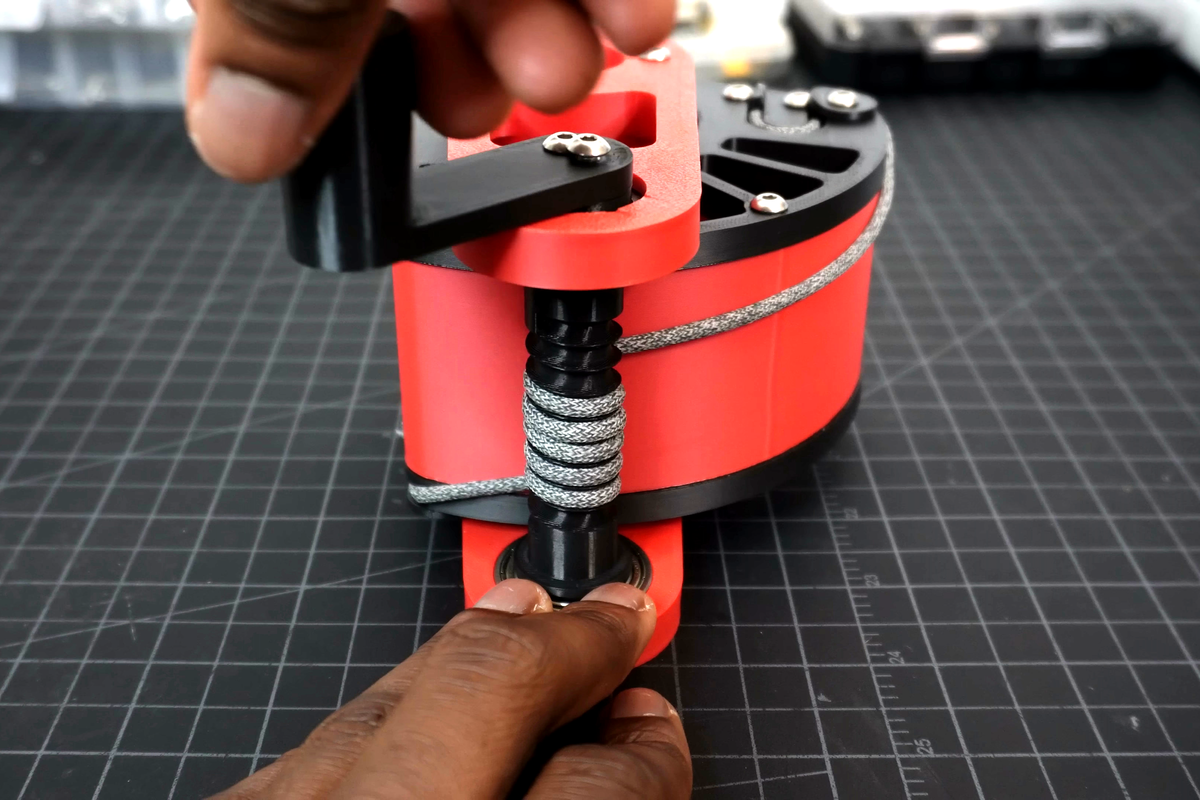
For more than a century, gears have been the dependable little metal teeth inside machines, robots, printers, cars, clocks, and every device that makes a satisfying mechanical click. Gears are not actually “old and busted” in the sense that we should throw them into the junk drawer of history. They are brilliant. They are precise. They are everywhere for good reasons.
But in the maker world, especially in robotics and 3D-printed mechanisms, gears can also be noisy, fussy, expensive, heavy, and occasionally about as forgiving as a cat on bath day. Print a gear slightly wrong, mount it slightly off-center, add a little tooth roughness, and suddenly your elegant robot arm sounds like a pepper grinder auditioning for a horror movie.
That is where the capstan drive enters with quiet confidence. A capstan drive uses a rope, cable, or tendon wrapped around drums to transfer motion and torque. Instead of meshing teeth, it relies on friction, tension, and wrap angle. It looks almost too simple to worklike something invented by a sailor, refined by a robot builder, and approved by someone who owns too many spools of Dyneema. Yet the idea is surprisingly powerful: low backlash, low inertia, smooth motion, quiet operation, and a design that plays nicely with 3D printing.
What Is a Capstan Drive?
A capstan is basically a rotating drum that uses friction to grip a line wrapped around it. If you have ever seen a ship winch, a climbing belay system, a tape recorder, or a rope wrapped around a post to hold a load, you have already met the capstan principle. The mechanical magic is not magic at all; it comes from the capstan equation, which explains how tension increases exponentially as the wrap angle and friction increase.
In a capstan drive, a smaller drum connected to a motor drives a larger output drum through a wrapped cable. The reduction ratio is roughly related to the drum diameters, much like gear reduction is related to gear tooth counts. If the motor drum is small and the output drum is large, the system trades speed for torque. That is the same bargain gears make, except the capstan does it with a flexible tensile element instead of rigid teeth.
The Big Idea: Replace Teeth With Tension
Traditional gears need teeth to push against teeth. A capstan drive needs a cable that stays in tension. That single difference changes the personality of the entire mechanism. A gear train is rigid, compact, and positive-drive. A capstan drive is smooth, compliant, and friction-based. It is not always better, but in the right application it feels like discovering that your toolbox has had a secret level the whole time.
Capstan systems are especially attractive for robotic joints that do not need unlimited rotation. Quadruped legs, robotic arms, haptic devices, camera gimbals, educational actuators, and lightweight experimental mechanisms can all benefit from a drive that reduces backlash without demanding aerospace-grade machining.
Why Makers Are Falling in Love With Capstans
The recent excitement around capstan drives comes from a very practical problem: many hobbyists and researchers want high-performance robot joints without buying expensive precision gearboxes. Strain wave gears and planetary gearheads are excellent, but they can be costly. 3D-printed gears are cheap, but they often bring tooth noise, backlash, friction, and inconsistent quality. Capstans sit in the middle with a wonderfully rebellious attitude: “What if we used rope?”
1. Low Backlash Without Fancy Gear Teeth
Backlash is the tiny gap or lost motion that occurs when a mechanism reverses direction. In gears, backlash is often necessary to prevent binding, allow lubrication, and tolerate manufacturing errors. Unfortunately, robots dislike backlash. A robot joint that hesitates before reversing direction can feel mushy, inaccurate, and hard to control.
A properly tensioned capstan drive can have extremely low backlash because the cable remains loaded against the drums. There are no teeth waiting to take up clearance. When the motor changes direction, the cable tension transmits motion immediatelyassuming the system is designed well and the cable has not gone slack. For precision positioning, that is a delicious mechanical advantage.
2. Low Inertia Makes Robots Feel More Alive
In robotics, inertia is the enemy of quick, responsive motion. Heavy gears mounted near the output joint add rotating mass. That mass must be accelerated, stopped, reversed, and controlled. A capstan drive can move part of the motor mass away from the joint and use lightweight drums and cables, reducing the inertia of the moving assembly.
This is one reason cable-driven mechanisms appear in haptic devices, legged robots, exoskeleton concepts, and experimental robotic limbs. A lower-inertia joint can respond more quickly and can feel more “transparent,” meaning external forces are easier to sense through the mechanism. In plain English: the robot becomes less like a stubborn appliance and more like a limb that actually listens.
3. Quiet Operation Is Not a Small Thing
Anyone who has built a 3D-printed gearbox knows the sound: whirr, buzz, grind, tiny plastic goblin noises. A capstan drive can be almost silent because there are no gear teeth repeatedly colliding. The cable rolls or slides under controlled tension, and the drums can be shaped to guide the line smoothly.
Quiet motion matters in educational robots, indoor research platforms, assistive devices, prosthetic prototypes, camera rigs, and any machine expected to coexist with humans without sounding like it is chewing gravel. Noise is not just annoying; it can indicate vibration, wear, and inefficiency.
How the Capstan Equation Makes Rope Feel Like a Superpower
The capstan equation says that the force ratio between the tight side and slack side of a line wrapped around a drum grows exponentially with friction coefficient and wrap angle. This is why a sailor can control a huge sail line with a few wraps around a winch, and why a climber’s belay device can generate serious holding force from a modest hand force.
For capstan drives, this means that a few turns of cable around a drum can create enough grip to transmit torque without obvious slipping. More wrap angle gives more frictional holding power. Better material pairing between cable and drum improves traction. Proper pretension increases stiffness. Suddenly, a smooth drum and a skinny line can behave like a serious transmission.
Of course, “friction saves the day” is also where the engineering homework begins. Too little friction and the cable slips. Too much friction and the system may wear, heat, or become inefficient. The goal is not maximum grip at all costs. The goal is predictable grip, stable tension, and repeatable motion.
Capstans vs. Gears: The Mechanical Showdown
Calling gears “old and busted” is mostly a joke. Gears are still the right answer in thousands of applications. They provide positive engagement, compact packaging, high torque density, continuous rotation, and reliable timing. If you need a transmission in an engine, a machine tool, an industrial reducer, or a drivetrain that must never slip, gears are not going anywhere.
But capstans can beat gears in several maker-friendly categories.
Capstans Win on Fabrication Forgiveness
3D-printed gears demand reasonably accurate tooth profiles. Layer lines, elephant’s foot, nozzle calibration, and material shrinkage can all affect performance. Capstan drums are more forgiving. A drum surface can be printed, machined, sanded, coated, or grooved. A helical guide can help the cable wind cleanly. The system still needs care, but it does not require dozens of precisely meshing teeth.
Gears Win on Unlimited Rotation
A major drawback of many capstan drives is limited travel. Because the cable winds and unwinds around drums, the system may be constrained to a certain angular range. That is fine for robot knees, hips, elbows, and many linkages. It is not ideal for wheels, spindles, or any shaft that must spin forever like it drank too much coffee.
Capstans Win on Smoothness and Backdrivability
Backdrivability means the output can drive the input. In robotics, this can be valuable for force control, impact absorption, and human-safe interaction. Gearboxes can be backdrivable too, depending on type and ratio, but many high-reduction gear systems add friction and reflected inertia. Capstan drives can offer a more direct, elastic, readable mechanical connection.
Gears Win on Predictable Industrial Ruggedness
Gears are well-understood, standardized, and supported by decades of manufacturing data. Designers can choose materials, lubrication, tooth forms, heat treatments, and gear ratios with high confidence. Capstan drives are also old in principle, but maker-scale capstan robot actuators are still a more experimental playground. That is exciting, but it means you must test early and test often.
The Cable Is the Hero, and Sometimes the Villain
A capstan drive is only as good as its cable. Early prototypes can use shoelaces, cord, fishing line, or steel cable, but serious systems need a material that resists stretch, creep, fatigue, and abrasion.
Steel cable may seem like the obvious grown-up choice, but it can fatigue when repeatedly bent around small drums. Synthetic fibers such as Dyneema DM20, Vectran, and other high-performance lines are attractive because they are strong, light, and flexible. Dyneema in particular has become popular in experimental capstan drives because it offers high strength with very low weight. DM20-style lines are valued where creep resistance matters, meaning the rope should not slowly lengthen under sustained load like a lazy rubber band pretending to be structural.
Creep: The Silent Accuracy Thief
Creep is long-term elongation under load. In a capstan drive, creep can reduce pretension and create slack. Slack creates backlash. Backlash creates sadness. Then the robot misses its target, and you start blaming the firmware even though the cable has quietly stretched behind your back.
The solution is not merely “use stronger rope.” Designers need to consider average load, peak load, temperature, bending radius, termination method, and the expected life cycle. A rope that works beautifully in a weekend prototype may behave differently after thousands of cycles.
Design Lessons for Building a Better Capstan Drive
A capstan drive rewards thoughtful design. It also punishes wishful thinking, which is rude but educational.
Use Enough Wrap Angle
The wrap angle controls how much frictional grip the system can develop. More turns generally increase holding force, but too many turns can create bulk, cable management problems, uneven winding, and friction losses. Many small capstan drive prototypes use a few turns, then tune from there.
Keep the Cable Tensioned
Pretension is the backbone of capstan performance. Without it, the cable can slip, jump grooves, or introduce positioning error. Tensioning can be handled with screws, springs, adjustable anchors, turnbuckles, or carefully designed clamps. The best method depends on whether the system needs easy field adjustment or a set-and-forget assembly.
Respect Bend Radius
Small drums are tempting because they create big reduction ratios in a compact package. But cables hate being bent too tightly. A tiny bend radius can accelerate fatigue, damage fibers, and shorten service life. The drum diameter should match the cable material and load requirements.
Guide the Cable Like It Has Opinions
Cables wander. Belts wander. Anything flexible with tension has a secret desire to leave the party. Grooves, helical winding paths, flanges, and fairlead pulleys can help keep the line where it belongs. If the cable crosses itself, rubs against sharp edges, or piles up unevenly, the drive may become inconsistent.
Test the Terminations
The cable itself may be incredibly strong, but the anchor point can be embarrassingly weak. Knots, clamps, crimps, splices, and printed hooks can all become failure points. A capstan actuator deserves pull testing, cycle testing, and inspection after load. Do not trust a knot just because it looks confident.
Where Capstans Make the Most Sense
Capstan drives are especially appealing in applications where limited rotation is acceptable and low backlash is valuable. A robot dog leg is a perfect example. The hip and knee do not need to spin continuously; they need controlled angular motion, high responsiveness, and enough torque to jump, land, and survive the occasional face-plant.
Five-bar linkages are another excellent playground. A capstan-driven five-bar robot can draw shapes, move quickly, and demonstrate precision without a bulky gearbox at every joint. Haptic devices are also natural candidates because low inertia and smooth backdrivability help users feel virtual forces more naturally.
Educational robotics may be one of the most exciting areas. Students can build precision-ish actuators with printed parts, affordable motors, and cable. They learn friction, tension, elasticity, control, and mechanical testing in one project. That is far more educational than simply bolting on an expensive gearbox and calling it a day.
Where Capstans Are a Bad Idea
Capstans are cool, not magical. They are not ideal for every job. If your application needs continuous rotation, perfect timing with no possibility of slip, exposure to abrasive grit, minimal maintenance, or very high torque in a tiny sealed package, gears may still be the mature adult in the room.
Capstan systems may require tension checks. Cable wear must be monitored. Materials can creep. Drums can polish or abrade. Environmental conditions such as temperature, humidity, dust, oil, and UV exposure can change performance. A capstan drive in a clean lab robot is one thing; a capstan drive in a muddy lawn robot is another. The mud robot will not read your design notes.
Why Capstans Pair So Well With 3D Printing
The capstan renaissance is partly a 3D-printing story. 3D printers make it easy to create custom drums, cable guides, actuator housings, and test fixtures. A maker can iterate rapidly without cutting precision gears. If the drum diameter is wrong, print another. If the cable rubs, add a guide. If the tensioner is awkward, redesign it before dinner.
Capstan drives also tolerate certain imperfections better than gears. A printed drum does not need a perfect involute tooth profile. Surface texture may even help grip, as long as it does not chew the cable. This is a rare case where the humble layered surface of a 3D print can be less of a flaw and more of a design variable.
The Future: Rope-Powered Robots With Better Manners
As robotics moves toward lighter, more compliant, and more affordable machines, capstan drives deserve attention. They offer a pathway to actuators that are quiet, low-cost, backdrivable, and maker-friendly. They also encourage better mechanical thinking. You cannot design a good capstan drive by pretending the cable is a rigid rod. You must understand tension, friction, routing, materials, and failure modes.
The best future is not “capstans replace gears.” That would be silly. The best future is “designers choose the right transmission without defaulting to gears every time.” Sometimes the answer is a planetary gearbox. Sometimes it is a belt. Sometimes it is direct drive. And sometimes, gloriously, it is a rope wrapped around a drum, doing math while looking like a camping accident.
Practical Experiences With Capstan Drives
The first experience many builders have with capstan drives is disbelief. You wrap a line around a small drum, pull it tight, and expect it to slip immediately. Instead, it grips. Add another turn, and it grips harder. Add proper tension, and the whole system begins to feel like a real actuator rather than a science fair dare.
One of the most useful lessons is that capstan drives are easy to prototype but not effortless to perfect. A quick test stand can be made with printed drums, bearings, a brushless motor, and cord. It may move beautifully on the first day. Then, after repeated cycles, the line beds in, tension changes, and the output starts to feel different. This is not failure; it is the mechanism introducing itself.
In hands-on builds, tensioning is usually the part that separates a clever demo from a dependable machine. A screw-based tensioner feels boring until you need one. Then it becomes the hero. Being able to add a quarter-turn of tension, test the joint, and repeat makes development much easier. Spring tensioners can help maintain load, but they can also reduce stiffness if used carelessly. Fixed anchors can be compact, but they make maintenance more annoying. Every design choice brings a tiny invoice.
Cable choice is another experience-rich topic. Soft cord is friendly and cheap, but it stretches. Steel cable is strong, but small-radius bending can fatigue it. High-performance synthetic line feels almost unfairly good when it works, but it demands clean routing and careful terminations. A rough printed edge that seems harmless can become a miniature saw. If the cable fuzzes, frays, or develops shiny wear spots, the mechanism is speaking. Listen before it starts yelling.
Drum geometry also matters more than beginners expect. A flat drum can work, but the cable may walk sideways. A grooved drum guides the line but can create stress concentrations if the groove is too sharp. A helical path can make winding predictable, but it may slightly change the effective reduction and complicate the math. This is where a bench test becomes more honest than a spreadsheet. The spreadsheet is still useful; it just has never watched a cable climb over itself at 2 a.m.
Another common discovery is that capstan drives feel unusually smooth. Compared with a cheap printed gear train, a well-tensioned capstan actuator can reverse direction with less clatter and less obvious lost motion. That smoothness is addictive. It makes small robot joints feel more expensive than they are. It also makes control tuning more enjoyable because the mechanism is not constantly adding mystery slop.
Still, the experience is not all sunshine and perfectly wrapped cable. Capstan drives require inspection. They like clean assembly. They reward alignment. They punish lazy cable anchoring. If you build one for a robot leg, you will eventually learn what happens when impact loads, fast reversals, and imperfect tension meet in the same small plastic housing. Usually, the answer is “redesign the tensioner” or “make the drum bigger” or “why is there cable dust on my desk?”
The real joy of capstan drives is that they make mechanical design visible. Gears often hide their problems inside a box. Capstans put the physics right in front of you. You can see the wrap, feel the tension, inspect the cable path, and understand why the output moves. For students, makers, and robotics experimenters, that transparency is priceless. It turns a transmission into a lesson you can touch.
So yes, gears are still great. But capstans are cool because they remind us that clever machines do not always need more teeth. Sometimes they need better tension, smarter friction, and a humble piece of line doing heroic work in silence.
Conclusion
Capstan drives are not a universal replacement for gears, but they are one of the most exciting transmission ideas for modern makers, lightweight robots, and 3D-printed mechanisms. They offer low backlash, smooth motion, quiet operation, and a surprisingly affordable path toward precision actuation. The trade-offs are real: limited rotation, cable creep, tension maintenance, and careful routing. But for robot joints, haptic devices, five-bar linkages, and experimental actuators, capstans deserve a serious look.
The best mechanical designers do not worship one solution. They compare tools. Gears are still kings of positive engagement and rugged industrial transmission. Capstans are the elegant rope-powered rebels that make lightweight motion feel smooth, responsive, and oddly delightful. In the right design, that old sailor’s trick becomes a modern robotics advantage.












