
Note: This article is written in a first-person creative nonfiction style, inspired by real microsculpture techniques, miniature art traditions, and accurate dinosaur research.
I make dinosaurs small enough to look like they escaped from a museum, took a wrong turn, and ended up hiding on the head of a pin. That is the strange little universe of microsculpture: a world where a T. rex jaw can be ruined by one sneeze, a Stegosaurus plate can vanish into carpet forever, and a single eyelash can feel like heavy machinery.
Microsculpture is not simply “making small things.” It is patience wearing a tiny tool belt. It combines sculpture, painting, model making, breath control, paleontology, and the kind of stubbornness usually reserved for opening a pickle jar that clearly has personal issues. When I decided to create 11 tiny dinosaur sculptures, I wanted each piece to do more than look cute under magnification. I wanted every miniature dinosaur to carry a little scientific truth: the posture, the texture, the anatomy, the attitude, and the story of an animal that lived millions of years before humans began arguing over whether pineapple belongs on pizza.
Why Tiny Dinosaur Sculptures Are So Fascinating
Dinosaurs already live in the imagination at dramatic scale. Tyrannosaurus rex is massive. Brachiosaurus is skyscraper-adjacent. Triceratops looks like nature designed a living shield and then added horns for emphasis. Shrinking them into handmade dinosaur miniatures creates a funny tension: the biggest creatures become the smallest objects. That contrast is exactly what makes miniature dinosaur art so addictive.
There is also a deeper challenge. A large dinosaur model can use size to impress people. A micro sculpture cannot. At a tiny scale, every detail must earn its place. One misplaced dot of paint can turn a Velociraptor into a surprised chicken nugget. One heavy touch can flatten a Brachiosaurus neck into prehistoric spaghetti. In microsculpture, the drama is not only in the finished artwork; it is in surviving the making of it.
The Process: How I Make Miniature Dinosaur Art
Before I sculpt anything, I research. I look at fossil reconstructions, museum references, skeletal proportions, and updated paleo art. Dinosaurs are not the tail-dragging monsters many of us grew up seeing in old cartoons. They were diverse, active animals that lived across the Triassic, Jurassic, and Cretaceous periods. Some had feathers. Some had armor. Some had long necks, sails, horns, claws, beaks, or tail clubs. A good tiny dinosaur sculpture should respect that variety.
Tools, Materials, and One Very Nervous Table
My tools are not glamorous. I use sharpened wire, handmade micro blades, ultra-fine brushes, magnification, soft lighting, and a work surface that must remain as still as possible. Materials may include polymer clay, resin, fine wire, pigment, micro beads, and carefully shaped fragments of hardened material. At this scale, a dust speck is not dust. It is a boulder with confidence.
The hardest part is movement. Breathing moves the hands. A heartbeat moves the fingers. A truck passing outside can feel like a minor earthquake. Microsculpture teaches you that the body is not as still as you think it is. You learn to pause, breathe gently, make one mark, and then back away before excitement ruins everything.
My 11 Tiny Sculptures Of Dinosaurs
This collection began with a simple idea: create a miniature dinosaur gallery that feels playful but still honors real prehistoric animals. I did not want generic green monsters. I wanted personality, proportion, and enough detail that each tiny sculpture could be recognized under magnification.
1. Tyrannosaurus rex: The Tiny King With Big Dental Energy
The first sculpture had to be Tyrannosaurus rex, because ignoring T. rex in a dinosaur collection is like opening a pizza shop and refusing to discuss cheese. My tiny T. rex stands with a forward-leaning posture, powerful legs, a thick tail for balance, and a head that takes up a hilariously large portion of its body. Even in miniature form, the jaw needed to feel heavy and dangerous.
The biggest challenge was the teeth. At normal scale, T. rex teeth are terrifying. At micro scale, they are tiny pale marks that can easily become accidental frosting. I added the suggestion of individual teeth rather than carving every one. Microsculpture often works like poetry: a few correct details let the viewer’s brain complete the animal.
2. Triceratops: Three Horns, One Microscopic Attitude
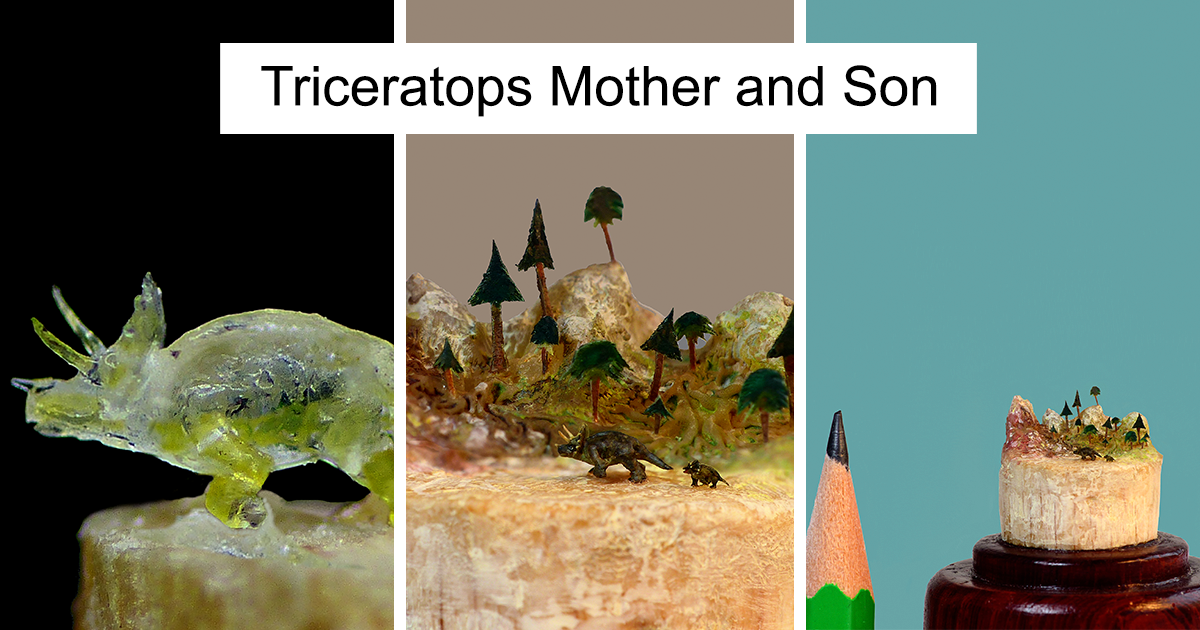
Triceratops is built like a prehistoric bulldozer with a decorative shield. For this tiny dinosaur sculpture, I focused on the frill, the brow horns, and the beak. The body is squat, sturdy, and low to the ground, because Triceratops should never look like it skipped leg day.
The frill was the most delicate section. Too thick, and it looked like a dinner plate. Too thin, and it snapped. I shaded the edges lightly to make the bony shield stand out. The finished piece has the energy of a very small animal that would still like you to respect its personal space.
3. Stegosaurus: The Plate-Backed Puzzle
Stegosaurus is one of the best dinosaurs for miniature art because its silhouette is unmistakable. Small head, arched back, upright plates, and a spiked tail: it is basically a walking logo for the Jurassic Period. My version is smaller than a seed, but the plates still rise along the back in alternating shapes.
The plates were maddening. Each one had to be placed individually, and each one had to look intentional. A crooked plate can be charming. Eleven crooked plates look like the dinosaur lost a fight with a tiny fence. I kept the tail spikes sharp in shape but rounded enough to survive handling under magnification.
4. Velociraptor: Feathered, Fast, And Not A Movie Monster
Velociraptor might be the most misunderstood dinosaur in pop culture. The movie version is large, scaly, and terrifying. The real animal was much smaller, feathered, and more birdlike than many people expect. For my tiny Velociraptor sculpture, I leaned into the feathers. I gave it a low, alert posture, a long tail, and a lifted sickle claw.
At micro scale, feathers are suggested through texture rather than carved one by one. I used fine strokes along the arms, tail, and body to create a soft edge. The result looks less like a monster and more like a prehistoric hawk that has just remembered you owe it money.
5. Brachiosaurus: The Gentle Giant Reduced To A Comma
Brachiosaurus was the emotional opposite of T. rex. Instead of teeth and menace, I needed height, calm, and elegance. The long neck is the soul of the sculpture. If it bends too much, the dinosaur looks tired. If it stands too stiff, it looks like a tiny plastic giraffe attending a formal dinner.
I shaped the body as a small rounded form, then built the neck upward in a slow curve. The front legs are slightly taller, giving the animal that classic high-shouldered look. Even tiny, Brachiosaurus feels peaceful, like it is browsing leaves from an invisible tree and refusing to participate in drama.
6. Ankylosaurus: The Armored Bean With A Tail Club
Ankylosaurus is pure defensive engineering. It had armor across its body and a heavy club at the end of its tail. In miniature form, it became one of the most satisfying pieces because the whole sculpture is about texture. I built the body low and wide, then added tiny bumps to suggest armor plates.
The tail club was the hero detail. Without it, the sculpture looked like a grumpy potato. With it, it became Ankylosaurus. That is the magic of miniature dinosaur art: one small feature can carry the identity of the entire animal.
7. Spinosaurus: The Sail-Backed River Hunter
Spinosaurus is a dream for a microsculptor because it looks unlike almost anything else. The long snout, cone-shaped teeth, tall sail, and semi-aquatic lifestyle give it a strange elegance. I sculpted mine with the head slightly lowered, as if watching water for fish.
The sail was tricky because it had to be thin but visible. I shaped it as a raised ridge along the back, then added a slight color gradient to make it stand apart from the body. The jaws were kept narrow to avoid turning Spinosaurus into a crocodile wearing a backpack. The final piece feels like a tiny river monster with excellent branding.
8. Parasaurolophus: The Crest That Steals The Show
Parasaurolophus is all about the crest. That long backward tube gives the dinosaur one of the most recognizable profiles in paleontology. Some scientists have suggested the crest may have played a role in sound, display, or species recognition. For a sculpture this small, it mostly played a role in making me question my life choices.
The crest had to be thin, smooth, and strong enough not to break when I breathed too proudly near it. I posed the animal mid-step, with the head lifted. It looks gentle, curious, and slightly musical, like it might honk politely before entering a room.
9. Microraptor: Four Wings In Almost No Space
Microraptor is one of my favorites because it brings dinosaurs and birds into the same tiny conversation. This small feathered dinosaur had long feathers on its arms and legs, creating a four-winged appearance. Sculpting that at micro scale is like trying to fold origami with a sigh.
I made the body dark and sleek, then used fine feather shapes to extend the limbs. The goal was not to create a perfect anatomical model but to capture the impression of a feathered dinosaur built for movement through trees or air. It is the most delicate sculpture in the collection, and also the one most likely to make viewers say, “Wait, dinosaurs did that?”
10. Apatosaurus: The Long-Necked Classic
Apatosaurus has the kind of classic dinosaur shape that feels instantly nostalgic: long neck, long tail, huge body, small head. The challenge was balance. A tiny sculpture with a long neck and tail wants to tip, sag, or collapse into a prehistoric question mark.
I kept the pose grounded, with the tail stretching behind the body like a counterweight. The head is small but carefully placed, giving the animal a calm, grazing expression. Not every dinosaur sculpture needs to roar. Some simply stand there being enormous, even when they are barely larger than a crumb.
11. Compsognathus: The Tiny Dinosaur That Belongs In A Tiny Collection
Compsognathus felt like the perfect final piece because it was already small compared with many famous dinosaurs. In a collection of tiny sculptures, it becomes a joke inside a joke: a miniature version of a dinosaur known for being miniature.
I sculpted it with quick legs, a narrow body, and a lively tail. The expression is alert and mischievous. If the T. rex is the king of the collection, Compsognathus is the tiny intern who knows where all the snacks are hidden. It brings humor to the set and reminds viewers that dinosaur diversity was enormous. They were not all giants. Some were small, fast, and probably very annoying to anything trying to nap.
What These Tiny Dinosaur Sculptures Taught Me
Making these 11 tiny sculptures of dinosaurs changed the way I think about both art and paleontology. Large artwork often announces itself from across the room. Microsculpture whispers. It asks people to lean in, slow down, and pay attention. That feels appropriate for dinosaurs, because fossils also ask us to look carefully. A bone, a tooth, a trackway, or a feather impression can rewrite an entire story.
The collection also reminded me that accuracy and charm can work together. A dinosaur sculpture does not need to be boring to be educational. A feathered Velociraptor can still be exciting. A scientifically updated Spinosaurus can still look dramatic. A Stegosaurus can be cute and still carry its defensive tail spikes with dignity.
My Personal Experience Creating Tiny Dinosaur Sculptures
The most memorable part of this project was learning how different each dinosaur felt in my hands, even before it looked finished. T. rex felt like architecture: skull, hips, tail, balance. Triceratops felt like shield-making. Stegosaurus felt like arranging microscopic roof tiles during an earthquake. Velociraptor felt like drawing motion into something almost too small to see. Every piece had a personality before it had paint.
I usually start with a rough shape and then remove or add material until the animal appears. That sounds mystical, but most of the time it looks like me hunched over a desk, muttering, “Please do not break,” to a speck. Microsculpture is humbling because the artwork does not care about your schedule. If the material is too soft, the details smear. If it is too hard, the tool skids. If the lighting is wrong, you chase shadows instead of forms. The studio becomes a tiny weather system, and you are the nervous meteorologist.
Painting is where the sculptures come alive, but it is also where disaster likes to wear tap shoes. A normal brushstroke is huge at this scale. I thin the paint, remove almost all of it from the brush, and touch the surface lightly. Sometimes the color lands perfectly. Sometimes it creates a blob that makes a dinosaur look as if it has been hit with a berry smoothie. When that happens, I breathe, clean what I can, and remind myself that even the fossil record is incomplete.
The emotional reward comes when the sculpture finally reads as the animal I imagined. The first time I saw the tiny Triceratops horns line up under magnification, I laughed out loud. The first time the Microraptor feathers caught the light, I forgot how frustrating they had been. The tiny Spinosaurus sail gave me the same feeling as seeing a museum mount from across a hall: recognition, wonder, and a little shiver of ancient weirdness.
People often ask why anyone would spend so much time on art that cannot be fully appreciated with the naked eye. My answer is simple: because looking closely changes people. When someone bends over a lens and sees a whole dinosaur smaller than a grain of rice, their face shifts from confusion to delight. For a second, they become a kid again. They discover that small things can hold big stories.
That is why I keep making miniature dinosaur art. It is not only about technical skill. It is about building a doorway into wonder. Dinosaurs already make us feel small in the grand timeline of Earth. Microsculpture flips that feeling in the funniest way possible: it makes dinosaurs small enough to fit in front of us, while somehow making our curiosity feel enormous.
Conclusion
Creating 11 tiny sculptures of dinosaurs was equal parts science lesson, art challenge, and comedy routine performed for an audience of dust particles. Each dinosaur pushed me to solve a different problem: the teeth of T. rex, the horns of Triceratops, the plates of Stegosaurus, the feathers of Velociraptor and Microraptor, the sail of Spinosaurus, and the long necks of Brachiosaurus and Apatosaurus.
Microsculpture rewards patience. Dinosaur art rewards research. Put them together, and you get a collection that celebrates scale, imagination, and the astonishing variety of prehistoric life. These tiny dinosaur sculptures may be small, but they carry a huge message: wonder does not need a large canvas. Sometimes it fits on the tip of a tool, under a lens, waiting for someone to look closer.












