
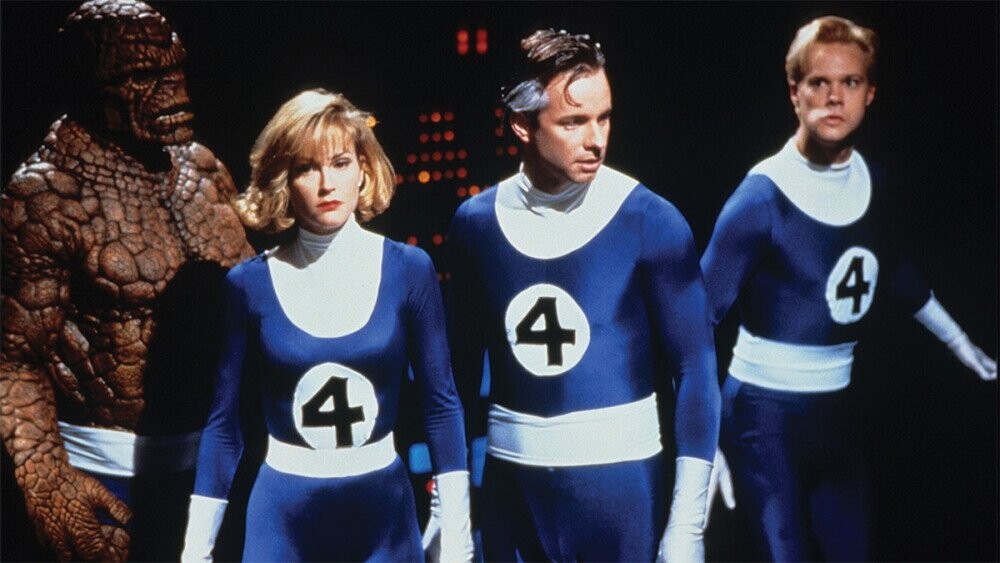
The Fantastic Four have always been Marvel’s trickiest family dinner. On paper, they should be the easiest superhero team to adapt: a brilliant scientist, his equally brilliant partner, her hotheaded brother, and their rock-skinned best friend explore the unknown, argue like relatives stuck in a holiday kitchen, and save the universe before dessert. Yet on screen, the First Family has had a bumpy road full of false starts, strange creative choices, and one legendary film that was finished, promoted, and then shoved into Hollywood’s secret basement like a cursed family photo.
That film is The Fantastic Four from 1994, produced by Roger Corman and directed by Oley Sassone. It was never officially released, but bootlegs, documentaries, fan discussions, and decades of comic-book archaeology have turned it into one of the most fascinating artifacts in superhero cinema. It had a tiny budget, rubbery effects, a Doctor Doom who looked like he escaped from a community theater production of “Space Macbeth,” and more sincerity than many blockbusters with the GDP of a small nation.
Now that Marvel Studios has brought the team into the MCU through The Fantastic Four: First Steps, the old 1994 movie is more than a punchline. It is a weird, charming, low-budget lesson plan. The MCU does not need to copy its limitations, of course. Nobody is asking Galactus to arrive wearing painted cardboard and a fog machine. But the 1994 movie understood several things about the Fantastic Four that bigger productions have sometimes missed. It knew that this team works best when it feels like a family, a science-adventure club, and a comic book brought to life without embarrassment.
The 1994 Fantastic Four Movie Was Small, But It Was Not Cynical
The first lesson is simple: sincerity matters. The 1994 Fantastic Four was reportedly made under complicated rights circumstances, with a very modest budget and a rushed production schedule. Yet the cast played the material straight. Alex Hyde-White as Reed Richards, Rebecca Staab as Sue Storm, Jay Underwood as Johnny Storm, Michael Bailey Smith as Ben Grimm, Carl Ciarfalio as The Thing, and Joseph Culp as Doctor Doom did not wink at the camera as if they were too cool for comic books. They committed.
That commitment is important because the Fantastic Four collapse the moment a movie treats them like an apology. The characters are not gritty street-level vigilantes. They are explorers, celebrities, scientists, siblings, spouses, rivals, and occasionally walking public-relations disasters. Their world should have big emotions, bright colors, strange machines, impossible skies, and family arguments conducted while someone is wearing a blue jumpsuit with a giant “4” on the chest. That is not a bug. That is the operating system.
The MCU can learn from the 1994 film’s willingness to embrace the premise without snickering. Yes, the old movie looks inexpensive. Yes, some effects have aged like milk left under a tanning lamp. But it never seems ashamed of being a Fantastic Four story. In an era when superhero movies sometimes over-explain their own weirdness, that confidence is refreshing.
Lesson One: The Team Must Feel Like a Family Before They Feel Like a Franchise
The Fantastic Four are not just “four heroes who work together.” That would be the Avengers with matching laundry. Reed, Sue, Johnny, and Ben are built on shared history. Reed and Sue carry the emotional weight of partnership. Johnny brings chaos, youth, ego, and heart. Ben is the bruised soul of the group, the one whose transformation is both superpower and wound. Their adventures matter because the audience cares whether these people still love each other after the lab explodes.
The 1994 movie, for all its technical rough edges, put the origin and group bond front and center. It understood that Ben’s tragedy cannot be reduced to “big orange guy punches stuff.” Ben Grimm is not only The Thing; he is a man grieving the loss of his old body while learning that his new form can still be heroic. That emotional idea is the key to the character. If the MCU wants The Thing to land with audiences, it should make room for humor, pain, loneliness, and loyalty. Clobberin’ time works best when it comes from a bruised heart.
The same applies to Sue Storm. The MCU should avoid treating Sue as merely “the responsible one” or “Reed’s partner.” The Fantastic Four work when Sue is the emotional strategist, the moral center, and sometimes the most powerful person in the room. A great Sue Storm does not simply turn invisible; she sees what everyone else misses.
Lesson Two: Doctor Doom Needs Grandeur, Not Just a Grudge
Doctor Doom is one of Marvel’s greatest villains because he is not merely evil. He is theatrical, brilliant, wounded, arrogant, and convinced that the world would be better if everyone stopped arguing and let him run it. He is part dictator, part sorcerer, part scientist, part opera singer trapped in a suit of armor. Subtle? Not usually. Memorable? Absolutely.
Joseph Culp’s Doctor Doom in the 1994 film may not have had the production resources to feel truly imperial, but the performance understood Doom’s dramatic scale. Doom should not feel like a tech CEO having a bad quarter. He should feel like a man who would monologue during a meteor shower because the universe clearly scheduled the lighting for him.
The MCU has a major opportunity here. If it uses Doctor Doom, it should resist shrinking him into a simple rival or a one-movie villain. Doom’s connection to Reed Richards is important, but Doom is bigger than jealousy. He is a ruler, a mythmaker, and a mirror image of Reed’s intellect without Reed’s humility. The 1994 movie reminds Marvel that Doom should be bold, strange, and unapologetically larger than life.
Lesson Three: Keep the Comic Book DNA Visible
One of the most lovable things about the 1994 Fantastic Four is its comic-book directness. The costumes are bright. The powers are clearly defined. The team identity is not hidden under layers of tactical gray. It looks like a comic book because that was the assignment.
Modern superhero movies often worry that colorful costumes will seem silly. But audiences have moved past that fear. They have accepted talking raccoons, multiverse variants, giant celestial beings, and men named Ant-Man. The Fantastic Four do not need to be sanded down. They need design language that says “adventure,” “science,” “family,” and “Jack Kirby energy” before anyone says a line of dialogue.
The Fantastic Four: First Steps wisely leaned into a retro-futuristic 1960s-inspired style, which fits the characters beautifully. That is exactly the kind of bold identity the franchise needs. The Fantastic Four should not look like every other MCU corner. Their world should feel like tomorrow as imagined by yesterday: sleek rockets, impossible architecture, cosmic maps, optimistic technology, and enough chrome to make a toaster jealous.
Lesson Four: Practical Texture Still Matters
The 1994 film relied on practical suits, makeup, miniatures, and old-school effects because it had no other choice. Not every result was convincing, but the physical texture gave the movie a handmade charm. The Thing suit, in particular, created a presence that digital effects sometimes struggle to replicate. You could feel the performer inside it trying to communicate Ben’s sadness and strength through posture, movement, and timing.
The MCU has access to world-class visual effects, and it should use them. Reed’s stretching, Sue’s force fields, Johnny’s flames, cosmic travel, and Galactus-scale spectacle demand modern tools. But the lesson from 1994 is not “avoid CGI.” The lesson is “do not let effects replace performance.” A great Fantastic Four movie needs physicality. Ben should feel heavy. Johnny’s flames should feel dangerous. Reed’s stretching should be weird, clever, and occasionally unsettling. Sue’s invisible force fields should feel elegant and powerful, not like generic blue energy from the superhero vending machine.
Lesson Five: The Origin Story Is Less Important Than the Emotional Story
The 1994 movie retold the team’s origin because it had to introduce the characters from scratch. Today, audiences are fluent in superhero language. They do not need every reboot to spend half the movie explaining that radiation plus ambition equals stretchy arms and family trauma. The MCU can move faster, but it should not skip emotional grounding.
The best approach is to treat the origin as history, not homework. Show how the accident shaped each person. Show how their fame changed their relationships. Show why Reed still feels responsible, why Sue holds the family together, why Johnny performs confidence even when afraid, and why Ben uses jokes like armor. Viewers do not need another checklist origin. They need to feel the cost of becoming fantastic.
Lesson Six: The Fantastic Four Should Be Explorers First
Many superhero teams exist to stop crimes or fight invasions. The Fantastic Four are different. They are explorers. Their natural habitat is the impossible: the Negative Zone, deep space, alternate dimensions, hidden civilizations, cosmic entities, strange laboratories, and dinner tables where someone accidentally opens a portal near the salad.
The 1994 film did not have the budget to fully explore that sense of wonder, but it clearly wanted to. Its ambition was bigger than its wallet. That ambition is exactly what the MCU should preserve. A Fantastic Four story should feel like discovery. The audience should sense that every door in the Baxter Building might lead to a new scientific miracle or a disaster requiring three apologies and a new insurance policy.
This is where the MCU can make the team essential rather than decorative. The Fantastic Four should expand the universe. They should bring in cosmic threats, scientific mysteries, and moral questions that cannot be solved by punching alone. Reed’s intelligence should create solutions and problems. Sue’s judgment should keep the team human. Ben’s loyalty should anchor the adventure. Johnny’s courage should turn recklessness into heroism.
Lesson Seven: Respect the Underdog Legacy
One of the most touching developments around The Fantastic Four: First Steps was the renewed attention given to the 1994 cast. For decades, the unreleased film was treated like a joke, but the people who made it were not joking. They were working actors, craftspeople, and filmmakers trying to honor beloved characters under difficult circumstances.
That history matters because superhero cinema is built on layers. Before billion-dollar cinematic universes, there were low-budget experiments, TV movies, serials, practical suits, awkward effects, and performers doing their best with very little. The MCU can honor that lineage without turning every movie into a cameo museum. A small nod, a respectful reference, or a thematic echo can acknowledge the past while still moving forward.
The 1994 movie proves that fans often respond to effort, not perfection. A flawed movie can survive if people feel the heart beating underneath the foam latex. That is a powerful lesson for a studio machine sometimes accused of being too polished, too connected, or too busy setting up the next thing.
What The MCU Should Avoid
Do Not Turn the Team Into Generic Avengers
The Fantastic Four should not simply become another superhero squad waiting for a crossover alarm. Their dynamic is more domestic, more scientific, and more exploratory. They are not soldiers. They are a family business with cosmic consequences.
Do Not Make Everything Dark and Serious
Yes, the Fantastic Four can handle grief, sacrifice, and danger. But their core tone should include wonder, humor, warmth, and oddball invention. If a Fantastic Four movie is afraid of being fun, it has already misplaced the keys to the Fantasti-Car.
Do Not Waste Doctor Doom
Doom should not be a disposable villain. He deserves patience, mythology, and scale. His rivalry with Reed should feel personal, but his ambition should feel global, cosmic, and terrifyingly sincere.
Why the 1994 Movie Still Matters
The 1994 Fantastic Four matters because it is a reminder that faithfulness is not only about budget. It is about tone, character, and affection for the source material. The film could not deliver modern spectacle, but it delivered a blueprint of what the Fantastic Four should feel like: earnest, colorful, strange, emotional, and slightly ridiculous in the best possible way.
The MCU has advantages the 1994 filmmakers could only dream of: major stars, advanced effects, global distribution, deep comic knowledge, and a fanbase trained to accept cosmic weirdness. But bigger tools do not automatically create a better Fantastic Four story. The heart of the franchise is still four people walking into the unknown together and coming home as a family.
500 More Words of Experience and Reflection: Watching the 1994 Movie Like a Fan, Not a Judge
Watching the 1994 Fantastic Four today is a strange experience, especially if you approach it after years of polished Marvel movies. Your first instinct may be to laugh at the seams. The sets look small. The effects are charmingly stiff. Some scenes carry the unmistakable perfume of “we had one take and a sandwich budget.” But after a while, something unexpected happens: you stop watching it like a failed blockbuster and start watching it like a group of people trying very hard to make the Fantastic Four real.
That shift matters. It is easy to mock an old superhero movie from the comfort of the streaming age, when even a mid-tier production can summon digital cities, glowing portals, and armies of sky creatures. But the 1994 film came from a different world. Superhero movies had not yet become Hollywood’s dominant species. Comic-book accuracy was not guaranteed. Many studios still treated the genre as risky, childish, or niche. Against that background, the film’s insistence on blue suits, big emotions, and classic character dynamics feels oddly brave.
The most valuable viewing experience is noticing how much the movie wants to be about people. Ben’s transformation is not just a visual gag. Reed’s guilt is not just plot glue. Sue and Johnny are not random teammates. Doctor Doom is not merely a masked obstacle. The movie may not always express these ideas gracefully, but the ideas are there. You can feel the creators reaching toward the emotional architecture of the comics.
That is exactly what the MCU should keep in mind. Fans will forgive many things if the emotional architecture is strong. They will forgive a goofy line, a strange costume choice, or even a visual effect that does not age perfectly. What they rarely forgive is a movie that misunderstands why the characters matter. The Fantastic Four are not beloved because Reed can stretch or Johnny can flame on. They are beloved because their powers externalize their personalities, conflicts, and bonds. Reed reaches too far. Sue protects. Johnny burns bright. Ben carries the weight.
The 1994 movie also teaches that limitations can create clarity. Because it could not rely on endless spectacle, it had to stage simple character moments. Modern blockbusters sometimes drown those moments under noise. A good Fantastic Four movie should certainly deliver cosmic scale, but it should also know when to slow down and let Ben sit with his sadness, let Sue challenge Reed, let Johnny reveal insecurity beneath swagger, or let the family share a quiet victory before the next impossible threat arrives.
In the end, the 1994 film is not a model of technical excellence. It is a model of earnest intention. It says, “Here are the Fantastic Four, and we believe they matter.” That belief is the thing the MCU must protect. Give the team spectacle, yes. Give them Galactus, Doom, the Negative Zone, and a Baxter Building full of retro-futuristic wonders. But above all, give them heart. Without that, even the best effects are just expensive wallpaper.
Conclusion
The MCU’s Fantastic Four can learn a surprising amount from the unreleased 1994 movie. Not how to stage visual effects, not how to manage franchise rights, and definitely not how to keep a movie off shelves for three decades. The real lessons are deeper: respect the comic-book roots, center the family bond, let Doctor Doom be grand, preserve the spirit of exploration, and never confuse sincerity with silliness.
The 1994 film became a cult legend because it tried. It tried with limited money, limited time, and limited industry support. That effort still shows. For Marvel Studios, the challenge is different but just as important. With all the resources in the world, the MCU must remember that the Fantastic Four are not powerful because they are polished. They are powerful because they are human, messy, brilliant, loyal, and brave enough to step into the unknown together.
Note: This article is written from researched public information about the 1994 unreleased Fantastic Four film, Marvel Studios’ The Fantastic Four: First Steps, superhero film history, box office reporting, official Marvel materials, and major entertainment coverage. Source links are intentionally not inserted to keep the HTML clean for web publishing.












