
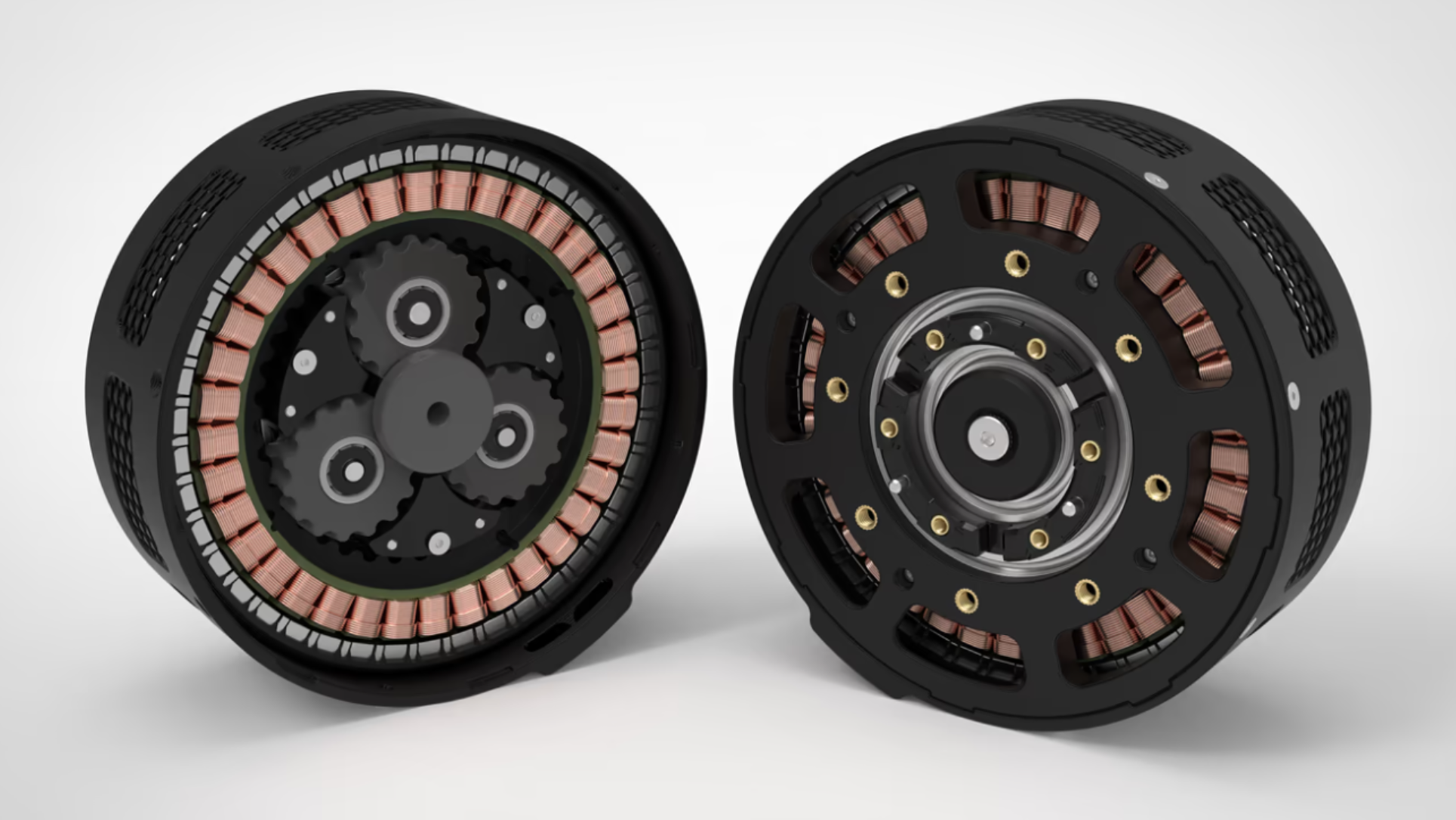
Some robot parts sound expensive before you even touch them. Say “quasi-direct-drive actuator” at a hobby robotics meetup and half the room imagines a laboratory invoice with too many zeroes. But the idea behind a budget quasi-direct-drive motor inspired by MIT’s Mini Cheetah is refreshingly practical: take the agility, torque transparency, and backdrivable feel of a high-performance robotic actuator, then ask, “Can we build something useful without selling a kidney, a GPU, or the family lawn mower?”
The answer is increasingly yes. MIT’s Mini Cheetah helped popularize a compact actuator philosophy built around a brushless DC motor, a low-ratio gearbox, and smart control. Instead of relying on a huge, high-reduction gearbox that makes a robot joint stiff and stubborn, quasi-direct-drive systems use modest gearing to multiply torque while preserving responsiveness. In plain English, the joint can push hard, move fast, and still “feel” the world. That is exactly the kind of behavior dynamic robots need when they trot, hop, recover from a stumble, or politely avoid turning themselves into expensive floor confetti.
Recently, makers and robotics builders have pushed this concept into cheaper territory. One standout example is a low-cost, 3D-printed QDD-style actuator designed for hobby and research projects, inspired by the MIT Mini Cheetah approach but optimized for accessibility. It swaps exotic manufacturing for clever geometry, printed components, hand winding, affordable controllers, and a willingness to prototype until the scrap bin looks like a tiny plastic robot graveyard.
What Is a Quasi-Direct-Drive Motor?
A quasi-direct-drive motor is not fully direct drive, but it tries to keep many of the best direct-drive qualities. A true direct-drive motor connects the motor directly to the output joint with no gearbox. This gives excellent transparency and low friction, but it usually requires a large motor to generate enough torque. Traditional servo systems go the other direction: they use high gear reductions to amplify torque, but that can increase friction, reflected inertia, backlash, and mechanical stiffness.
Quasi-direct-drive sits in the middle. It typically uses a large-diameter brushless DC motor paired with a low-ratio transmission such as 6:1, 7:1, 8:1, 9:1, or 10:1. That low reduction multiplies torque without turning the joint into a brick wearing bearings. The result is a compact robotic actuator with useful torque density, good backdrivability, and better force control than many high-ratio geared systems.
The Big Idea: Torque Without the Tin-Can Robot Feel
Robots that interact with the world need more than raw strength. A legged robot must absorb impacts. A robotic arm should not behave like an angry industrial gate. A research actuator needs to respond quickly to commands and external forces. QDD actuators are attractive because they provide torque while keeping the joint mechanically “honest.” When something pushes the output, the system can sense or respond to that interaction instead of hiding everything behind a stiff gearbox.
This is why QDD designs appear so often in quadrupeds, humanoids, robotic arms, and open-source legged robot projects. They help bridge the gap between delicate lab machines and athletic robots that can survive the real world, where the floor is uneven, gravity is rude, and every prototype eventually meets the edge of a table.
Why MIT’s Mini Cheetah Became the Reference Point
MIT’s Mini Cheetah became famous because it made dynamic legged robotics look almost playful. The robot is small, modular, electrically actuated, and capable of athletic movements that once required larger, more fragile, or more expensive systems. Its actuator philosophy is especially important: each joint is driven by a compact motor module using commercially available motor concepts, low-ratio gearing, sensing, and control electronics.
The Mini Cheetah’s design helped prove that dynamic robots do not always need giant hydraulic systems or ultra-custom hardware to be impressive. Its modular motors can be replaced more easily than deeply integrated systems. That matters for research because robots fall. They fall while learning. They fall while testing. They fall in ways that make graduate students stare silently into the middle distance. A modular actuator lets the team repair, iterate, and return to testing quickly.
The 6:1 Gearbox Lesson
One of the most discussed features of the Mini Cheetah actuator is its low-ratio gearbox. A single-stage reduction around 6:1 gives the joint more torque while preserving high speed and responsiveness. This is very different from a conventional gearbox with a large reduction ratio, where the joint may be strong but less backdrivable and less suitable for precise force interaction.
For budget builders, the takeaway is not “copy MIT exactly.” The real lesson is design balance. Use enough reduction to get useful torque. Keep the ratio low enough that the actuator remains responsive. Choose the motor diameter, winding, controller, encoder, bearings, and gearbox around the motion you actually need. In other words, do not build a backflipping robot leg when your project is a desk-sized SCARA armunless your desk has excellent health insurance.
The Budget Approach: Inspired, Not Cloned
A budget quasi-direct-drive motor inspired by MIT’s Mini Cheetah usually starts with the same principles but different constraints. The goal is not to produce a lab-grade duplicate. It is to create an affordable actuator that captures enough of the QDD behavior to be useful in real projects.
That means using accessible components: a BLDC stator that can be bought online, permanent magnets, 3D-printed housings, a compact low-ratio gearbox, an encoder, and a controller capable of field-oriented control. The builder may hand-wind the stator, print custom parts, test different materials, and accept that early prototypes will make noises best described as “mechanical popcorn.”
Cost Is a Design Constraint, Not Just a Shopping Problem
Cheap parts do not automatically make a good actuator. A low-cost QDD motor needs thoughtful design to avoid wasting money on failed prints, weak gears, overheating coils, poor alignment, or controllers that behave like they are negotiating with ghosts. Cost control begins with architecture: fewer machined parts, printable geometry, standard bearings, a reasonable motor size, and a controller that is good enough for closed-loop torque or position control.
In one notable budget design, the target was under $80 per actuator, with every custom component 3D printable and no need for metal machining. The design used a large-diameter radial BLDC layout, a low-ratio gearbox, a carefully arranged magnet rotor, and a controller based on affordable open motor-control ecosystems. That combination pushed the concept far below the cost of many commercial QDD actuators.
Core Components of a Budget QDD Actuator
A budget QDD actuator may look like a compact pancake motor from the outside, but inside it is a crowded little apartment where magnets, copper, plastic gears, bearings, sensors, and firmware all argue about physics.
1. Large-Diameter BLDC Motor
The motor is the heart of the system. A larger air-gap radius helps improve torque production because torque benefits strongly from motor diameter. This is why many QDD actuators use flat, pancake-style brushless motors instead of long, narrow motors. A wide rotor gives the magnetic forces more leverage, much like using a longer wrench to loosen a stubborn bolt.
For a budget design, builders may use commercially available stators or rewind them by hand to hit a desired torque constant and voltage range. Hand winding is not glamorous. It involves patience, copper wire, careful phase planning, and the realization that your fingers are not as small as the motor designer assumed. But it can produce an actuator tuned for low-speed torque rather than high-speed drone propellers.
2. Low-Ratio Gearbox
The gearbox is where QDD earns the word “quasi.” A low gear ratio multiplies torque but keeps the output backdrivable. Planetary gearboxes are popular because they are compact and distribute load across multiple planets. Cycloidal-inspired profiles and other print-friendly geometries can also appear in budget designs because they may reduce backlash and avoid delicate sharp tooth roots that 3D printers dislike.
In budget projects, the gearbox is often the hardest mechanical challenge. Plastic gears can deform, heat up, wear, or fail under shock loads. Layer direction, material choice, lubrication, bearing support, tooth geometry, and housing stiffness all matter. The design may work beautifully on the bench and then sound like a coffee grinder when asked to swing a heavy arm at speed. That is not failure; that is data wearing noise-canceling headphones.
3. Rotor and Magnet Arrangement
A typical brushless motor rotor uses permanent magnets and often includes a ferrous backing to guide magnetic flux. But if the rotor is 3D printed, adding iron or steel becomes more complicated. Some budget designs explore Halbach magnet arrangements to improve the magnetic field on the stator side while reducing reliance on a metal backing.
A Halbach array is a clever magnet pattern that concentrates magnetic flux on one side. In a QDD actuator, this can help preserve torque performance while keeping the rotor printable and lightweight. It may also reduce rotor inertia, which helps the motor reverse direction more easily. Less inertia is a big deal for dynamic robots because joints often need to accelerate, brake, and change direction quickly.
4. Encoder and Controller
A QDD actuator is only as useful as its control loop. The controller needs to know rotor position, regulate current, and command torque, velocity, or position. Field-oriented control is widely used because it gives smooth and efficient control of brushless motors. Encoders may be magnetic, optical, or integrated into the controller board.
Popular ecosystems such as ODrive, moteus, and VESC-style controllers have made high-performance BLDC control more approachable. They support closed-loop control, current regulation, configuration tools, and communication interfaces that can fit robotic projects. For a budget build, controller cost can dominate the bill of materials, so some builders use lower-cost boards inspired by older open designs.
Why Backdrivability Matters
Backdrivability is the ability to move the actuator output by applying external force. In a robot leg, that means the ground can push back through the joint. In a robotic arm, it means a human or object can influence motion without fighting a locked mechanical wall. This property is valuable for safety, compliance, impact handling, and torque estimation.
High-ratio gearboxes often reduce backdrivability because friction and reflected inertia increase. QDD actuators reduce those problems by using low gearing. The motor controller can also estimate torque from current, making the actuator more aware of physical interaction. That is why QDD designs are often described as torque transparent: the output torque is more directly related to motor current and easier to control.
Performance Expectations: What “Budget” Can and Cannot Mean
A budget QDD actuator can be surprisingly capable, but the word “budget” should not be confused with “magic.” A low-cost 3D-printed actuator may demonstrate strong holding torque and low backlash in short tests, but long-term durability is another story. Plastic gears wear. Coils heat. Magnets can loosen. Bearings can shift. Controllers can hit current limits. The actuator might survive an impressive bench test and still need redesign before it belongs on a robot expected to run for hours.
Still, the value is enormous. A hobbyist or student can study actuator physics, torque control, gearbox behavior, motor winding, thermal limits, and embedded control without buying a commercial robot joint. That is the real win. Budget QDD motors make advanced robotics less mysterious and more experimental.
Useful Applications
A budget quasi-direct-drive motor can be useful in small robotic arms, SCARA arms, legged robot prototypes, force-feedback devices, educational test rigs, camera motion systems, and research platforms. It is especially interesting where the project needs smooth motion, torque control, compact packaging, and some tolerance for physical interaction.
However, it may not be ideal for every job. If you need micron-level positioning under heavy industrial loads, a precision servo gearbox may be better. If you need continuous high torque with strict safety certification, a commercial actuator is safer. If you only need to spin a lightweight wheel, a simple BLDC motor may be enough. QDD is powerful, but it is not a universal seasoning. Sprinkle carefully.
Design Trade-Offs to Watch
Thermal Limits
Torque comes from current, and current brings heat. A compact actuator with dense windings can heat quickly, especially during holding torque tests where the motor is not spinning enough to cool itself. Good thermal design includes temperature monitoring, conservative current limits, suitable wire gauge, and realistic duty-cycle expectations.
Gear Wear
3D-printed gears can make budget QDD possible, but material choice matters. Nylon, reinforced nylon, PET-CF, or engineering filaments may outperform basic PLA in loaded gear applications. Lubrication, tooth shape, print orientation, and post-processing can dramatically change lifespan. A gear that survives a short torque test may still wear under repeated dynamic motion.
Controller Headroom
A motor controller should not be chosen only by peak current printed on a product page. Sustained current, cooling, voltage range, encoder compatibility, firmware maturity, communication protocol, and safety features all matter. A cheap controller that browns out every time the actuator sneezes is not cheap; it is a tuition payment to the School of Debugging.
Mechanical Alignment
QDD actuators pack many components into a thin, circular housing. Small alignment errors can cause rubbing, uneven air gaps, noisy gears, encoder problems, or bearing stress. Budget designs should include assembly fixtures, test procedures, and tolerances that match the manufacturing method. 3D printers are wonderful, but they are not tiny metalworking wizards.
Why This Matters for Open Robotics
The biggest impact of budget QDD motors is not just cheaper hardware. It is access. When high-performance actuators cost hundreds or thousands of dollars each, dynamic robotics becomes a gated garden. Students, independent researchers, small labs, and hobbyists may understand the theory but lack the hardware to test it. A lower-cost actuator changes that equation.
Open-source actuator designs also encourage learning. Builders can inspect CAD files, study winding choices, simulate magnetic fields, modify gear profiles, and tune control loops. They do not simply buy a black box; they gain a mechanical-electrical-software puzzle that teaches through every small failure. In robotics, that is often the best teacher, even if the teacher smells faintly like warm plastic and solder flux.
Practical Experience: Lessons From Working Around Budget QDD Ideas
Experience with budget quasi-direct-drive actuator concepts usually begins with optimism and a spreadsheet. The spreadsheet says the motor should produce enough torque. The CAD model says everything fits. The 3D printer says, “Sure, I can make that,” and then quietly adds a small warp to keep you humble. The first real lesson is that QDD design is a system problem. A motor is not just a motor. It is magnets, copper, heat, inertia, bearings, gear teeth, firmware, calibration, power supply limits, and mechanical packaging all trying to cooperate at the same time.
One practical lesson is that torque numbers need context. Holding torque on a bench is useful, but it does not fully describe dynamic performance. A joint that can hold a heavy load may still struggle with rapid direction changes if the rotor inertia is high, the controller is poorly tuned, or the gearbox has friction. On the other hand, a smooth, backdrivable actuator with modest peak torque can feel much more capable in real robotic motion than a stiff actuator with a heroic but short-lived torque claim.
Another lesson is that cheap prototypes are valuable because they invite iteration. With expensive commercial actuators, every test feels like handling crystal glass during an earthquake. With a budget printed actuator, failure is still annoying, but it is not financially tragic. You can print another gear, revise a housing, change the magnet fixture, test a new lubrication method, or rewind a stator. That freedom encourages better engineering because it rewards experiments instead of punishing curiosity.
Material choice becomes very real very quickly. PLA may be fine for a display model, but loaded gears and motor housings often need tougher materials. Nylon can be more forgiving, but it absorbs moisture and requires careful printing. Fiber-filled materials can add stiffness, yet they may be abrasive in moving contact. There is no perfect filament, only trade-offs wearing different labels.
Power is another area where experience changes behavior. High-current BLDC systems deserve respect. A supply that works for gentle motion may current-limit during torque testing. Batteries can deliver frightening current if mishandled. Sensible builders use conservative settings, fusing, insulation, thermal monitoring, secure fixtures, and adult-level caution. The actuator may be budget-friendly, but electricity does not offer student discounts on mistakes.
Finally, the best budget QDD projects succeed because they do not pretend to be finished too early. They measure. They revise. They publish what worked and what did not. They treat noise, heat, backlash, and broken parts as feedback. That mindset is exactly what made Mini Cheetah influential in the first place: not just a cool robot, but a platform for faster learning. A budget QDD motor carries that same spirit into garages, classrooms, small labs, and maker spaces. It says dynamic robotics should not belong only to institutions with heroic funding. Sometimes it can begin with a printer, a motor controller, a pile of magnets, and the stubborn belief that a robot joint should be both strong and sensible.
Conclusion
A budget quasi-direct-drive motor inspired by MIT’s Mini Cheetah is more than a cheaper actuator. It represents a design philosophy: build compact, responsive, torque-aware robotic joints with accessible parts and smart engineering. By combining a large-diameter BLDC motor, low-ratio gearing, encoder feedback, and field-oriented control, builders can create actuators that feel closer to advanced research hardware without paying advanced research hardware prices.
The real promise is educational and experimental. Budget QDD actuators help makers understand why torque density, backdrivability, reflected inertia, gearbox geometry, and controller tuning matter. They also prove that “low cost” does not have to mean low imagination. With enough testing, careful safety practices, and a healthy respect for thermal limits, these motors can become practical building blocks for robotic arms, legged robots, and open-source research platforms.
MIT’s Mini Cheetah showed the robotics world what modular, high-performance electric actuation could unlock. Budget QDD projects show that the same ideas can inspire a wider community. And that is how good engineering spreads: not as a copy, but as a clever remix with fewer invoices and more fingerprints.












