
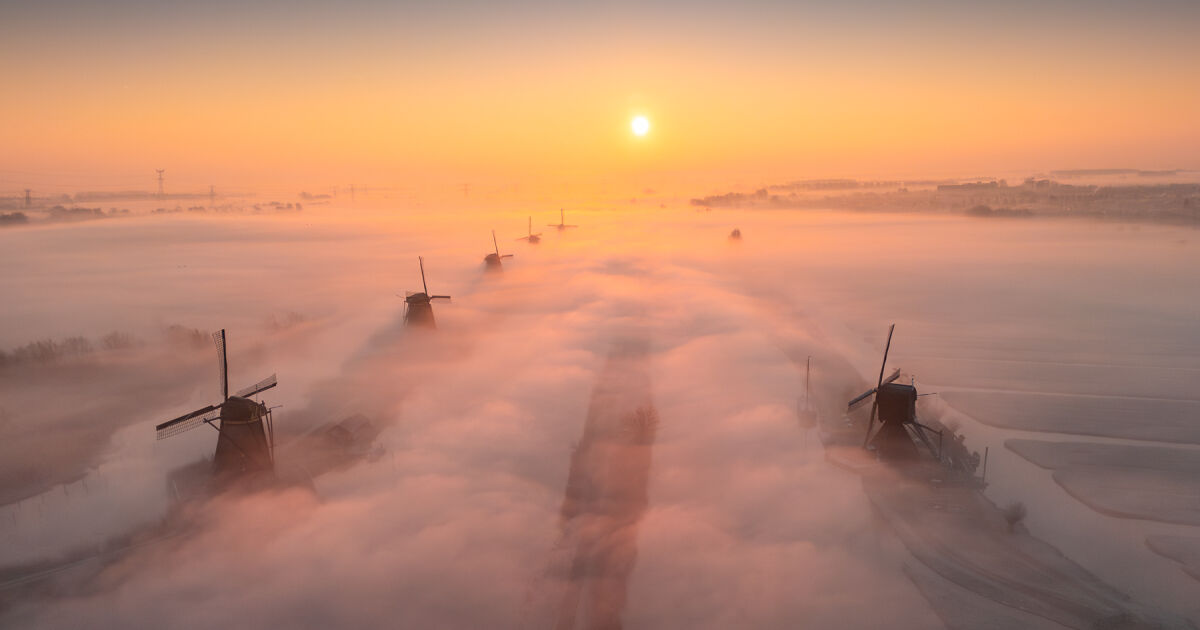
There are mornings when the world seems to forget it has sharp edges. Roads soften into pale ribbons, trees turn into charcoal sketches, and old windmills rise from the mist like patient giants who have been waiting centuries for someone to bring a camera. That was the feeling behind this photo story: I Captured Dutch Windmills Above The Mist (13 Pics), a quiet visual journey through one of the Netherlands’ most iconic landscapes.
Dutch windmills are not just postcard props, though they certainly know how to pose. They are part of a long, practical, deeply human story about water, land, weather, engineering, and stubborn optimism. In a country where much of life has been shaped by the need to manage water, windmills once worked like tireless mechanical guardians. They pumped water from low-lying polders, helped reclaim land, powered sawmills, ground grain, pressed oil, and became a symbol of Dutch creativity long before “sustainable technology” became a conference buzzword.
But seen above the mist, these windmills become something else too: poetic, mysterious, almost cinematic. The mist hides the modern world just enough to let the past breathe. A fence disappears. A canal becomes a silver line. The sails of a mill appear first, then the roof, then the dark body of the structure, as if the landscape is slowly revealing a secret. It is landscape photography with a built-in dramatic entrance.
The Magic Of Dutch Windmills In The Mist
Photographing Dutch windmills is already a gift. Photographing them above a blanket of mist is the kind of gift that makes a photographer whisper “thank you” to the weather, then immediately check whether the lens cap is still on. Mist changes the entire emotional language of a landscape. It reduces clutter, lowers contrast, softens color, and turns ordinary distance into atmosphere. Instead of seeing everything at once, the viewer is invited to look slowly.
In the Netherlands, morning mist often gathers over canals, meadows, ditches, and low fields, especially when cool overnight air meets moisture near the ground. For photographers, that means the best scenes usually happen before the rest of the world has finished its first coffee. The reward is worth the alarm clock betrayal. When the sun begins to rise, the mist can glow from within, creating layers of gold, blue, gray, and pearl around the mills.
Windmills are especially powerful subjects because their silhouettes are instantly recognizable. Even when half-hidden, a Dutch mill has presence. The cap, sails, tower, and sturdy body create a shape that feels both architectural and alive. In mist, that shape becomes even stronger because the background fades away. The mill stops being one object among many and becomes the main character.
Why Dutch Windmills Matter Beyond The Pretty Picture
It is easy to look at a windmill photo and think only of charm: wooden blades, old brick, canals, bicycles, maybe a nearby cow pretending not to be photogenic. But windmills helped shape the Netherlands in a very real way. They were once essential tools in the country’s long relationship with water. By pumping excess water from low land into canals and storage basins, they helped keep communities, farms, and roads dry.
Kinderdijk, one of the most famous windmill landscapes in the Netherlands, is a perfect example. Its historic mill network was built as part of a larger water-management system designed to drain polders and protect the land from flooding. The surviving mills, canals, dikes, pumping stations, and sluices together show how the Dutch learned to live with water rather than simply fight it. That is why the landscape feels so meaningful: it is not a museum piece dropped into a field. It is a record of survival, planning, and maintenance.
Zaanse Schans tells another side of the story. North of Amsterdam, the Zaan region became one of Europe’s early industrial areas, with windmills used for sawing wood, grinding pigments, processing spices, pressing oil, and producing other goods. The area’s preserved mills and wooden houses now help visitors understand how wind power supported trade, craft, and industry. In other words, the Dutch windmill was not a decorative background extra. It was the engine room.
A Landscape Built For Layers
What makes windmill photography in the Netherlands so compelling is the layering. There is the natural layer: water, sky, reeds, birds, mud, frost, clouds. There is the human layer: dikes, footpaths, bridges, mills, farms, sluices. Then there is the weather layer, which can rewrite the scene in minutes. Mist is the great editor. It removes the unnecessary, highlights the essential, and gives the viewer room to imagine what is hidden.
In the 13 photos behind this story, the mist behaves differently from frame to frame. In one image, it floats low, leaving the sails sharp against the pale sky. In another, it rises high enough to swallow the base of the mill, making the structure look as if it is hovering. A third image catches the moment when sunlight touches the vapor and turns the canal into a glowing path. Each picture feels connected, but each one has its own mood.
The 13 Picture Moments
Picture 1: The First Sail Above The Fog
The first image opens with restraint. Only the upper sails of a windmill cut through a low blanket of mist. The rest of the scene is almost hidden. It feels like the landscape is stretching awake, one blade at a time.
Picture 2: A Canal Turned To Silver
Here, the canal reflects the early morning light while the windmill stands slightly off-center. The mist softens the far bank, helping the water lead the eye straight toward the subject. It is the kind of composition that makes silence feel visible.
Picture 3: The Row Of Sleeping Giants
A line of mills disappears into the distance, each one lighter than the last. Perspective and mist work together, creating depth without clutter. The farthest mill looks almost like a memory.
Picture 4: Golden Light On Old Wood
In this frame, the first warm sunlight touches the wooden sails. The contrast between golden light and cool mist gives the scene energy. It is gentle, but not sleepy.
Picture 5: Birds Over The Polder
A few birds cross the pale sky above the mill. Their tiny shapes add scale and movement. The windmill feels grounded; the birds make the morning feel alive.
Picture 6: The Hidden Farm Path
A narrow path bends toward a mist-covered mill. The foreground is visible, the destination is partly concealed, and that mystery makes the picture stronger. Not every photograph needs to explain itself immediately.
Picture 7: Reflections In Still Water
Still water doubles the shape of the mill, but the mist blurs the reflection just enough to keep it from feeling too perfect. A flawless mirror can be impressive; an imperfect one often feels more human.
Picture 8: A Windmill Above The Clouds
From a slightly elevated angle, the mist sits below the mill like a soft inland sea. The result is almost surreal, as if the windmill has climbed above the clouds for a better view of breakfast.
Picture 9: Reeds, Frost, And A Quiet Horizon
The foreground reeds carry tiny beads of moisture, while the windmill rises in the distance. This image works because it respects the small details. Mist photography is not only about grand scenes; sometimes the magic is waiting on a blade of grass.
Picture 10: The Blue Hour Mill
Before sunrise, the whole scene turns blue-gray. The windmill becomes a strong dark shape, and the mist gives the sky and ground a shared softness. It feels colder, calmer, and more meditative.
Picture 11: A House Beside The Mill
This picture includes a small home near the windmill, reminding us that these landscapes are not just tourist attractions. People have lived and worked around these mills for generations. The mist adds beauty, but the human connection gives the image weight.
Picture 12: Sun Breaking Through
Light finally breaks across the scene, turning the mist into glowing bands. The windmill is no longer hidden; it has become a stage performer under a very tasteful spotlight.
Picture 13: The Last Look Back
The final image is quieter than the dramatic sunrise frames. The mist begins to lift, the day becomes ordinary again, and the windmill returns to the landscape. It is a reminder that the best photography often captures moments that do not last.
How Mist Changes Landscape Photography
Mist does three important things for photography. First, it simplifies. Busy backgrounds fade, which helps the subject stand out. Second, it creates depth. Objects closer to the camera appear darker and clearer, while distant objects become softer and lighter. Third, it adds emotion. The same windmill photographed under a flat midday sky may look charming; photographed through morning mist, it can look timeless.
For Dutch windmills, this effect is especially valuable because the surrounding landscape is often open and horizontal. The Netherlands has big skies, flat fields, reflective canals, and long sightlines. Mist turns those features into layers. Instead of one flat view, the photographer gets a sequence of planes: reeds, water, mill, trees, horizon, sky. That structure helps the viewer travel through the image.
Best Conditions For Capturing Windmills Above The Mist
The most promising mornings often come after a cool, calm night with moisture in the air. Clear skies can allow the ground to cool, and light winds help the mist settle rather than blow away. Low-lying areas near canals, rivers, meadows, and polders are especially good places to watch. In practical terms, this means checking the forecast, arriving early, and accepting that nature has a very casual attitude toward appointments.
A photographer should scout the location before the actual shoot. In darkness and fog, everything looks different, including paths, water edges, and distances. Knowing where the canals, bridges, viewing points, and safe walking routes are can make the difference between a peaceful morning and an accidental mud-based comedy routine.
Composition Tips For Misty Windmill Photos
Strong mist photography depends on clear composition. Because mist lowers contrast, the shape of the subject matters. Windmills are ideal because their silhouettes remain readable even in soft light. Placing the mill slightly off-center can create a natural balance, especially when a canal, path, or row of reeds leads toward it.
Reflections are another powerful tool. A still canal can echo the windmill’s shape, doubling the visual impact. But the reflection does not need to be perfect. A few ripples, floating leaves, or drifting mist can make the image feel more authentic. The goal is not to sterilize the landscape. The goal is to let it breathe.
Negative space also works beautifully. A large pale sky or empty mist-covered field can make the windmill feel solitary and iconic. In a world obsessed with filling every corner, mist reminds us that emptiness can be dramatic too.
The Human Story Behind The Mills
One of the most interesting things about Dutch windmills is that they are still cared for by people with specialized knowledge. The craft of operating windmills and watermills requires skill, weather awareness, mechanical understanding, and respect for tradition. Modern pumps and electric systems do much of the heavy lifting today, but historic mills still need to move, function, and be maintained if they are to survive.
That makes every photograph of a Dutch windmill more than a nostalgic image. It is also a portrait of maintenance. Someone repaired those sails. Someone watched the weather. Someone understood how the structure should respond to wind. Heritage does not preserve itself. It asks for hands, time, money, patience, and occasionally a heroic tolerance for tourists with selfie sticks.
Why These Photos Feel Timeless
The reason Dutch windmills above the mist feel so timeless is that they combine opposites. They are practical machines, yet they look poetic. They are old, yet still relevant. They belong to specific places, but they speak a visual language people around the world understand. A windmill in mist suggests patience, resilience, memory, and quiet power.
There is also something refreshing about a landscape that does not shout. No neon. No skyscraper flexing its glass muscles. No giant billboard asking you to download an app. Just wood, water, weather, and light. In a digital age, that simplicity feels luxurious.
Travel Notes For Visitors
For travelers hoping to see Dutch windmills in person, Kinderdijk and Zaanse Schans are two of the best-known destinations. Kinderdijk offers a sweeping water-management landscape with historic mills set along canals. Zaanse Schans offers a preserved village atmosphere with mills, traditional crafts, wooden houses, and easy access from Amsterdam.
Visitors should remember that these are heritage areas, not movie sets. Some mills and nearby homes are connected to real people and working traditions. Stay on marked paths, respect private spaces, avoid flying drones where restricted, and give the landscape the same courtesy you would give a museum. The best photo is never worth being the person locals remember for climbing a fence.
Experiences From Photographing Dutch Windmills Above The Mist
The experience of capturing Dutch windmills above the mist begins long before the shutter clicks. It starts in the dark, usually with a questionable amount of sleep and a backpack that suddenly feels heavier than it did the night before. The road is quiet. The air smells damp. Streetlights fade behind you as you move toward the open polder, and the first real sign that the morning might be special is not visual at all. It is the silence.
Mist changes sound. Footsteps become softer. Distant birds feel closer. Even a passing bicycle seems to glide instead of roll. When the first windmill appears, it rarely arrives all at once. A sail comes first, then the cap, then a dark vertical shape, then perhaps a second mill farther away. It feels less like finding a subject and more like being allowed into a scene that was already happening without you.
One of the biggest lessons from photographing mist is patience. The scene can transform every five minutes. A composition that looks dull at 6:20 can become extraordinary at 6:27 when the sun reaches the edge of the fog. A mill that is completely hidden can suddenly emerge, perfectly framed by pale light, and then disappear again before you have finished congratulating yourself. The landscape has a sense of humor. It keeps photographers humble.
Another memorable part is the physical feeling of the morning. The camera body is cold. The tripod legs collect moisture. Your shoes become acquainted with mud in a way that feels personal. Your fingers move more slowly than usual, especially when adjusting filters or changing focal lengths. Yet none of this feels like a problem in the moment. It feels like the price of admission.
There is also a special challenge in avoiding cliché. Dutch windmills are among the most photographed subjects in Europe, so the task is not simply to capture a windmill. The task is to capture a mood, a detail, a relationship between weather and structure. Sometimes that means stepping back and letting the mill occupy only a small part of the frame. Sometimes it means focusing on reeds, ripples, or the way mist gathers along a canal. The obvious shot may be beautiful, but the quieter shot often lasts longer in memory.
After sunrise, the mood changes quickly. Colors warm, contrast increases, visitors arrive, and the dreamlike quality slowly becomes daylight reality. This is not disappointing; it is part of the story. The mist lifts, the mills become solid again, and the landscape returns to its practical self. That transition is a reminder that photography is built on timing. You cannot own the mist. You can only meet it, work with it, and be grateful when it lets you take something home.
By the end of the morning, the best images are not always the ones that looked most dramatic on the camera screen. Sometimes the strongest photo is the simplest: one windmill, one canal, one soft line of mist, one quiet sky. That is the beauty of this subject. It does not need to perform tricks. Dutch windmills above the mist already carry centuries of history, engineering, weather, and wonder. The photographer’s job is simply to notice when all of that rises into view.
Conclusion
I Captured Dutch Windmills Above The Mist (13 Pics) is more than a scenic photo collection. It is a reminder that the Netherlands’ most familiar icons still have the power to surprise us. Above the mist, windmills become both historical monuments and living shapes in the morning light. They tell stories of water management, craftsmanship, resilience, and landscape design, while also offering photographers one of the most atmospheric subjects imaginable.
The beauty of these images comes from balance: old structures in changing weather, practical machines in poetic light, quiet fields shaped by centuries of human effort. Whether you love travel photography, Dutch history, misty landscapes, or simply the peaceful drama of sunrise, these windmills offer a scene that feels both grounded and dreamlike. And yes, they also prove that waking up before dawn can occasionally be a brilliant idea, even if your alarm clock remains the villain of the story.
Note: This article is written as original web-publishing content based on real heritage, travel, meteorological, and photography context. It avoids unnecessary source-link clutter inside the article body for a cleaner reader experience.











