
There are two kinds of people in this galaxy: people who have watched Star Wars so many times they can identify a lightsaber ignition by emotional texture, and people who hear “Naboo” and assume it is either a wellness app or a very expensive baby stroller.
My wife belonged proudly to the second group. She had never seen a single Star Wars movie. Not A New Hope. Not The Empire Strikes Back. Not even the scene where everyone learns that Darth Vader is not simply a tall man with breathing problems and a cape budget. She knew the basics through cultural osmosis: Darth Vader exists, Yoda talks like a fortune cookie with tenure, and lightsabers are “the glow sticks for adults.”
So, naturally, I made the bold, questionable, possibly marriage-testing decision to introduce her to the franchise with Star Wars: Episode IThe Phantom Menace.
Was this the correct entry point? Film scholars may debate it. Fans may shout into comment sections until the servers beg for mercy. My wife, however, had no baggage, no childhood nostalgia, no plastic podracer toy buried in a closet, and no opinion about whether midi-chlorians should be discussed in polite society. She was the cleanest possible test audience: intelligent, funny, patient, and completely unprepared for Jar Jar Binks.
Why Start With The Phantom Menace?
On paper, The Phantom Menace seems like a logical beginning. It is Episode I, after all. It introduces young Anakin Skywalker, the Jedi Order before everything collapses, the political machinery of the Galactic Republic, Queen Padmé Amidala, Obi-Wan Kenobi before the hermit era, and Darth Maul before he became one of the coolest characters with the fewest lines in blockbuster history.
But release order and story order are two different creatures. The movie arrived in 1999 after a 16-year gap since Return of the Jedi, and expectations were not just high; they were floating somewhere above Coruscant traffic. For longtime fans, The Phantom Menace was not merely a film. It was a cultural event, a return to a galaxy that had become mythology, merchandise, Halloween costumes, lunchboxes, video games, and family identity.
For my wife, it was Tuesday night.
Before the Movie: What Do You Think Star Wars Is About?
Me: “What do you know about Star Wars?”
Her: “There are space people. Darth Vader is bad. There is a little green guy who speaks backward. Someone is someone’s father. Also, I think there are robots.”
Me: “Do you know who Anakin Skywalker is?”
Her: “Is that Luke Skywalker’s cousin? Or is everyone named Skywalker because they live in space?”
Me: “Do you know what the Force is?”
Her: “Like positive thinking, but with furniture moving?”
Honestly, not bad. If the Jedi Council had allowed explanations this concise, the Republic might have lasted longer.
The Opening Crawl: A Test of Patience and Font Size
The movie begins the classic way: yellow text drifting into space while John Williams politely informs your nervous system that something important is happening. My wife leaned forward, read the crawl, and immediately paused the movie.
Her: “Wait. Taxation of trade routes? This is the first one?”
And there it was: the first collision between Star Wars as mythic adventure and The Phantom Menace as a movie surprisingly interested in parliamentary procedure. For fans, the Trade Federation blockade of Naboo is part of the larger Palpatine chessboard. For a newcomer, it sounds like C-SPAN got invaded by robots.
Still, she appreciated the seriousness. “I like that the movie trusts children to care about tariffs,” she said. “That is either brave or insane.”
Qui-Gon Jinn: The Calm Dad of the Galaxy
My wife liked Qui-Gon Jinn immediately. Liam Neeson’s Jedi Master has a grounded, slightly rebellious presence. He is wise without being smug, calm without being asleep, and willing to bend rules when the Force whispers, “This child from Tatooine is extremely important and also very good at driving dangerous machines.”
Her: “He seems like the only adult who knows what movie he is in.”
That may be the most accurate review of Qui-Gon ever delivered from our couch. Qui-Gon gives The Phantom Menace a spiritual center. He is less interested in committees and more interested in intuition. He believes in Anakin when the Jedi Council sees risk. He listens to the Living Force, which my wife described as “therapy, but with laser swords.”
Obi-Wan Kenobi: Handsome, Polite, Slightly Underused
Ewan McGregor’s young Obi-Wan also received approval.
Her: “He has strong substitute-teacher energy, but in a good way.”
She noticed that Obi-Wan spends much of the movie observing, questioning, and occasionally looking like he would love a clearer assignment. That is not a criticism. In many ways, The Phantom Menace is Qui-Gon’s movie more than Obi-Wan’s. Obi-Wan becomes crucial in the final act, but for much of the story, he is the apprentice watching his master make choices that will reshape the entire galaxy.
My wife’s verdict: “I trust him. I also feel like he owns one nice robe and takes care of it.”
Jar Jar Binks Enters the Chat
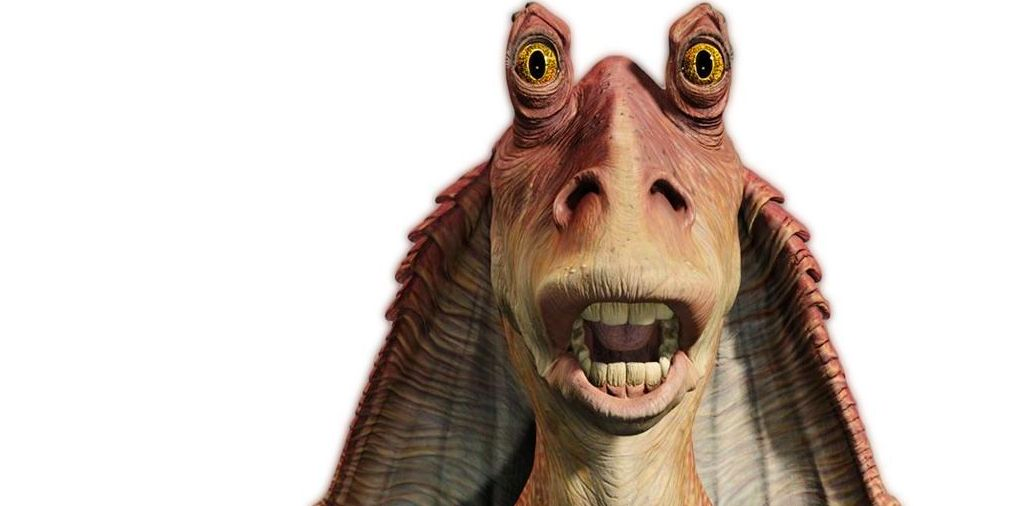
Then came Jar Jar.
Every Star Wars fan knows this moment is a stress test. Jar Jar Binks, the exiled Gungan who becomes the unlikely bridge between Naboo’s humans and the underwater Gungan society, is one of the most debated characters in the entire franchise. He is comic relief, plot device, chaos engine, and walking reminder that George Lucas was aiming part of this movie squarely at children.
My wife stared at the screen in silence for a full minute.
Her: “Is he supposed to be adorable, annoying, or legally responsible for something?”
I said, “All three, depending on whom you ask.”
To her credit, she did not hate him instantly. She found him “a lot,” which is the polite marital version of “please explain why this amphibious goofball is speaking like that.” But she also understood his function. Jar Jar introduces the Jedi to the Gungans, helps connect divided communities on Naboo, and later becomes important in galactic politics. Whether that importance is inspiring or horrifying depends on how many prequels you have watched.
Padmé Amidala: The Surprise MVP
Queen Amidala fascinated my wife. The gowns, the makeup, the royal voice, the decoy strategy, the calm under pressureshe was hooked.
Her: “Why is the teenage queen the most competent person in this entire government?”
Excellent question. Padmé’s role is one of the film’s strongest elements. She is young, but she is not passive. She refuses to let Naboo remain a bargaining chip in a political game. She leaves her planet to plead her case before the Senate, grows disillusioned with slow-moving democracy, and returns home to build an alliance with the Gungans.
My wife especially liked the reveal that Padmé had been posing as one of her own handmaidens. “That is the first time the movie has tricked me in a way I respect,” she said. “The wardrobe department deserves a medal and maybe its own Senate seat.”
Anakin Skywalker: Sweet Kid, Huge Red Flag
Young Anakin Skywalker was more complicated. My wife found him sweet, brave, and clearly written as a child of destiny. She also noticed something fans sometimes forget because we already know where the story goes: Anakin is introduced less as a villain-in-training than as a generous boy trapped in a cruel system.
He helps strangers. He misses his mother. He risks his life in the podrace. He wants to become a Jedi because the world has told him he is small, and the Force suggests otherwise.
Her: “He seems like a nice kid. But everyone keeps talking about him like he is a nuclear weapon with bangs.”
That is basically the prequel trilogy in one sentence.
The Podrace: Suddenly, She Was Invested
The podrace changed everything. Up to that point, my wife had been entertained but skeptical. Then the engines screamed, the canyon opened up, Sebulba cheated like a professional dirtbag, and Anakin launched himself into the galaxy’s most irresponsible youth sporting event.
Her: “Okay. This rules.”
The podrace remains one of The Phantom Menace’s most durable sequences because it is easy to understand. No Senate. No prophecy. No trade disputes. Just a child trying to survive a desert death race while aliens gamble and engines explode. It is visually clear, sonically thrilling, and structured like classic silent-film action with futuristic machinery.
My wife did ask why anyone would allow a child to compete. I explained that Tatooine has “limited regulatory oversight.” She said that sounded like something printed in tiny letters on a space insurance form.
Darth Maul: Minimal Dialogue, Maximum Impact
Darth Maul required no explanation. The moment he appeared with the red-and-black face, horns, and double-bladed lightsaber, my wife understood the assignment.
Her: “That guy looks like he was designed by someone who knew the toy would sell.”
Correct. Also, he is genuinely striking. Maul is not a deep character in this film, but he does not need to be. He is visual menace, physical threat, and Sith mythology made athletic. His final duel with Qui-Gon and Obi-Wan is the moment where The Phantom Menace becomes undeniable. The choreography is fast, elegant, and dramatic. John Williams’ “Duel of the Fates” gives the fight a ritual intensity, as if the galaxy itself is holding its breath.
My wife watched the entire duel without checking her phone. In modern marriage terms, that is a five-star review.
So, Is The Phantom Menace Actually Good?
After the credits rolled, I asked the big question.
Me: “Did you like it?”
Her: “Parts of it, yes. All of it, no. Do I understand why people argue about it? Absolutely.”
That answer may be the most balanced take possible. The Phantom Menace is not a clean masterpiece, but it is not empty either. It is visually ambitious, musically unforgettable, politically strange, emotionally uneven, and packed with images that lodged themselves permanently into pop culture. It has stiff dialogue and thrilling action. It has Jar Jar stepping in poop and Darth Maul igniting one of the coolest weapons in movie history. It has Senate procedure and space monks. It is both too much and somehow not enough.
For a first-time viewer, the movie’s biggest challenge is not that it is confusing. It is that it assumes emotional context while also trying to create chronological context. It wants to be a beginning, but it was made for an audience already haunted by the ending.
What a New Viewer Notices That Fans Miss
Watching The Phantom Menace with someone who has never seen Star Wars is a humbling experience. Fans bring decades of interpretation to every frame. We know Palpatine is dangerous before the movie says so. We know Anakin’s innocence is tragic. We know Obi-Wan will become a legend. We know the Jedi Council’s caution is both reasonable and doomed.
A newcomer sees something different. They see a movie about adults failing to communicate, institutions moving too slowly, a queen forced to solve a crisis herself, and a gifted child pulled into a destiny he cannot understand. They also see a floppy-eared alien nearly ruin several scenes, but nobody said fresh eyes are gentle.
My wife did not care about canon debates. She cared about whether the story worked in the moment. That made her reactions refreshing. She did not ask whether the movie “ruined” anyone’s childhood. She asked why the Jedi did not go back and free Anakin’s mother. Frankly, that is a much better question.
Final Verdict From the Wife Who Had Never Seen Star Wars
Best character: Padmé, because she “gets things done while everyone else holds meetings.”
Most confusing element: The Trade Federation, because “they look like villains but sound like they are worried about paperwork.”
Most enjoyable scene: The podrace, because “finally, the movie becomes a sport with consequences.”
Most stressful character: Jar Jar Binks, because “he seems one accident away from changing history.”
Coolest moment: Darth Maul’s double-bladed lightsaber, because “that is cinema doing exactly what cinema should do.”
Would she watch Episode II? “Yes, but only because I need to know how this sweet child becomes the breathing helmet man.”
Conclusion: The Phantom Menace Works Best as a Conversation
The Phantom Menace may be the strangest possible gateway into Star Wars, but it is also an unexpectedly fun one. It forces new viewers to ask basic questions that veteran fans have buried under years of lore. Who are the Jedi really helping? Why is the Republic so fragile? Why does the funniest character in the movie also seem capable of accidentally destabilizing civilization?
My wife did not leave the movie as a superfan, but she left curious. That matters. Curiosity is the true Force behind any franchise that lasts. A perfect movie can impress you; a weird movie can keep you talking until midnight.
And if a film can make your spouse ask sincere questions about galactic politics, desert racing, secret queens, prophecy, and whether Darth Maul moisturizes, then maybe it has done something right.
Bonus Experience: What It Was Like Watching The Phantom Menace With a First-Timer
The funniest part of introducing someone to Star Wars through The Phantom Menace is realizing how much fan knowledge operates like invisible subtitles. I knew why certain names mattered. My wife did not. I knew the appearance of Senator Palpatine should trigger alarm bells. She saw a polite politician with excellent posture. I knew Anakin’s fear would become central to the saga. She saw a lonely kid who needed a safer home and maybe one responsible adult with a follow-up plan.
That gap made the viewing experience better. Instead of silently revisiting a movie I had already judged years ago, I had to watch it actively. I had to separate what the movie actually explains from what I had imported from the rest of the franchise. That is where The Phantom Menace becomes fascinating. It is full of world-building, but not all of that world-building lands the same way for someone without nostalgia.
For example, the Jedi are presented as noble peacekeepers, but my wife immediately noticed their emotional distance. They speak calmly, dress beautifully, and carry legendary weapons, but their system feels cold when Anakin is brought before them. To fans, the Council’s hesitation foreshadows tragedy. To her, it looked like a group interview where nobody wanted to hire the child but everyone wanted to keep discussing his aura.
The political scenes also played differently. Many fans remember them as slow, but my wife found them oddly realistic. “This is what would happen,” she said. “A planet would be invaded, and a committee would schedule outrage for later.” That observation made the Senate scenes more interesting. The bureaucracy is not accidental filler; it is the weakness Palpatine exploits. The movie may not make every procedural beat thrilling, but the idea underneath is sharper than its reputation suggests.
Then there was the shared laughter. Jar Jar slipping, battle droids folding like nervous lawn chairs, Anakin saying lines with maximum child-actor sincerity, and me trying not to overexplain every background alienthese became part of the fun. The movie turned into a social experience rather than a sacred text. That is probably the healthiest way to watch any beloved franchise: with affection, skepticism, snacks, and someone willing to say, “I’m sorry, but why is this frog man now a general?”
By the end, my wife had not become obsessed with Star Wars, but she had become invested enough to continue. That felt like a win. Not every first viewing needs to create a lifelong fan. Sometimes it simply opens a door. Sometimes it reminds the longtime fan that wonder and confusion are neighbors. And sometimes it proves that even a divisive prequel can become a great night at home when the right person is beside you asking the wrong questions in the best possible way.
Note: This article is original, written in standard American English, and designed for web publication without embedded source links or unnecessary reference markers.












