
Some airplanes look fast. Some look graceful. And some look like a committee meeting between a pancake, a pogo stick, and a science fair project that got Pentagon funding.
Introduction: When American Aviation Got Delightfully Strange
U.S. military aviation history is full of icons: the P-51 Mustang, the B-17 Flying Fortress, the F-15 Eagle, the SR-71 Blackbird. These aircraft look like they belong in serious documentaries narrated by someone with a voice like polished granite. But tucked between the famous legends are experimental aircraft so unusual they seem to have escaped from a cartoon hangar.
The weirdest aircraft in U.S. military history were not jokes. They were serious attempts to solve serious problems: how to take off without a runway, how to escort bombers across enormous distances, how to improve maneuverability, how to land on small ships, and how to test radical aerodynamic ideas before computers could politely say, “Are you absolutely sure about this?”
These strange military aircraft prove one important point: progress often looks ridiculous before it looks brilliant. The first person to suggest a tiny fighter carried inside a bomber probably received a long silence in the conference room. The first engineer to say, “What if the plane stood on its tail like a pencil?” probably did not get invited to lunch right away. Yet these experimental aircraft helped shape the thinking behind future VTOL aircraft, fly-by-wire systems, compact fighter concepts, and advanced flight research.
Below are five of the weirdest U.S. military aircraft ever built, tested, or seriously developed. Some flew beautifully. Some flew awkwardly. Some mostly taught engineers what not to do, which is still a very respectable contribution to science.
1. Vought V-173 “Flying Pancake”
The aircraft that looked like breakfast but flew like research
The Vought V-173, better known as the “Flying Pancake,” may be the most delicious-looking aircraft in U.S. military aviation history. Built during World War II as a proof-of-concept aircraft for the U.S. Navy, it had a flat, rounded body that made it look less like a fighter and more like something a diner cook accidentally over-engineered.
Its strange shape had a purpose. Designer Charles H. Zimmerman believed that a low-aspect-ratio, nearly circular wing could produce useful lift at very low speeds. In plain English, the aircraft was designed to take off and land in surprisingly short distances. That mattered to the Navy, which was always interested in aircraft that could operate from limited space. Aircraft carriers are large, yes, but pilots still prefer not to treat the ocean like a backup runway.
The V-173 had two large propellers mounted near the front edges of its disk-like body. These propellers helped move air across the wing and improve lift. The result was a plane that looked absurd but had a real aerodynamic argument behind it. It was not a flying joke; it was a flying question mark with propellers.
Test flights began in 1942, and the V-173 completed many flights over its test career. It was slow, experimental, and not designed as a combat-ready machine. Still, it helped validate ideas that later influenced the larger Vought XF5U, nicknamed the “Flying Flapjack.” The XF5U was intended as a more advanced Navy fighter version, but the rapid rise of jet aircraft made piston-driven oddities less attractive. Military aviation had moved on, and the pancake was left behind on the plate.
Why does it remain one of the weirdest U.S. military aircraft? Because it challenged the very silhouette of what an airplane was supposed to be. Most aircraft have a fuselage, wings, and tail. The V-173 looked at that formula and said, “What if the whole thing is basically wing?” That is the kind of thinking that keeps aerospace history wonderfully weird.
2. McDonnell XF-85 Goblin
The tiny “parasite fighter” that lived inside a bomber
The McDonnell XF-85 Goblin sounds like something from a fantasy novel, and honestly, it looked the part. This tiny jet fighter was designed after World War II to be carried inside a much larger bomber. Its job was to protect long-range bombers that might fly beyond the reach of traditional escort fighters.
The idea was bold: a bomber would carry the Goblin inside its bomb bay. If enemy aircraft appeared, the Goblin would be lowered on a trapeze-like mechanism, released into flight, do its defensive work, then return and hook back onto the trapeze. In theory, it was elegant. In practice, it was like asking a hummingbird to dock with a moving garage door during a windstorm.
The XF-85 had no normal landing gear because it was not meant to land on a runway during regular operations. It had folding wings and a compact, egg-like body. This gave it one of the strangest profiles in military aviation history. It looked brave, slightly confused, and very easy to misplace.
Testing showed that the aircraft could fly, but recovery was the real problem. Turbulence around the carrier aircraft made docking extremely difficult. Even skilled test pilots faced a demanding challenge. The concept was eventually canceled as aerial refueling improved and longer-range escort fighters became more practical.
The Goblin remains fascinating because it came from a real strategic problem. During the early Cold War, bombers needed protection over vast distances. The XF-85 was one possible answer, and while it was not the answer that survived, it showed how far engineers were willing to go when conventional solutions were not enough.
In the museum world, the Goblin is irresistible. It is small, strange, and instantly memorable. If most fighter aircraft look like predators, the Goblin looks like a jet-powered tadpole that wandered into a defense budget. Yet behind the cartoonish appearance was serious engineering, serious testing, and a serious lesson: sometimes the hardest part of flight is not getting into the air; it is getting back where you came from.
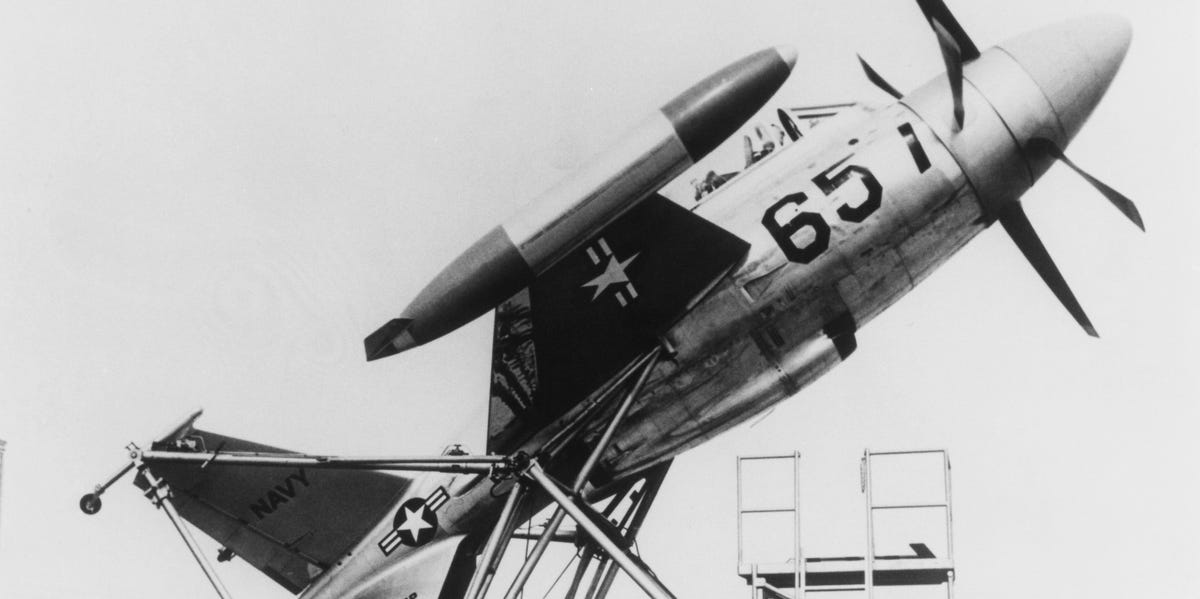
3. Convair XFY-1 Pogo
The tail-sitting aircraft that took “vertical takeoff” very literally
The Convair XFY-1 Pogo is what happens when engineers look at a runway and say, “Seems optional.” Developed for the U.S. Navy in the 1950s, the Pogo was a vertical takeoff and landing experimental aircraft designed to stand upright on its tail before launching into the sky.
Its concept was connected to a major Navy interest: aircraft that could operate from small ships without needing full aircraft carriers. During the Cold War, planners imagined defensive aircraft that could be placed on more vessels, giving fleets more flexibility. Helicopters could hover, but fixed-wing aircraft offered speed and range advantages. The Pogo tried to combine the best of both worlds, though it also collected some of the worst headaches from each.
The XFY-1 looked like a fighter jet that had been parked the wrong way. It stood nose-up, with large propellers at the front and a tail structure that acted as its landing support. The pilot sat in a cockpit that had to make sense in both vertical and horizontal flight. That alone deserves applause, and perhaps a neck massage.
The Pogo successfully demonstrated vertical flight and transitions to horizontal flight, which was no small achievement. But landing was brutally difficult. The pilot had to descend backward while looking over the shoulder and controlling the aircraft with extreme precision. Imagine backing a moving truck into a narrow garage, except the truck is flying, the garage is below you, and everyone watching has a clipboard.
The Pogo was ultimately too demanding for practical service. It required exceptional pilot skill, and jet technology was advancing quickly. Faster conventional aircraft and more capable helicopters made the tail-sitter concept less attractive. The Pogo became a brilliant dead end: a machine that proved something could be done, while also proving most people would prefer not to do it.
Still, it belongs on any list of weird U.S. military aircraft because it represents a fearless period of experimentation. The 1950s were a golden age of “try it and see” aviation. Sometimes the result was a sleek supersonic aircraft. Sometimes the result was a plane standing on its tail like it had been startled by a loud noise.
4. Ryan X-13 Vertijet
The jet that landed by hanging itself on a trailer
If the Convair Pogo was strange, the Ryan X-13 Vertijet politely asked someone to hold its coffee and became even stranger. Built to explore whether a pure jet aircraft could take off vertically, transition to normal forward flight, then land vertically again, the X-13 was one of the most memorable experimental aircraft of the 1950s.
The X-13 did not use a normal runway for its signature operation. Instead, it launched from a vertical platform and returned by hooking onto a cable mounted on a special trailer. Yes, a jet aircraft landed by catching a hook on a trailer. Aerospace engineers are many things, but boring is not one of them.
The Vertijet had a compact delta-wing design and a tilting pilot seat to help with the transition between vertical and horizontal flight. The aircraft was meant to demonstrate a concept, not become a standard frontline aircraft. Its mission was research, and in that role, it succeeded. It showed that a jet could perform the full vertical-to-horizontal-to-vertical flight cycle.
The military interest was easy to understand. Runways are useful but vulnerable. If aircraft could launch from small platforms, hidden sites, or mobile systems, planners would gain flexibility. The X-13 explored that dream at a time when VTOL technology was still young and full of dramatic possibilities.
But practical problems were hard to ignore. Vertical jet operations required intense pilot workload, precise control, and specialized equipment. The trailer landing system was clever, but it was not exactly the simple, rugged solution military planners usually prefer. A combat aircraft that needs to politely hook itself onto a vertical platform after each mission may be a little too theatrical for daily use.
Even so, the X-13 deserves admiration. It was not silly; it was daring. It tested a question that engineers needed answered. Could a jet behave like this? Yes. Should every jet behave like this? Absolutely not. And that is the beauty of experimental aviation: success does not always mean mass production. Sometimes success means learning enough to build smarter aircraft later.
5. Grumman X-29A
The forward-swept jet that looked like it was flying backward
The Grumman X-29A looked as if someone assembled a fighter aircraft after reading the instructions in a mirror. Its wings swept forward instead of backward, giving it one of the most striking profiles in modern U.S. military aviation history.
Developed with support from the U.S. Air Force, NASA, and DARPA, the X-29A was not designed as a production fighter. It was a technology demonstrator built to test advanced ideas: forward-swept wings, close-coupled canards, composite materials, and computerized fly-by-wire controls. In other words, it was a flying laboratory wearing a very dramatic outfit.
Forward-swept wings offered potential aerodynamic benefits, especially at high angles of attack. However, they also created serious structural and stability challenges. Airflow and wing loads could twist the wings in dangerous ways if the structure was not carefully designed. The X-29A used composite materials and digital flight controls to manage problems that would have been extremely difficult for earlier aircraft.
The aircraft first flew in the 1980s and became famous for its futuristic appearance. Unlike some experimental aircraft that mainly proved a concept was too strange to continue, the X-29A produced valuable research. Its flight program helped engineers understand unstable aircraft designs, advanced control systems, and the relationship between aerodynamic ambition and computer-assisted stability.
What makes the X-29A weird is not that it failed. In many ways, it was a research success. Its weirdness comes from how boldly it rejected traditional aircraft appearance. Most swept-wing jets point their wings backward, visually suggesting speed even while sitting still. The X-29A pointed its wings forward, as if impatient to arrive before the rest of itself.
The X-29A also represents a shift in experimental aviation. Earlier weird aircraft often relied on mechanical cleverness and heroic piloting. The X-29A showed that computers could help manage aircraft that were aerodynamically unstable by nature. That idea became increasingly important in later aircraft design. The plane looked bizarre, but its lessons were serious and lasting.
Why So Many Weird Aircraft Came From U.S. Military Research
Military aviation has always rewarded advantage. A shorter takeoff, a longer range, a tighter turn, a safer landing system, or a better control method can change how aircraft are designed. That pressure creates room for experimentation. When standard answers are not good enough, engineers start asking strange questions.
Could a fighter live inside a bomber? That gave us the XF-85 Goblin. Could an aircraft stand on its tail and launch from a ship? That led to the XFY-1 Pogo. Could a jet land by hooking onto a trailer? Hello, X-13 Vertijet. Could a wing sweep forward instead of backward? The X-29A said yes, with help from computers. Could a pancake-shaped aircraft actually fly? The V-173 answered, “Surprisingly, yes.”
Not every experimental aircraft needs to become operational to matter. Many of these designs were stepping stones. They showed where the limits were. They revealed pilot workload problems, airflow issues, structural challenges, and maintenance concerns. They also inspired later thinking about vertical lift, advanced flight controls, and unconventional airframes.
That is why weird aircraft deserve respect. They are not just aviation trivia. They are the sketchbook pages of aerospace progress. Some pages are messy. Some are brilliant. Some look like breakfast with landing gear. But all of them help tell the story of how aviation moves forward.
Experience Notes: What These Strange Aircraft Teach Aviation Fans
Spending time with the weirdest aircraft in U.S. military history changes how you look at aviation. At first, the reaction is usually laughter. The Flying Pancake looks too flat. The Goblin looks too small. The Pogo looks like it was stored upright to save closet space. The X-13 looks like a jet trying to park on a wall. The X-29A looks like a sleek aircraft from the future, but a future where the wings attended a rebellion meeting.
Then something interesting happens. The longer you study these aircraft, the less funny they become and the more impressive they feel. Each one reflects a moment when engineers faced a real problem and refused to accept ordinary limits. That attitude is the heart of experimental aviation. It is not about being weird for attention. It is about being willing to look strange while searching for an answer.
For aviation enthusiasts, these aircraft also make museum visits more memorable. Famous aircraft often impress through size, speed, or combat reputation. Experimental aircraft impress through curiosity. Standing near one of them, you can almost hear the design conversation: “This might work.” “It might not.” “Let’s build it carefully and find out.” That spirit is exciting because it makes history feel alive rather than finished.
These machines are also a reminder that progress is rarely tidy. Modern aircraft benefit from decades of trial, error, data, and risk management. The smooth confidence of today’s aerospace technology was built partly on odd-looking prototypes that exposed problems before those problems reached larger programs. In that sense, a canceled aircraft can still be a successful teacher.
The human side matters, too. Test pilots, engineers, mechanics, and project teams worked with machines that often had no precedent. They had to invent procedures, solve unexpected problems, and evaluate ideas that did not fit comfortably into existing categories. That requires discipline, not just courage. Weird aircraft are fun to talk about, but the people behind them were doing serious work.
For writers, students, and history fans, these aircraft offer a useful lesson beyond aviation: unusual ideas deserve careful testing before they are dismissed. Some strange concepts fail. Some lead to breakthroughs. Some do both at the same time. The V-173 did not create a new generation of pancake fighters, but it expanded understanding of low-speed lift. The XFY-1 Pogo did not become a practical Navy fighter, but it advanced VTOL research. The X-29A did not become a production fighter, but it helped validate advanced control concepts.
That is the real experience of studying these aircraft: you begin by asking, “Who thought this was a good idea?” You end by thinking, “Actually, I understand why they tried.” And somewhere between those two reactions, aviation history becomes much more interesting.
Conclusion: Weird Aircraft Are Where Imagination Meets Engineering
The 5 weirdest aircraft in U.S. military history are more than odd museum pieces. They are evidence of a bold experimental culture that helped push aviation beyond familiar shapes and comfortable assumptions. The Vought V-173 Flying Pancake explored radical lift ideas. The McDonnell XF-85 Goblin tested the parasite fighter concept. The Convair XFY-1 Pogo and Ryan X-13 Vertijet chased vertical takeoff dreams from wildly different angles. The Grumman X-29A proved that even an unstable-looking aircraft could produce stable knowledge when paired with advanced materials and flight controls.
These aircraft may not have become everyday military machines, but they made aviation smarter. They showed what worked, what almost worked, and what looked amazing in a hangar but made pilots sweat through their flight suits. In the grand story of American aircraft design, the weird ones matter because they remind us that innovation is not always sleek at first. Sometimes it arrives shaped like a pancake, hangs under a bomber, stands on its tail, hooks onto a trailer, or flies with its wings pointed the “wrong” way.
And honestly, aviation history is better because of it.













