
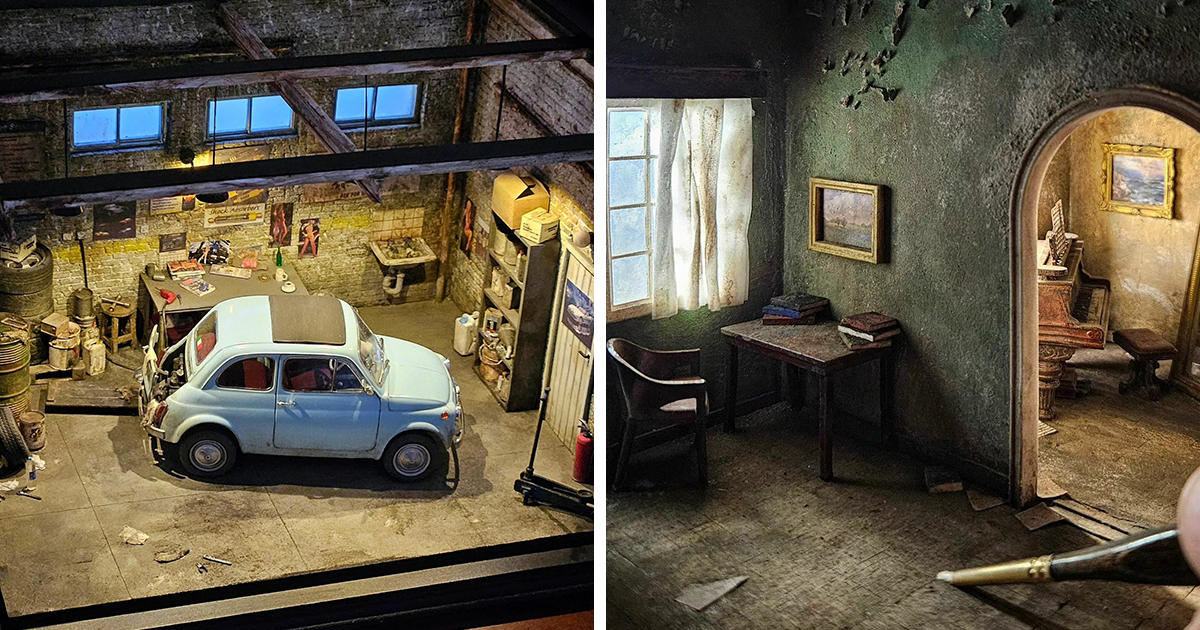
There is a very specific kind of magic that happens when a full-sized person leans over a tiny world. Suddenly, your normal human concernsemails, laundry, that mysterious object in the fridgego quiet. You are no longer standing in a room. You are peeking into a moonlit bakery, a mossy alley, a dusty attic, or a train platform where the suitcase is smaller than your thumbnail but somehow has more emotional baggage than you do.
That is the strange, delightful pull behind my collection of 42 miniature dioramas: tiny handmade scenes designed to make viewers feel as if they could shrink down, step through the frame, and start exploring. Each miniature scene is a small invitation. Some are cozy. Some are mysterious. Some look like places you visited in a dream and then forgot until you saw them under a desk lamp.
Miniature diorama art has a long history of combining storytelling, craftsmanship, scale, and illusion. Museums use dioramas to teach science and history. Fine-scale miniature artists use them to preserve architecture, domestic life, memory, and imagination. Hobbyists use them because, frankly, building a whole city at real size is frowned upon by landlords. In miniature, however, anything is possible: a forest can fit inside a shoebox, a diner can glow from a shelf, and a rainy street corner can exist forever in the exact second before someone opens the door.
Why Miniature Dioramas Feel So Big
The charm of miniature dioramas is not only that they are small. A paperclip is small, and nobody has ever whispered, “I wish I could live inside this paperclip.” The power comes from the way scale changes our attention. When a chair is reduced to the size of a postage stamp, we suddenly notice the curve of the backrest, the chipped paint, the little cushion that looks like someone sat there every morning with coffee.
A strong diorama creates a complete world with limited space. It uses proportion, texture, lighting, and perspective to trick the brain in the nicest possible way. A painted backdrop can make a room feel deeper. A warm LED hidden behind a tiny window can turn cardboard into evening. A scattering of fallen leaves can suggest weather, season, and story without a single character saying a word.
The Secret Ingredient: Implied Life
The best tiny worlds look recently abandoned or just about to be entered. A miniature bookstore feels more alive when one book is left open. A little kitchen becomes more believable when the spoon is not perfectly centered. A forest path gains drama when one footprint disappears into the moss. These details create what I like to call “implied life”the sense that someone was here, someone is coming back, and you, enormous visitor, have interrupted the scene with your giant eyeballs.
The 42 Tiny Worlds: A Tour Through the Collection
My 42 dioramas are not meant to be identical. They are more like tiny chapters in a very small, very nosy novel. Some scenes celebrate cozy domestic spaces; others explore forgotten places, urban corners, natural landscapes, and whimsical fantasy rooms. Together, they form a miniature map of places people secretly want to visit but cannot always find in real life.
1. Cozy Rooms That Feel Like a Cup of Tea
Several pieces in the collection focus on comforting interiors: a reading nook with stacked books, a cottage kitchen with a half-finished pie, a tiny bedroom with rumpled blankets, and a plant-filled studio where every pot looks like it has strong opinions about sunlight. These handmade dioramas lean into warmth. They use wood textures, soft fabric scraps, paper lampshades, and carefully placed clutter to create a feeling of home.
Cozy miniatures work because they compress familiarity. A full-sized living room may look ordinary, but reduce it to miniature scale and suddenly every object feels chosen. A tiny mug on a tiny table is not just a mug. It is a character witness. It says, “Someone lives here, and yes, they probably own too many blankets.”
2. Rainy Streets, Alleys, and Neon Corners
Another group of dioramas explores city life: a rainy alley, a late-night noodle shop, a narrow apartment stairwell, a laundromat glowing at midnight, and a corner store with posters peeling from the wall. These scenes use reflections, glossy surfaces, transparent plastic, and small lights to create atmosphere.
Urban miniature scenes are especially satisfying because cities are already layered with detail. There are signs, pipes, bricks, wires, stickers, stains, vents, window boxes, and mysterious doors that probably lead to either a basement or an adventure. In miniature form, those details become even more theatrical. A single crooked sign can suggest an entire neighborhood.
3. Nature Dioramas for People Who Like Moss Too Much
Some of the 42 miniature worlds step outdoors: a woodland path, a creek crossing, a greenhouse overtaken by vines, a mushroom village, and a quiet campsite under a painted night sky. Nature dioramas rely heavily on texture. Foam becomes stone. Flocking becomes grass. Wire becomes roots. Coffee grounds can become soil, which is both practical and a little emotionally confusing if you make the diorama before breakfast.
These scenes borrow from the tradition of habitat displays, where art and observation work together. Even a fantasy forest feels more convincing when it follows real visual logic: moss grows in damp corners, leaves gather at edges, stones sit partly buried, and water reflects light. The more truthful the small details feel, the easier it is for the imagination to move in.
4. Memory Rooms and Forgotten Places
A miniature attic, an abandoned classroom, a closed theater, a dusty toy shop, and an old train station all belong to the collection’s “memory rooms.” These dioramas are not scary, exactly, but they do feel haunted by ordinary life. A chalkboard with half-erased writing. A ticket booth with one last stub. A suitcase left under a bench. These are tiny props, but they carry emotional weight.
Miniature art is excellent at preserving the feeling of places that disappear. A diorama can hold a childhood bedroom, a grandparents’ kitchen, a corner store, or an old street long after the real version changes. It does not replace memory, but it gives memory a stage.
How a Miniature Diorama Is Built
From the outside, a finished diorama looks like a little miracle. From the worktable side, it looks more like a craft store had a dramatic argument with a recycling bin. The process usually begins with a concept: a mood, a location, a story, or sometimes one tiny object that demands an entire universe around it.
Step One: Choose the Scale
Scale is the invisible skeleton of a miniature scene. Many fine-scale miniatures use a 1:12 ratio, where one inch represents one foot, but diorama artists also work in 1:24, 1:48, 1:64, and other scales depending on the subject. A room scene may need enough space for furniture details, while a city street can work beautifully at a smaller scale because the viewer reads it as a larger environment.
Step Two: Build the Bones
The structure can be made from foam board, basswood, chipboard, cardboard, resin, clay, or 3D-printed parts. Walls must be straight enough to look intentional, but not always perfect. In fact, slight imperfection often makes a miniature feel more real. Real buildings sag, settle, crack, and collect suspicious stains. A perfect miniature wall can look fake. A slightly weathered one looks like it has paid rent.
Step Three: Add Texture and Weathering
Texture is where the magic gets serious. Brick can be carved into foam. Wood grain can be scratched into painted sticks. Rust can be layered with orange, brown, and black paint. Dust can be made from soft pastels. Posters can be printed, aged, torn, and glued to walls. Weathering gives miniature scenes their sense of time. Without it, a tiny alley looks like a toy. With it, the alley looks like it has seen three generations of gossip.
Step Four: Light the Scene
Lighting is one of the fastest ways to make a diorama feel alive. A warm window suggests safety. A cold blue lamp suggests loneliness. A flickering sign suggests either a cyberpunk diner or an electrician who gave up in 1987. LEDs, fiber optics, translucent plastics, and reflective paint can turn a simple box into a cinematic tiny world.
Why Viewers Want to Shrink and Explore
The phrase “wanting to shrink and explore” is not just cute. It describes the viewer’s real reaction to highly detailed miniature scenes. Miniatures invite slow looking. They reward curiosity. The closer you get, the more you find. A tiny receipt on the counter. A cat tail under the sofa. A map with a red circle. A cracked teacup. A secret door behind the shelf.
In a world where we often scroll past images in half a second, handcrafted dioramas ask us to stay. They turn looking into discovery. They also make us feel powerful and gentle at the same time. We tower over the scene, but we do not want to crush it. We want to protect it. We want to become small enough to belong inside it.
What Makes a Miniature Scene Memorable?
A memorable miniature diorama needs more than technical skill. The cleanest tiny chair in the world will not matter if the scene has no mood. The most impressive miniature worlds usually share four qualities: story, scale, texture, and surprise.
Story
Every object should help the viewer ask a question. Who lives here? What happened? Why is the door open? Why is there one shoe on the stairs? Story does not require a written explanation. In fact, a little mystery is better. A diorama should give viewers enough clues to start imagining, not so many answers that the scene becomes a museum label with wallpaper.
Scale
Good scale keeps the illusion from wobbling. A cup that is too large, a chair that is too low, or a door handle in the wrong place can make the viewer’s brain say, “Hold on, something is weird here.” Sometimes that weirdness is intentional, especially in fantasy work. But when realism is the goal, scale consistency helps the viewer enter the scene without tripping over math.
Texture
Texture makes the tiny world tactile. You can almost feel the cracked pavement, the soft quilt, the damp moss, the dusty floorboards. Even when viewers are not allowed to touch the pieceand please do not touch the piece unless invited, because tiny doorknobs have suffered enoughtexture gives the eyes something to feel.
Surprise
The final ingredient is surprise. Maybe a dragon sleeps under the café. Maybe the attic window opens onto outer space. Maybe a normal kitchen has one impossibly small door near the floor. Surprise creates delight, and delight is why people lean closer.
Lessons From Making 42 Miniature Dioramas
After building 42 miniature dioramas, I have learned that patience is not a personality trait. It is a muscle, and mine complained loudly at first. The first time I tried to cut a tiny window frame, it looked less like architecture and more like a nervous cracker. But with each scene, the work became more natural. I learned how to plan better, measure twice, and accept that glue has a sense of humor.
I also learned that small mistakes can become design features. A wall stain can become water damage. A crooked shelf can become an old shelf. A cracked tile can become realism. Miniature artists quickly discover that perfection is not always the goal. Believability is. Real places are full of dents, scratches, stains, repairs, and little signs of use. A miniature scene with too much perfection can feel sterile, like a real estate listing for mice.
The 42 dioramas also taught me how emotional tiny objects can be. A miniature chair can feel lonely. A tiny lamp can feel hopeful. A small suitcase can suggest departure, reunion, regret, or adventure. It is ridiculous and wonderful that a one-inch object can make a grown person feel poetic, but that is the job. Miniature art compresses emotion the way it compresses space.
Experience Notes: What It Feels Like to Live With Tiny Worlds
Living with miniature dioramas is not the same as simply owning art. It feels more like sharing space with dozens of very quiet neighborhoods. They sit on shelves, inside display boxes, under glass domes, and beside lamps, calmly minding their own tiny business. Then, at the right angle, one of them catches your eye and suddenly you are gone. You are no longer in your room; you are standing outside a miniature bakery at 6 a.m., wondering if the tiny croissants are fresh.
One of my favorite experiences is watching people discover the details. At first, they see the whole scene. Then they lean in. Then comes the best part: the tiny gasp. It usually happens when they notice something unnecessary but meaningfula little umbrella by the door, a note on a desk, a plant cutting in a jar, a single sock under the bed. Those details are small rewards for paying attention. In a loud world, miniature dioramas quietly train people to notice again.
Another unexpected experience is how personal viewers become about their favorite scenes. Someone who loves books will immediately choose the miniature library. Someone who grew up near a train station may linger over the platform. A person who misses a childhood home might stare at the kitchen diorama longer than expected. The scenes are fictional, but people bring real memories to them. That is when the work feels less like making objects and more like building tiny mirrors.
The practical side is less glamorous. Miniature dust is real. It is sneaky, dramatic, and somehow always finds the one corner you cannot reach. Storage is another challenge. A full-sized artist can stack canvases. A diorama maker must protect windows, wiring, roofs, signs, plants, fences, and one deeply fragile miniature chair that seems personally committed to breaking. There is also the strange habit of seeing potential materials everywhere. Packaging foam becomes stone. Bottle caps become tables. A scrap of fabric becomes curtains. Suddenly, throwing anything away feels irresponsible because it might become a roof tile one day.
Still, the rewards are worth the clutter. Making 42 miniature dioramas has changed the way I look at real spaces. I notice how light falls across a doorway, how posters curl at the corners, how chairs gather under café tables, how rain darkens concrete, how plants claim neglected windows. The tiny worlds make the large world sharper. They remind me that atmosphere is built from details, and details are everywhere once you slow down enough to see them.
Conclusion: Small Scenes, Big Imagination
My 42 miniature dioramas are tiny, but their purpose is wonderfully oversized. They are built to make viewers pause, lean in, smile, wonder, and maybe wish for a shrink ray with responsible safety instructions. Each scene proves that storytelling does not need a giant canvas. Sometimes it only needs a little room, a little light, a little texture, and one perfectly placed object that makes the imagination unlock the door.
Miniature diorama art continues to fascinate because it gives us control and mystery at the same time. We can see the whole world from above, yet we still want to step inside and explore what is hidden around the corner. That is the beauty of tiny worlds: they make us feel big enough to protect them and small enough to dream our way in.











