
Celebrity homes usually arrive on the internet wrapped in quiet beige, museum-like minimalism, and furniture so expensive it looks afraid of human contact. Then Gigi Hadid opened the digital door to her remodeled New York City apartment, and the internet collectively dropped its oat milk latte.
The supermodel’s $5.8 million NoHo apartment, which she spent about a year designing and curating, quickly became one of the most talked-about celebrity interiors online. Not because it was predictable. Not because it was cold, glossy, or staged within an inch of its marble countertops. Quite the opposite: Hadid’s home was bold, colorful, personal, playful, and, depending on who you ask, either a design fever dream or a pasta-themed escape room.
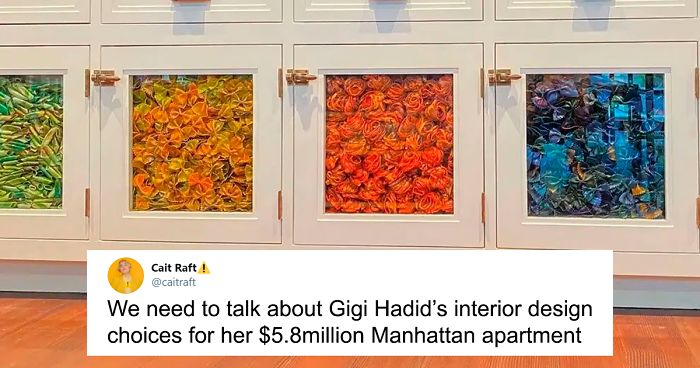
At the center of the conversation were the now-famous rainbow pasta cabinet doors, decorative pool balls, a giant pen, a bathroom covered in The New Yorker covers, a glam chair that inspired more than a few gothic jokes, and a general sense that Hadid had looked at “safe neutral luxury” and politely said, “No thanks, I’ll take the noodles.”
But behind the memes is a more interesting story about celebrity design, personal taste, internet judgment, and why a home that makes people laugh may actually be doing something right.
The Apartment: A $5.8 Million NoHo Home With Serious Design Credentials
Before the jokes started flying, the apartment itself already had a résumé. Hadid reportedly bought the NoHo townhouse-style unit for about $5.82 million in an Annabelle Selldorf-designed building. The duplex included three bedrooms, three and a half bathrooms, high-end finishes, a private terrace, an outdoor fireplace, and a fully equipped outdoor kitchen. In other words, this was not exactly a starter apartment where the couch also functions as a laundry mountain.
The property was also connected to Hadid’s larger New York real estate story. She already owned another unit in the same building, a roughly $3.97 million apartment purchased earlier, and reports suggested she planned to combine the spaces. That context matters because this was not a quick “buy some throw pillows and call it a day” refresh. Hadid treated the place like a deeply personal design project.
On Instagram, she described the home as a passion project and dream spot that she had spent the previous year designing and curating. She also credited architect Gordon Kahn and her mother, Yolanda Hadid, for helping along the way. The result was not a traditional celebrity showpiece. It was more like a scrapbook, a fashion mood board, and a high-budget arts-and-crafts cabinet all moved into a luxury Manhattan shell.
Why Gigi Hadid’s Apartment Went Viral
Most celebrity home reveals go viral for one of three reasons: the house is enormous, the closet is ridiculous, or the kitchen island is big enough to host a regional gymnastics meet. Gigi Hadid’s apartment went viral because people could not decide whether it was brilliant, chaotic, hilarious, or all three before breakfast.
The design choices were not subtle. The living room featured a colorful Missoni sectional with a patchwork effect, Jean Paul Gaultier pillows, vintage skis, and artwork with a strong personality. The kitchen featured a bowl of colorful pool balls on the island, because apparently fruit bowls were too emotionally available. Then came the detail that launched a thousand tweets: cabinet fronts filled with brightly colored pasta.
Those pasta cabinets were not random grocery-store noodles taped behind glass after a late-night crafting spiral. They were created with artist Linda Miller Nicolson, known for her vibrant pasta art. The cabinets included glass pockets filled with lacquered, shellacked pasta shapes such as farfalle, tagliatelle, and garganelli. The process reportedly took weeks to develop so the pasta could survive as decor rather than dinner.
Still, online audiences do not always pause for craftsmanship when they see rainbow noodles inside luxury cabinetry. They react first. They analyze later. And in this case, the reactions were instant, loud, and often very funny.
The Most Talked-About Design Choices
1. The Rainbow Pasta Cabinet Doors
The pasta cabinet doors became the unofficial mascot of the apartment. For fans, they were whimsical, creative, and deliciously weird. For critics, they were confusing, impractical-looking, and impossible to ignore. The joke practically wrote itself: rich people really can turn anything into decor, including carbohydrates.
But from a design perspective, the pasta cabinets also reveal something important about Hadid’s taste. She likes color, texture, humor, and objects that carry a story. The pasta was not simply “quirky for quirky’s sake.” It connected to an artist she admired, a handmade process, and a kitchen that looked more like a lived-in creative space than a sterile showroom.
Would most people choose pasta-filled cabinet fronts for their own homes? Probably not. Would most people keep staring at them anyway? Absolutely. And in design, attention is a form of power.
2. The Pool Ball Bowl
Another detail that raised eyebrows was a bowl filled with colorful pool balls on the kitchen island. It looked sculptural, playful, and slightly like a billiards table had sneezed. In a room already packed with color, the pool balls added yet another layer of visual punch.
Some viewers saw it as fun styling. Others wondered whether anyone in the apartment had ever tried to use the bowl for, you know, bowl things. But the choice fit the larger theme: Hadid’s apartment was not chasing calm. It was chasing personality.
3. The Giant Pen
Some homes have a vase in the hallway. Some have a framed photograph. Gigi Hadid’s apartment had a very large pen. The internet, naturally, did what it does best and turned the oversized writing instrument into a character.
The giant pen became a symbol of the apartment’s theatrical energy. It was not just an object; it was a punchline, a conversation starter, and possibly the only pen in New York City that could sign a lease from across the room.
4. The New Yorker Bathroom
Hadid’s bathroom wall covered with The New Yorker covers was another polarizing feature. Some people found it witty and very Manhattan. Others felt that a bathroom wallpapered with magazine covers was a little too close to being trapped inside a dentist’s waiting room with excellent taste in cartoons.
Still, the idea has logic. Bathrooms are small spaces where bold wallpaper can work beautifully. They allow homeowners to experiment without overwhelming the entire home. In this case, the bathroom became a cultural collage, turning a practical room into a mini gallery.
5. The Glam Chair and Vintage Touches
Hadid’s glam room included an ochre velvet salon-style chair with antique-inspired framing. Add in vintage skis, an antique Chevy door used as art, layered textiles, and high-fashion accessories, and the apartment began to feel like a cabinet of curiosities for someone who lives at the intersection of fashion, travel, nostalgia, and color.
Not everyone wants a glam chair that looks ready to host a dramatic monologue. But it fits the apartment’s message: this is not a home designed to disappear into the algorithm. It wants to be remembered.
Why People Made Fun Of The Apartment
The jokes were not really about one cabinet or one chair. They were about expectation. When people imagine a supermodel’s Manhattan apartment, they often picture creamy neutrals, soft boucle, marble, glass, and furniture that whispers, “Please do not spill coffee near me.” Hadid delivered something else entirely.
Her home was colorful, layered, eccentric, and at times aggressively whimsical. It looked less like a celebrity real estate listing and more like the inside of a creative brain that had been left alone with an unlimited design budget and no fear of comment sections.
That made it easy to tease. The internet loves a celebrity home reveal because it creates a rare illusion of access. Viewers get to become judges, decorators, comedians, and real estate experts all at once. Hadid’s apartment gave them plenty of material. Every room seemed to contain at least one detail that could become a meme before lunch.
But there is another reason the apartment drew such strong reactions: it challenged the popular idea that expensive design should look universally tasteful. Hadid’s home proved that money does not always lead to minimalism. Sometimes it leads to pasta cabinets. And honestly, that is much more interesting.
Is Gigi Hadid’s Interior Design Actually Bad?
Calling the apartment “bad” is too easy. A better question is whether it succeeds at what it appears to be trying to do. If the goal was to create a calm, timeless, resale-friendly interior, then yes, the pasta cabinets may be a hard sell to someone named Richard who only buys greige furniture. But if the goal was to create a personal, expressive, joyful home, the apartment makes a stronger case.
Good interior design is not always about pleasing everyone. It is about function, feeling, and coherence. Hadid’s apartment may not be traditionally cohesive in a quiet-luxury way, but it is emotionally cohesive. The through line is playfulness. Color appears again and again. Handmade and artful pieces appear again and again. Fashion-world references appear again and again. The home reflects the owner.
That matters. A house can have perfect proportions and still feel dead. A room can be expensive and still look like nobody has ever laughed in it. Hadid’s apartment, for all its chaos, feels alive. You can dislike the choices and still recognize that they were choices, not defaults.
Gigi Hadid’s Style Has Always Been About Experimentation
Hadid’s apartment makes more sense when viewed alongside her fashion identity. She has spent years moving between polished runway glamour, casual streetwear, cozy knits, bold color, and off-duty pieces that feel approachable. Her home follows a similar path: fashionable but not overly precious, curated but not frozen, expensive but not anonymous.
In later comments about her design style, Hadid described her homes as “eclectic” and “industrial farmhouse.” She also talked about loving wood, handmade objects, art, color, and spaces that feel welcoming. That helps explain why her apartment does not look like a minimalist glass box. She is drawn to warmth, craft, and personality.
Her favorite color has also been described as sunflower yellow, with cherry red as another shade she enjoys. Once you know that, the apartment’s bright energy feels less random. It is part of a broader visual language: sunny, tactile, layered, and not especially interested in being quiet.
What The Apartment Says About Celebrity Home Culture
Celebrity homes often become public performance spaces. A living room is no longer just a living room; it becomes a brand statement. A kitchen becomes evidence of taste. A bathroom becomes a think piece. That pressure explains why so many celebrity interiors feel similar. Neutral palettes are safe. Minimalism photographs well. Expensive restraint rarely gets mocked.
Hadid took a different route. Her apartment opened itself up to teasing because it showed risk. Risk is what makes design interesting, but it also makes design vulnerable. The same pasta cabinets that delighted some viewers horrified others. The same layered styling that felt joyful to fans felt overwhelming to critics.
That is the trade-off of personal style. If your home strongly reflects you, some people will not like it. If nobody has an opinion, the design may be too bland to matter.
Lessons From Gigi Hadid’s Bizarre Design Choices
Personal Beats Perfect
The biggest lesson from Hadid’s apartment is that personal design is often more memorable than perfect design. A technically flawless beige room may be easy to admire, but it rarely inspires a group chat meltdown. Hadid’s kitchen did. That does not mean everyone should install pasta cabinets. It means a home should contain something that could only belong to the person living there.
Color Changes Everything
Hadid’s apartment uses color as energy. The Missoni sofa, pasta cabinets, pool balls, yellow tones, and art pieces all create motion. Color can make a room feel confident, warm, youthful, or chaotic, depending on how it is balanced. The key is deciding how much stimulation you want. Hadid clearly wanted a lot.
Humor Belongs In Design
Many people decorate as if their homes are being graded by a silent panel of Scandinavian architects. Hadid’s apartment reminds us that humor has a place in interiors. A strange object, a bold pattern, or an unexpected piece of art can make a room feel human. Design does not always have to stand in the corner looking serious.
Luxury Does Not Have To Mean Neutral
Luxury is often marketed as quiet, pale, and smooth. Hadid’s home argues that luxury can also be colorful, odd, handmade, and deeply specific. The price tag may be high, but the spirit is closer to creative collecting than showroom perfection.
Experience: What This Viral Apartment Teaches Anyone Decorating A Real Home
The funny thing about Gigi Hadid’s apartment is that most people will never own a multi-million-dollar NoHo duplex, but almost everyone understands the fear of decorating “wrong.” You buy a sofa and wonder if it is too bold. You hang a print and worry it looks silly. You choose a paint color, then spend three days staring at the wall like it has personally betrayed you.
That is why this topic is more relatable than it first appears. The budget may be celebrity-level, but the emotional problem is ordinary: How do you make a home feel like you without worrying that other people will judge it?
In real homes, the most memorable rooms usually include at least one risky choice. Maybe it is a bright yellow chair, a gallery wall of family photos, a weird flea-market lamp, or a kitchen backsplash that your practical friend calls “a decision.” These pieces give a room its heartbeat. They are also the things guests remember. Nobody leaves dinner saying, “I cannot stop thinking about your perfectly acceptable white wall.” They remember the strange lamp shaped like a mushroom.
Hadid’s apartment pushes this idea to an extreme. Most of us do not need pasta sealed into cabinet doors, and frankly, most landlords would need a quiet moment and a glass of water before approving that. But the principle still works. Choose one feature that makes you smile before it makes sense to anyone else. That could be a painted ceiling, a vintage rug, a bold shower curtain, or open shelves filled with pottery from trips and thrift stores.
The second lesson is to edit around the weirdness. If everything in a room is shouting, the room becomes visually exhausting. Hadid’s apartment sometimes walks close to that line, which is why people had such strong reactions. In an everyday home, a good rule is to let one or two items be the star while the rest of the room supports them. If you have a wild sofa, choose calmer side tables. If you have dramatic wallpaper, keep accessories simple. If you have pasta cabinets, well, perhaps let the pasta have the microphone.
The third lesson is that homes evolve. Hadid has spoken about her design style changing as she gained more confidence, and that is true for almost everyone. Your first apartment may be practical and safe. Your next home may get bolder. Your taste changes with age, travel, relationships, work, children, hobbies, and even the restaurants you cannot stop visiting. A home is not a museum label. It is allowed to grow up with you.
Finally, the apartment shows that public opinion is not the same as personal success. The internet may laugh, but the internet does not live there. The best home design is not the one that gets universal approval. It is the one that supports your routines, reflects your memories, and gives you a private sense of delight. If your kitchen makes you happy, if your couch invites people to sit, if your hallway art says something you believe, the room is doing its job.
So, should everyone copy Gigi Hadid’s apartment? No. Should everyone take a little courage from it? Definitely. Decorate with taste, yes, but also with nerve. Add the odd object. Keep the sentimental piece. Use the color you actually love. Your home does not need to become a viral celebrity debate, but it should feel less like a catalog and more like a life.
Conclusion
Gigi Hadid’s remodeled $5.8 million apartment became a viral sensation because it refused to behave like a typical celebrity home. Instead of safe neutrals and predictable luxury, she created a colorful, eccentric, highly personal space filled with art, humor, fashion references, and yes, unforgettable pasta cabinets.
People made fun of her design choices because they were unusual, easy to meme, and wildly different from what many expect a supermodel’s Manhattan apartment to look like. But the criticism also proves the apartment’s strange success. It had a point of view. It told a story. It made people react.
Whether you love it, hate it, or remain emotionally trapped inside the pasta cabinet discourse, Hadid’s apartment offers a useful reminder: the most interesting homes are not always the ones that play it safe. Sometimes they are the ones bold enough to be bizarre.












