
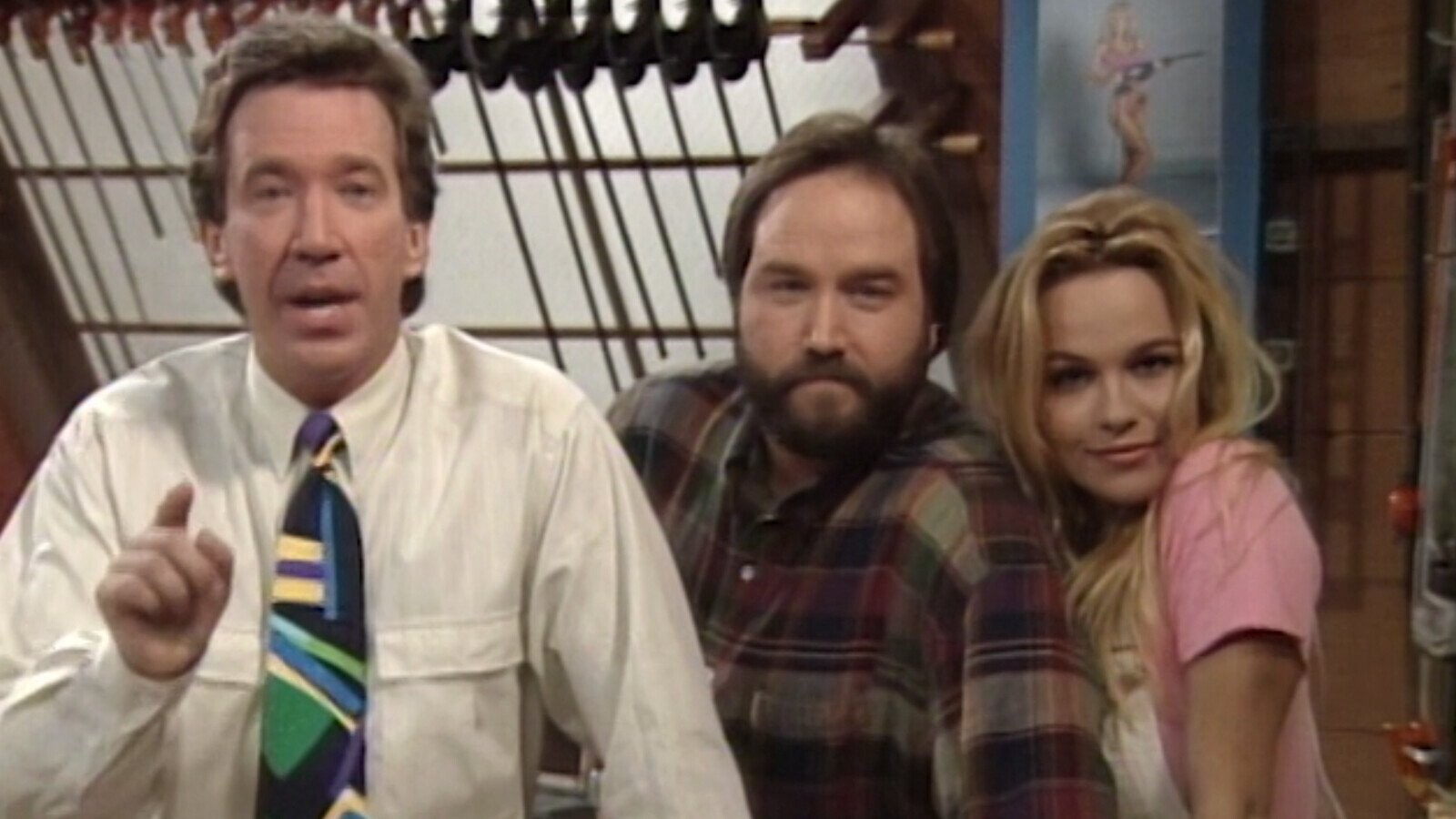
Celebrity stories have a strange way of aging. Some disappear faster than a sitcom catchphrase after the laugh track fades. Others come back years later wearing a new hat, holding a microphone, and saying, “Actually, let’s talk about this again.” That is exactly what happened when Tim Allen revisited Pamela Anderson’s allegation from the early days of Home Improvement and reportedly referred to it as a “gag.”
The story began publicly in 2023, when Anderson’s memoir Love, Pamela brought renewed attention to her early career, her experiences in Hollywood, and the way fame shaped how people treated her. In the book, Anderson alleged that Allen exposed himself to her on her first day filming Home Improvement in 1991, when she was 23 and he was 37. Allen denied the allegation at the time, saying it never happened and that he would never do such a thing.
Now, with Allen later discussing the claim on the Howie Mandel Does Stuff podcast and reportedly framing it as something he believed was a joke or “gag,” the conversation has shifted again. The question is no longer only what happened decades ago. It is also about how celebrities respond to uncomfortable allegations, how workplace behavior has changed since the 1990s, and why audiences are less willing than ever to shrug off stories that were once filed under “Hollywood being Hollywood.”
The Background: Pamela Anderson’s Claim in Love, Pamela
Pamela Anderson’s memoir was not released as a gossip grenade. It was part of a larger effort by Anderson to reclaim her own story after decades of tabloid framing, public objectification, and media narratives she did not control. Alongside the Netflix documentary Pamela, a Love Story, the book presented Anderson as more than a red swimsuit, more than a headline, and more than the flattened pop-culture image many people carried from the 1990s.
Within that broader personal history, Anderson described an alleged incident on the set of Home Improvement. She wrote that she encountered Allen in a hallway while he was wearing a robe and that he briefly exposed himself. According to Anderson’s account, Allen suggested it was “only fair” because he had seen her nude in a magazine context. Anderson described laughing uncomfortably, a phrase that says a lot without shouting. It suggests the awkward social pressure many young performers have felt when faced with behavior from a more powerful colleague: laugh, move on, do not become “difficult,” and get through the workday.
That detail matters because Anderson was not yet the global Baywatch icon many people remember. At the time, she was a young actress stepping into a popular sitcom led by an older male star. Home Improvement would become one of the defining family comedies of the 1990s, and Anderson’s role as Lisa, the original “Tool Time girl,” placed her inside a show-within-a-show built partly around gendered workplace comedy. The setup was light, broad, and very much of its era. Looking back, however, the “of its era” defense is exactly where modern audiences start raising eyebrows.
Tim Allen’s Denial and Later “Gag” Framing
Allen denied Anderson’s allegation when it first circulated publicly. His response was direct: he said the incident did not happen. That denial remains central to any fair discussion of the story. This is an allegation, not a court finding, and the public record consists of Anderson’s account, Allen’s denial, and subsequent comments from both sides.
The newer twist came when Allen addressed the subject again during a podcast appearance. He reportedly suggested that he believed Anderson had been joking or doing a “gag,” and he questioned parts of the story, including the bathrobe detail. He also connected the allegation to clickbait and public reaction, saying people began asking why he had done something that would be considered sexual harassment.
That response is why the headline caught fire. Calling a serious allegation a “gag” is risky public-relations territory. Even if Allen meant that he believed Anderson had been joking, the word can sound dismissive to readers who understand the memoir passage as part of a serious personal narrative. In modern celebrity culture, tone is not decoration. Tone is evidence of awareness, empathy, and judgment. Or, sometimes, the lack of all three.
Comedy also complicates the issue. Allen built his career on stand-up timing, blue-collar persona, sitcom physicality, and that famous caveman-adjacent grunt that somehow became a national sound effect. But the rules of comedy are not magic shields. A joke in a workplace can still be inappropriate. A prank can still cross a line. And if the other person remembers it as uncomfortable rather than funny, the punchline starts looking less like comedy and more like a power imbalance wearing a fake mustache.
Why the Story Resurfaced Again
This story resurfaced partly because nostalgia never sleeps. Home Improvement remains a familiar brand for many viewers, and Allen continues to be associated with family-friendly television through projects such as Last Man Standing, The Santa Clause, and Shifting Gears. When a performer connected to wholesome sitcom history is tied to an uncomfortable allegation, the contrast attracts attention.
It also resurfaced because Hollywood keeps reexamining the 1990s. That decade once seemed like a bright, goofy mall of pop culture: sitcoms, beach dramas, tabloid covers, late-night jokes, and celebrity interviews that now feel like they were conducted inside a room with no HR department. Today, many viewers watch old clips and ask different questions. Was that joke harmless? Was that interview respectful? Was that workplace safe? Did fame give people permission to treat certain women as public property?
Anderson’s public reintroduction has been a major part of that reexamination. In recent years, she has been discussed less as a punchline and more as a person who endured intense scrutiny, exploitation, and misrepresentation. Her memoir and documentary invited audiences to reconsider what they thought they knew. The Tim Allen allegation sits inside that bigger cultural shift.
Pamela Anderson’s Position: No Ill Will, But Still Not Okay
One important part of Anderson’s response is that she has not framed the story as a campaign of revenge. In interviews after Allen’s denial, she indicated that she understood why he would deny it, given the modern consequences of admitting such behavior. She also suggested she did not carry personal hatred toward him. That nuance is often lost online because nuance is not very clickable. It does not wear sparkly shoes or start fights in comment sections.
Still, Anderson’s lack of “ill will” does not erase the seriousness of the allegation. A person can say, “I do not want to destroy someone,” and also say, “This happened to me, and it was wrong.” Those two ideas can exist in the same sentence without needing a celebrity boxing match to settle them.
Her account also reflects a common theme in stories from women who entered entertainment young: boundaries were frequently blurred by fame, gender expectations, and the assumption that a woman known for modeling or sex-symbol status had somehow forfeited ordinary professional respect. Anderson’s memoir challenges that assumption directly. Being publicly photographed, admired, or sexualized does not mean a person has consented to private disrespect. That should not be a revolutionary statement, but pop culture spent decades acting like it needed a committee meeting.
The Home Improvement Context
Home Improvement premiered in 1991 and became one of ABC’s major sitcom successes. The show starred Tim Allen as Tim Taylor, a Detroit-area family man and host of the fictional home-repair program “Tool Time.” Its humor often came from exaggerated masculinity, DIY disasters, family lessons, and Allen’s ability to turn male overconfidence into a weekly demolition derby.
Anderson played Lisa, the first “Tool Time girl,” during the show’s early seasons before leaving for Baywatch. In that role, she was often positioned as part assistant, part glamour presence, and part setup for the show’s gender comedy. That does not automatically make the series malicious. Many viewers still enjoy it as a warm, silly family sitcom. But it does place the allegation in a setting where the line between performance, flirtation, and workplace culture deserves closer examination.
There was also a separate resurfaced blooper involving Allen and co-star Patricia Richardson in which Allen lifted a kilt during filming. Richardson later clarified that he was wearing boxer shorts and that her reaction would have been very different had he not been covered. That distinction matters. It also shows how easily “it was a joke” depends on context, consent, and what the other person actually experiences.
Why “It Was a Joke” No Longer Ends the Conversation
For decades, “just kidding” functioned like a trapdoor under uncomfortable conversations. Someone crossed a line, the room went silent, and then the explanation arrived: relax, it was a joke. The problem is that humor is not only about the intention of the person delivering it. It is also about the situation, the audience, the workplace, the power dynamics, and whether the person on the receiving end felt free to object.
In a professional environment, especially one involving a young actress and an established male lead, “I thought it was funny” is not a complete defense. It may explain intent, but it does not erase impact. If a joke requires the less powerful person to laugh nervously to protect their job, their reputation, or the mood on set, the joke has already failed the workplace test.
This is why Allen’s reported “gag” framing landed poorly with many readers. It seemed to treat the allegation as a misunderstanding born from comedy, while Anderson’s memoir presented it as part of a larger pattern of uncomfortable experiences. The gap between those interpretations is the entire story.
Celebrity Memory, Public Accountability, and the Court of Opinion
Stories from decades ago are difficult for the public to process. Memory is personal. Denial is also part of the record. There may be no video, no HR file, and no tidy ending with dramatic courtroom music. That uncertainty creates a space where audiences often sort themselves into camps: believe her, believe him, blame the media, blame the culture, or blame the fact that nobody in 1991 seemed to understand that “workplace boundaries” should not sound like an optional software update.
But public accountability is not always the same as legal judgment. Sometimes accountability means examining the way we talk about allegations. Sometimes it means asking why certain behavior was normalized. Sometimes it means letting a person describe an experience without turning the conversation into a referendum on whether they are “too sensitive” or “seeking attention.”
Allen’s supporters may see the allegation as inconsistent with the image they have of him. Anderson’s supporters may see his denial and later comments as dismissive. Both reactions are predictable. The more useful question is what the story reveals about entertainment workplaces, celebrity entitlement, and the long shelf life of moments that one person may remember as a joke while another remembers as humiliating.
How the Media Framed the Story
The media coverage followed a familiar rhythm. First came the memoir excerpt. Then came Allen’s denial. Then came Anderson’s response. Then came resurfaced clips, co-star comments, podcast remarks, and opinion pieces. In other words, the celebrity news blender was set to “purée.”
Still, the strongest coverage made an important distinction: Anderson alleged the incident; Allen denied it. That is the responsible phrasing. The weaker coverage treated the story like a tabloid tug-of-war, reducing a complicated workplace allegation to a headline designed to make readers click before their coffee cooled.
For publishers, this story offers a lesson in careful wording. Allegations involving sexual misconduct should not be written like sports recaps. They require precision, restraint, and context. A writer can analyze tone, timeline, and public reaction without turning the subject into cheap spectacle.
What This Says About 1990s Hollywood
The 1990s entertainment industry often sold women as images first and people second. Anderson became one of the most recognizable examples of that machine. She was famous, desired, mocked, copied, and misunderstood, often all in the same week. Her public persona made money for magazines, television shows, tabloids, and studios. But the cost of that persona was that many people acted as if they had a claim on her.
That is the deeper issue beneath this allegation. Anderson’s story is not only about one alleged hallway encounter. It is about a culture where a young woman’s public sexuality could be used as an excuse to ignore her private boundaries. It is about the difference between being seen and being respected. It is about how the entertainment business often confused access with consent.
Today, the industry is far from perfect, but the language has changed. Intimacy coordinators exist. HR policies are more visible. Social media gives performers a direct channel to challenge narratives. Audiences are more skeptical of “boys will be boys” explanations. The old sitcom shrug does not work the way it used to.
Why the Story Still Matters
Some readers may wonder why anyone is still talking about an alleged incident from 1991. The answer is simple: old stories shape current standards. When public figures revisit past allegations, their responses show whether they understand the cultural shift around workplace respect and personal boundaries.
Allen’s reported description of the allegation as a “gag” may appeal to people who think modern audiences are too serious. But for others, it reinforces the exact problem Anderson described: uncomfortable behavior being minimized because the person accused saw himself as joking. In 2026, that explanation does not close the book. It opens a new chapter.
The story also matters because Anderson’s memoir was part of a wider act of narrative control. For years, other people profited from telling Pamela Anderson stories. With Love, Pamela, she told her own. Readers do not have to treat every memory as legally proven to recognize the importance of letting her speak in her own voice.
Experience-Based Reflection: What This Topic Teaches Writers, Viewers, and Workplaces
When covering a story like “Tim Allen Calls Pamela Anderson’s Flashing Allegation a ‘Gag,’” the biggest challenge is avoiding two traps. The first trap is sensationalism. The second trap is false neutrality so stiff it sounds like a filing cabinet wrote it. A good article needs to be careful, but it also needs to be human.
From a publishing perspective, this topic is a strong example of how entertainment news has evolved. Years ago, a headline like this might have been treated as spicy celebrity drama, the kind of thing tossed into a gossip column between divorce rumors and red-carpet fashion notes. Today, readers expect more. They want context. They want to know what was alleged, what was denied, what changed culturally, and why the language used by each person matters.
For writers, the experience of handling this subject is a reminder that SEO should not flatten ethics. Yes, the keywords matter: Tim Allen, Pamela Anderson, flashing allegation, Home Improvement, Love Pamela, Howie Mandel podcast. But the article cannot simply repeat those terms like a robot trying to win a spelling bee. The story involves real people, reputations, memory, discomfort, denial, and public interpretation. Search optimization should help readers find the article, not turn the article into a carnival sign.
For workplaces, the lesson is even clearer. A joke is not automatically harmless because the person telling it has good timing. A prank is not automatically acceptable because the room laughs. In many professional settings, especially creative ones, people feel pressure to seem cool, flexible, and unbothered. Young workers may laugh because they do not know what else to do. New performers may stay quiet because they do not want to lose the opportunity. Assistants, interns, junior actors, and crew members may absorb discomfort because the powerful person is “just being funny.” That is exactly why modern workplace standards focus not only on intent but also on impact.
For viewers, the experience is a reminder that nostalgia is not a contract to ignore uncomfortable history. You can still remember Home Improvement as a funny sitcom. You can still acknowledge Tim Allen’s importance to 1990s television comedy. You can also take Anderson’s account seriously and understand why the “gag” framing bothers people. Mature media literacy allows more than one thought at a time. It is not a light switch; it is a dimmer.
For public figures, the takeaway may be the simplest: when discussing an allegation, tone matters. A denial can be firm without sounding dismissive. A response can protect one’s position without mocking the person making the claim. The public often listens not only for what is said, but for whether the speaker seems to understand the gravity of the subject.
Ultimately, the continuing attention around this story shows that audiences are reprocessing the entertainment culture they inherited. The 1990s are not being erased; they are being reread. Some jokes still hold up. Some look dusty. Some make people ask who had to laugh along to keep the show moving. That last question is uncomfortable, but it is also useful. Culture improves when people stop treating discomfort as an overreaction and start treating it as information.
Conclusion
The controversy around Tim Allen calling Pamela Anderson’s flashing allegation a “gag” is not just another celebrity headline with a short shelf life. It is a compact case study in memory, denial, workplace boundaries, comedy, and the changing standards of public accountability. Anderson presented the alleged incident as part of her personal story in Love, Pamela. Allen denied it and later reportedly suggested he believed it had been a joke or misunderstanding. The gap between those positions is where the cultural conversation lives.
What makes the story resonate is not only the fame of the people involved. It is the larger question it raises: when someone remembers a moment as a joke and someone else remembers it as uncomfortable, whose experience gets centered? In today’s media environment, audiences are less willing to accept “that was just how things were” as a satisfying answer. The past may explain behavior, but it does not automatically excuse it.
For readers, publishers, and entertainment fans, the best approach is neither blind outrage nor blind dismissal. It is careful attention. Use precise language. Respect the difference between allegation and proof. Notice power dynamics. And remember that comedy works best when everyone is actually in on the joke.












