
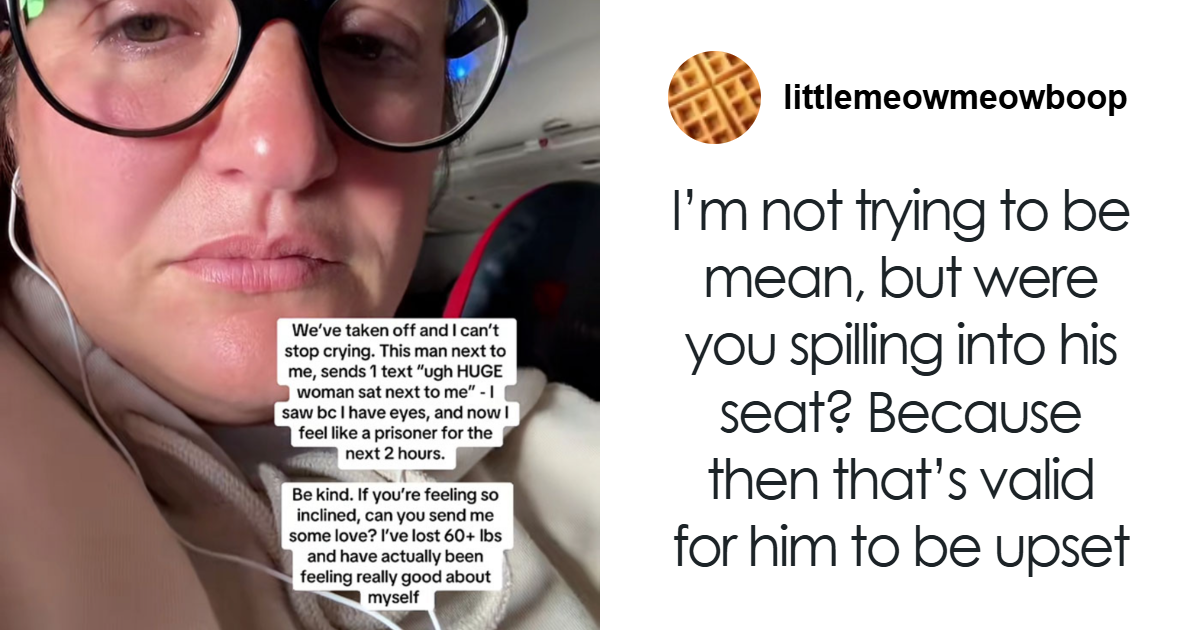
A crowded airplane cabin is already a masterclass in patience. You are strapped into a narrow seat, your knees are negotiating with the seatback pocket, and your personal space has been reduced to the size of a paperback novel. Now imagine looking over and seeing the person beside you texting something cruel about your body. That is the painful situation Vanessa Confessore said she experienced on a Delta flight from Florida to New York, and it quickly became more than one passenger’s bad travel day.
The story, often summarized online as “woman breaks down in tears on flight over seatmate’s text,” struck a nerve because it combined several modern anxieties at once: airplane crowding, body-shaming, phone privacy, viral TikTok storytelling, and the simple fear of being judged in a place where there is nowhere to go. Confessore said she saw a seatmate send a message describing her as a “HUGE woman,” and the words hit especially hard because she had recently lost 60 pounds and was feeling more confident about traveling.
The incident is not just about one rude text. It is about how easily casual cruelty becomes public, how difficult flying can be for plus-size passengers, and why basic kindness still matters at 30,000 feet. In a plane cabin, everyone is sharing recycled air, limited elbow room, and the collective hope that the person in 14B does not remove their shoes. The least travelers can do is not turn another human being into a punchline.
The Flight Text That Started A Bigger Conversation
According to Confessore’s account, she had boarded a Delta flight after a weekend trip in Tampa and was heading back to New York City. She said the man seated near the window reacted negatively when she approached the row. After takeoff, she noticed a message on his phone that referred to a “huge woman” sitting next to him. She later explained that the text was visible because the screen was close and the font was large.
What happened next is what made the story travel far beyond the plane. Confessore recorded herself quietly crying and shared the experience on TikTok. She described feeling trapped for the two-hour flight, sitting beside someone who had reduced her to a complaint. That detail resonated with viewers because airplane discomfort is already physically confining; emotional discomfort can make the cabin feel even smaller.
Her reaction was not theatrical. It was human. A hurtful sentence does not need to be shouted to cause damage. Sometimes the cruelest comments are the ones people think they are making privately. But airplanes are not private living rooms. They are tight public spaces where phone screens glow like tiny billboards, especially when the person next to you is close enough to know whether you chose pretzels or cookies.
Why The Story Went Viral
The story went viral because it was instantly understandable. Most people have felt judged at some point: for their body, their clothes, their parenting, their anxiety, their age, their accent, or simply for existing in public on a rough day. The flight setting made the emotional stakes sharper. On a sidewalk, you can keep walking. In an airplane seat, you are buckled into the moment until the landing gear comes down.
Social media users responded strongly, with many offering support and praising Confessore for being vulnerable. Others debated whether she should have looked at the phone at all. That debate is predictable but incomplete. Yes, passengers deserve privacy. No, people should not intentionally read private messages. But there is a difference between snooping and seeing words displayed openly inches from your face. In cramped public spaces, discretion is part of etiquette.
The incident also touched a wider cultural issue: body-shaming often hides behind “just being honest” or “just venting.” But honesty without empathy is not bravery; it is just bad manners wearing a tiny hat. A person can be uncomfortable in a crowded cabin without insulting someone’s body. Travelers can ask a flight attendant for help, request a seat change when possible, or quietly manage their frustration like adults with boarding passes.
The Real Problem: Airplane Seats Are A Social Pressure Cooker
Modern economy cabins are not famous for spacious luxury. The average passenger is often trying to fit a full human body, a winter coat, a backpack, a water bottle, and emotional stability into one assigned rectangle. When flights are full, tension rises. Armrests become diplomatic borders. Reclining seats become international incidents. And the middle seat remains, as always, a character-building exercise no one requested.
Airline seating policies add another layer of stress. Delta’s guidance says passengers who cannot safely and comfortably fit in a single seat may purchase an additional seat, and those who do not do so in advance may risk being moved or rebooked if additional space is needed. American Airlines similarly tells customers who need more than one seat for comfort and safety to book an additional seat by calling reservations.
These policies are framed around safety and comfort, but the lived experience can feel deeply personal. For plus-size travelers, the uncertainty starts before boarding. Will the seat belt fit? Will the armrest go down? Will a stranger stare, sigh, complain, or post about them? Air travel is stressful for almost everyone, but plus-size passengers often carry the extra burden of anticipating judgment before the plane even leaves the gate.
Body-Shaming Is Not A Travel Hack
One of the strangest ideas floating around the internet is that shame somehow improves people. Research and public-health organizations say the opposite. Weight stigma is associated with psychological distress, poor body image, low self-esteem, and disordered eating behaviors. In other words, making people feel small does not make anyone healthier. It just makes the world meaner.
Confessore’s story illustrates how quickly a careless remark can undo someone’s sense of progress. She had recently lost weight and was feeling more comfortable traveling. Then one visible text made her feel exposed. That does not mean her confidence was weak. It means words can land hard when they target something deeply personal.
People are not luggage. They do not become less deserving of dignity because they take up space. And in the specific context of flying, everyone takes up space. The tall passenger folds like a lawn chair. The broad-shouldered passenger claims the armrest by accident. The person with a giant under-seat bag invades the foot zone. The parent with a toddler is running an airborne snack negotiation. Airplanes require compromise from everyone.
Phone Privacy Works Both Ways
The seatmate’s text also sparked a separate discussion about phone privacy. It is fair to say passengers should not intentionally read other people’s messages. But it is also fair to say that if you write something cruel in giant text while sitting shoulder-to-shoulder with the subject of that cruelty, you are not exactly operating the Pentagon.
Good airplane etiquette includes managing your screen. Lower the brightness. Tilt the phone away. Avoid typing insults about the person beside you. This is not advanced civics. It is the same logic as not loudly discussing someone’s appearance while they are standing next to you in an elevator.
There is a bigger lesson here for the digital age: private cruelty often becomes public when screens are involved. Text messages feel casual, but they can still wound. The fact that a comment is typed instead of spoken does not make it harmless. If anything, seeing cruelty in writing can feel colder because it looks deliberate.
What A Passenger Can Do In A Similar Situation
If you ever find yourself hurt by a seatmate’s behavior, the first priority is safety and calm. You do not have to confront the person. You also do not have to pretend nothing happened. A discreet conversation with a flight attendant may help, especially before takeoff or when the seatbelt sign is off. Crew members cannot magically create space on every full flight, but they can sometimes reseat passengers, monitor conflict, or offer support.
If the issue is seating comfort rather than harassment, the most practical step is to speak with the crew or gate agent as early as possible. Once the aircraft door closes, options shrink dramatically. Before departure, there may be more flexibility to move someone, identify an empty seat, or explain available choices.
For emotional situations, grounding helps. Put on headphones. Text someone supportive. Breathe slowly. Remind yourself that one stranger’s opinion is not a verdict. Confessore said support from her husband and later from online strangers helped her process the moment. That matters because public humiliation often isolates people. Connection reverses that effect.
What Airlines Can Learn From Viral Incidents Like This
Airlines cannot control every rude passenger, just as restaurants cannot stop every customer from being a fork-dropping menace. But airlines can reduce conflict by making policies clearer, training staff to handle sensitive seating concerns with dignity, and giving passengers better information before travel day.
The Federal Aviation Administration has taken public comments on minimum seat dimensions necessary for passenger safety, and the broader debate over seat size has continued for years. A U.S. appeals court declined to force the FAA to issue minimum seat-size rules in 2023, but the issue has not disappeared from public conversation. Passengers still feel squeezed, and squeezed people are not always their best selves.
Clearer communication would help everyone. Plus-size passengers should not have to decode vague policies at the gate. Neighboring passengers should know whom to ask for help if they truly do not have enough space. Flight attendants should not be left to improvise emotionally delicate conversations in the aisle while 140 people pretend not to listen.
The Internet’s Reaction: Support, Criticism, And The Middle Seat Of Public Opinion
As with almost every viral story, the internet divided itself into teams. Many people empathized with Confessore, saying the seatmate’s text was unnecessarily cruel. Some shared similar stories of being judged on flights, in restaurants, at gyms, or in medical offices. Others argued that the seatmate had a right to vent privately, even if the words were painful to see.
The most useful response sits somewhere more thoughtful than outrage. A person may feel uncomfortable in a cramped seat. That feeling can be real. But discomfort does not justify dehumanizing someone. There are adult ways to handle space issues, and none of them require turning a neighboring passenger into a body-shaming text message.
The viral response also showed the brighter side of social media. The same platforms that can amplify cruelty can also deliver support at scale. Confessore said many comments were encouraging, and that kindness helped transform the experience from humiliation into solidarity. That does not erase the hurt, but it changes the ending.
Why “Taking Up Space” Became The Heart Of The Story
One phrase associated with Confessore’s story stood out: the idea that everyone deserves to take up space. It is a simple line, but it lands because many people are taught to apologize for their bodies, needs, emotions, or presence. Airplane cabins make that lesson visible. The person in the middle seat tries to make themselves smaller. The anxious flyer tries not to bother anyone. The plus-size traveler braces for judgment.
But dignity is not measured in inches of seat width. A passenger does not become less worthy because a cabin is crowded. A person’s body is not a public comment section. The real etiquette test is not whether we can avoid discomfort; it is whether we can remain decent when discomfort appears.
Personal Experiences And Everyday Lessons From This Flight Story
Many travelers have a story that begins with, “I was on a flight and the person next to me…” Sometimes it ends with a funny complaint about loud gum chewing. Sometimes it ends with a lifelong friendship. Sometimes it ends with a reminder that strangers can be either surprisingly kind or impressively terrible before the beverage cart even arrives.
Think about the emotional math of flying. People arrive at airports already overloaded. Someone may be coming home from a funeral, heading to a job interview, visiting a sick parent, celebrating a birthday, or quietly surviving a hard season. You cannot tell by looking. The passenger who seems “too emotional” may have used every ounce of courage just to board. The person who looks confident may be carrying a private insecurity. The traveler who appears calm may be one rude comment away from tears.
That is why this story feels bigger than a single seatmate’s text. It asks a basic question: What kind of stranger are you when no one is applauding? Are you the person who sighs loudly when someone sits down, or the person who shifts your bag and says, “No worries”? Are you the person who texts an insult, or the person who remembers that the human beside you has a life as full and complicated as yours?
Anyone who has flown often has seen small acts of grace. A passenger helps lift a suitcase. Someone swaps seats so a parent can sit with a child. A nervous flyer is comforted by a stranger during turbulence. A flight attendant quietly gives extra water to someone who looks overwhelmed. These moments rarely go viral, but they are the glue that keeps public life from becoming unbearable.
The opposite is also true. Small acts of cruelty can echo. A laugh, a stare, a muttered comment, or a visible text can follow someone long after baggage claim. That does not mean everyone must walk around terrified of saying the wrong thing. It simply means we should practice the radical art of not being needlessly awful.
For plus-size travelers, the lessons are practical as well as emotional. Checking airline policies before booking can reduce uncertainty. Calling reservations about an extra seat, seat belt extender, or seating options may help, even though it should not have to feel like preparing for a courtroom appearance. Choosing aisle or window seats strategically, boarding early when allowed, and speaking privately with gate agents can make the experience smoother. Still, the responsibility should not rest only on the traveler who fears being judged. Airlines and fellow passengers share responsibility for making cabins humane.
For neighboring passengers, the lesson is equally simple. If there is a genuine seating issue, ask the crew for help discreetly. Do not photograph people. Do not post their bodies. Do not text insults where they can see them. And if you are tempted to make a stranger the villain of your travel discomfort, pause for five seconds. The real villain may be the seat pitch, the full flight, the ticketing system, or the fact that economy class sometimes feels like a group project designed by a sardine.
In the end, the most powerful response to this incident is not rage. It is a better standard. We can want fair airline seating policies and still reject body-shaming. We can care about passenger comfort and still protect dignity. We can acknowledge that airplanes are cramped without pretending cruelty is inevitable. A little kindness will not add three inches of legroom, but it can make a two-hour flight feel less like a prison and more like a shared ride home.
Conclusion
The story of a woman breaking down in tears on a flight over her seatmate’s text became viral because it exposed something many travelers already know: flying compresses more than bodies. It compresses patience, privacy, insecurity, and social responsibility into a narrow row of seats. Vanessa Confessore’s experience was painful, but the public response turned it into a wider conversation about body-shaming, airline seating, and everyday decency.
The takeaway is not complicated. Travelers can be uncomfortable without being cruel. Airlines can create clearer systems without stripping passengers of dignity. And all of us can remember that the person beside us is not an obstacle, a joke, or a text-message complaint. They are a human being trying to get somewhere, just like us.











