
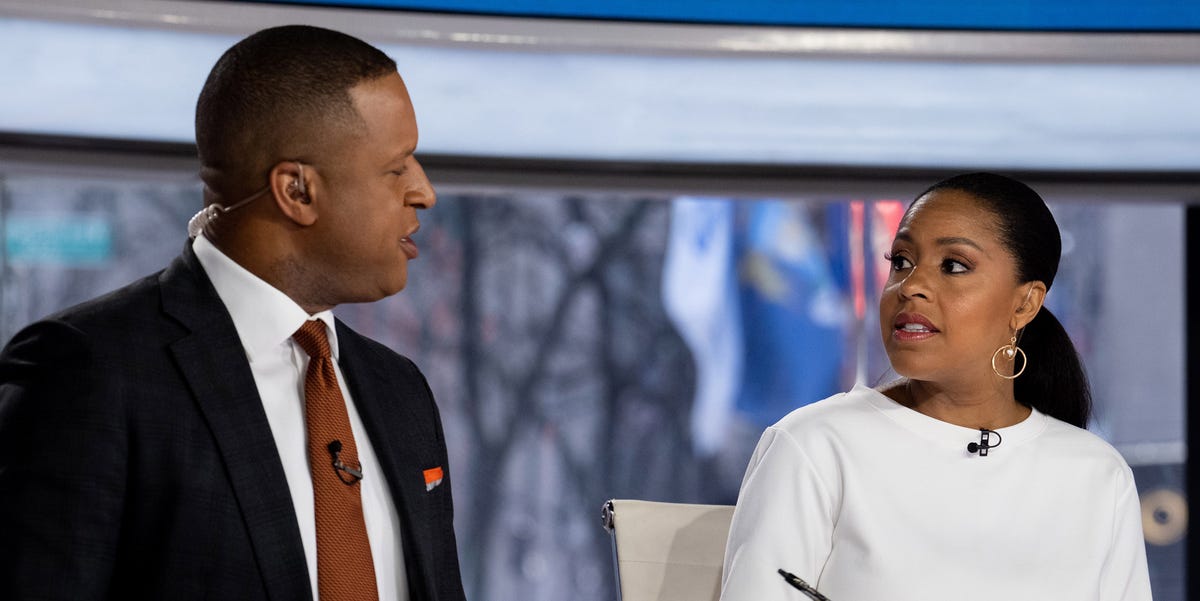
Morning television usually runs on a predictable blend of coffee, headlines, weather maps, and the kind of friendly banter that makes viewers feel like they are eavesdropping on very polished breakfast with friends. So when a familiar face disappears, people notice fast. That is exactly what happened when Sheinelle Jones stepped away from Today, leaving fans to wonder where one of the show’s most beloved anchors had gone.
What followed was not tabloid chaos for the sake of chaos. It was something more human, more emotional, and honestly more revealing about how closely audiences watch the people who greet them every morning. When Sheinelle’s co-stars said they were “praying” for her, the comment landed because it sounded deeper than a routine “we’ll see her soon.” It signaled that something serious was happening behind the scenes, even if the details were still private.
Now that the timeline is clearer, the story has become less about celebrity absence and more about love, grief, privacy, faith, and the rare kind of workplace bond that can survive bright studio lights and public scrutiny. Here is why those comments mattered, why viewers reacted so strongly, and why Sheinelle Jones’ story has continued to resonate long after the original concern first surfaced.
Why Fans Started Asking Where Sheinelle Jones Had Gone
In January 2025, Sheinelle Jones finally addressed the question that had been bouncing around social media and entertainment news for weeks: Why was she missing from Today? In a message to supporters, she explained that she was taking time away to deal with a family health matter. She thanked viewers for their kindness, acknowledged the support of her Today family, and promised, “I’ll see you soon.”
That statement was brief, warm, and intentionally limited. It told the public just enough to understand that this was not a contract dispute, not a casual vacation, and not one of those mysterious “scheduling issues” that people in television sometimes use when they would prefer everyone stop asking questions. It was personal. It was serious. And it was not something Sheinelle wanted to turn into public theater.
That restraint actually made viewers more protective of her. Sheinelle has long had a reputation for being upbeat, funny, and steady on air. She is the kind of anchor who can shift from news mode to lifestyle chatter without seeming fake, which is not as easy as it looks. So when someone like that quietly steps back and asks for grace, audiences tend to respond with concern instead of suspicion.
Her absence also came during a period of transition for the Today show, which only made it more noticeable. Big changes were happening around the morning franchise, and fans were already paying extra attention to who was on set, who was filling in, and who was missing. In other words, if there were ever a moment when a prolonged absence would stand out, this was it.
Why the “Praying” Comment Hit So Hard
The phrase that really stuck came later, when Sheinelle’s co-stars began offering updates. Craig Melvin said he had spoken with her recently and that the team talked to her all the time. Dylan Dreyer added that Sheinelle missed being there and was doing what she needed to do. Al Roker put it even more plainly: “We’re just praying for her.” Dylan was similarly direct at the Kentucky Derby, saying Sheinelle was “hanging in there” and that they were “praying for her and her family.”
That wording mattered. In television, people often default to safe, polished language. “Sending love.” “Thinking of her.” “Wishing her the best.” Those phrases are fine, but they can feel a little prepackaged, like sympathy wrapped in network-approved bubble wrap. “Praying for her,” though, sounds more personal. More urgent. More like something you say when a situation has moved beyond inconvenience and into real pain.
It also told viewers something else important: the Today cast was not speaking about Sheinelle as a distant colleague. They were speaking as people who cared about her deeply and were still actively in touch with her. Craig’s comment that they talked all the time suggested ongoing support rather than ceremonial concern. Dylan’s remark made it clear that Sheinelle still wanted to be there, which reassured fans that her absence was not a sign of professional uncertainty. And Al’s comment, brief as it was, gave the whole thing emotional weight.
That is why the story spread so quickly. It was not just “anchor absent from show.” It became “close-knit team publicly asks for prayers for one of their own.” Morning TV audiences respond strongly to those moments because they tune in for connection as much as information. These hosts are not just delivering segments about celebrities and sourdough starters. They are part of the emotional wallpaper of people’s mornings.
The Heartbreaking Reason Became Clear
For months, the public only knew that Sheinelle was dealing with a serious family matter. Then, in May 2025, the fuller picture became heartbreakingly clear. On air, Savannah Guthrie announced that Sheinelle’s husband, Uche Ojeh, had died at age 45 after battling glioblastoma, an aggressive form of brain cancer.
That announcement changed how many viewers understood everything that had come before it. Suddenly, the earlier remarks from Craig, Dylan, and Al carried even more emotional gravity. What had sounded like serious concern now read as the visible edge of a private family crisis that the show had been honoring with care. In hindsight, the cast’s decision to say just enough while still protecting Sheinelle’s privacy seems remarkably thoughtful.
It also explained why the language around her absence felt so tender. This was not ordinary time off. Sheinelle had stepped away during an unimaginably difficult chapter, choosing family over visibility, which is easy to praise in theory and much harder to live in real time when your career is built in public.
Uche was not just someone mentioned in the footnotes of Sheinelle’s biography. He was part of the story people had quietly absorbed over the years: her marriage, her children, the life she referenced naturally on air. When Savannah described the pain felt by Sheinelle and their three children, the loss became even more real for viewers who had followed her journey as a working mother, journalist, and partner.
Why This Story Resonated Beyond Entertainment News
There are plenty of celebrity headlines that flare up for a day and vanish before lunch. This was not one of them. The story of why Today cast members were praying for Sheinelle Jones resonated because it sat at the intersection of several things audiences understand deeply: family illness, the need for privacy during crisis, the challenge of returning to work after loss, and the comfort of having a supportive circle when life goes sideways.
Sheinelle’s public image also shaped the response. She is not a scandal magnet. She is not known for oversharing. She tends to come across as grounded, warm, and competent. So when she said little, people respected the silence. And when her co-stars spoke, their words felt earned.
There is also something powerful about seeing a high-profile workplace respond with gentleness instead of gossip. Too often, public curiosity turns people’s worst moments into content. Here, the broader message from the Today team was simple: Sheinelle is loved, she is taking care of what matters most, and we are not going to force her grief into a headline before she is ready.
That approach may be one reason the audience stayed emotionally invested without turning cruel. Concern did not disappear, of course. The internet is still the internet. But the dominant tone around Sheinelle was compassion, not speculation. Frankly, that alone is enough to qualify as a minor miracle online.
How Sheinelle Jones Reframed the Story Through Strength and Honesty
When Sheinelle returned to Today in September 2025, she did not try to paper over what had happened. In her first deeply personal interview back, she described her experience of grief as a “beautiful nightmare,” a phrase that captured the impossible contradiction so many grieving people recognize immediately. Loss is awful. Love remains beautiful. The two truths coexist, and neither cancels the other out.
That interview mattered because it moved the story from mystery to meaning. Sheinelle was no longer only the subject of concern. She became the narrator of her own experience again. She spoke about carrying on, about her family, and about the complicated nature of grief, which is rarely tidy enough for neat television packaging.
By 2026, her public story had evolved again. She was promoting her book, Through Mom’s Eyes, and speaking candidly about how finishing it became part of keeping a promise to Uche. She explained that she had delayed the book while focusing on her husband and children, then later reworked parts of it after his death because she felt she could not write honestly about motherhood without addressing the greatest challenge she had faced.
That detail gives the entire story another layer. The woman people were once waiting to see back at the anchor desk was now turning pain into something constructive and outward-facing. Not into a spectacle, but into work with meaning. The book became connected not just to career ambition, but to love, memory, and survival.
Her recent public moments have reinforced that impression. She has spoken about leaning on faith during a roller-coaster year. She has talked about holding each other up with her mother after multiple family losses. Her children even surprised her on air during her book release week, creating one of those live television moments that feels emotional because it clearly was not manufactured in a conference room by someone holding a ratings chart.
What the “Today” Cast’s Reaction Really Says About Their Bond
The phrase “work family” gets tossed around so casually that it often loses meaning. Sometimes it is just corporate glitter sprinkled over meetings nobody wanted. But in this case, the support surrounding Sheinelle seems to have reflected something real.
Craig Melvin’s update suggested frequent contact. Dylan Dreyer’s words reflected real concern, not generic optimism. Al Roker’s prayerful remark showed emotional sincerity. Savannah Guthrie later delivered devastating news on air with visible care. Jenna Bush Hager, Hoda Kotb, and others also publicly rallied around Sheinelle in different moments. Together, those responses painted a picture of colleagues who were trying to protect someone they love while still acknowledging the audience’s concern.
That balance is hard. Morning-show hosts live in a weird hybrid space. They are journalists, entertainers, co-workers, and semi-familiar public companions all at once. They owe audiences honesty, but they also owe each other humanity. In Sheinelle’s case, the Today team handled that balance better than many public institutions do.
And maybe that is why the story keeps lingering in people’s minds. It is sad, yes. But it is also strangely reassuring. It reminds viewers that behind polished studio smiles and segment teases, there can still be genuine tenderness. Not every on-air friendship is fake. Not every supportive statement is PR foam. Sometimes colleagues really are praying for each other.
What These Experiences Reveal About Grief, Work, and Public Life
Stories like this hit especially hard because they mirror experiences ordinary people know too well. A co-worker disappears from the office for a while. A family says they are dealing with a private medical issue. Friends send food, texts, and quiet encouragement. Then one day the full truth arrives, and everyone realizes the person was carrying far more than they ever said out loud. Sheinelle Jones’ story feels familiar because, in one form or another, many families have lived some version of it.
There is also something deeply relatable about the way grief interrupts normal life without asking permission. Morning television, like most jobs, runs on schedule, rhythm, and routine. But grief does not care about call times, production meetings, or whether your makeup is camera-ready. It barges in, rearranges everything, and leaves people trying to function while carrying an invisible weight. That is part of why viewers responded so strongly when Sheinelle’s co-stars said they were praying for her. People recognized the emotional code immediately: this is serious, this is painful, and this is bigger than work.
Another part of the story that resonates is the tension between privacy and public life. Sheinelle did not owe viewers every detail the moment her family entered crisis. In fact, her refusal to overshare may be one reason the public response stayed largely respectful. She set a boundary, and her co-stars reinforced it. For anyone who has ever had to keep functioning in public while protecting a private heartbreak, that boundary feels not cold, but wise.
Then there is the return. Returning after loss is one of the strangest experiences a person can have. The world expects a comeback montage. Real life delivers something much messier. You laugh and cry on the same day. You can be proud of surviving and still furious that survival was required. Sheinelle’s phrase “beautiful nightmare” captured that better than a hundred polished think pieces ever could. It is the kind of description that sounds contradictory until you have lived through something that breaks your heart and deepens it at the same time.
Her 2026 appearances added yet another emotional layer. A book launch. A birthday celebration. Children surprising their mother on live TV. Colleagues showing up again. Those are not signs that grief is over. They are signs that life continues to grow around grief. That distinction matters. Healing is not erasing pain. It is learning how to carry it without letting it erase everything else.
In that sense, the “praying for Sheinelle Jones” headline is really about more than one TV host. It is about what people hope for when someone they care about is facing the unfixable. They hope for strength, for peace, for time, for comfort, for good people nearby, and for the chance to keep going when going on seems absurd. That is what viewers were really hearing in those comments from the Today cast. Not gossip. Not filler. Just love, said out loud on a morning show.
Conclusion
The reason Today cast members were “praying” for Sheinelle Jones turned out to be far more heartbreaking than fans initially knew. What began as concern over an unexplained absence eventually opened into a story about family illness, devastating loss, faith, friendship, and resilience. Along the way, her colleagues showed what supportive workplace love can look like in public without crossing the line into intrusion.
And Sheinelle herself has reshaped the narrative with honesty and grace. She returned. She spoke. She kept a promise. She let viewers see not a polished fairytale ending, but something more useful: a real person continuing forward through grief with courage, humor, and heart. In a media world full of noise, that kind of authenticity cuts through. No wonder people are still talking about it.












