
Some military inventions sound as if they escaped from a late-night science fiction marathon: a spy plane that outran missiles, a giant claw ship built to steal a submarine from the ocean floor, satellites that dropped film canisters from space, and a dragonfly-shaped robot designed for intelligence collection. The twist? These are not movie props. They are real declassified military technologies, publicly documented and, in many cases, now sitting in museums instead of secret hangars.
The history of defense innovation is full of ideas that once felt impossible. During the Cold War and after, military engineers chased speed, stealth, precision, remote sensing, miniaturization, and information dominance with the kind of imagination usually reserved for comic-book villains and very ambitious garage inventors. Some projects succeeded spectacularly. Others were brilliant, strange, impractical, or all three at once. That is part of what makes them fascinating.
This guide explores 10 declassified military technologies that sound like sci-fi but are based on real programs, aircraft, weapons, sensors, and intelligence tools. Think of it as a tour through the “wait, they actually built that?” wing of modern military history.
1. Project AZORIAN: The Giant Claw Ship Built to Grab a Soviet Submarine
If a screenwriter pitched Project AZORIAN as a movie plot, someone would probably say, “Tone it down.” In the 1970s, the CIA helped build the Hughes Glomar Explorer, a massive ship publicly presented as a deep-sea mining vessel. Its real mission was far more dramatic: recover part of a sunken Soviet submarine from more than three miles below the Pacific Ocean.
The technology behind the mission was outrageous in the best possible way. The ship needed a hidden “moon pool,” heavy-duty hydraulic systems, and a huge mechanical capture vehicle that functioned like a deep-ocean claw machine. Only instead of winning a plush bear, the goal was to lift a 1,750-ton submarine section under total secrecy. Casual weekend project, right?
Although the operation did not recover everything planners hoped for, it remains one of the most extraordinary engineering and intelligence efforts of the Cold War. It also pushed forward deep-ocean heavy-lift technology and proved that, given enough urgency, secrecy, and funding, humans will absolutely try to build a submarine-snatching sea monster.
2. CORONA: Spy Satellites That Dropped Film from Space
Before digital satellite imagery became routine, the United States used the CORONA reconnaissance satellite program to photograph areas of strategic interest during the Cold War. The sci-fi part was not merely that cameras were in orbit. It was how the pictures came home.
CORONA satellites exposed photographic film in space, ejected the film in capsules, and sent those capsules falling back toward Earth. U.S. aircraft then caught them in midair. Yes, the government essentially played high-stakes aerial baseball with spy film from orbit.
Declassified in the 1990s, CORONA helped reshape U.S. intelligence by providing hard visual evidence about Soviet military capabilities. Its imagery helped reduce uncertainty about the so-called missile gap and demonstrated the enormous value of space-based reconnaissance. Today, satellite mapping feels normal because our phones casually tell us where the nearest taco place is. But CORONA was one of the early steps that turned space into an intelligence platform.
3. A-12 OXCART: The Spy Plane That Flew at Mach 3
The CIA’s A-12 OXCART looked like something designed by someone who had just heard the phrase “too fast” and taken it personally. Developed as a successor to the U-2, the A-12 was built for extreme speed and altitude. It could fly above 90,000 feet and reach speeds over Mach 3.
That combination made it a nightmare for adversaries to intercept. The aircraft needed special materials, advanced aerodynamics, powerful engines, and careful thermal management because flying that fast turns air friction into a very rude blowtorch. Pilots had to wear pressure suits that looked closer to astronaut gear than ordinary flight equipment.
The A-12 was part aircraft, part engineering dare. Its speed and altitude records for an air-breathing piloted jet remain legendary. It also paved the way for broader public fascination with high-speed reconnaissance aircraft such as the SR-71 Blackbird. If the OXCART had appeared in a spy novel before it was real, readers might have called it unrealistic.
4. F-117 Nighthawk: The “Invisible” Fighter That Changed Air Combat
The F-117 Nighthawk did not look like a normal aircraft. It looked like a stealthy doorstop from another planet. But its strange faceted shape had a serious purpose: reduce radar detectability and allow precision strikes against heavily defended targets.
The F-117 first flew in 1981 and became the first operational aircraft designed around stealth technology. During Operation Desert Storm, it flew more than 1,200 sorties and became one of the most famous examples of how stealth could change battlefield planning. It was not literally invisible, of course. No aircraft can simply put on a cloak and vanish like a shy wizard. But the Nighthawk made detection and tracking much harder.
Its importance goes beyond one aircraft. The F-117 helped prove that shaping, materials, mission planning, and electronic awareness could work together to reduce radar signatures. Modern stealth aircraft owe much to the lessons learned from this angular midnight legend.
5. GPS: The Military Navigation System That Now Guides Everyone
Today, GPS helps people find coffee shops, delivery drivers avoid wrong turns, hikers stay oriented, and lost tourists pretend they “meant to walk this way.” But the Global Positioning System began as a military capability for precise positioning, navigation, and timing.
GPS uses a constellation of satellites to provide location and time data around the world. Originally designed to serve military needs, it later became a global utility supporting transportation, agriculture, telecommunications, emergency response, finance, and everyday navigation. In 2000, the United States ended Selective Availability, a feature that had intentionally reduced civilian GPS accuracy, making civilian GPS dramatically more useful.
It may not look as flashy as a stealth jet, but GPS is one of the most transformative military-origin technologies in modern life. It quietly powers countless systems. Without it, a lot of modern convenience would collapse into “turn left after the big tree,” which is charming but not ideal for air traffic control.
6. Night Vision and Thermal Fusion: Owning the Dark
Night vision is so common in movies and video games that it is easy to forget how futuristic it once was. The military pursuit of seeing in darkness turned the night into a tactical environment rather than a natural barrier.
Traditional night vision amplifies small amounts of available light. Thermal imaging detects heat differences. Fused systems combine these capabilities, giving soldiers a better chance to see people, vehicles, or objects in darkness, smoke, fog, dust, or light foliage. The U.S. Army’s Enhanced Night Vision Goggle systems illustrate how far this technology has evolved from bulky early devices to more capable wearable sensors.
In science fiction, enhanced vision is often a superpower. In military technology, it became a system of sensors, optics, displays, batteries, and rugged design. The basic idea is simple: when the other side thinks darkness is cover, night vision politely disagrees.
7. MQ-1 Predator: The Drone That Rewrote Remote Warfare
The MQ-1 Predator helped move unmanned aircraft from niche reconnaissance tools to central players in modern military operations. It was a medium-altitude, long-endurance remotely piloted aircraft used for intelligence, surveillance, reconnaissance, and later precision strike missions.
Its sci-fi quality came from the combination of persistence and distance. Operators could monitor a target area for extended periods while the aircraft flew far from traditional cockpit risks. With sensors, communications links, and precision weapons, the Predator changed how militaries thought about time-sensitive targets and battlefield awareness.
The Predator was not the first unmanned aircraft, but it became one of the most influential. It showed that aircraft did not need an onboard pilot to have strategic impact. That idea has now expanded into a world of drones ranging from palm-sized scouts to large remotely piloted systems. The future arrived, and it had a camera, a satellite link, and no seat for Maverick.
8. Active Denial System: The Heat Ray That Actually Exists
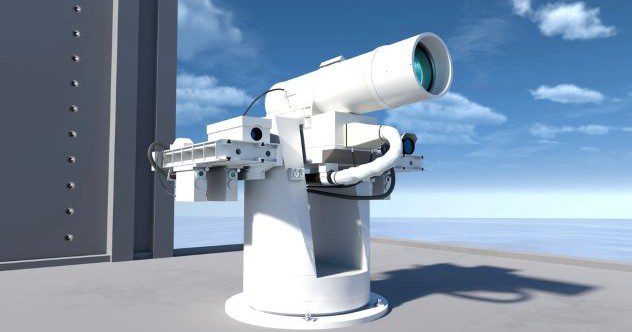
The phrase “heat ray” sounds like something a villain would aim at a city while laughing from a volcano base. Yet the Active Denial System is a real directed-energy technology developed under the Department of Defense’s non-lethal weapons efforts.
The system projects millimeter waves at 95 gigahertz, producing an intense heating sensation on the skin and encouraging people to move away from the beam. Public demonstrations have described it as a non-lethal tool intended for crowd control, checkpoint security, perimeter defense, and similar situations where forces may need options between shouting and shooting.
The key idea is reversibility. The effect is designed to stop when the person leaves the beam. Like many non-lethal technologies, it raises serious questions about ethics, deployment, safety, and oversight. Still, purely as technology, it sits firmly in the “sounds made up, is not made up” category.
9. Electromagnetic Railgun: Launching Projectiles with Electricity
Traditional guns use chemical propellants. An electromagnetic railgun uses electrical energy and magnetic fields to accelerate a projectile between conductive rails. In other words, it is a cannon that decided gunpowder was too old-fashioned.
The Office of Naval Research sponsored railgun development and demonstrated systems designed to launch projectiles at extreme speeds. Public materials described goals such as very long range, high muzzle velocity, and projectiles traveling at hypersonic speeds. The concept promised major advantages: no explosive propellant, potentially greater range, and very fast impact energy.
Railguns also came with major engineering challenges. They require immense electrical power, durable materials, heat management, and components tough enough to survive repeated launches. Even if the technology has faced practical obstacles, its existence proves that “electric cannon” is not just a phrase you find on a child’s drawing of a spaceship.
10. Insectothopter: The CIA’s Dragonfly Drone
Long before consumer drones buzzed around parks and wedding videos, the CIA’s Office of Research and Development built the Insectothopter, a micro unmanned aerial vehicle disguised as a dragonfly. Developed in the 1970s, it was intended to prove that miniature platforms could support intelligence collection.
The original concept involved a tiny listening device disguised as an insect. The dragonfly design was chosen because it was easier to maneuver than the earlier bumblebee concept. It was never operational, but as a proof of concept, it was decades ahead of the public imagination.
The Insectothopter shows how intelligence technology often begins with a strange question: “Could we make the sensor smaller, quieter, and less noticeable?” Sometimes the answer is a satellite. Sometimes it is a spy plane. And sometimes, apparently, it is a robot dragonfly. Nature inspired the disguise; engineering tried to supply the wings.
Why These Declassified Military Technologies Still Matter
These technologies are not just historical curiosities. They reveal recurring themes in military innovation: see farther, move faster, hide better, communicate more precisely, reduce risk to personnel, and gather better information before making decisions. The details change, but the strategic logic remains familiar.
They also show that “sci-fi” often becomes real through slow, difficult engineering. A spy satellite is not magic; it is optics, orbital mechanics, film recovery, aircraft coordination, and mission planning. A stealth aircraft is not a cloak; it is geometry, materials, radar physics, and disciplined operations. A drone is not a robot warrior from nowhere; it is sensors, communications, endurance, training, and policy.
Another lesson is that technology does not stay in one box forever. GPS moved from military navigation to civilian infrastructure. Night vision became common in law enforcement, wildlife research, security, and consumer optics. Satellite imagery now supports agriculture, disaster response, mapping, and climate analysis. Even failed or limited projects can influence future research by proving what is technically possible, what is impractical, and what should never be repeated without better judgment.
Real-World Experiences and Reflections: When Sci-Fi Becomes Museum History
One of the strangest experiences related to declassified military technologies is realizing how ordinary they can look once they leave the classified world. A museum display does not hum with secret energy. A satellite film capsule may sit behind glass like an oversized metal thermos. A pressure suit may look stiff and slightly theatrical. A drone may appear smaller than expected. But when you read the story behind each object, the room changes.
Standing near a retired stealth aircraft, for example, can be surprisingly funny. The F-117 does not have the smooth, heroic curves people expect from a fighter jet. It looks sharp, awkward, and almost intentionally unfriendly to aerodynamics. Yet that odd shape was the point. The aircraft reminds visitors that good engineering is not always pretty. Sometimes it is effective first and elegant later. The same is true of Project AZORIAN’s deep-sea recovery gear. A giant claw sounds absurd until you understand the problem: a submarine section lying miles below the surface, surrounded by secrecy, pressure, politics, and Cold War urgency.
Another memorable part of exploring these technologies is how quickly they make modern life feel borrowed from yesterday’s secrets. GPS is the easiest example. Most people use it without thinking. A phone says “turn right,” and we obey this tiny glass rectangle like it is an oracle with a data plan. Yet the system behind that simple instruction came from military positioning and timing requirements. The same invisible precision that helps guide aircraft and coordinate networks now helps someone find the fastest route to a grocery store. That is not just technological progress; that is historical whiplash.
Night vision creates a similar reaction. The first time someone looks through a night-vision device, even a civilian version, the brain needs a second to adjust. Darkness becomes textured. Shapes appear where there was only black space. The experience feels like cheating against nature. Then you consider what advanced military systems addthermal overlays, better resolution, ruggedness, and weapon-sight integrationand it becomes clear why seeing first can be decisive.
The Insectothopter offers a different kind of lesson: ambition can be both brilliant and ridiculous. A dragonfly drone in the 1970s sounds adorable until you imagine the technical problems. Power, control, wind, miniaturized sensors, stability, and reliability all become enormous obstacles at tiny scale. It was not operational, but it predicted a future where small drones and micro-sensors would become serious topics. Sometimes a failed prototype is less a dead end than a postcard from the future.
These experiences make declassified military technology valuable for more than trivia. They teach humility. Every “obvious” invention was once uncertain. Every sleek modern tool has ancestors that looked weird, failed tests, burned budgets, annoyed engineers, and confused the public. Declassified projects remind us that innovation is rarely smooth. It is messy, expensive, daring, sometimes ethically complicated, and occasionally shaped like a dragonfly.
Most of all, they blur the line between imagination and implementation. Science fiction asks, “What if?” Military research often asks, “How soon?” The answer may take decades, thousands of tests, and a mountain of classified paperwork. But eventually, some of those answers emerge into daylight. And when they do, the past suddenly looks a lot more futuristic than we expected.
Conclusion
Declassified military technologies prove that reality can be just as strange as fiction. From the submarine-grabbing Hughes Glomar Explorer to satellites that dropped film from orbit, from Mach 3 spy planes to dragonfly drones, these projects show how far engineers and intelligence agencies were willing to go to solve impossible-looking problems.
The most fascinating part is not only that these technologies existed. It is that many of their ideas now echo through everyday life. GPS guides commuters. Satellite imagery supports weather, mapping, agriculture, and disaster response. Drones have become common tools. Night vision and thermal imaging are no longer reserved for elite military units. Yesterday’s secret advantage often becomes tomorrow’s public utility.
Of course, not every invention should be celebrated without questions. Technologies such as directed energy systems, drones, and surveillance satellites raise ethical concerns about privacy, accountability, safety, and military escalation. The best way to understand them is with both curiosity and caution. Wonder is healthy. Blind enthusiasm is not.
Still, the next time a movie shows a secret aircraft, robotic insect, space camera, or electric cannon, remember: history already got there first. And as these 10 declassified military technologies show, the real world has never been short on science fiction. It just files the paperwork differently.











