
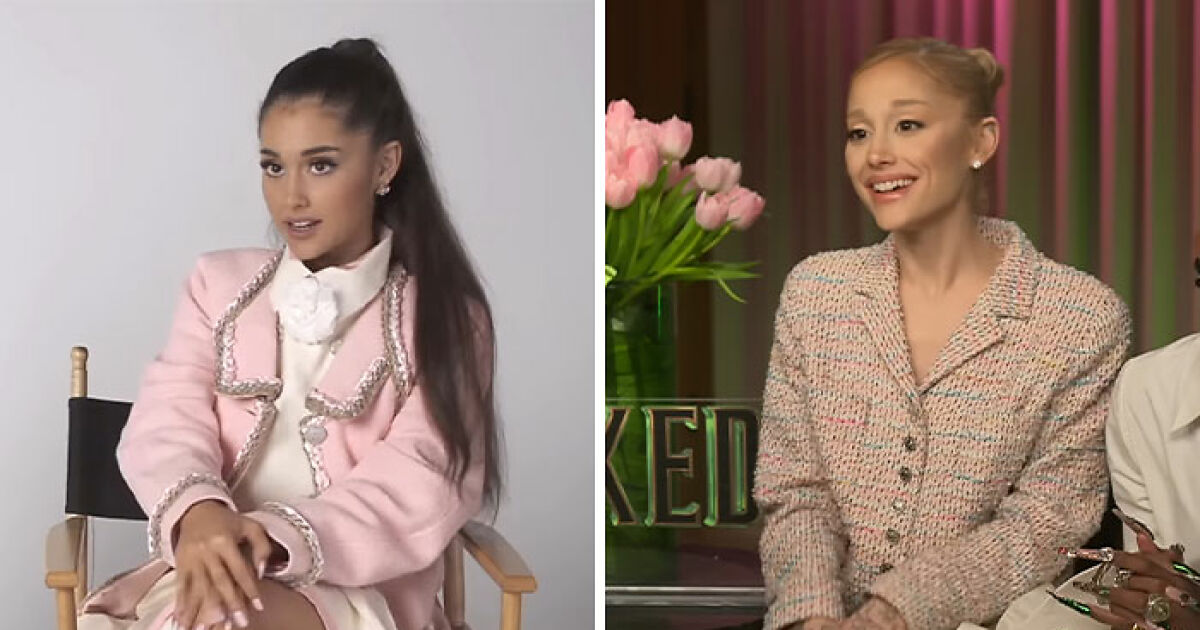
Every few months, the internet rediscovers an old celebrity clip and reacts as if it has uncovered a classified government file. This time, the star at the center of the digital gasping is Ariana Grande. A resurfaced interview from her Scream Queens era has collided headfirst with the soft-spoken, highly polished, emotionally delicate Ariana of the Wicked press tour, and fans have been doing what fans do best: comparing, theorizing, dissecting, and acting like they just witnessed two people wearing the same face.
The contrast is undeniably striking. In the older clip, Grande comes across as dry, fast, cheeky, and a little wicked in the lowercase sense of the word. In the newer Wicked interviews, she appears gentler, breathier, more theatrical, and sometimes so carefully composed that the internet has treated her every blink like an encrypted message. For some viewers, the shift is fascinating. For others, it is baffling. But the real story is more interesting than a simple “then vs. now” slideshow.
The truth is that Ariana Grande did not wake up one day and become a completely different human being. What fans are reacting to is the visible overlap of artistic growth, vocal technique, media pressure, role immersion, and the strange way social media compresses a decade of change into a 15-second clip. When that happens, even normal evolution can look like a plot twist.
The Resurfaced Interview That Sparked the Conversation
The old clip making the rounds online comes from Grande’s 2015 Scream Queens period, when she appeared in glossy fashion-magazine-style promo content with castmates including Abigail Breslin. The version now circulating focuses on a moment in which Grande reacts with deadpan sarcasm and perfect timing, giving viewers the sort of side-eye energy that social media still treats like currency. It is sharp, funny, and unmistakably youthful.
That clip has been compared side by side with her Wicked press appearances, where she often speaks in a much lighter register, carries herself with an almost porcelain level of delicacy, and seems more emotionally porous than punchy. That contrast has led some fans to say the old Ariana feels more spontaneous, while the newer version feels more refined, more guarded, or more character-inflected. In internet language, that becomes: “Is this even the same person?”
Of course, that is an exaggerated way of describing what is really a very normal thing: people change. But because celebrities age in public, fans expect continuity in a way they rarely expect from themselves. Nobody looks at a video of their own 19-year-old self and says, “Excellent, no changes whatsoever.” Yet the internet often demands that exact miracle from famous women.
Why Ariana Grande Seems So Different in the Wicked Era
1. Wicked did not just give her a role. It gave her a whole new performance framework.
Grande’s attachment to Glinda was not casual, and that matters. This was not a random acting gig wedged between album cycles. It was a dream role tied to her musical theater roots, and by her own account, she prepared for it with intense discipline. That level of preparation changes more than your calendar. It changes posture, diction, breath support, vocal habits, and even the way you answer simple questions in an interview. Spend enough time living in a highly stylized musical world, and some of that world follows you home like glitter after a craft project.
Glinda is not a low-key character. She is bright, musical, precise, mannered, and emotionally expressive in a very specific way. If you are training daily for a role like that, then speaking lightly, articulating more sharply, and protecting your voice are not cosmetic habits. They are part of the job. So when fans say Ariana sounds different now, the answer is partly yes. She does. But that does not automatically make it fake. Sometimes a changed voice is exactly what happens when a singer is doing serious vocal work and trying not to fry the instrument that pays the bills.
2. The voice conversation is bigger than one viral clip.
One reason the resurfaced interview hit so hard is that fans had already been discussing Grande’s speaking voice during the Wicked rollout. Her higher, airier tone became a topic all by itself, which is both extremely internet and deeply exhausting. Grande later indicated that changes in her vocal placement are intentional and connected to how much singing she is doing. That explanation makes perfect sense to anyone who has spent time around trained vocalists, but social media tends to prefer conspiracy over technique because conspiracy gets more comments.
Once you accept that vocal health and performance demands are part of the equation, the mystery becomes less mysterious. A pop singer making a massive movie musical while singing live, protecting range, rehearsing constantly, and managing long press days is not going to sound exactly like she did in a casual interview from nearly a decade earlier. She is older, more experienced, and using her instrument differently. That is not shapeshifting. That is professionalism with a side of internet confusion.
3. A decade of fame can sand down anyone’s edges.
It is also impossible to ignore the emotional cost of growing up famous. The Ariana in old promo clips had not yet lived through the full scale of pop superstardom, public heartbreak, intense tabloid coverage, and years of online scrutiny. The Ariana people see now is a performer who has spent a huge chunk of her adult life being studied like a group project nobody asked for. That kind of attention changes people. It can make them quieter, more selective, more careful, or simply more tired of being interpreted by strangers.
So yes, the newer version may feel softer, more measured, and less eager to throw a punchline across the table. That does not mean the humor is gone. It may just mean the delivery system has changed. Sarcasm is easy when the room feels safe. Grace becomes more useful when the whole planet thinks it is entitled to your every micro-expression.
The Wicked Press Tour Made Everything Feel Even More Dramatic
If the resurfaced interview had appeared during a regular album cycle, the reaction might have been milder. But it surfaced during the Wicked press era, which was already one of the most analyzed celebrity promotional runs in recent memory. Between emotional interviews, fan memes, the now-legendary “holding space” moment, and Grande and Cynthia Erivo’s visibly affectionate on-camera dynamic, the internet had already decided that this press tour was not normal. It was theater, feelings, friendship, spirituality, camp, confusion, and internet performance art all at once.
That atmosphere mattered. In the Wicked era, every gesture felt amplified. If Grande reached for Erivo’s hand, the internet wrote a thesis. If she laughed delicately, people said Glinda had permanently moved into the building. If she spoke softly, fans debated whether it was vocal care, method acting, emotional burnout, or all three before breakfast. In that context, an old clip showing a more openly snarky Ariana was always going to explode.
Really, the old video did not create the question. It simply gave the internet a visual prop for a conversation it was already having: how much of the current Ariana is personal evolution, and how much is shaped by Wicked?
What Fans Are Actually Reacting To
When people say Ariana Grande seems “different,” they are usually reacting to four things at once: her voice, her energy, her media style, and their own memory of who she used to be. That last part is important. Fans do not compare celebrities to reality. They compare them to memory, and memory is wildly selective. It keeps the funny bits, the iconic bits, the ponytail bits, the meme bits. It forgets all the quieter moments that did not go viral.
So the resurfaced clip lands like a jump scare because it is high contrast. The old Ariana appears quick, a little bratty in a knowingly funny way, and casually dismissive in the sort of clipped cadence the internet loves. The newer Ariana, by contrast, often appears earnest, polished, and almost hyper-aware of emotional tone. Put those side by side, and the whiplash feels real. But that does not mean one version is authentic and the other is artificial. It may simply mean both are authentic to different contexts.
People are not single-note characters. They are playlists. Sometimes you get Track 3. Sometimes you get the deluxe edition with orchestral arrangements and emotional damage.
Did Wicked Change Ariana Grande Professionally? Absolutely.
Even if you set the meme discourse aside, Wicked clearly changed the public frame around Ariana Grande. For years, she was primarily discussed as a pop star with a huge voice, huge hits, and huge internet presence. Then Wicked arrived and repositioned her in a more expansive way: movie star, musical-theater technician, prestige performer, and eventually an Oscar-nominated actress. That kind of shift does not just add a line to the résumé. It changes how audiences watch you.
Once the culture starts viewing someone through an acting lens instead of a pop-star lens, every habit gets reread. A speech pattern is no longer just a speech pattern; it becomes “character work.” A wardrobe choice becomes “era branding.” A soft answer becomes “reinvention.” Grande’s Wicked success magnified that effect. The film was not a niche project tucked in a corner. It was a major release, a box-office force, and an awards-season player. Naturally, she became the subject of a bigger, louder conversation.
That also explains why the old clip feels so revealing to fans. It shows her in a pre-Wicked, pre-prestige, more loosely filtered celebrity mode. The audience is not just comparing two interviews. It is comparing two career identities.
So, Is She Really “Different” Now?
Yes. And no. And also, obviously.
She is different in the same way anyone is different after nearly a decade of adulthood, hard work, scrutiny, and artistic transformation. She is different because the role of Glinda required technical adjustments and emotional investment. She is different because stars in their thirties are not supposed to look and sound exactly like they did in their early twenties, no matter how badly the comment section wants to stage a reunion tour for old mannerisms.
But she is also not unrecognizable if you look past the viral contrast. The precision is still there. The timing is still there. The instinct for performance is definitely still there. The control over how a moment lands is still extremely Ariana Grande. What changed is the wrapping. The sarcasm did not vanish into Oz. It just got dressed in satin gloves and learned breath control.
Why This Story Resonates Beyond One Celebrity
This is not only an Ariana Grande story. It is also a fan-culture story. The internet loves before-and-after narratives because they create the illusion that people can be solved like equations. Old clip plus new clip equals hidden truth. But human beings are not math. They are context. Mood, career stage, health, training, grief, joy, pressure, age, friendship, and environment all shape how someone sounds and moves through the world.
That is why the reaction to this resurfaced interview has been so intense. It taps into a universal fascination: the strange discomfort of realizing that someone you have watched for years has continued to become a person while you were busy bookmarking old versions of them. Fans are not only reacting to Ariana. They are reacting to time.
Experiences Around This Topic: Why Watching a Celebrity “Change” Feels So Personal
Anyone who has followed a pop star for years knows the oddly emotional experience of watching an old clip resurface and feeling like they are looking at a time capsule from another universe. That reaction is bigger than celebrity gossip. It touches nostalgia, memory, identity, and the parasocial way fans build timelines in their heads. We remember where we were when a certain song came out, how a specific interview felt, what a performer sounded like in one era, and how confidently we believed we “knew” them. Then a newer version appears, and suddenly it feels like the furniture in a familiar room has been rearranged.
That is part of why the Ariana Grande conversation has become so sticky online. Fans are not only noticing that her voice and mannerisms seem different. They are also experiencing the weird emotional shock of seeing two eras collapse into one feed. In real life, the transformation happened gradually over many years. On social media, it happens in ten seconds: 2015 Ariana, cut to Wicked Ariana, cue collective digital screaming. The human brain is terrible at processing long-term change when it is presented as instant contrast.
There is also a very real fan experience tied to role immersion. When a performer takes on a character as iconic as Glinda, audiences start looking for traces of that character everywhere. A more musical cadence in speech? Must be Glinda. A lighter tone? Definitely Glinda. A soft hand gesture? Somebody call the yellow brick road. This can be funny, but it also shows how strongly audiences blend performance and personhood. We do not just watch the work. We keep watching after the work is done, trying to see how much of the role stuck to the actor like stage glitter.
Another relatable part of this story is the way fans use old clips to negotiate change. Sometimes they do it affectionately. Sometimes they do it critically. Sometimes they do it like amateur anthropologists who drank too much coffee. But underneath all of it is a very human impulse: we want continuity from the people whose art has accompanied our lives. When they evolve, it can feel like we are being asked to update our own emotional filing system.
That does not mean fans are wrong to notice change. Noticing is normal. Speculating is inevitable. Laughing at the contrast is half the internet’s business model. But the healthiest version of that experience leaves room for complexity. A celebrity can be more polished and more authentic. More careful and more sincere. More technically trained and still fully themselves. Growth does not always look natural on camera because cameras flatten people into angles and sound bites. Real change is messier than that.
In the end, the experience of watching Ariana Grande shift from the Scream Queens era to the Wicked era says as much about audiences as it does about her. We are all trying to make sense of time, transformation, and the strange intimacy of pop culture memory. Sometimes the internet calls that baffling. A wiser description might be simpler: she grew, we noticed, and because this is the internet, everybody brought a megaphone.
Conclusion
The resurfaced Ariana Grande interview has captivated Wicked fans not because it proves she is secretly a different person, but because it highlights how dramatically public identity can evolve over time. Put a 2015 promo clip beside a Wicked press-tour moment and the difference feels enormous. Add years of fame, vocal training, emotional wear, and a dream role that demanded precision, and suddenly the internet has its favorite kind of mystery: one that is not really a mystery at all.
If there is a takeaway here, it is not that Ariana Grande changed “too much.” It is that audiences are still learning how to process celebrity growth without treating it like a glitch in the matrix. The old Ariana was real. The Wicked Ariana is real too. The only thing truly unrealistic is expecting any performer to stay frozen in one era forever.












