
Note: This article is based on verified public information about The Simpsons, Rainier Wolfcastle, the fictional McBain clips, and the 1991 Christopher Walken film McBain. No source links are included in the article body for cleaner web publishing.
Few television jokes have aged into cult mythology as strangely as McBain, the granite-jawed action hero from The Simpsons. He was not just a one-off parody of 1980s and early 1990s action movies. He was a full-blown joke universe: a violent cop, a dead partner, a corrupt villain named Mendoza, exploding rooms, terrible one-liners, and enough cinematic testosterone to make a protein shake file a restraining order.
But here is the wonderfully bizarre twist: The Simpsons introduced McBain before a real Hollywood action movie called McBain hit theaters. The real film starred Christopher Walken, not a cartoon Arnold Schwarzenegger stand-in, and it had no connection to Springfield. Still, the overlap created enough concern that The Simpsons temporarily moved away from using the name “McBain” and leaned instead on the character’s in-universe actor, Rainier Wolfcastle.
That tiny naming problem became a perfect example of how pop culture can trip over itself. A parody invented to mock action cinema suddenly had to make room for an actual action movie with the same name. It was as if the joke looked in the mirror and found Christopher Walken staring back.
Who Is McBain in The Simpsons?
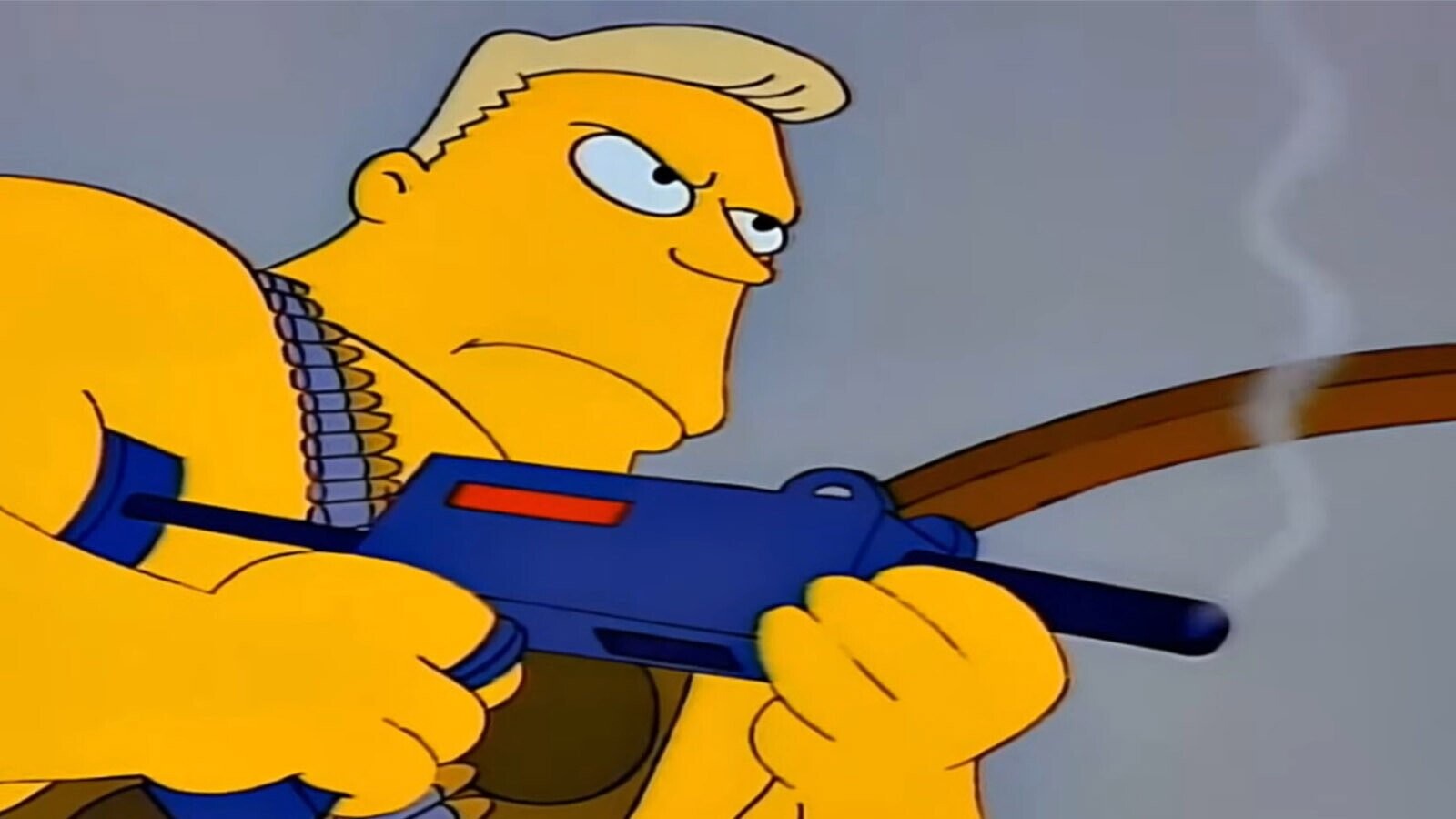
McBain is a fictional action movie character played inside The Simpsons universe by Rainier Wolfcastle, a musclebound Austrian movie star clearly modeled on Arnold Schwarzenegger. Wolfcastle has the accent, the physique, the deadpan delivery, and the emotional range of a garage door with deltoids. That is the joke, and it works beautifully.
The character first appeared in the Season 2 episode “The Way We Was,” which originally aired in January 1991. The episode is mainly remembered as the flashback story of how Homer and Marge met in high school, but it opens with the family watching a McBain movie clip on television. In that scene, McBain discovers that Senator Mendoza is connected to a drug cartel. When his police captain refuses to believe him, McBain responds in the most McBain way possible: with violence, property damage, and absolutely no paperwork.
What made McBain funny was not simply that he spoofed Arnold Schwarzenegger. He also absorbed pieces of other action icons. There are shades of Die Hard, Lethal Weapon, rogue-cop thrillers, revenge movies, drug-war cinema, and the kind of police procedurals where every captain exists solely to shout, “You’re off the case!” before being proven spectacularly wrong.
The Hidden McBain Movie Across Early Seasons
One of the cleverest things about the McBain gag is that the scattered clips across the early seasons form a surprisingly coherent mini-movie. Viewers who watched casually might have treated each scene as a disposable parody. But when the clips are placed in order, they build a complete action plot.
The Setup: McBain Versus Mendoza
The first clip establishes McBain as a cop investigating Senator Mendoza’s drug cartel. It has all the necessary ingredients: a corrupt politician, a furious hero, an obstructive boss, and a window that is about to have a very bad day. The scene tells viewers everything they need to know about the kind of movies being mocked. In McBain’s world, subtlety is what happens when the grenade launcher is in the shop.
The Dead Partner Scene
In “Oh Brother, Where Art Thou?,” the McBain storyline continues. McBain meets his partner Scoey, who is days from retirement. Anyone who has seen enough action movies knows that saying you are close to retirement is basically ordering your own cinematic tombstone. Scoey is killed by an assassin, and his dying words push McBain toward revenge against Mendoza.
This is a classic buddy-cop cliché, and The Simpsons squeezes the joke perfectly. The show understands that action movies often treat character development like a speed bump between explosions. Scoey exists just long enough to be lovable, doomed, and motivational.
The Bigger Gun Problem
In “The War of the Simpsons,” McBain complains that his gun is too small to avenge his partner. His captain reminds him that the department goes “by the book.” McBain then shoots the book. It is a joke so direct it almost wears a headband. The scene works because it compresses an entire genre philosophy into one gag: rules are for people who do not have biceps and a catchphrase.
The Ice Sculpture Ambush
In “Saturdays of Thunder,” McBain gets closer to Mendoza by disguising himself as an ice sculpture at a party. He then reveals himself with the pun “Ice to see you,” because no action hero is truly complete until he commits a felony against wordplay. Mendoza escapes with the help of a drugged salmon puff, which may be the most Simpsons sentence ever written.
The Final Showdown
The McBain storyline reaches a climax in “Last Exit to Springfield,” one of the most celebrated episodes in the entire series. McBain storms Mendoza’s headquarters, survives an assassination attempt, and finally throws the villain out of a high-rise window. It is excessive, loud, and ridiculous, which means it is doing exactly what it was designed to do.
Then a Real Movie Called McBain Happened
Here is where the story gets beautifully strange. Months after The Simpsons introduced its cartoon McBain, a real action movie titled McBain was released in 1991. The film was written and directed by James Glickenhaus and starred Christopher Walken as Robert McBain, a former prisoner of war and Vietnam veteran who helps overthrow a corrupt Colombian regime.
On paper, that sounds like a movie Rainier Wolfcastle might have made between McBain II: You Have the Right to Remain Dead and some fictional sequel involving robotic orangutans. In reality, the film was not connected to The Simpsons. It was a separate production with its own action-movie ambitions, cast, financing, and distribution plan.
The overlap was pure pop-culture coincidence, but it was an awkward one. The Simpsons had used “McBain” as a deliberately silly action-hero name. The real movie used it seriously, or at least seriously enough for a film in which a handful of veterans help topple a government. Suddenly, the cartoon parody and the live-action action film were standing in the same room, both wearing sunglasses indoors.
Why The Simpsons Backed Away From the McBain Name
The show did not erase Rainier Wolfcastle. Instead, it shifted focus. Rather than continuing to rely heavily on “McBain” as the character’s public identity, the writers used the actor’s name, Rainier Wolfcastle. That allowed The Simpsons to keep the Schwarzenegger parody alive without poking the legal bear over a title that now existed in the real movie marketplace.
This distinction matters. The character was not truly retired forever. The McBain name was temporarily cooled down, while Wolfcastle became the safer and more flexible recurring character. Over time, the show brought back references to McBain, and fans continued to treat the fictional movie series as one of the great recurring jokes of the golden era.
The situation was ironic because The Simpsons got there first. Its McBain appeared before the Walken movie reached theaters. But entertainment law and brand caution are not always about who made the funniest joke first. Studios often avoid potential confusion, conflict, or expensive arguments, even when they might ultimately win. Sometimes the easiest solution is not to fight. Sometimes it is to rename the muscleman and move on.
The Real McBain Movie Was Not Exactly a Blockbuster
The 1991 McBain film had recognizable names, including Christopher Walken, María Conchita Alonso, Michael Ironside, and Steve James. It also had a large-scale premise involving war trauma, political corruption, drug cartels, old debts, and military-style action. The production was ambitious, with filming connected to locations such as New York and the Philippines.
Yet the movie did not become a major commercial hit. Its domestic box office was small compared with its reported production cost, and it later became more of a cult curiosity than a mainstream action classic. In an odd way, that helped the cartoon McBain survive in the public imagination. Most casual viewers today are more likely to think of the Simpsons parody than the Walken film when they hear the name.
That is not necessarily an insult to the real movie. Cult films often live in strange corners of memory. Some are rediscovered because they are better than people expected; others because they are so unusual that viewers cannot look away. A Christopher Walken-led action movie called McBain sits in the second category for many fans: not universally beloved, not forgotten, and definitely not boring as a trivia answer.
Why the McBain Joke Worked So Well
McBain worked because The Simpsons was not merely naming a fake action hero. The writers understood the grammar of action movies. They knew the doomed partner. They knew the angry captain. They knew the villain who hosts fancy parties while committing international crimes. They knew the hero who says something stupid before shooting everyone in the room. Most importantly, they knew that action movies often operate by emotional shortcut: if the hero is angry enough, the script assumes he is right.
Rainier Wolfcastle added another layer. He was not just McBain; he was an actor with his own career, ego, family, and absurd filmography. That meant the joke could expand beyond fake movie clips. Wolfcastle could appear at public events, star in other ridiculous productions, endorse products, or stumble through Springfield celebrity life. By shifting from McBain to Wolfcastle, the show may have accidentally made the character more useful.
In other words, the legal headache may have improved the joke. McBain was a parody of one kind of movie. Wolfcastle was a parody of Hollywood itself.
McBain, Schwarzenegger, and the Art of Loving What You Mock
The best parodies are rarely built from pure contempt. McBain is funny because it exaggerates action-movie stupidity, but it also clearly enjoys it. The writers were laughing at the genre while also celebrating its confidence, rhythm, and glorious nonsense. The same is true of many great Simpsons pop-culture jokes. They are sharp, but not joyless.
Arnold Schwarzenegger’s action era gave comedy writers a mountain of material: the accent, the physique, the impossible weapons, the icy one-liners, the heroic invincibility, and the sense that every villain’s headquarters was designed by someone who really wanted it to explode. McBain distilled that era into a character who felt instantly familiar even though he was fake.
That is why the real McBain movie coincidence is so funny. The Simpsons invented a name that sounded like a fake action franchise, and Hollywood responded by proving that, yes, it was absolutely plausible as a real one.
How the Internet Turned McBain Into a Cult Discovery
Years later, fans began editing the scattered McBain clips together into a short “movie.” This gave new life to the joke. People who had watched the episodes for decades suddenly realized that the scenes were not random; they were pieces of a miniature action narrative hiding inside unrelated plots.
That discovery fits perfectly with how modern audiences experience classic television. Streaming, clip compilations, social media threads, and fan edits make it easier to notice patterns that were once buried in weekly broadcasts. In the early 1990s, most viewers simply caught an episode when it aired or later in syndication. Today, fans can reconstruct a joke across seasons like pop-culture archaeologists with better Wi-Fi.
McBain benefits from that treatment because the joke rewards attention. It is funny as a single scene, but even funnier as an accidental film-within-a-show. The more viewers assemble it, the more impressive the writing becomes.
The Bigger Lesson: Pop Culture Moves Fast and Gets Weird
The McBain situation is a reminder that television, movies, and parody do not exist in separate boxes. They overlap, collide, borrow, echo, and occasionally step on each other’s toes. A joke name can become a real title. A fictional actor can become more memorable than the character he plays. A throwaway parody can outlive the films that inspired it.
It also shows how careful long-running shows must be. The Simpsons has always been packed with references, parodies, and cultural commentary. That density is part of its genius, but it also creates risk. When a joke gets too close to a real product, celebrity, trademark, or film title, the writers and producers have to decide whether the laugh is worth the possible trouble.
In McBain’s case, the answer was simple: keep Wolfcastle, ease off the name, and let time sort out the rest. Time did. Today, the whole story feels less like a legal scare and more like one of the most Simpsons-style things that ever happened outside The Simpsons.
Experiences and Reflections: Why This McBain Story Still Feels So Fun
For many longtime viewers, discovering the McBain backstory feels like finding a secret room in a house they have lived in for years. You remember the jokes. You remember the accent. You remember Mendoza. But realizing that the clips form a connected mini-movie changes the experience. It turns a familiar gag into a hidden reward for paying attention.
That is one reason the McBain story travels so well online. It gives fans the pleasure of rediscovery. Someone watches the early episodes again and notices the continuity. Someone else learns there was an actual Christopher Walken movie called McBain. Then everyone collectively has the same reaction: “Wait, that was real?” It is the kind of trivia that feels too perfect to be true, which is exactly why it sticks.
The experience also says something about how people bond with older television. Classic Simpsons episodes are comfort food for many viewers, but they are not simple comfort food. They are layered, fast, and packed with jokes that land differently as you get older. A child might laugh because McBain punches someone through a window. An adult laughs because the scene is parodying police bureaucracy, action-film masculinity, lazy screenwriting, and the way movie violence often pretends to be moral clarity.
There is also a nostalgic pleasure in remembering the action movies being spoofed. The late 1980s and early 1990s were full of heroes who solved institutional corruption by ignoring institutions entirely. They were cops who hated rules, soldiers haunted by war, lone wolves who always had one more bullet, and men whose emotional vocabulary consisted mostly of squinting. McBain condenses all of that into a few seconds at a time.
The real Walken movie adds another layer to the experience because it proves the parody was not far from reality. Hollywood really was making action stories with names, plots, and premises that sounded almost fictional already. That does not make those movies worthless. In fact, it makes them fascinating. They reveal what audiences wanted, what studios believed would sell, and how the action genre processed politics, masculinity, revenge, and spectacle.
Watching the cartoon McBain today can feel like watching a comedy sketch, a film-studies lecture, and a time capsule all at once. The jokes are short, but the cultural shadow behind them is huge. That is why McBain remains memorable even though he was never a central character. He represents The Simpsons at its sharpest: quick enough to parody the moment, smart enough to build a hidden structure, and weirdly lucky enough to predict a naming collision with a real movie.
In the end, the McBain saga is not just about a character being prematurely retired. It is about adaptation. The show adjusted, Wolfcastle survived, and the joke became bigger than the problem that interrupted it. That is the real punchline: McBain may have been pushed aside for a while, but like any proper action hero, he found a way to come crashing back through the window.
Conclusion
The story of McBain is one of those pop-culture accidents that sounds invented by a comedy writer after too much coffee. The Simpsons created a fake action hero to parody the loudest, dumbest, most lovable habits of action cinema. Then a real movie with the same name arrived, forcing the show to step back from the McBain label and rely more heavily on Rainier Wolfcastle.
That temporary retreat did not weaken the joke. If anything, it made the character’s legacy stranger and stronger. McBain became a hidden mini-movie, Wolfcastle became a broader Hollywood parody, and fans gained one of the funniest behind-the-scenes trivia stories in Simpsons history. The real McBain may not have conquered the box office, but it accidentally helped create one of the most memorable naming collisions in animated television.












