
Note: The rankings and opinions in this article are editorial interpretations based on established art-history information about Michelangelo, the Sistine Chapel ceiling, Renaissance fresco technique, museum records, and modern scholarly debate. They are not official museum rankings.
Some artworks politely ask for your attention. The Creation of Adam kicks open the door, points two fingers at the universe, and says, “Remember me forever.” Painted by Michelangelo on the ceiling of the Sistine Chapel, this High Renaissance masterpiece is one of the most recognizable images in world art. Even people who could not name five Renaissance painters can usually recognize those two almost-touching fingers. That tiny gap has become shorthand for life, faith, creativity, suspense, divine energy, and, occasionally, very dramatic Wi-Fi connection memes.
But why does The Creation of Adam still dominate art rankings, museum discussions, pop culture references, and personal opinions more than 500 years after Michelangelo painted it? The answer is not only “because it looks famous.” It is famous because the composition is brutally efficient, emotionally charged, symbolically rich, and technically brilliant. It turns a biblical moment into a visual cliffhanger. God reaches. Adam reaches back. The universe holds its breath.
This article ranks the strongest elements of The Creation of Adam, explores popular opinions about the fresco, explains why it remains such a cultural giant, and adds practical viewing experiences for readers who want to understand the painting beyond the postcard version.
What Is The Creation of Adam?
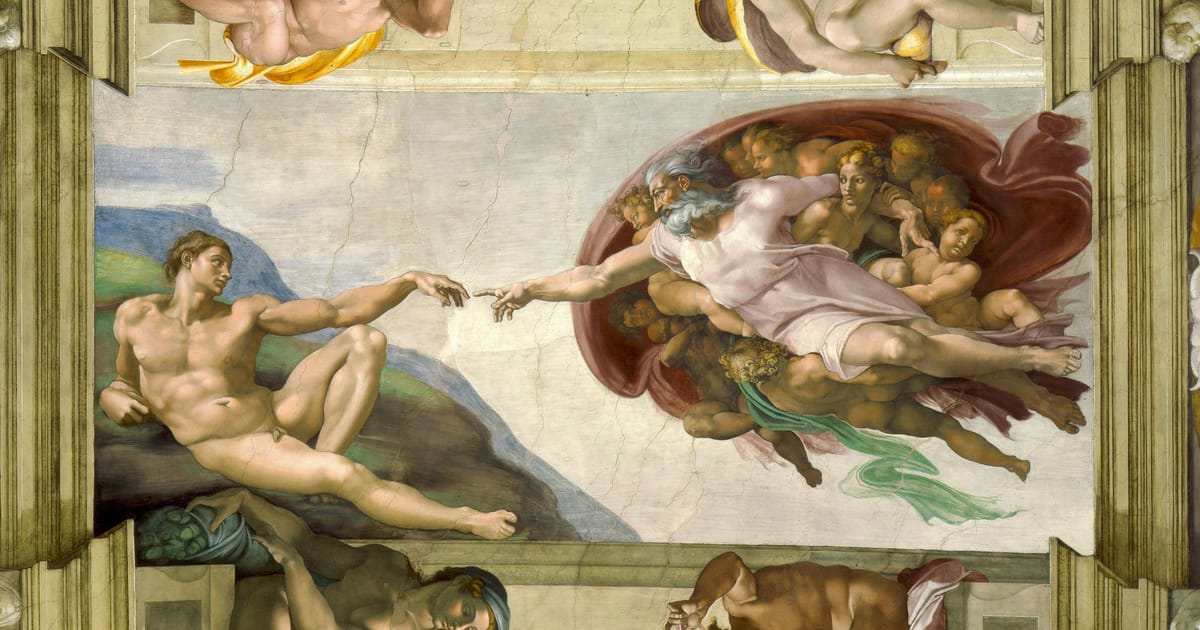
The Creation of Adam is a fresco by Michelangelo Buonarroti, painted as part of the Sistine Chapel ceiling in Vatican City between 1508 and 1512. The scene illustrates the biblical creation narrative from Genesis, where God gives life to Adam, the first man. It belongs to a larger ceiling program that includes nine central scenes from Genesis, surrounded by prophets, sibyls, ignudi, ancestors, and architectural illusion. In other words, Michelangelo did not paint one nice ceiling decoration; he painted a theological, artistic, and anatomical fireworks show overhead.
The fresco shows Adam reclining on the earth, muscular yet not fully animated. On the right, God surges forward in a swirling cloak, surrounded by figures often interpreted as angels or symbolic presences. Between them is the most famous almost-touch in art history. The fingers do not quite meet, and that small space does a suspiciously large amount of emotional labor.
The Creation of Adam Rankings: Best Elements of the Masterpiece
1. The Finger Gap: The Greatest Millimeter in Art
Ranking first is, of course, the gap between God’s finger and Adam’s finger. No contest. If art history had a dramatic pause button, Michelangelo found it. The space between the two hands creates tension because the viewer knows what is about to happen: Adam will receive life. Yet Michelangelo freezes the action one instant before contact. That delay makes the scene feel alive, not static.
Many religious paintings show completed miracles. Michelangelo gives us the second before the miracle lands. That is why the image works on posters, T-shirts, textbooks, advertisements, and parodies. The gesture is simple enough for instant recognition but deep enough for endless interpretation. It suggests dependence, longing, power, distance, and possibility. It is also proof that sometimes the most important part of a painting is the part where nothing is painted.
2. God’s Movement: A Divine Sprint Across the Ceiling
God does not stroll into this fresco. He arrives like a cosmic storm with excellent beard management. His body leans forward, his arm cuts through space, and the surrounding drapery makes him appear to fly. This sense of motion contrasts sharply with Adam’s relaxed, earthbound posture.
That contrast gives the painting its rhythm. God is energy; Adam is potential. God is active; Adam is waiting. The difference between them is not only theological but physical. Michelangelo, who considered himself primarily a sculptor, builds meaning through the body. God’s urgency makes the act of creation feel powerful and immediate, while Adam’s heavy pose makes him feel newly formed, beautiful, and still incomplete.
3. Adam’s Body: Ideal Beauty With a Human Problem
Adam is one of the great reclining figures of Western art. He is idealized, muscular, youthful, and classically proportioned. Yet he is not simply a heroic bodybuilder lounging on a hill after leg day. His hand is limp, his posture is loose, and his expression seems calm but not fully awake. Michelangelo makes Adam physically perfect but spiritually unfinished.
This is a brilliant choice. If Adam looked weak, the scene might become sentimental. If he looked fully alive, the miracle would already be over. Instead, he exists between body and soul. He has form, but not divine spark. He has beauty, but not animation. He is a masterpiece inside a masterpiece, waiting for the final upgrade.
4. The Composition: Simple at First, Complicated Forever
At first glance, The Creation of Adam looks surprisingly simple. Two main figures. One clear gesture. A pale background. Not much architectural clutter. But the more you study it, the more complicated it becomes. The diagonal line from Adam’s body to God’s body creates movement across the panel. The open space between them gives the figures room to breathe. The asymmetry keeps the scene dynamic.
Michelangelo understood ceiling viewing. Visitors would see the fresco from far below, so the composition had to be readable from a distance. That is why the bodies are large, the gestures are bold, and the background is comparatively restrained. It is visual design before the phrase “user experience” existed. Michelangelo was not just painting for theologians and cardinals; he was painting for neck-craning humans standing on a chapel floor.
5. The Mystery Around God’s Cloak: Brain, Womb, or Symbolic Cloud?
One of the most debated opinions about The Creation of Adam concerns the shape surrounding God and the figures around him. Some modern viewers and scholars have compared the outline to a human brain, suggesting Michelangelo may have embedded a neuroanatomical symbol into the fresco. Others see the form as womb-like, connecting the image to birth, creation, and life. Traditional art historians often interpret the figures around God through theological or symbolic frameworks, including possible references to Eve, Mary, wisdom, or future humanity.
Which interpretation is correct? The honest answer is: art history enjoys a good argument, and this one brought snacks. Michelangelo had deep knowledge of anatomy, so anatomical readings are tempting. At the same time, not every rounded shape in Renaissance art is a secret medical diagram. The best opinion may be that the ambiguity is part of the painting’s power. The form can suggest mind, birth, divinity, and mystery all at once without needing to behave like a labeled textbook illustration.
6. The Fresco Technique: Beauty Under Pressure
Fresco painting is not casual. Michelangelo painted on wet plaster, which meant the pigment bonded with the wall as the surface dried. This technique required speed, planning, and terrifying confidence. There was little room for “Oops, let me just Ctrl+Z that.” The Sistine Chapel ceiling was physically demanding, technically complex, and enormous in scale.
Knowing that makes The Creation of Adam even more impressive. The clean forms and graceful movement can make the scene look effortless, but it was born from intense preparation. Surviving drawings and related studies show Michelangelo’s careful attention to anatomy, pose, and gesture. The relaxed final image hides a mountain of labor, which is usually how genius works: it makes the impossible look annoyingly easy.
7. Cultural Impact: The Meme Before Memes
The Creation of Adam ranks near the top of global art recognition because it escaped the chapel ceiling and entered the public imagination. The hands alone have been quoted, copied, parodied, commercialized, remixed, and reinterpreted countless times. They appear in advertising, movie references, political cartoons, internet jokes, tattoos, murals, and modern artworks.
This level of reproduction can make the original feel almost too familiar. Yet that familiarity is also proof of the fresco’s strength. Most images lose power when repeated too often. The Creation of Adam somehow survives the refrigerator magnets. That is not luck; it is design.
Popular Opinions About The Creation of Adam
Opinion 1: It Is the Best Scene on the Sistine Chapel Ceiling
Many viewers rank The Creation of Adam as the greatest single panel on the Sistine ceiling. This opinion is easy to understand. The scene is clear, emotionally immediate, and visually unforgettable. While other ceiling panels are more crowded or narratively complex, this one communicates instantly. It does not require a long theological lecture to feel important.
Opinion 2: It Is Overrated Because It Is Too Famous
Another opinion says the fresco is overrated because pop culture has flattened it into a symbol. This criticism has some merit. When an artwork appears everywhere, viewers may stop looking closely. The hands become a logo instead of a miracle. Still, calling the painting overrated usually says more about overexposure than quality. The original fresco remains powerful because it balances simplicity, anatomy, symbolism, and emotional suspense with rare precision.
Opinion 3: The Brain Theory Makes It More Interesting
Some viewers love the idea that Michelangelo hid a brain shape around God because it makes the image feel like a Renaissance puzzle. This interpretation suggests that God is giving Adam not only life but intellect or consciousness. Whether one accepts the theory fully or cautiously, it adds a fascinating layer to modern discussion. The key is not to reduce the whole painting to one hidden-shape theory. The Creation of Adam is bigger than a visual Easter egg.
Opinion 4: The Painting Is Really About Distance
A strong modern interpretation is that the painting’s emotional center is not contact but separation. God and Adam are close, but not touching. That distance can represent human longing, divine mystery, free will, or the gap between potential and fulfillment. This opinion works especially well because the painting refuses to show the final spark. It lets viewers live inside anticipation.
Why The Creation of Adam Still Matters
The fresco still matters because it speaks across categories. Religious viewers may see divine creation. Art lovers may see compositional genius. Anatomy enthusiasts may see Michelangelo’s knowledge of the human body. Designers may admire the clarity of the silhouette. Casual viewers may simply feel the drama of two hands reaching across space.
Great art does not survive because everyone agrees on one meaning. It survives because each generation finds a new way to argue with it, admire it, parody it, and claim it. The Creation of Adam is not only an image from the Renaissance. It is a living visual language. When someone uses two reaching fingers in a modern poster, the message is instantly understood: connection is coming. Life is about to begin. Something electric is waiting in the gap.
Viewing Experiences Related to The Creation of Adam
Seeing The Creation of Adam in reproduction is useful, but seeing it as part of the Sistine Chapel ceiling changes the experience completely. In a book or online image, the fresco is isolated and perfectly framed. In the chapel, it is one scene among a vast ceiling filled with bodies, prophets, sibyls, narratives, painted architecture, and visual motion. The first experience is “famous image.” The second is “oh, this ceiling is an entire universe, and my neck has filed a complaint.”
A common viewer experience is surprise at the panel’s placement. Many people expect The Creation of Adam to dominate the chapel like a giant billboard. Instead, it participates in a larger visual system. The famous hands are part of a sequence, and understanding that sequence makes the scene richer. Adam is not just a handsome figure waiting for a divine finger tap; he belongs to a story of creation, fall, prophecy, and salvation. The panel gains depth when seen as one chapter in Michelangelo’s massive theological drama.
Another experience is discovering how physical the artwork feels. Michelangelo’s figures do not look delicate or decorative. They have weight. Adam seems to press against the earth. God’s body appears to cut through air. Even the supporting figures around God create a sense of crowding, urgency, and movement. This physicality reflects Michelangelo’s sculptural imagination. He painted bodies as if he were carving them out of the ceiling.
Many viewers also notice that the emotional tone is quieter than expected. Because the image is so famous, people often imagine it as explosive. But the actual scene is controlled and almost silent. There is no thunderbolt, no crowd reaction, no theatrical burst of light. The drama sits in restraint. The hands do not touch. Adam does not leap up. God does not shout. The silence makes the moment feel larger.
For modern audiences, the fresco often becomes personal. Some see it as a symbol of creativity: the instant before an idea becomes real. Others see it as a metaphor for relationships: two people reaching, almost connecting, separated by a small but meaningful distance. Students may remember it as the image that made Renaissance art suddenly feel less dusty. Designers may admire how one gesture can carry an entire message. Even meme-makers, in their chaotic little way, recognize the composition’s power. A weak image does not survive parody; a strong image becomes parody-proof.
The best way to experience The Creation of Adam is to look beyond the hands after first acknowledging them. Study Adam’s relaxed wrist, God’s urgent shoulder, the open space between the figures, the strange protective shape behind God, and the calm landscape beneath Adam. Let the famous detail lead you into the whole painting. That is where the reward lives. The hands are the doorway, but the masterpiece is the room.
Conclusion: Final Ranking and Overall Opinion
So where should The Creation of Adam rank among the greatest artworks of all time? Very high. Top-tier. Museum-superstar level. The fresco earns its reputation not because it is old, religious, or endlessly reproduced, but because it turns a complex idea into an unforgettable image. Michelangelo captures the beginning of human life without showing the actual instant of contact. He gives us suspense instead of completion, and that choice keeps the painting alive.
The strongest opinion is this: The Creation of Adam is not overrated; it is overexposed. There is a difference. Overexposure can make viewers lazy, but the artwork itself remains extraordinary. Look at it carefully, and the familiar image becomes strange again. The fingers hover. Adam waits. God rushes forward. The gap glows with invisible energy. Five centuries later, the spark still has not gone out.











