
Note: This article contains major spoilers for several classic and modern war movies.
War movies often promise courage, sacrifice, brotherhood, and explosions large enough to make your popcorn question its life choices. But the best war films also do something much harder: they show how death can arrive without poetry, justice, or even a decent reason. In these stories, characters do not always die saving the day. Sometimes they die because a commander made a bad call, a frightened soldier froze, a rescue went wrong, or history simply shrugged.
That is what makes pointless deaths in war movies so unforgettable. They are not pointless to the story; they are pointless inside the cruel logic of war. Their lack of meaning becomes the meaning. These scenes remind viewers that war does not hand out noble endings like participation trophies. It is messy, random, political, and often brutally unfair.
Below are 13 war movie deaths that still feel depressingly pointless, even years after the credits roll.
1. Thomas Blake in 1917
In 1917, Lance Corporal Thomas Blake dies after doing something that should have counted as humane: helping a wounded enemy pilot out of a burning plane. Instead of receiving even a second of mercy, Blake is stabbed by the German pilot he tries to save.
The death is devastating because it arrives in the middle of a mission built around prevention. Blake and Schofield are racing to stop a doomed attack and save hundreds of men, including Blake’s own brother. Yet Blake himself is lost in a sudden, ugly moment that has no tactical grandeur. No trumpet. No final charge. Just a young soldier bleeding out while his friend realizes the war has taken another person for no sensible reason.
2. Medic Wade in Saving Private Ryan
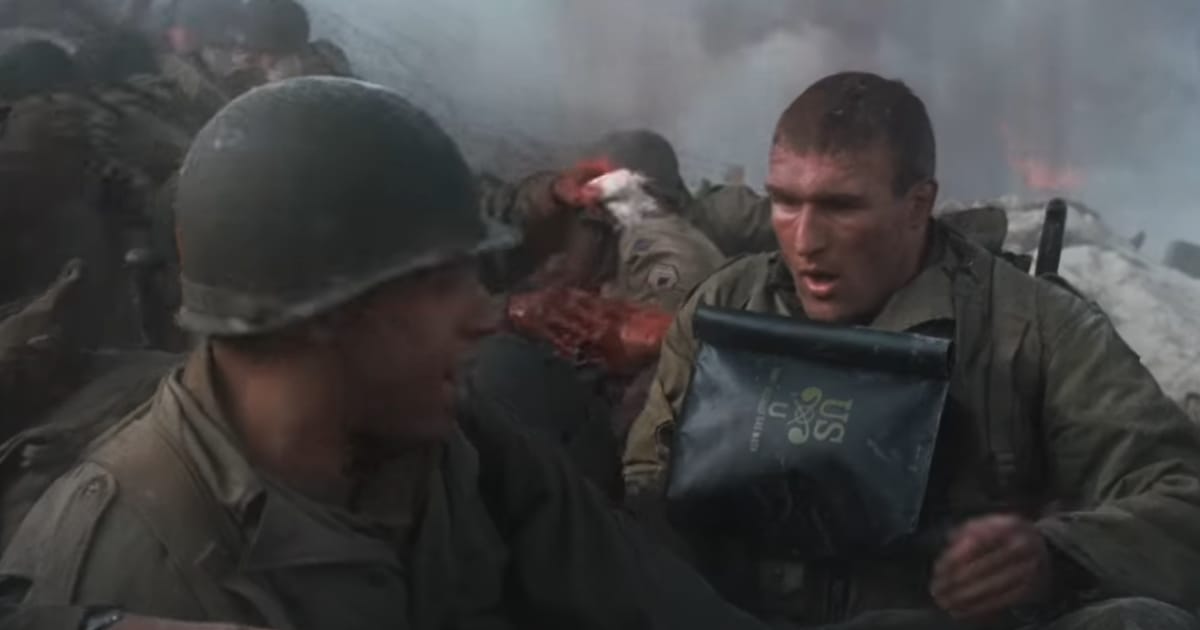
Medic Irwin Wade spends much of Saving Private Ryan trying to keep other people alive. That is why his death hurts like a boot dropped on the heart. During the attack on a German machine-gun position, Wade is fatally wounded, and the men who rely on him suddenly become helpless children around his body.
What makes Wade’s death feel so pointless is the decision that leads to it. Captain Miller chooses to neutralize the gun nest even though the squad’s main mission is to find Private Ryan. The attack succeeds, technically, but the cost is unbearable. Wade dies asking for his mother, and the scene strips away every polished myth about battlefield glory. The healer becomes the casualty. War, apparently, has a terrible sense of irony.
3. Stanley Mellish in Saving Private Ryan
Private Mellish’s death is one of the most difficult scenes in modern war cinema to watch. During the final battle at Ramelle, he fights a German soldier in close quarters while Upham stands frozen nearby, unable to intervene. Mellish is slowly stabbed, and the audience is forced to sit with the horror of a death that feels preventable.
The pointlessness is not just that Mellish dies. It is that he dies within arm’s reach of possible help. The scene captures one of war’s most uncomfortable truths: courage is not automatic. Training, friendship, and good intentions can collapse under terror. Mellish’s death becomes a nightmare about hesitation, guilt, and the unbearable weight of one second too late.
4. Sergeant Elias in Platoon
Sergeant Elias in Platoon is not killed simply by the enemy. He is betrayed by Barnes, a fellow American soldier, and then left to be finished off by North Vietnamese forces. His famous death scene, arms raised as he falls, has become one of the defining images of Vietnam War cinema.
Elias’s death is depressingly pointless because it grows out of moral rot inside his own unit. He is not a casualty of strategy, victory, or even a failed rescue. He is removed because he stands in the way of Barnes’s brutality. In a movie about a platoon tearing itself apart, Elias’s death says the quiet part out loud: sometimes the war is outside the wire, and sometimes it is standing right beside you.
5. Private Pyle in Full Metal Jacket
Leonard “Gomer Pyle” Lawrence never reaches Vietnam. His war happens in boot camp, where humiliation, punishment, and dehumanization grind him down until he kills Gunnery Sergeant Hartman and then himself.
Pyle’s death is pointless because it is manufactured. It is not caused by enemy fire or battlefield chaos, but by a system that confuses cruelty with discipline. Full Metal Jacket shows how a person can be broken before ever entering combat. Pyle becomes a weapon before he becomes a soldier, and the result is not strength. It is tragedy in a bathroom, lit like a nightmare and echoing long after the scene ends.
6. The Teenage Sniper in Full Metal Jacket
Near the end of Full Metal Jacket, American Marines discover that the sniper who has been picking them off is a young Vietnamese girl. After she is wounded, she begs to be killed. Joker eventually shoots her.
This death is pointless in the most haunting way because everyone involved has already been robbed of innocence. The Marines are exhausted and brutalized. The sniper is young, terrified, and dying. Nobody wins anything meaningful in that room. The scene turns combat into a bleak moral trap: mercy and violence become almost indistinguishable. That is not a victory; that is a spiritual invoice no one can pay.
7. George in Dunkirk
Christopher Nolan’s Dunkirk is filled with large-scale danger, but one of its saddest deaths happens in a small civilian boat. George, a teenage hand who impulsively joins the rescue effort, suffers a fatal head injury after a shell-shocked rescued soldier panics and struggles aboard the Moonstone.
George does not die in a heroic dogfight or a grand naval sacrifice. He dies because trauma spills into a cramped space, because fear has nowhere to go, and because war reaches civilians even when they are trying to help. His death feels especially pointless because his dream is so modest: he wants to do something worth remembering. He gets his newspaper mention, yes, but the cost is absurdly high.
8. Paul Bäumer in All Quiet on the Western Front
Paul Bäumer’s death has been one of the great anti-war gut punches for generations. In the 2022 film version of All Quiet on the Western Front, Paul is killed just as the armistice takes effect. After surviving years of mud, gas, hunger, fear, and slaughter, he dies seconds from silence.
Few war movie deaths are more openly pointless. Paul’s death is not a turning point in history. It does not change the outcome. It is the outcome: young men consumed by decisions made far above them. The tragedy is not that Paul almost made it. The tragedy is that “almost” is all war has left to offer him.
9. Nick in The Deer Hunter
Nick’s death in The Deer Hunter is not a battlefield death, but it belongs on any serious list of devastating war movie deaths. After surviving Vietnam, he remains trapped in the psychological wreckage of the war, playing Russian roulette in Saigon until one final trigger pull kills him.
The death is pointless because the war has already ended for Nick’s friends in a technical sense, but not in any human sense. Mike tries to bring him home, reaching for memories of hunting and friendship, yet Nick is too far gone. His death shows that survival is not always rescue. Sometimes the body leaves the war, while the mind is still locked in a room with a loaded gun.
10. Mr. Clean in Apocalypse Now
Tyrone “Mr. Clean” Miller is young, loud, and heartbreakingly unprepared for the madness of Apocalypse Now. During an ambush on the river, he is shot and killed while a tape from his mother continues playing. It is almost too cruel, which is exactly why it works.
Clean’s death is pointless because the mission itself is a descent into absurdity. The patrol boat is traveling deeper into a war that has lost any stable moral compass. His mother’s recorded voice turns the scene into a devastating collision between home and horror. One moment he is somebody’s son. The next, he is another body on a boat drifting toward madness.
11. Private Witt in The Thin Red Line
Private Witt’s death in The Thin Red Line is complicated because he does choose to draw the enemy away and protect others. Yet the larger context makes the sacrifice feel swallowed by something vast and indifferent. Witt dies on Guadalcanal, surrounded by men who barely understand the spiritual questions he carries.
His death is not pointless because he lacks courage. It feels pointless because the war cannot honor the depth of what he gives. Terrence Malick’s film treats battle as a wound in nature itself, and Witt’s death becomes another beautiful, terrible image inside a machine that keeps moving. Even noble sacrifice can feel small when the war is big enough to erase it.
12. Setsuko in Grave of the Fireflies
Setsuko’s death in Grave of the Fireflies may be animated, but anyone who thinks that makes it easier has clearly never watched the film and then tried to function like a normal person. She is a child trying to survive wartime Japan with her older brother Seita after bombing, hunger, and social collapse destroy their family.
Her death from starvation is among the most crushing civilian deaths in war cinema. There is no battlefield glory, no heroic last stand, and no strategic explanation that could make it bearable. Setsuko dies because systems fail, adults fail, resources disappear, and children pay the bill. The pointlessness is the point: war does not only kill soldiers. It hollows out lunchboxes, homes, and childhood itself.
13. Tran Thi Oanh in Casualties of War
In Brian De Palma’s Casualties of War, the Vietnamese girl known as Tran Thi Oanh is abducted, assaulted, and murdered by American soldiers. The film is based on the real Hill 192 incident, making the death even harder to discuss casually. There is no entertainment cushion here. The story is about moral collapse.
This is perhaps the most brutally pointless death on the list because it is not even disguised as combat. It is a war crime. The film uses Eriksson’s refusal to participate and his later push for justice to expose how war can create an atmosphere where cruelty is excused, hidden, or treated as paperwork. Tran’s death is not random; it is the result of dehumanization. That makes it even more disturbing.
Why Pointless War Movie Deaths Stay With Us
Pointless deaths in war movies are powerful because they refuse to let the audience relax into easy storytelling. In a conventional action movie, death often has a neat function. The mentor dies so the hero can grow. The villain dies so justice can clap politely from the balcony. The sidekick dies so the soundtrack can swell and everyone can feel motivated for act three.
Great war movies do not always play that game. They understand that real conflict is rarely tidy. A soldier may die because a message arrives too late. A civilian may die because governments gamble with geography. A child may die because food distribution collapses. A friend may die because another friend freezes. These stories hurt because they feel emotionally true, even when the films themselves are fictionalized or dramatized.
Viewer Experiences: Watching These Scenes Without Looking Away
Watching these war movie deaths can feel less like entertainment and more like being handed emotional homework with no answer key. The first experience many viewers have is shock. Not “jump scare” shock, but the quiet kind where the room seems to shrink. Wade asking for his mother, Blake realizing he will not finish the mission, or Setsuko fading from hunger can make the viewer suddenly aware of how fragile people are when history turns violent.
The second experience is frustration. That is where the word “pointless” really earns its place. Viewers often replay the scene in their heads and look for an escape hatch. What if Upham had moved faster? What if Blake had not helped the pilot? What if George had stayed home? What if the officers in Paths of Glory-style military systems valued human life over reputation? This mental bargaining is part of the pain. The films create situations where the audience can see how avoidable the loss feels, while also understanding that war is built from thousands of avoidable disasters stacked on top of each other like the world’s worst sandwich.
The third experience is moral discomfort. Some deaths do not allow viewers to separate “our side” and “their side” cleanly. Platoon, Casualties of War, and Full Metal Jacket are especially strong at this. They suggest that war does not merely test morality; it can corrode the language people use to recognize morality in the first place. That is why these films are still discussed long after release. They do not just ask, “Who died?” They ask, “What had to break before this death became possible?”
There is also a communal experience around these scenes. People recommend war movies with warnings attached: “It is brilliant, but prepare yourself.” That warning matters. Films like Grave of the Fireflies or All Quiet on the Western Front are not casual background viewing while folding laundry, unless your laundry routine includes existential devastation. These movies demand attention. They make viewers sit with grief rather than rush past it.
For writers, filmmakers, and film fans, these deaths also offer a lesson in storytelling. A death scene does not need a long speech to be meaningful. Sometimes a small detail is enough: a mother’s voice on a tape, a red coat on a wagon, a friend unable to move, a child offering imaginary food. Specific details make fictional deaths feel human instead of decorative.
Ultimately, the experience of watching depressingly pointless deaths in war movies is uncomfortable because it should be. These scenes push against the idea that war is primarily a stage for heroism. Heroism exists, of course, but so do panic, bureaucracy, cruelty, hunger, bad luck, and silence. The best war films make room for all of it. They remind us that the most haunting deaths are not always the biggest explosions. Sometimes they are the ones that leave us whispering, “That did not have to happen.”
Conclusion
The most depressing war movie deaths are not always the bloodiest. They are the ones that expose the terrible waste underneath the spectacle. Thomas Blake, Wade, Mellish, Elias, Pyle, George, Paul Bäumer, Nick, Mr. Clean, Witt, Setsuko, Tran Thi Oanh, and others like them remain unforgettable because their endings feel unfair in a way that cannot be repaired by victory speeches.
That is why these pointless deaths in war movies matter. They do not glorify combat; they question it. They do not make loss look noble by default; they make loss look human. And if a war film can make viewers feel the cost of one life instead of cheering for the size of the explosion, it has done something more important than entertain. It has made the audience remember.












