
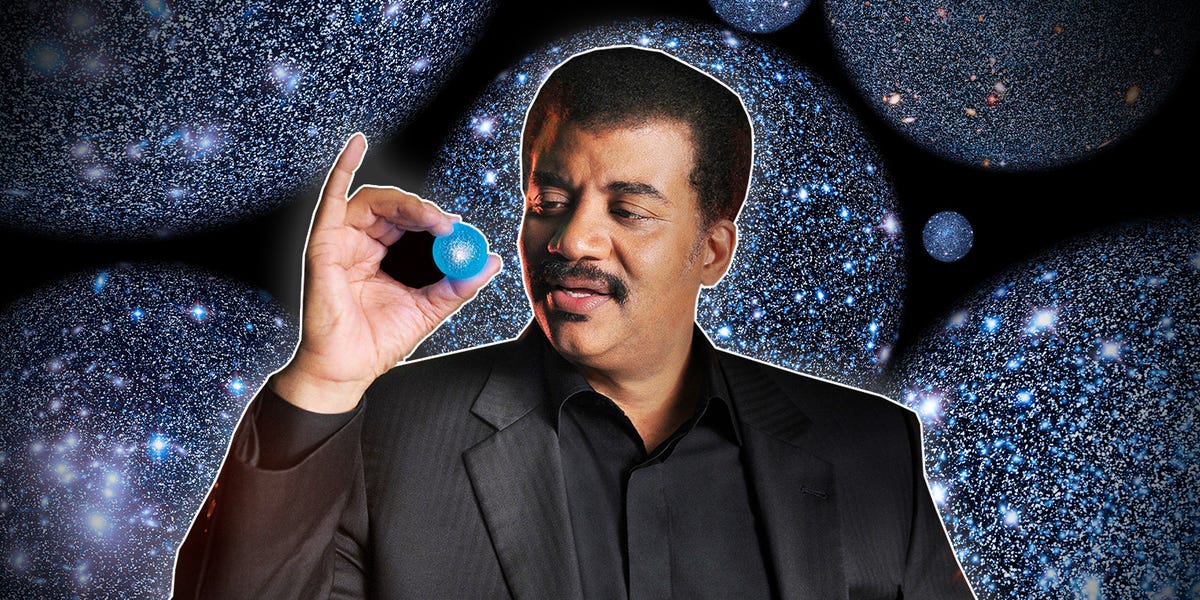
There are ideas that make your brain feel elegant, like a jazz pianist in a tailored suit. Then there is the multiverse, which makes your brain feel like a confused raccoon holding a calculator upside down. The concept sounds simple enough: maybe our universe is not the only universe. Maybe reality is a vast collection of cosmic neighborhoods, bubble universes, quantum branches, or mathematical possibilities, each with its own historyor even its own laws of physics.
Easy, right? Absolutely not. The multiverse is one of those topics where the first five minutes feel like science fiction, the next ten feel like philosophy, and after that you begin staring suspiciously at your coffee mug, wondering whether another version of you remembered to buy oat milk.
The problem is not that humans are stupid. Human brains built telescopes, decoded DNA, landed machines on Mars, and invented pizza delivery tracking. The problem is that our brains evolved to survive mid-sized dangers on one small planet: falling rocks, bad berries, angry animals, social embarrassment, and the eternal mystery of where we put our keys. We did not evolve to picture infinite spacetime, quantum superposition, cosmic inflation, or universes beyond the reach of light. So when physicists talk about parallel universes, eternal inflation, and reality splitting into countless possibilities, our minds do what any sensible primate mind would do: they overheat.
What Is the Multiverse, Really?
The word “multiverse” does not refer to one single theory. It is more like an umbrella for several scientific and philosophical ideas suggesting that our observable universe may be only one part of a much larger reality. Depending on which physicist you ask, the multiverse might mean distant cosmic regions beyond our observable horizon, bubble universes produced by inflation, quantum many-worlds branches, or a vast “landscape” of possible physical laws.
Our observable universe is already absurdly huge. The universe is about 13.8 billion years old, and because space itself has expanded while light has traveled, the observable universe stretches far beyond a simple 13.8-billion-light-year radius. Even this visible cosmic bubble contains hundreds of billions of galaxies, each packed with stars, planets, dust, black holes, and enough weirdness to keep astronomers joyfully under-caffeinated for centuries.
The multiverse asks us to go one step further: what if even this enormous observable universe is not the whole show? What if it is merely the local chapter, the cosmic zip code we happen to inhabit?
Cosmic Inflation: The Universe Hit the Fast-Forward Button
One major path to the multiverse begins with cosmic inflation. Inflation is the idea that, extremely early in cosmic history, space expanded at a staggering rate for a tiny fraction of a second. This concept helps explain why the universe looks so smooth on large scales and why tiny quantum fluctuations could have been stretched into the seeds of galaxies.
Here is where things get spicy. In some versions of inflation, the process does not stop everywhere at once. It ends in some regions, creating “pocket” or “bubble” universes like ours, while continuing elsewhere. If that picture is correct, new universes could keep forming in a larger inflating background. Our universe would be one bubble in a cosmic foam bath. Very scientific. Very majestic. Also, very difficult to visualize without accidentally imagining soap.
This inflationary multiverse is not proven, but it emerges naturally from some models of early-universe physics. That is part of what makes the idea so fascinating and controversial. It is not merely “what if there is a universe where dinosaurs invented jazz?” It is a serious consequence of some mathematical frameworks used to understand the birth and structure of the cosmos.
The Quantum Version: Every Choice Gets Weird
Another famous route to parallel worlds comes from quantum mechanics, especially the many-worlds interpretation. In ordinary life, a cat is either on the couch or not on the couch. In quantum mechanics, particles can exist in superpositions of possible states until measured. The many-worlds interpretation says that all possible outcomes occur, but in different branches of reality.
This does not mean that every time you choose tacos instead of sushi, the universe theatrically splits with a thunderclap and dramatic violin music. The idea is far more technical than the pop-culture version. Still, it suggests that reality may contain a branching structure where every quantum outcome is realized in some branch. Somewhere in the mathematical machinery, possibility refuses to stay politely hypothetical.
For human intuition, this is almost rude. We are built to understand single outcomes: the ball landed here, the door is closed, the toast burned because someone turned the dial to “volcano.” Quantum theory is comfortable with probabilities, amplitudes, and states that do not behave like billiard balls. Our everyday mental software keeps trying to open quantum reality with a house key.
Why the Human Brain Struggles With Cosmic Scale
Our brains are magnificent, but they are not infinite. Working memory can hold only a small amount of information at once. We can reason abstractly, but our thinking still leans heavily on metaphors, images, stories, and bodily experience. We understand “far” because we have walked across rooms. We understand “large” because we have seen mountains, whales, stadiums, and the grocery bill after buying berries out of season.
But the multiverse is not merely large. It may be larger than large in a way that laughs at the entire idea of large. “Huge” is for planets and galaxies. “Possibly infinite” is a different beast. Infinity is not a very big number; it is the collapse of the number game. Humans can manipulate infinity in mathematics, but emotionally and visually, we usually replace it with “a lot, but with dramatic lighting.”
We Think in Stories, Not Spacetimes
Humans love narratives. Beginning, middle, end. Hero, problem, lesson. Unfortunately, cosmology does not always care about our plot structure. The universe may not have a tidy outside, a satisfying boundary, or a narrator who explains the rules in chapter three. The multiverse is especially annoying because it may not be a single place with a map. It may be a set of causally disconnected regions, mathematical branches, or physical possibilities that cannot communicate with one another.
That is hard to hold in the mind because we instinctively ask normal questions: Where is it? What direction is it? Can we go there? Is there parking? But other universes, if they exist, may not be “over there” in the ordinary sense. They may be beyond our cosmic horizon, separated by expanding space, or not spatially connected to us at all.
Our Senses Are Local, but Reality Is Not
Human senses evolved for local survival. Eyes detect nearby light. Ears detect nearby vibrations. Skin detects heat, pressure, and the occasional betrayal of a table corner against the shin. None of these senses gives us direct access to curved spacetime, quantum fields, dark matter, dark energy, or anything beyond the observable universe.
Even in our own universe, most of reality is invisible to direct human experience. Ordinary matterthe stuff of stars, planets, people, sandwiches, and suspiciously expensive phone chargersmakes up only a small fraction of the cosmic energy budget. The rest is dominated by dark matter and dark energy, both inferred from their effects rather than seen directly. If our brains struggle with the invisible ingredients of our own universe, it is no surprise that multiple universes make the mental gears squeal.
The Observable Universe Is Already a Humility Machine
Before we even reach the multiverse, the observable universe gives human ego a firm but educational slap. The Milky Way is one galaxy among vast cosmic structures. Earth is one planet around one star. Humans have existed for a tiny flicker of cosmic time. We are late arrivals at a party that began billions of years before we had shoes, language, or the ability to argue about whether pineapple belongs on pizza.
The cosmic microwave backgroundthe ancient afterglow of the early universegives scientists a baby picture of the cosmos from when it was only hundreds of thousands of years old. From that faint radiation, researchers can infer the universe’s age, composition, geometry, and early fluctuations. This is one of science’s greatest achievements: tiny temperature variations in ancient light have become clues about everything from galaxies to cosmic expansion.
But the multiverse may sit beyond that observational wall. Our instruments can map the universe we can see, but if other universes are causally disconnected from ours, they may never send us light, gravity waves, postcards, or passive-aggressive calendar invites.
The Testability Problem: Science Meets the Cosmic Curtain
One reason the multiverse remains controversial is testability. Science works best when theories make predictions that observations can confirm or challenge. If a proposed universe lies forever beyond observation, how can we test whether it exists?
Supporters argue that the multiverse can be a serious scientific idea if it emerges from theories that also explain observable facts. For example, if inflation is strongly supported by evidence and certain inflation models naturally lead to a multiverse, then the multiverse becomes part of a broader scientific framework. Critics respond that if every possible outcome happens somewhere, predictions can become slippery. A theory that explains everything may risk predicting nothing clearly.
This leads to the “measure problem.” In an infinite or enormously vast multiverse, how do we calculate probabilities? If there are infinitely many universes of one kind and infinitely many of another, comparing them is not like comparing apples and oranges. It is like comparing infinite apple orchards to infinite orange groves while the calculator catches fire.
Why Pop Culture Makes the Multiverse Easierand Wronger
Movies and comics have made the multiverse wildly popular. That is good because it gets people excited about big ideas. It is also risky because fictional multiverses are usually designed for emotional payoff, not scientific accuracy. In entertainment, the multiverse lets characters meet alternate versions of themselves, fix regrets, bring back fan favorites, or finally give the villain a tiny mustache.
Scientific multiverse theories are less convenient. They usually do not include portals, glowing doors, or a version of you who became a rock star because you practiced guitar instead of scrolling at midnight. Other universes, if real, may be unreachable forever. They may not contain alternate Earths. They may have different constants of nature, different particles, or no stars at all. Some might be sterile, chaotic, or physically impossible for life as we know it.
That gap between science and story matters. Pop culture gives us a human-sized multiverse full of choices and identity. Physics gives us a reality-sized multiverse full of math, probability, inflation fields, quantum states, and existential indigestion.
Our Brains Use Metaphors Because the Real Thing Won’t Fit
When scientists explain the multiverse, they often use metaphors: bubbles, branches, landscapes, quilts, foam, membranes. These metaphors are useful, but they are not literal. A bubble universe is not necessarily a shiny sphere floating in a cosmic bathtub. A quantum branch is not a tree limb where tiny physicists sit and wave. A string theory landscape is not a scenic national park with equations camping under the stars.
Metaphors are mental scaffolding. They help us climb toward ideas that cannot be pictured directly. But every metaphor has a breaking point. Push it too far, and it starts lying. That is one reason the multiverse feels so slippery: the deeper we go, the more our familiar images fail.
Could We Ever Prove the Multiverse Exists?
Maybe, maybe not. Some researchers have explored whether collisions between bubble universes could leave traces in the cosmic microwave background. Others look for signatures that might support or rule out certain models of inflation. Quantum interpretations may be judged by how well they fit the mathematics and experimental results of quantum mechanics, even if their deeper metaphysical claims remain debated.
Future telescopes and missions studying cosmic structure, early-universe light, gravitational waves, and dark energy may sharpen the picture. They may support inflation, challenge it, or reveal something stranger than anyone expected. Science has a habit of doing that. The universe is not obligated to be intuitive, but it is surprisingly willing to leave clues.
Still, direct evidence for other universes may remain out of reach. That does not make the question worthless. Some of the most powerful ideas in science begin as attempts to explain why the observable world looks the way it does. The multiverse may be real, wrong, incomplete, or a stepping-stone toward a better theory. In every case, it exposes the edge of human understandingand edges are where science gets interesting.
Why Not Understanding Is Part of the Fun
There is a strange joy in hitting the limits of imagination. The multiverse reminds us that the human mind is not a transparent window onto reality. It is a biological tool that evolved under very specific conditions. It is brilliant at faces, patterns, language, cooperation, and spotting snacks from across the room. It is less brilliant at picturing infinite-dimensional possibility spaces.
But that does not mean we are helpless. Mathematics extends intuition. Telescopes extend sight. Particle accelerators extend touch. Computers extend calculation. Scientific communities extend individual minds across generations. No single brain can “fathom” the multiverse in a warm, cozy, visual way. But many brains working together can build models, test predictions, refine equations, and gradually map the border between knowledge and mystery.
Experiences That Make the Multiverse Feel Almost Personal
The multiverse may be a cosmic idea, but the feeling behind it is surprisingly familiar. Almost everyone has had a moment when life seems to split into invisible branches. You choose one school instead of another. You take a job, decline a call, move to a new city, end a relationship, start a conversation, miss a train, or say yes when you almost said no. Later, you wonder: what happened to the life I did not live?
Of course, wondering about alternate life paths is not the same as proving parallel universes. Your “what if” daydream is not a peer-reviewed cosmological model, even if it has excellent emotional cinematography. But the psychological experience helps explain why the multiverse fascinates us. It turns private regret, curiosity, and imagination into a cosmic metaphor. Maybe somewhere, some version of events unfolded differently. Maybe reality is bigger than the single timeline we remember.
One everyday experience that hints at our limits is looking at a clear night sky. At first, the view feels peaceful: a few bright stars, maybe the Moon, perhaps a planet pretending to be a star because astronomy enjoys practical jokes. Then you remember that each star is a sun, that many may have planets, that the Milky Way is only one galaxy, and that galaxies themselves gather into filaments across cosmic space. The mind tries to zoom out, but it does not really zoom. It swaps one simplified picture for a bigger simplified picture. Eventually, the whole thing becomes a beautiful mental blur.
Another experience is trying to understand deep time. We can say “13.8 billion years,” but saying it is not the same as feeling it. A thousand years already strains imagination. A million years becomes symbolic. A billion years is basically the brain waving a tiny white flag. Yet cosmology asks us to think not only about billions of years but about processes that occurred in fractions of a second after the Big Bang. The universe forces us to think at both impossible extremes: the unbelievably vast and the unbelievably tiny.
Then there is the experience of choice. Multiverse stories appeal to us because they make possibility visible. They suggest that somewhere, a different version of you made the braver decision, the kinder decision, the ridiculous decision involving karaoke and a cowboy hat. That can feel comforting or unsettling. But in real life, the lesson may be simpler: because we only experience one path, our choices matter intensely. We do not need confirmed parallel universes to feel the weight of possibility. We already live inside it.
The multiverse also teaches humility. It says, gently but firmly, that human common sense is not the boss of reality. The universe has no duty to fit into the shapes our ancestors found useful on the savanna. It may be stranger, larger, and less centered on us than we can comfortably imagine. That is not an insult to humanity. It is an invitation. We are small, yes, but we are small creatures capable of asking enormous questions. That is a pretty good deal for a species that still occasionally walks into glass doors.
So perhaps our puny human brains cannot fully fathom the multiverse. Perhaps no brain can turn it into a neat picture. But we can circle it with math, metaphor, observation, and wonder. We can admit confusion without surrendering curiosity. And when the idea becomes too large to hold, we can do what humans have always done at the edge of the unknown: look up, laugh nervously, and keep asking.
Conclusion
The multiverse is difficult because it attacks every comfort zone our minds possess: scale, causality, identity, probability, and proof. It asks local brains to think nonlocally, visual minds to accept invisible structures, and story-loving humans to confront a reality that may not care about tidy endings. Whether the multiverse turns out to be a real feature of physics or a fascinating wrong turn, it remains valuable because it stretches our imagination to the breaking pointand then politely asks it to stretch a little more.
Our brains may be puny compared with the cosmos, but they are also astonishing. They can notice their own limits, invent tools to overcome them, and transform confusion into inquiry. That may be the most human response to the multiverse: not mastery, not certainty, but awe with homework.
Note: This article synthesizes established ideas from modern cosmology, quantum theory, cognitive science, and public science education. It is written for general readers and does not claim that the multiverse has been experimentally proven.












