
Disaster movies have a simple job description: destroy something expensive, make the audience gasp, and give at least one scientist a terrible day at work. Accuracy is optional. Explosions are not.
Still, the best disaster movie clips often work because they borrow just enough real science to make the impossible feel alarmingly close. Earthquakes really can rupture highways. Tsunamis really can surge miles inland. Pyroclastic flows are every bit as terrifying as they look. Asteroids are not merely a screenwriter’s excuse to put Bruce Willis in a spacesuit.
But then Hollywood adds a little seasoning. A magnitude-9 earthquake appears on the wrong fault. A climate system changes faster than a microwave dinner. Neutrinos suddenly develop the personality of a blowtorch. The result is spectacular cinema and, occasionally, a migraine for the nearest geophysicist.
For this ranking of the top 10 disaster movie clips critiqued by experts, we compare iconic scenes with established findings from earthquake scientists, volcanologists, meteorologists, climate researchers, tsunami specialists, and planetary-defense experts. The ranking considers scientific realism, cinematic impact, and one crucial question: how loudly would an expert yell at the screen?
10. Volcano (1997): Lava Erupts Beneath Los Angeles
The clip
A volcano suddenly erupts beneath Los Angeles, sending lava through streets, subway tunnels, and neighborhoods while emergency crews desperately attempt to redirect the molten rock.
What experts would say
The biggest problem arrives before the lava does: central Los Angeles is an extremely unlikely location for a new volcano to suddenly appear. Volcanic activity is not randomly sprinkled across the planet like geological confetti. It is strongly connected to tectonic settings, existing volcanic regions, and deeper magma systems.
California absolutely has real volcanic hazards, particularly in regions such as the Cascades, the Long Valley area, and other recognized volcanic centers. A surprise eruption beneath the La Brea Tar Pits, however, belongs firmly in the Hollywood section of the geology library.
The movie does better with one general idea: lava can destroy infrastructure by burning, burying, or surrounding whatever lies in its path. Yet most surface lava flows are not sprinting predators. Depending on composition, slope, and eruption rate, many advance slowly enough for people to escape on foot. The real danger is often less “lava chasing your fire truck” and more “your neighborhood is permanently becoming new geology.”
Expert verdict: Great urban chaos, deeply questionable address.
9. 2012 (2009): Neutrinos Cook the Planet
The clip
Scientists discover that unusual neutrinos from intense solar activity are heating Earth’s interior. The crust destabilizes, continents shift, Yellowstone erupts, and the planet apparently decides to cancel civilization.
What experts would say
Neutrinos are real particles, but the movie gives them a dramatic career change. They interact extraordinarily weakly with ordinary matter. Enormous numbers can pass through matter without depositing the kind of energy required to heat Earth’s core like a cosmic oven.
Once that fictional switch is flipped, 2012 piles disaster upon disaster with the enthusiasm of someone who has discovered an unlimited visual-effects budget. Massive earthquakes, crustal displacement, volcanic catastrophe, and global flooding occur in a compressed chain reaction that has little resemblance to how Earth’s systems actually behave.
The film deserves credit for commitment. It does not merely bend physics; it puts physics in a limousine, drives it off a cliff, and narrowly escapes in a small airplane.
Expert verdict: Scientifically disastrous. As a disaster spectacle, almost impressively unstoppable.
8. Armageddon (1998): Drill the Asteroid and Blow It Apart
The clip
A gigantic asteroid is heading toward Earth, so NASA sends expert oil drillers into space. Their mission is to land on the object, drill deep into it, place a nuclear device inside, and split it into two pieces that will pass harmlessly around Earth.
What experts would say
The asteroid threat itself is real. Planetary defense is a serious scientific field, and NASA’s DART mission demonstrated that a spacecraft can deliberately strike an asteroid and measurably change its motion.
The questionable part is everything involving last-minute asteroid surgery. Real planetary-defense strategies depend heavily on discovering a dangerous object early. With enough warning time, even a relatively small change in velocity may shift an asteroid away from a future collision course.
Nuclear devices have been studied as a possible option for certain extreme scenarios, but the movie’s plan to drill into a Texas-sized asteroid and split it perfectly at the last possible moment is extraordinarily optimistic. Asteroids vary in structure. Some are solid bodies; others are rubble piles. Breaking one apart could create multiple dangerous objects instead of two obedient pieces politely missing Earth.
Expert verdict: Real problem, real interest in deflection technology, gloriously improbable execution.
7. The Day After Tomorrow (2004): New York Freezes Almost Instantly
The clip
Climate disruption triggers enormous storms, a catastrophic surge floods Manhattan, and temperatures plunge so rapidly that people flee an advancing wall of deadly cold.
What experts would say
The movie starts with a legitimate scientific subject: major changes in ocean circulation can influence regional and global climate. The Atlantic Meridional Overturning Circulation, often discussed in relation to North Atlantic climate, is an active area of research.
The problem is the timescale. Climate systems can change abruptly in the geological sense without behaving like an instant freeze ray. The movie compresses complex processes that would unfold over much longer periods into a few action-packed days.
The famous outdoor freeze sequences are particularly cinematic. Air temperature does not normally crash across a city in a sharp moving boundary that freezes everything behind it in seconds. That is meteorology rewritten as a monster movie.
Yet the film’s central trick is clever: it takes genuine anxiety about climate instability and turns the timeline knob until it snaps off.
Expert verdict: Real scientific concerns traveling at action-movie speed.
6. San Andreas (2015): A Giant Earthquake and San Francisco Tsunami
The clip
The San Andreas Fault unleashes an enormous earthquake, devastating California. Soon afterward, a towering tsunami crashes into San Francisco Bay.
What experts would say
California faces serious earthquake risk, and a major San Andreas rupture could cause catastrophic shaking, fires, infrastructure failures, and enormous economic damage. That part needs no Hollywood assistance.
The movie dramatically oversizes the event. Scientific modeling indicates that the San Andreas Fault is capable of extremely large earthquakes, but an event beyond roughly magnitude 8.3 would be considered highly unlikely.
The tsunami is an even bigger scientific stretch. The San Andreas is primarily a strike-slip fault, meaning the plates move mostly horizontally past one another. The largest earthquake-generated tsunamis usually involve major vertical displacement of the seafloor, particularly at subduction zones.
California will not split off and fall into the ocean, either. That myth is stubborn enough to deserve its own movie franchise, but plate tectonics refuses to cooperate.
Expert verdict: The earthquake risk is real; the blockbuster amplification is enormous.
5. Twister (1996): Chasing Tornadoes and Judging Their Strength on Sight
The clip
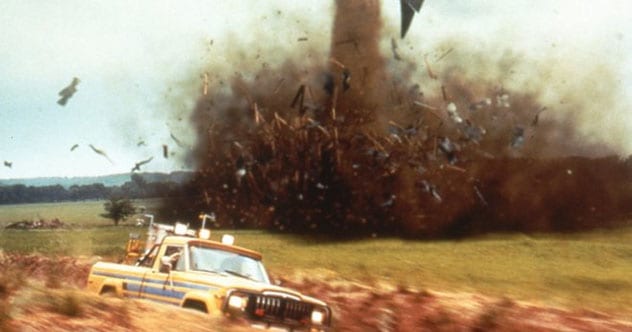
Storm chasers race toward violent tornadoes, deploy a sensor-filled device called Dorothy, and identify powerful storms as F4s or F5s while dodging flying debris, overturned vehicles, and one extremely famous cow.
What experts would say
Twister has more genuine science in its DNA than its flying livestock might suggest. Dorothy was inspired by real attempts to place instruments near tornadoes, and the film helped popularize storm research for an entire generation.
However, scientists do not officially assign a tornado’s Enhanced Fujita rating simply by staring at the funnel and announcing a number. Modern EF ratings are based primarily on post-storm damage surveys. Experts examine how buildings, trees, and other structures were affected and use that evidence to estimate wind intensity.
The movie’s culture of driving dangerously close to tornadoes also makes real meteorologists nervous for obvious reasons. Research storm chasing involves planning, communication, radar interpretation, escape routes, and respect for rapidly changing conditions.
And one general movie-inspired safety idea deserves special criticism: highway overpasses are not reliable tornado shelters. They can expose people to intense winds and dangerous flying debris.
Expert verdict: Influential, exciting, partly grounded in real research, and absolutely not a driving tutorial.
4. Dante’s Peak (1997): The Acid Lake Escape
The clip
As a volcano erupts, characters cross a lake that has become dangerously acidic. The boat deteriorates as they desperately try to reach shore.
What experts would say
This scene is a fascinating case of Hollywood finding a real phenomenon and then turning the volume to eleven. Volcanic crater lakes can indeed become extremely acidic. Magmatic gases can dissolve into water and create conditions dangerous to people and animals.
What is less convincing is the speed with which the movie’s lake becomes capable of rapidly eating through a metal boat. Highly acidic volcanic water can cause burns and corrosion, but the instant cinematic destruction is exaggerated.
The broader movie earns more respect from volcanologists than many disaster films. Monitoring earthquakes, gas emissions, and other warning signs is a real part of volcano surveillance. Communities near active volcanoes also face difficult decisions about warnings and evacuations when scientists cannot predict every eruption with perfect certainty.
The film mixes different styles of volcanic behavior for maximum excitement, but it at least understands that volcano disasters involve science, communication, public officials, and uncomfortable uncertaintynot merely a mountain suddenly exploding because the third act has arrived.
Expert verdict: Surprisingly thoughtful geology buried beneath some extra-strength Hollywood acid.
3. Pompeii (2014): Trying to Escape a Pyroclastic Flow
The clip
Mount Vesuvius erupts with spectacular violence as ash, debris, and fast-moving volcanic destruction race toward populated areas.
What experts would say
The exact sequence and visual details are dramatized, but the underlying hazard is terrifyingly real. Pyroclastic flows are dense, fast-moving mixtures of hot gas, ash, and volcanic material. Unlike many ordinary lava flows, they can move at highway speeds or faster and are extraordinarily difficult to escape once they are close.
Real pyroclastic density currents can burn, suffocate, bury, and destroy. During major eruptions, they may follow valleys and low terrain while sometimes carrying enough momentum to cross obstacles.
This is one case where Hollywood does not need to invent much. The scientific version is already nightmare fuel. The movie’s greatest distortion is the familiar action-film insistence that important characters might successfully outrun almost anything if the soundtrack becomes dramatic enough.
Expert verdict: The danger is real. Your chances of winning a footrace against a major pyroclastic flow are not.
2. The Impossible (2012): The 2004 Indian Ocean Tsunami
The clip
A family at a coastal resort is struck by a massive tsunami. Water surges through buildings and vegetation, carrying debris and separating people in violent, chaotic currents.
What experts would say
Unlike many entries on this list, The Impossible is based on a real catastrophe. The destructive chaos depicted in the impact sequence reflects a fundamental truth about tsunamis: they are not simply oversized versions of ordinary beach waves.
A tsunami approaching land may appear as a rapidly rising flood, powerful surge, or wall of turbulent water. Its long wavelength gives the moving water tremendous capacity to inundate coastal areas. Debris becomes a major secondary hazard, turning vehicles, wood, glass, and building materials into dangerous projectiles.
The scene also captures something movies sometimes miss: surviving the first impact does not mean the danger is over. Tsunamis can arrive in multiple waves, and powerful return flows can be devastating.
Natural warning signs can include strong or prolonged earthquake shaking, unusual ocean behavior, sudden water withdrawal, or a loud roar from the sea. In a real coastal emergency, immediate movement toward high ground can matter more than waiting for a cinematic hero to explain the plot.
Expert verdict: Horrifying partly because the disaster is presented as physical chaos rather than fantasy.
1. Deep Impact (1998): A Cosmic Impact Sends a Tsunami Inland
The clip
A fragment of a comet strikes the Atlantic Ocean, producing a vast tsunami that races toward the coast while people attempt to escape to higher ground.
What experts would say
Deep Impact is frequently treated as one of the more scientifically grounded major asteroid-and-comet disaster movies. The central threat is legitimate: sufficiently large near-Earth objects can cause regional or global catastrophe, and planetary defense exists because the risk, while rare, is physically real.
An ocean impact could generate enormous waves, although the exact size, shape, and inland reach would depend on the object’s size, velocity, impact angle, water depth, coastline, and local topography. Hollywood naturally prefers one visually perfect wall of water. Real tsunami behavior is messier.
The film also understands an essential principle that modern planetary-defense efforts emphasize: detection and warning time matter. Saving Earth is far more believable when scientists discover a threat early enough to study it, calculate its orbit, and plan a response.
That does not make every number or visual effect in Deep Impact flawless. It simply puts the movie in rare company. Its science is used to support the drama rather than being repeatedly tackled by the drama and left unconscious behind a burning building.
Expert verdict: Not a documentary, but one of Hollywood’s more respectable attempts at scientifically grounded extinction-level entertainment.
What Disaster Movie Experts Notice That Most Viewers Miss
Expert critiques reveal a pattern across almost every disaster movie. Hollywood usually begins with something real and then changes one of three variables: scale, speed, or certainty.
Earthquakes become larger than the fault can reasonably produce. Climate changes that might unfold over decades or longer happen before the characters finish lunch. Scientists deliver perfect predictions down to the minute, even when real hazard forecasting involves probabilities, incomplete data, and rapidly changing information.
Another common mistake is confusing different kinds of hazards. A horizontal fault is asked to create a giant tsunami. Slow lava behaves like a pursuing predator. A pyroclastic flow becomes something a motorcycle might outrun with sufficient emotional determination.
Yet scientific accuracy is not the only reason these scenes matter. Disaster movies introduce millions of viewers to concepts such as fault lines, storm chasing, volcano monitoring, asteroid deflection, tsunami warning signs, and emergency evacuation. Even an inaccurate film can inspire someone to investigate the real science.
That makes expert criticism more interesting than simply shouting, “Wrong!” The better question is: Which part is real, which part is exaggerated, and what should viewers understand if the hazard actually happens?
The Viewing Experience: What Changes When You Watch Disaster Movies Like an Expert
Watching disaster movie clips casually is easy. The building falls down, the audience says “wow,” and somebody drops the popcorn. Watching the same scene through an expert lens creates an entirely different experience.
The first change is that the quiet details become more interesting than the explosions. In an earthquake movie, the most important question may not be whether a skyscraper collapses. It may be whether the fault type could create the event shown on screen. During a tornado sequence, an experienced meteorologist may notice radar use, storm structure, escape planning, and shelter choices before caring about the computer-generated debris.
This creates a strange but enjoyable tension. The more you learn about real disasters, the less you need Hollywood to exaggerate them. A genuine pyroclastic flow moving at extraordinary speed is frightening without a villain, a countdown clock, or a family argument that must be resolved before evacuation. A real tsunami does not need to look like a perfectly curling surfing wave. A fast-rising, debris-filled flood can be far more dangerous.
Another part of the experience is learning to separate scientific realism from emotional realism. A scene can contain incorrect physics while accurately portraying panic, uncertainty, communication failures, or the difficulty of persuading people to evacuate. Dante’s Peak, for example, exaggerates some volcanic details but captures the uncomfortable problem of making public decisions when scientists know danger is increasing but cannot provide absolute certainty.
The reverse can also happen. A movie may use technically impressive imagery while making human behavior feel artificial. Real disasters are often confusing. Information arrives in fragments. Roads become blocked. Communications fail. People underestimate threats, search for relatives, help strangers, or refuse to leave familiar places. The most convincing disaster scenes understand that catastrophe is not only a physics problem; it is a human decision-making problem.
There is also a practical benefit to the expert-viewing experience. Once viewers recognize recurring myths, they become harder to forget. A highway overpass is not a good tornado shelter. Strong coastal shaking can be a natural tsunami warning. California is not going to fall into the Pacific Ocean. A volcano does not need rivers of movie-style lava to be deadly; ash, lahars, gases, and pyroclastic flows may be more dangerous.
Perhaps the most enjoyable part is realizing that experts are not necessarily enemies of fun. Scientists can recognize absurd physics and still appreciate a spectacular movie. In fact, knowing exactly why a scene is impossible can make it more entertaining. There is a special joy in watching 2012 demolish several branches of science before the opening act is finished.
The ideal experience, then, is not choosing between entertainment and accuracy. It is enjoying both levels at once. Let Hollywood destroy the city. Then ask the geologist what would really happen. Cheer for the heroes escaping the wave. Then learn how actual tsunami warnings work. Admire the asteroid explosion, but remember that real planetary defense is more likely to involve careful observation, orbital calculations, and years of preparation than a heroic drilling crew arriving at the last possible second.
Once you start watching this way, disaster movies become more than spectacle. They become giant, noisy thought experimentsand occasionally very expensive science quizzes.
Conclusion: Hollywood Can Break the Rules, but Reality Gets the Last Word
The best disaster movie clips critiqued by experts reveal why the genre remains irresistible. Real science provides the foundation, and Hollywood builds a flaming skyscraper on top of it.
Volcano puts an eruption where one is extraordinarily unlikely. 2012 weaponizes neutrinos. Armageddon turns planetary defense into deep-space drilling. The Day After Tomorrow accelerates climate change beyond recognition, while San Andreas asks one fault to perform several geological jobs at once.
Other movies get surprisingly close to reality. Twister reflects genuine storm-research ambitions. Dante’s Peak understands the uncertainty surrounding volcanic crises. Pompeii draws power from hazards that are already terrifying. The Impossible shows the brutal chaos of a real tsunami, and Deep Impact remains one of the more thoughtful examples of cosmic-disaster cinema.
Scientific criticism does not ruin these movies. It gives them a second life. The explosion may last two minutes, but the argument about whether it could actually happen can last all night.
Note: This ranking is an editorial synthesis of publicly available expert commentary and established scientific guidance. The ranking order and verdicts are editorial assessments rather than official scores issued by any scientific agency.













