
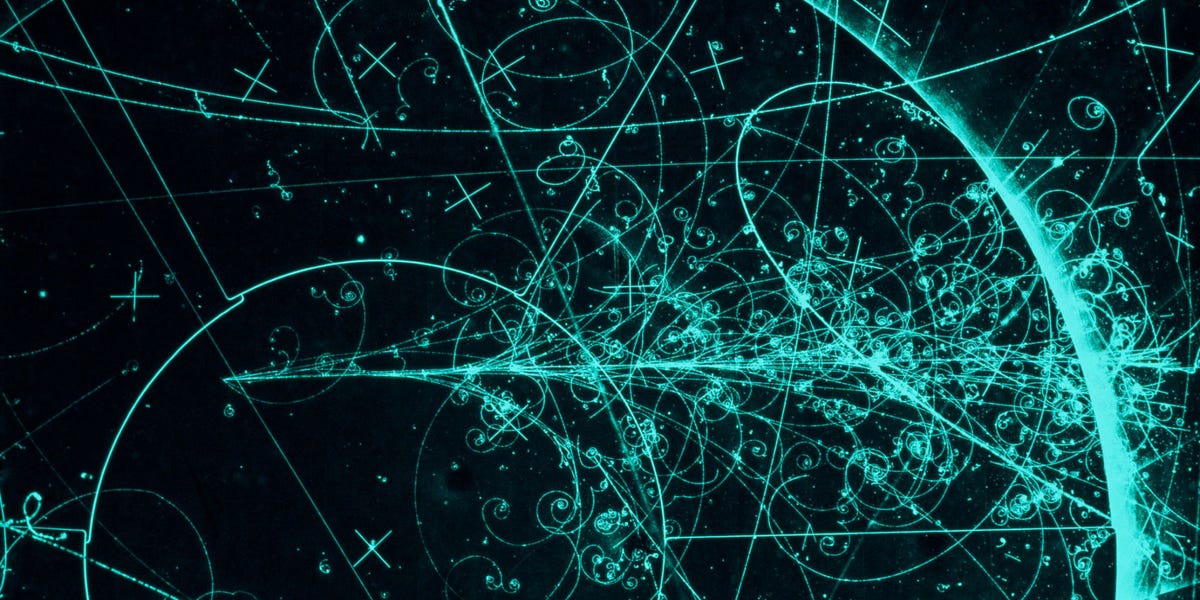
Imagine discovering that every electron in the universe is not merely identical, but literally the same electron, zipping forward and backward through time like a cosmic sewing needle stitching reality together. The electron in your phone, the electron in a star, the electron helping hold together a molecule in your morning coffeewhat if they were all one tireless little traveler wearing trillions upon trillions of disguises?
That is the strange, beautiful, and slightly brain-bending idea behind the “one-electron universe,” a hypothesis famously associated with physicist John Archibald Wheeler and later discussed by Richard Feynman. It is not the mainstream explanation accepted by modern physics, but it remains one of those rare thought experiments that makes people stop, blink twice, and ask, “Wait… physics is allowed to do that?”
The short answer is yes, physics is allowed to ask wild questions. The longer answer is that this idea opens a surprisingly useful door into quantum mechanics, antimatter, time, particle identity, and quantum field theory. So, let’s take a walk through the weirdest possible electron family reunionwhere the guest list may contain exactly one guest.
The Big Idea: One Electron, Infinite Appearances
The one-electron universe proposes that all electrons and positrons could be different appearances of a single electron moving through spacetime. Instead of imagining countless separate electrons scattered around the cosmos, picture one continuous worldline winding through time like spaghetti dropped by a very ambitious chef.
At any given moment, we would see many crossing points of that worldline. Each crossing would look like an electron. If the same line doubled back through time, that backward-moving segment could appear to us as a positronthe electron’s antimatter counterpart. In this view, matter and antimatter become two directions of the same underlying path.
Is this how physicists currently explain the universe? Not exactly. Modern quantum field theory gives us a cleaner and more successful picture: electrons are excitations of an underlying electron field. Still, Wheeler’s idea survives because it captures something genuinely true about physics: electrons are not tiny personalized marbles with name tags. They are perfectly identical in every measurable intrinsic property.
Why Electrons Are Already Suspiciously Identical
Every electron has the same electric charge, the same rest mass, the same spin, and the same basic behavior under the known forces. An electron in a hydrogen atom on Earth is not “kind of similar” to an electron in a distant galaxy. It is identical in the strict physics sense. If two electrons were swapped, the universe would not leave a receipt.
This is already weird if you come from everyday life. Two baseballs can be similar, but not truly identical. One has a scuff, one has a slightly different weight, one has been chewed by a golden retriever named Max. Electrons do not work that way. They do not carry scratches, serial numbers, biographies, or tiny motivational stickers.
Quantum mechanics treats identical particles differently from distinguishable objects. This matters enormously. The behavior of electrons is tied to the Pauli exclusion principle, which says that no two identical fermions, such as electrons, can occupy the exact same quantum state at the same time. That principle helps explain the structure of atoms, the periodic table, chemical bonding, the stability of matter, and why you do not sink through your chair like a dramatic ghost.
Where Richard Feynman Enters the Story
Richard Feynman is often connected to this idea because of his work on quantum electrodynamics, or QED, the theory that describes how electrons and photons interact. Feynman diagrams show particle interactions as lines and vertices, providing a visual shorthand for complex calculations. They look like scientific doodles, but they are not casual napkin art; they are powerful tools for computing probabilities.
One of the striking interpretations in this framework is that a positron can be treated mathematically like an electron moving backward in time. That does not necessarily mean a tiny particle is literally rewinding its personal movie while yelling “beep-beep-beep” like a truck in reverse. It means the equations allow a deep relationship between particles, antiparticles, time direction, and charge.
Wheeler reportedly suggested the more radical step: perhaps there is only one electron, moving forward and backward through time so many times that it appears as all electrons and positrons everywhere. Feynman appreciated the boldness of the idea, even though it has serious problems as a literal model. Like many great thought experiments, it may be wrong in detail while still being wonderfully productive in imagination.
The Positron Problem: A Cosmic Accounting Issue
The one-electron universe has a famous problem: if electrons moving forward in time and positrons moving backward in time are part of the same grand worldline, why do we see far more electrons than positrons in the observable universe?
Our universe is matter-dominated. Positrons exist, but ordinary matter is not evenly matched by antimatter in daily life. Your desk is not constantly exploding into energy because every electron is meeting an equal number of positrons at lunch. Thankfully, office furniture remains mostly non-apocalyptic.
This imbalance is one reason the one-electron universe is not accepted as a literal description of reality. Any serious version of the idea would need to explain why our time-slice through spacetime contains so many electron appearances and comparatively few positron appearances. Modern physics treats the matter-antimatter imbalance as a major cosmological mystery, but not one solved by simply declaring “one electron did it.”
Modern Physics Has a Different Answer: Fields First, Particles Second
The mainstream explanation for why all electrons are identical comes from quantum field theory. In this view, the universe is filled with fields. The electron field exists everywhere, and what we call an electron is a quantized excitation of that field.
A useful analogy is a wave on the ocean. Two waves can appear in different places, but they are not made from different “wave stuff.” They are patterns in the same ocean. Similarly, electrons are not separate handmade beads manufactured in a cosmic workshop. They are standardized excitations of the same underlying field.
This explains why every electron shares the same basic properties. They are not all identical because the universe has excellent quality controlalthough, to be fair, it does. They are identical because each electron is an excitation of the same field governed by the same rules.
This field-based explanation is more powerful than the one-electron universe because it fits with the broader Standard Model of particle physics, which organizes known elementary particles and three of the four fundamental forces: electromagnetism, the weak force, and the strong force. Gravity remains outside the Standard Model, which is physics’ way of saying, “The group project is not finished yet.”
What Would It Mean If the One-Electron Universe Were True?
If every electron were literally the same electron, identity would become stranger than science fiction. The electron in your laptop would also be the electron in lightning, in seawater, in a dinosaur fossil, and in a star that no human has ever seen. The universe would not be filled with many electrons; it would be filled with many moments of one electron.
Time Would Look Less Like a Straight Road
In everyday life, time feels like a one-way hallway. You walk from breakfast to lunch to dinner, with no option to detour back to yesterday and un-send an awkward message. In the one-electron idea, spacetime is more like a completed map. The electron’s path may loop, fold, and intersect with different time-slices. We experience one slice at a time, but the hypothetical worldline exists across the larger spacetime structure.
Particles Would Be Events, Not Tiny Things
This idea encourages us to stop thinking of particles as miniature billiard balls. An electron detected in a lab would be more like an event: a point where the grand worldline intersects our measurement. That view sounds strange, but it nudges us toward a real lesson from quantum physics: particles are not classical objects wearing smaller hats.
Antimatter Would Become a Directional Clue
In the one-electron universe, positrons are not separate “anti-electrons” in the ordinary sense. They are appearances of the same underlying entity moving in the opposite time direction. Again, this is not the standard literal interpretation, but it reflects a meaningful connection in relativistic quantum theory: particles and antiparticles are deeply linked.
Why the Idea Still Matters Even If It Is Probably Not Literally True
The value of the one-electron universe is not that it replaces modern particle physics. It does not. Its value is that it sharpens the question: why are all electrons identical?
That question is easy to overlook because physics students quickly learn to treat electrons as interchangeable. But if you pause for a moment, the sameness is astonishing. There are no slightly heavier electrons, no premium electrons, no discount electrons with suspicious packaging. Wherever we find electrons, they obey the same fundamental rules.
The one-electron universe dramatizes that fact. It turns a technical feature of quantum theory into a vivid mental image: maybe electrons are identical because they are all the same thing. Modern quantum field theory says something subtler but related: electrons are identical because they are excitations of the same field.
Specific Examples That Make the Question Feel Real
Example 1: Chemistry and the Periodic Table
Chemistry depends on electrons. The way electrons arrange themselves around atomic nuclei gives elements their personalities. Oxygen behaves like oxygen because of its electron structure. Carbon forms long chains because of how its electrons participate in bonding. Sodium and chlorine become table salt because electrons make the relationship workchemistry’s version of a very practical friendship.
If electrons were not identical, chemistry would become chaos. Imagine baking a cake where every sugar molecule had slightly different electron rules. The recipe would not say “preheat oven”; it would say “good luck.” The consistency of electrons makes stable atoms and repeatable chemistry possible.
Example 2: Electronics and Technology
Your phone, laptop, Wi-Fi router, and every power grid depend on electrons behaving reliably. Electric current is not a parade of unique little celebrities; it is the organized motion of charge. The fact that electrons share the same charge and quantum behavior allows engineers to build circuits, semiconductors, sensors, and computer chips.
In a poetic sense, modern technology is humanity persuading electrons to perform choreography. Flip a switch, and trillions of electrons respond according to rules that are the same today, tomorrow, and in a galaxy far away. That reliability is the quiet miracle behind the noisy miracle of your group chat.
Example 3: Stars and Dense Matter
The Pauli exclusion principle helps explain why matter resists compression. In extreme astrophysical objects such as white dwarfs, electron degeneracy pressure plays a crucial role in supporting the star against gravitational collapse. This is not because electrons are stubborn in a human sense, although one could admire the attitude. It is because identical fermions cannot all pile into the same quantum state.
So the identical nature of electrons is not a minor footnote. It affects atoms, materials, planets, stars, and the large-scale story of the universe.
Is the One-Electron Universe Science, Philosophy, or Cosmic Comedy?
It is a little bit of all three, but mostly it is a thought experiment. It is scientific because it emerged from real questions in physics. It is philosophical because it challenges our assumptions about identity, time, and individuality. And it is cosmic comedy because the idea that the entire universe is one electron repeatedly photobombing itself is, frankly, hilarious.
Still, good physics often begins with a question that sounds absurd. “What if time slows down?” gave us relativity. “What if energy comes in packets?” helped launch quantum theory. “What if particles are waves?” opened the door to modern quantum mechanics. Compared with those, “What if every electron is the same electron?” is strange, but not uniquely strange. Physics has a very high weirdness tolerance.
The Best Way to Understand the Idea
The best way to think about the one-electron universe is not as a proven fact, but as a conceptual flashlight. Shine it on the universe, and it illuminates several important truths:
- Electrons are perfectly identical in their intrinsic properties.
- Quantum particles are not classical objects with trackable individuality.
- Particles and antiparticles are deeply connected in relativistic physics.
- Modern physics often describes particles as excitations of fields.
- Time may be more subtle in fundamental theories than it feels in ordinary life.
In that sense, the one-electron universe is less like a final answer and more like a brilliant question wearing a lab coat.
Experiences and Reflections: Living With the One-Electron Idea
Spending time with the question “What if every electron is the same electron?” changes the way ordinary reality feels. You can be doing something completely normalcharging your phone, turning on a lamp, stirring cream into coffeeand suddenly the world looks less like a collection of separate objects and more like a set of patterns repeating with impossible precision.
The first experience is usually confusion. That is normal. In fact, confusion is practically the welcome mat of quantum physics. The mind wants to picture one tiny dot racing through time, making every atom by being extremely punctual. But that image quickly becomes impossible. There are too many electrons, too many interactions, too many histories. The idea stretches imagination until it squeaks.
Then comes the second experience: appreciation. Whether or not the one-electron universe is literally true, it makes electron identity feel remarkable. Before thinking about it, an electron may seem like a boring particle from a textbook diagram. After thinking about it, the electron becomes a clue that nature is built from deep regularities. The sameness of electrons is not dull; it is the foundation that allows matter to be stable and science to be repeatable.
A third experience is humility. Human intuition evolved for fruit, weather, friendships, and avoiding falling rocksnot for quantum fields. So when physics says that particles are indistinguishable, that measurement changes what can be known, or that antimatter can be mathematically related to time reversal, our instincts may complain loudly. That complaint is not failure. It is the sound of everyday thinking meeting a universe that never promised to be obvious.
A fourth experience is wonder. Look at a metal spoon. It seems solid, plain, and not especially cosmic. But its shape, shine, and firmness depend on electrons obeying quantum rules. The spoon is not just a utensil; it is a treaty negotiated by fields, charges, exclusion principles, and electromagnetic interactions. Breakfast suddenly has better special effects.
The most useful personal lesson from this topic is that strange questions can be valuable even when the answer is “probably not.” The one-electron universe may not be the accepted model, but asking it forces us to understand what the accepted model actually says. It pushes us from “electrons are tiny balls” toward a more accurate picture: particles are quantum objects, identity is not classical, and fields may be more fundamental than the particles we casually name.
That is why this idea remains so memorable. It gives the imagination a ladder. You climb up expecting a wild theory about one electron, and when you look around, you find yourself seeing quantum mechanics, antimatter, chemistry, stars, and technology from a higher angle. Not bad for one little particleespecially if, in some poetic sense, it keeps showing up everywhere.
Conclusion: One Electron or One Deeper Lesson?
So, what if every electron is the same electron? As a literal claim, the idea faces major problems and is not the standard view of physics. But as a thought experiment, it is spectacularly useful. It captures the mystery of why electrons are identical, highlights the strange relationship between matter and antimatter, and points toward the modern idea that particles arise from underlying quantum fields.
The universe probably is not one electron doing all the work like the most overqualified intern in history. But the question remains powerful because it reminds us that reality is not built from familiar little objects. It is built from rules, fields, symmetries, probabilities, and patterns so consistent that every electron anywhere behaves like every electron everywhere.
And that may be even more amazing than the original idea.
Note: This article is an original educational synthesis based on established physics concepts. The “one-electron universe” is presented as a thought experiment, not as an accepted replacement for modern quantum field theory.











