
The universe has apparently hidden most of its matter and declined to leave a forwarding address. Scientists can see dark matter’s gravitational influence on galaxies, galaxy clusters, and the large-scale structure of the cosmos, yet no one has confirmed what the mysterious substance is made of. To tackle that problem, researchers launched construction of one of the most sensitive dark matter detectors ever conceived: LUX-ZEPLIN, better known as LZ.
Construction formally began in February 2017 after the U.S. Department of Energy approved the project’s final design. The detector was destined for the Sanford Underground Research Facility in Lead, South Dakota, nearly a mile below the Black Hills inside the former Homestake Gold Mine. At its heart would be roughly 10 metric tons of exceptionally pure liquid xenon, cooled, shielded, monitored, and treated with the sort of care usually reserved for crown jewels or a toddler carrying an open cup of grape juice.
The goal was direct detection: waiting for a dark matter particle to collide with an ordinary xenon atom and produce a tiny, measurable recoil. That sounds simple until one remembers that ordinary radiation is everywhere, cosmic rays constantly strike Earth, detector materials can contain trace radioactivity, and the hoped-for signal may occur only rarely. LZ therefore had to become not merely a large detector, but an extraordinarily quiet one.
A Major Construction Milestone Deep Below South Dakota
On February 9, 2017, LZ passed the Department of Energy review stage known as Critical Decision 3, or CD-3. That approval accepted the final design and authorized full construction. The milestone moved the project from detailed planning and prototype testing into the demanding work of manufacturing components, preparing underground spaces, building purification systems, and coordinating an international scientific collaboration.
The location was already famous. Homestake had once been one of North America’s deepest and most productive gold mines. After gold operations ended, the site was transformed into the Sanford Underground Research Facility, or SURF. Its shafts, tunnels, and excavated caverns offered something precious to particle physicists: thousands of feet of rock that could block much of the cosmic radiation bombarding Earth’s surface.
LZ was designed for installation at the 4,850-foot level in the Davis Cavern, where its predecessor, the Large Underground Xenon experiment, had operated. The new detector combined experience from LUX in the United States and ZEPLIN in the United Kingdom. The name LUX-ZEPLIN reflects that scientific merger, although it also sounds like a luxury airship, which is a pleasing bonus.
Why Scientists Are Hunting Dark Matter
Dark matter does not absorb, reflect, or emit light in the way ordinary matter does. Researchers infer its existence from gravity. Stars orbit galaxies faster than visible matter alone can explain. Gravitational lensing reveals more mass in galaxy clusters than telescopes can see. Measurements of the cosmic microwave background and the growth of structure across the universe also point to a large reservoir of invisible matter.
Current cosmological models indicate that dark matter makes up about 85 percent of all matter, while familiar atoms account for the remainder. Yet the Standard Model of particle physics does not contain an established particle with all the required properties. That gap has inspired a long list of candidates, including axions, sterile neutrinos, and weakly interacting massive particles, commonly called WIMPs.
LZ was primarily designed to search for WIMPs. In many models, these particles would pass through planets, buildings, and people almost without noticing them. Very occasionally, however, a WIMP might strike an atomic nucleus. A detector containing a large number of heavy xenon atoms provides many possible targets and a realistic chance of recording such a collision.
Why Use 10 Tons of Liquid Xenon?
Xenon is a noble element, meaning it is chemically unenthusiastic and does not readily react with other materials. It is also dense, heavy, and capable of producing both light and free electrons when energy is deposited in it. These properties make liquid xenon an excellent medium for rare-event searches.
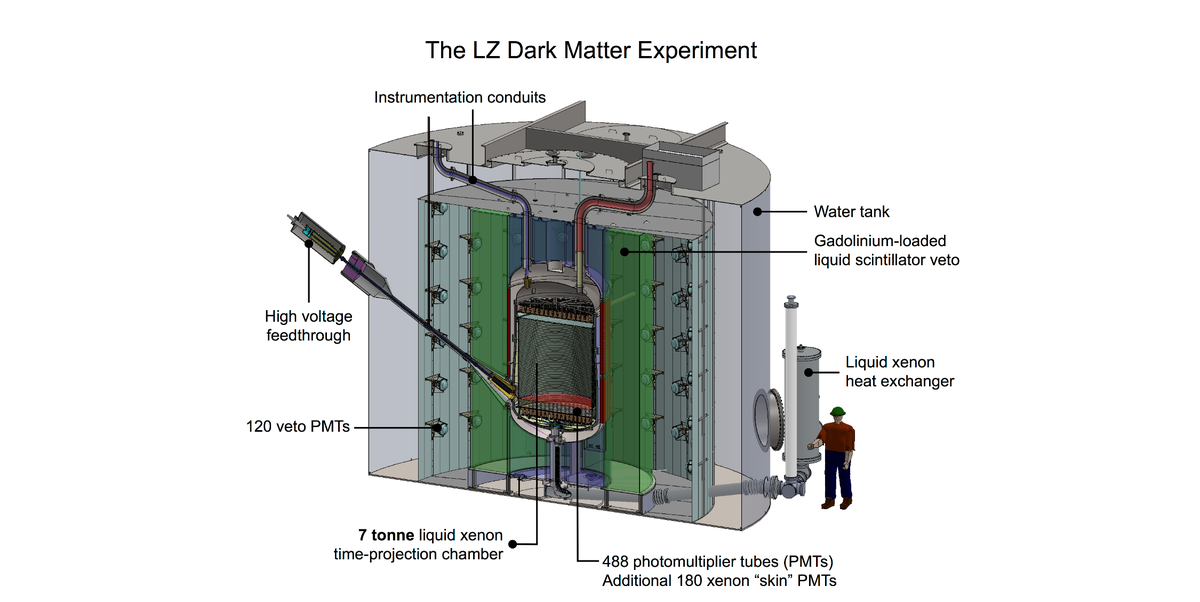
LZ contains close to 10 metric tons of liquid xenon in total. Roughly seven tons form the active region of its central time projection chamber, while a smaller inner portion is selected during analysis as the cleanest fiducial target. This distinction matters: saying the detector has 10 tons of xenon is correct, but not every kilogram is used identically in every physics analysis.
Two Signals From One Tiny Interaction
The central instrument is a dual-phase xenon time projection chamber, or TPC. Most of the xenon is liquid, with a thin layer of xenon gas above it. When a particle interacts in the liquid, it can create an immediate flash of ultraviolet scintillation light. Scientists call that first pulse S1.
The same interaction can also knock electrons free. An electric field causes those electrons to drift upward through the liquid. When they reach the surface and enter the gas, they generate a second burst of light called S2. The time between S1 and S2 helps determine the vertical position of the event, while the pattern of light across the upper sensor array reveals its horizontal location.
The ratio and shape of the two signals also help distinguish nuclear recoils, which a WIMP could produce, from electronic recoils caused by many common radioactive backgrounds. It is a bit like identifying a caller not only by the ringtone, but also by how long the phone took to ring and which room heard it first.
Why Put the Detector Nearly a Mile Underground?
At Earth’s surface, cosmic rays and the secondary particles they generate can create a noisy stream of detector events. Some of those events can resemble the low-energy interactions scientists hope to find. Placing LZ at the 4,850-foot level dramatically reduces that cosmic-ray background because the overlying rock acts as an enormous natural shield.
Going underground does not eliminate every unwanted signal. Radioactive isotopes can occur naturally in rock, air, dust, construction materials, and even the detector itself. Radon can drift into experimental spaces. Neutrons can scatter from xenon nuclei and imitate the expected signature of a WIMP. The project therefore uses multiple layers of active and passive defense.
A Detector Built Like an Extremely Paranoid Onion
The liquid xenon chamber is surrounded by additional xenon that acts as an active veto. Around that sits an outer detector containing about 17 tons of gadolinium-loaded liquid scintillator. Gadolinium is especially effective at capturing neutrons, allowing researchers to identify events that might otherwise masquerade as dark matter.
The assembly is placed inside a large tank holding roughly 238 tons of purified water. The water absorbs radiation from the surrounding cavern and provides another layer of protection. Hundreds of light-sensitive photomultiplier tubes watch the detector systems. The central TPC alone uses 494 low-radioactivity three-inch photomultiplier tubes arranged above and below the active xenon.
Each layer either blocks unwanted radiation or tags suspicious interactions. If an event appears in the central chamber while another detector layer lights up at nearly the same time, researchers can reject it as background. True dark matter is expected to be antisocial: one small collision, no entourage.
Construction Was as Much About Cleanliness as Heavy Engineering
A dark matter detector cannot simply be assembled from whatever metal, cable, bolt, and seal happens to be on sale. Ordinary materials may contain traces of uranium, thorium, potassium-40, or other radioactive contaminants. Even tiny quantities can matter when the experiment is searching for extremely rare interactions.
The LZ collaboration conducted an extensive radioassay program to screen candidate materials. Titanium for the cryostat, photomultiplier tubes, plastics, cables, electronics, and structural components had to meet strict cleanliness standards. Parts were cleaned, stored, transported, and assembled under controlled conditions. Dust was treated less like housekeeping trouble and more like an uninvited radioactive coworker.
Engineers also had to develop systems capable of purifying xenon continuously. Electronegative impurities can capture drifting electrons before they reach the gas, weakening the S2 signal and degrading event reconstruction. Krypton and radon isotopes can create additional backgrounds, so the xenon supply required specialized purification and careful monitoring.
Cryogenics presented another challenge. Xenon must remain cold enough to stay liquid, and the detector needs stable pressure, temperature, electric fields, liquid level, and circulation. A problem in any one subsystem can affect the entire instrument. LZ was therefore a tightly coupled machine in which plumbing, electronics, software, materials science, and particle physics all had to behave at the same time.
Moving a Giant Precision Instrument Underground
Large detector components could not be carried through a convenient ground-level laboratory door. They had to be manufactured at specialized facilities, tested, protected from contamination, transported to South Dakota, lowered through the mine shaft, and maneuvered through underground passages. Size, weight, cleanliness, and safety constraints shaped nearly every construction decision.
The central detector was assembled in a clean environment before being moved underground. Existing infrastructure from LUX, including the Davis Cavern and water tank, helped make the project possible, but LZ was much larger and more complex. Its total xenon inventory was about 27 times that of LUX, while its projected sensitivity was dozens of times greater.
From Construction Site to Working Dark Matter Observatory
The project experienced the normal complications of a large scientific build, followed by the abnormal complication of a global pandemic. Nevertheless, assembly and commissioning continued, and LZ began producing science data. In July 2022, the collaboration announced its first dark matter search results based on 60 live days of operation. The detector found no WIMP signal, but it immediately demonstrated world-leading sensitivity over an important mass range.
Later analyses used much larger exposures. Results released in 2024 combined 280 live days and 4.2 tonne-years of exposure, again finding no excess above expected backgrounds while setting some of the strongest limits on WIMP interactions. In December 2025, the collaboration reported a low-mass search using 417 live days of data. No WIMPs appeared, but the experiment pushed into new territory and observed evidence of low-energy interactions from boron-8 solar neutrinos.
That outcome illustrates a crucial point: a well-designed experiment can succeed scientifically without discovering the particle it was built to find. Every region ruled out constrains theories, guides future detector designs, and prevents physicists from spending eternity searching the same already-checked attic.
Experience-Based Lessons From Building a Mile-Deep Dark Matter Detector
The most valuable experiences connected with a project like LZ are not limited to particle physics. They offer practical lessons in construction, systems engineering, logistics, quality control, and long-term teamwork. The first lesson is that the site is part of the instrument. The former Homestake mine is not merely a dramatic address; its rock overburden performs essential scientific work by suppressing cosmic rays. Reusing the Davis Cavern and water tank also shows how legacy infrastructure can support a new generation of research when planners understand both its strengths and its constraints.
The second lesson is that cleanliness must be designed into the workflow. It cannot be added during the final week with a heroic supply of wipes. Material screening, clean assembly, controlled storage, radon management, and contamination tracking all influence the detector’s ultimate sensitivity. Teams working on medical devices, semiconductor plants, spacecraft, or precision optical systems face a similar truth: contamination control is a chain, and one casual step can undo months of careful work.
A third lesson concerns interfaces. LZ combines cryogenics, high voltage, purification, vacuum systems, photodetectors, calibration hardware, data acquisition, controls, safety equipment, and analysis software. Each subsystem can function perfectly on a test bench and still cause trouble when connected to everything else. Successful construction therefore depends on clear interface definitions, shared documentation, realistic integration tests, and engineers who are willing to ask apparently simple questions before those questions become expensive.
Underground logistics provide a fourth lesson: every maintenance task should be imagined before installation. Access is limited, replacement parts cannot always be delivered quickly, and moving large equipment through shafts and tunnels demands planning. Designers must consider lifting points, cable routing, emergency procedures, tool access, spare components, and the sequence in which parts can be removed. A component that is easy to install but impossible to service is not a clever component; it is a future meeting.
The fifth lesson is the importance of prototypes. Before full construction, teams tested smaller chambers, purification equipment, photomultiplier performance, high-voltage grids, controls, and material-cleaning methods. Prototypes expose assumptions while changes are still affordable. They also create shared experience across institutions, allowing scientists and engineers to develop a common language before confronting the full detector.
A sixth lesson is that safety and communication cannot be separated from technical performance. Underground work involves shaft access, heavy lifts, confined routes, cryogenic fluids, high voltage, and emergency planning. Teams from different laboratories must follow the same procedures and report problems without hesitation. A schedule can recover from a delayed installation; it cannot justify a preventable injury or a damaged detector. Strong safety culture is therefore not paperwork surrounding the science. It is one of the systems that makes the science possible.
Finally, LZ demonstrates that patience is an engineering requirement. The project moved from concepts and design reports to construction, underground assembly, commissioning, calibration, and years of data analysis. A rare-event experiment may operate beautifully and still record no dark matter. The team must be prepared to learn from null results, improve background models, reopen analysis choices, and continue collecting data. In frontier science, persistence is not a motivational poster. It is part of the apparatus.
Conclusion: A Quiet Machine for One of Physics’ Loudest Questions
The beginning of LUX-ZEPLIN construction marked a major step in the direct search for dark matter. The project placed nearly 10 tons of liquid xenon inside a multilayered detector almost a mile underground, combining a vast natural rock shield with ultraclean materials, sophisticated veto systems, precision sensors, and powerful data analysis.
LZ has not yet revealed a WIMP, but it has transformed the scientific landscape by testing interactions weaker than previous experiments could reach. Its progress shows why negative results are not empty results: they narrow the possibilities, challenge theories, and move the next search closer to the truth. Somewhere in the universe, dark matter is shaping galaxies. In a former gold mine beneath South Dakota, scientists have built one of humanity’s best chances to catch it in the act.
Note: The headline describes the project’s historical construction launch in February 2017. LUX-ZEPLIN has since been completed, commissioned, and operated as an active dark matter and neutrino experiment at the Sanford Underground Research Facility.












