
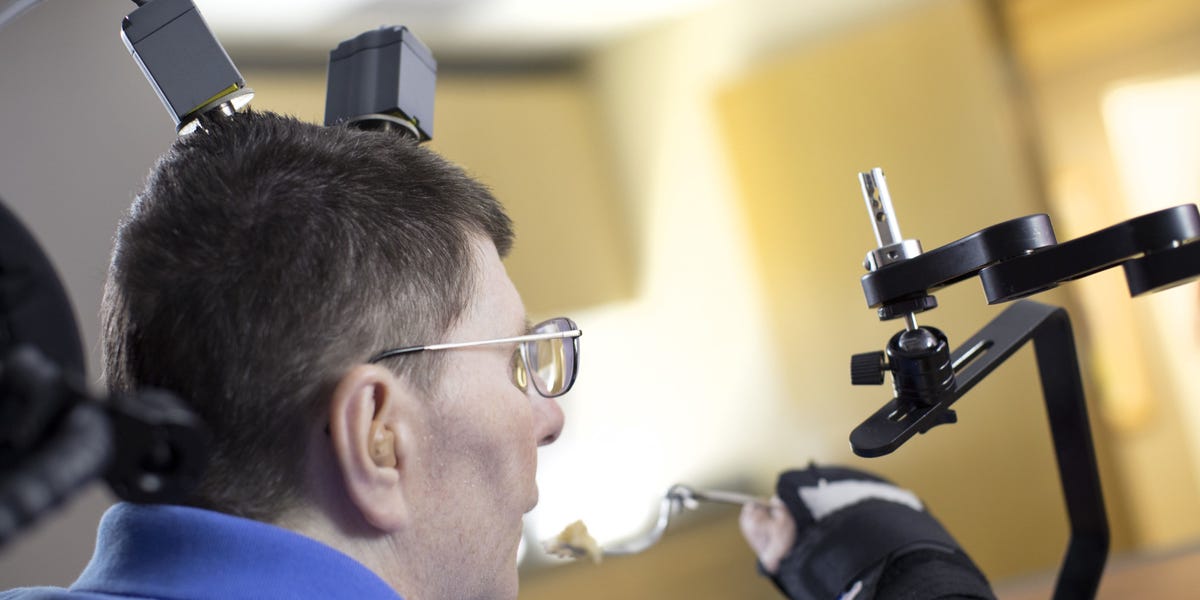
A forkful of mashed potatoes may not sound like a medical milestone. It sounds like Tuesday dinner. But for a man who had lived for years with paralysis below the shoulders, lifting food to his mouth again was more than a small movement. It was a doorway back to independence.
The story of a brain implant helping a paralyzed man feed himself again is one of those rare moments where neuroscience, engineering, rehabilitation, and plain human determination all show up at the same table. In this case, the table had food on it, and the technology helped make sure the person who wanted the bite could actually take it himself.
At the center of the breakthrough was Bill Kochevar, a Cleveland man who became paralyzed after a bicycling accident. Years after losing movement below his shoulders, researchers used a brain-computer interface, also called a BCI, combined with functional electrical stimulation, or FES, to reconnect his intention to move with the muscles in his arm and hand. In simpler language: his brain still knew what it wanted to do, and the implant system helped deliver the message around the damaged spinal cord.
What Happened: A Brain Signal Found a Detour
After a spinal cord injury, the brain may still generate signals for movement. The problem is that the normal route from brain to muscle can be blocked. Imagine texting someone, but the phone tower between you and them is down. The message exists. The destination exists. The middle connection is the troublemaker.
The brain implant system used in Kochevar’s case worked like a carefully engineered detour. Tiny recording arrays were placed in the motor cortex, the part of the brain involved in planning and controlling movement. When he imagined moving his arm or hand, those arrays recorded patterns of neural activity. A computer decoded the signals and translated them into movement commands. Then, implanted electrodes in his arm delivered small electrical pulses to activate specific muscles.
The result was not science fiction sparkle dust. It was slow, deliberate, and experimental. But it was real. Kochevar was able to use his own arm and hand to perform meaningful tasks, including drinking through a straw, scratching his face, and feeding himself.
Why Feeding Himself Matters So Much
To someone without paralysis, feeding yourself can feel automatic. You decide you want a bite, your hand moves, your fork rises, and the only drama is whether the pasta sauce lands on your shirt. For someone with quadriplegia, that ordinary sequence can require assistance from another person every single time.
That is why this breakthrough mattered. It was not only about moving a limb. It was about restoring a piece of personal agency. The ability to take a bite without waiting, asking, or being positioned by someone else carries emotional weight. Independence is not always loud. Sometimes it is a spoon, a cup, or a napkin moved by your own intention.
Brain implant technology for paralysis aims to restore function in ways that directly affect daily living. Researchers often measure success in terms of control accuracy, signal stability, and movement range. Patients and families may measure it differently: Can I drink water? Can I scratch an itch? Can I eat when I am hungry? Can I do one thing today that yesterday required help?
How the Brain Implant Worked
1. The Brain Still Produced Movement Intentions
Even though Kochevar could not voluntarily move his arm after his spinal cord injury, his brain could still generate movement-related activity. When he imagined moving, the implant recorded those signals. This is a key idea behind many brain-computer interfaces: the body may be unable to act, but the brain’s intention can still be detected.
2. Software Decoded the Signal
The recorded brain activity was sent to a computer system. Over time, the software learned to associate patterns of neural activity with intended movements. Before controlling his own arm, Kochevar trained with a virtual arm on a screen. This gave researchers a way to map brain signals to movement commands without immediately requiring full physical movement.
3. Electrical Stimulation Activated the Muscles
Functional electrical stimulation delivered small pulses to muscles in the hand, wrist, elbow, and shoulder. These pulses did not magically “heal” the spinal cord. Instead, they helped activate muscles directly. The system bypassed the injured pathway and created a new route from intention to action.
4. Rehabilitation Rebuilt Strength and Endurance
After years of paralysis, muscles can weaken and lose endurance. Kochevar went through extensive rehabilitation before using the system for functional tasks. Researchers used repeated stimulation and training to improve strength, range of motion, and stamina. In other words, the implant was not a plug-and-play gadget. It was more like a high-tech instrument that required practice, tuning, patience, and a very committed human operator.
Brain-Computer Interface: A Simple Explanation
A brain-computer interface is a system that translates brain activity into commands for an external device or another body system. Some BCIs help people control computer cursors. Others help with communication. Some are designed for robotic arms, prosthetics, or muscle stimulation systems.
There are different types of BCIs. Some are noninvasive and record signals from outside the head, often using sensors placed on the scalp. Others are implanted and can record more detailed signals from the brain. Implanted systems may offer stronger signal quality, but they also involve surgery and careful medical oversight.
In paralysis research, the goal is often to restore communication, movement, or both. For people with severe motor impairment, even modest improvements can be life-changing. A reliable way to control a cursor, select letters, move a robotic arm, or activate paralyzed muscles can open new possibilities for work, social life, self-care, and dignity.
Why This Was a Big Step for Neuroprosthetics
Earlier brain-computer interface studies had shown that people with paralysis could control computer cursors or robotic arms using thought. That was already impressive. But Kochevar’s case added another meaningful layer: the system helped him move his own arm.
That distinction matters. A robotic arm can be useful, but reanimating a person’s own limb has deep practical and emotional meaning. The arm is familiar. The movement, even if assisted, belongs to the person’s body. It is not simply controlling a machine across the room; it is restoring a broken conversation between the brain and the muscles.
The system combined two major fields: brain-computer interfaces and functional electrical stimulation. BCIs interpret intention. FES activates muscles. Together, they can form a bridge over the damaged spinal cord. It is not a cure for paralysis, but it is a powerful proof of concept.
The Role of Training: No, the Brain Did Not Get a Remote Control Overnight
One of the most important parts of this story is training. The technology did not work like a superhero origin story where someone wakes up and immediately controls everything with cinematic background music. Kochevar practiced. Researchers calibrated the system. His arm needed conditioning. The computer needed data. The movements needed refinement.
This makes the achievement more impressive, not less. Medical breakthroughs often look tidy in headlines, but the real progress happens through long sessions, small adjustments, and repeated attempts. Every successful bite carried behind it months of engineering, surgery, therapy, neuroscience, and persistence.
That also helps set realistic expectations. Brain implants for paralysis are promising, but they are still complex. Many systems remain investigational and are used in research settings. Wires, external computers, calibration, surgery, and specialized teams may still be involved. The dream is to make these systems more reliable, wireless, portable, and practical for home use.
Recent Advances: AI Is Making Brain Implants Smarter
Since Kochevar’s breakthrough, brain-computer interface research has continued to move forward. More recent studies have explored artificial intelligence models that adapt to changes in brain activity over time. This matters because brain signals are not perfectly fixed. They can shift from day to day, especially as a person learns to use a system.
In 2025, researchers at UC San Francisco reported that a paralyzed man could control a robotic arm by imagining movements. The system used AI to account for changes in the brain’s movement patterns and allowed the participant to grasp, move, and drop objects. The research suggested that smarter decoding software may help BCIs remain useful for longer periods with less constant recalibration.
This is an important direction for the field. If brain implants are ever going to become everyday assistive tools, they must be dependable outside the lab. Nobody wants a device that works beautifully on Monday and acts like it forgot its password on Tuesday. Stability, speed, comfort, safety, and ease of use are the big-ticket items.
What This Technology Could Mean for People With Paralysis
The most exciting promise of brain implant technology is not that it can create dramatic demonstrations. It is that it could eventually help people perform ordinary tasks with less help. Eating, drinking, grooming, using a phone, typing, opening a cabinet, or adjusting a blanket may sound simple. For someone with severe paralysis, these tasks can define the difference between dependence and partial independence.
There is also a psychological dimension. Regaining control over even one movement can change how a person experiences the day. It may reduce frustration, increase confidence, and improve participation in family and social life. The science is technical, but the goal is deeply human.
Still, it is important not to oversell the technology. A brain implant is not a universal cure. People have different injuries, health conditions, goals, and risks. Surgery is serious. Devices can fail. Systems may require maintenance, training, and medical support. Insurance coverage, cost, accessibility, and long-term safety must also be addressed before these technologies can move from research labs into broader clinical use.
The Challenges Ahead
Making the System Wireless
Many early implanted BCI systems relied on external cables and lab-based equipment. Future systems need to be more compact and wireless. A practical home device should not make the user feel like they are plugged into a small weather station.
Improving Movement Speed and Smoothness
Early movements can be slow and deliberate. For daily life, users need smoother control, better grip strength, faster response times, and more natural coordination. Picking up a fork is one milestone. Cutting food, adjusting grip, and handling different textures are harder challenges.
Long-Term Safety and Durability
Implanted devices must remain safe and functional over long periods. Researchers continue to study how electrodes perform over time, how the body responds, and how to reduce infection risk, signal loss, and hardware problems.
Affordability and Access
Even the best medical technology has limited impact if only a small number of people can access it. Future progress will require not only better engineering but also ethical planning, clinical trials, regulatory review, insurance pathways, rehabilitation support, and patient education.
Why the Story Captured Public Attention
The phrase “brain implant helps paralyzed man feed himself again” is powerful because it turns advanced neuroscience into something instantly understandable. People may not know the details of motor cortex decoding or functional electrical stimulation, but everyone understands the meaning of eating independently.
That is why this story traveled beyond medical journals. It appeared in mainstream news because it touched a universal nerve: the desire to move, choose, and care for oneself. The technology was extraordinary, but the task was beautifully ordinary. That contrast made the achievement memorable.
It also reframed what progress can look like. In medicine, success is not always a complete cure. Sometimes success is a regained gesture. Sometimes it is one task made possible again. Sometimes it is a person saying, in effect, “I can do this myself.”
Experiences and Reflections Related to Brain Implant Technology
When people hear about a brain implant helping a paralyzed man feed himself again, their first reaction is often amazement. The second reaction is usually a question: “How would that feel?” While every patient’s experience is unique, the emotional landscape around this kind of technology is easy to imagine. It likely includes excitement, nervousness, patience, frustration, hope, and a lot of repetitive practice.
For a person living with paralysis, daily routines can become carefully coordinated events. Meals, drinks, clothing, grooming, and mobility may depend on caregivers, schedules, and equipment. Even with excellent support, the loss of spontaneous action can be exhausting. Wanting a sip of water and needing someone else to help is not just inconvenient. It can feel like the day is always being negotiated.
That is why the experience of using a BCI-FES system may be emotionally powerful. The first successful movement might not look dramatic to an outside observer. The arm may move slowly. The fork may wobble. The bite may take effort. But inside that moment is something huge: intention became action again.
There is also the experience of learning to trust the system. At first, the user may wonder whether the movement will happen at all. Then comes the strange feedback loop of imagining movement, watching the arm respond, adjusting the mental command, and learning what kind of thought produces the best result. It is not exactly like normal movement, and it is not exactly like controlling a machine. It sits somewhere in between, which is why training matters so much.
Families and caregivers may experience the breakthrough differently. They may see not only the movement but the confidence that comes with it. A small action can change the emotional tone of a room. When someone feeds himself after years of needing help, the people around him may feel pride, relief, and awe. There may also be practical questions: Will this become available outside the lab? How safe is it? How much will it cost? Can it work at home? Will it help with more tasks?
Researchers, meanwhile, experience the story as both a victory and a challenge. A successful demonstration proves the idea can work, but it also reveals everything that still needs improvement. The system must become easier to use, more comfortable, more reliable, and more accessible. The ultimate goal is not to impress people with a laboratory video. The goal is to help someone live more freely on an ordinary Wednesday.
The most meaningful experience connected to this topic may be the return of choice. Feeding oneself is not only a physical act. It is a decision made visible. I want this bite. I want this drink. I want to try again. For people with paralysis, brain implant technology offers a glimpse of a future where more of those choices can be acted on directly.
That future will not arrive all at once. It will come through clinical trials, careful safety studies, better software, improved implants, smarter rehabilitation, and conversations with the people who would actually use the technology. The best designs will be shaped not only by engineers and doctors, but also by patients who know what independence really means in daily life.
Conclusion: A Small Bite, a Giant Leap
The story of a brain implant helping a paralyzed man feed himself again is not just a tale of wires, electrodes, and algorithms. It is a story about reconnecting intention with action. Bill Kochevar’s achievement showed that even years after a severe spinal cord injury, the brain may still hold usable movement signals. With the right technology, those signals can be decoded and routed to muscles in a new way.
Brain-computer interfaces and functional electrical stimulation are still developing. They are not simple consumer gadgets, and they are not cures for paralysis. But they are among the most promising tools in neurotechnology because they focus on something practical: restoring useful function. If future systems become wireless, durable, affordable, and easier to train, they could help more people regain parts of daily life that many of us barely notice.
For now, the image remains unforgettable: a man who had not moved his arm for years guiding food to his own mouth through thought-powered technology. It is humble, human, and quietly revolutionary. Also, mashed potatoes have probably never carried so much scientific significance.











