
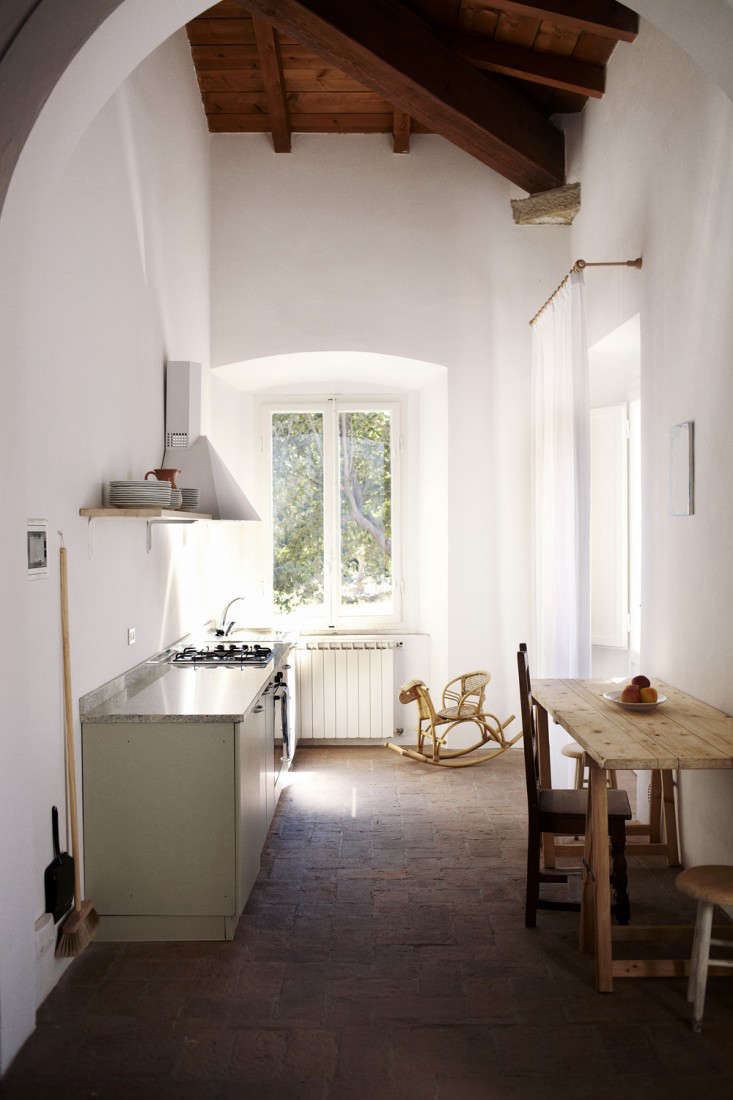
A Tuscan kitchen does not have to arrive wearing faux grapevines, glossy cherry cabinets, and enough decorative ironwork to outfit a medieval drawbridge. The most convincing version is quieter: old stone, pale paint, useful furniture, and objects that look as though they wandered in over decades rather than arriving together on a delivery truck.
That is the appeal of the apartment kitchens at Villa Lena, an artist retreat on an 18th-century estate in Tuscany. French designer Clarisse Demory worked with what already existed, softening tall walls with whitewash, repainting dated cupboards in pale sage, retaining expressive granite counters, and adding uncomplicated tables, chairs, shelves, and everyday tools. The result is unmistakably Italian in setting but distinctly French in attitudepractical, restrained, and just imperfect enough to feel alive.
What Makes This Tuscan Kitchen Feel French?
The room’s architecture supplies the Tuscan bones: high ceilings, masonry, aged surfaces, natural stone, and a sense that summer heat has been passing through the windows for a few centuries. The French contribution is editorial. Instead of amplifying every rustic detail, the design pares things back. Colors are chalky rather than saturated, furniture is lightweight rather than monumental, and the decorative objects are mostly things that earn their keep.
French country kitchens often balance weathered stone, exposed timber, aged metal, open storage, marble or other natural counters, and furniture-like pieces. Tuscan kitchens favor many of the same ingredients, including terra-cotta, rough wood, stone, and warm earth tones. The useful overlap is not “European theme decor.” It is a shared respect for honest materials, visible craftsmanship, and rooms that improve as they are used.
The Real Secret: Restraint
Anyone can buy a rooster-shaped cookie jar. Restraint is harder. This look succeeds because no single element shouts, “I am rustic!” The sage cabinets whisper. The stone counters mumble. The old table has nothing to prove. Together, they create atmosphere without turning the kitchen into a theme-park trattoria.
Start With a Soft, Sun-Faded Color Palette
Use Warm White Instead of Refrigerator White
Begin with walls and ceilings in a warm, mineral-looking white. A true limewash creates cloudlike variation because the finish absorbs and reflects light differently across the surface. On unsuitable walls, a matte mineral paint or conventional paint in a chalky finish can provide a related effect with easier maintenance. The goal is not a perfect white box; it is a softly mottled background that lets old stone, wood, cookware, and food provide the color.
Always test large samples on more than one wall. Natural light changes neutral paint dramatically, and a shade that looks like warm cream at breakfast can turn peachy by dinner. Rooms with cooler northern light generally benefit from warmer undertones. In this style, a little warmth is welcome; glaring blue-white is the guest who arrived early and refuses to leave.
Paint Cabinets a Dusty Sage Green
Pale sage is the bridge between Tuscany and France. It recalls olive leaves, shutters, herbs, and painted country furniture without becoming aggressively botanical. Choose a muted green with gray, beige, or yellow undertones rather than a bright mint. A low-sheen cabinet enamel is practical, but the final appearance should remain quiet enough to sit beside stone without competing with it.
For a collected look, do not insist that every painted surface match. The lower cabinets can be sage while a freestanding cupboard remains cream, raw wood, or a deeper green. A slightly varied palette feels as though the room evolved through repairs, inheritances, and one very productive weekend with a paintbrush.
Keep the Stone, Even When It Is Not Fashionable
The Villa Lena kitchen offers a useful lesson in working with an existing feature rather than automatically replacing it. Strongly patterned granite can feel dated when surrounded by glossy cabinets and busy tile. Pair the same stone with matte paint, plain walls, simple shelving, and aged wood, and it becomes expressive rather than overwhelming.
When choosing new counters, consider honed granite, soapstone, marble, quartzite, or a locally available stone with visible movement. Do not select it from a small photograph alone. View the full slab, place cabinet and wall samples against it, and decide whether you enjoy its natural markings. Stone has “birthmarks,” and that is part of the point.
Depending on the material, sealing may improve stain resistance, but it will not make a surface invincible. Use non-acidic cleaners on calcium-based stones such as marble and limestone because lemon, vinegar, and other acidic products can dull or etch them.
Let the Floor Look Older Than Your Phone
Weathered limestone, terra-cotta, brick, or matte stone-look tile creates the right foundation. For a lighter interpretation, retain existing wood flooring and allow its grain to show. The important qualities are low shine, natural variation, and enough durability for dropped spoons, muddy shoes, and the occasional olive making a brave escape across the room.
Pattern can add movement without adding clutter. Herringbone, diagonal-set square tile, or irregularly sized pavers all suit the style. Keep grout close to the tile’s midtone so the floor reads as a broad field of material rather than graph paper.
Replace the Showpiece Island With a Working Table
A recycled-plank table on trestle legs captures the spirit better than an oversized built-in island. It can serve as a prep station, breakfast table, desk, flower-arranging bench, and landing pad for groceries. It also leaves visual space beneath the top, helping a modest kitchen feel larger.
Look for an old farm table, a sturdy workbench, or a simple trestle base topped with properly prepared lumber. Counter height is useful for standing prep, while standard dining height makes the table more comfortable for long meals. In a small room, a narrow table or drop-leaf design provides flexibility. Add a washable runner or large cutting board where heavy chopping occurs rather than trying to preserve the wood like a museum artifact.
Mix the Chairs, but Repeat One Idea
Pair a woven rattan chair with a beech folding chair, a painted café chair, or a small stool. The mix works when one characteristic repeatssimilar seat height, a shared neutral palette, curved backs, or natural fibers. Avoid a chaotic collection of ten “statement chairs.” When every chair tells a story at full volume, dinner becomes a panel discussion.
Use Open Shelves Like a Cook, Not a Stylist
Simple wood boards on plain brackets are central to this humble Tuscan kitchen look. Open shelves break up cabinetry, make frequently used dishes easy to reach, and turn honest household objects into decoration. They are also generally less material-intensive than full upper cabinets.
The trick is deciding what deserves exposure. Display everyday white plates, clear glasses, a few bowls, cutting boards, coffee supplies, and a pot you actually use. Hide plastic food containers, backup appliances, medicine, and the mug commemorating a conference no one remembers. Leave breathing room between groups so the shelf feels practical rather than overstocked.
Build a Useful Still Life
Choose accessories that can move directly from shelf to table: a red-clay pot, glass bottle vase, wooden spoon crock, linen towel, pepper mill, or stack of shallow bowls. Add one living element, such as rosemary in a terra-cotta pot or branches clipped from the yard.
A broom with natural bristles can hang on a wall, but only if it remains a broom. The kitchen loses credibility the moment the cleaning tools become too precious to clean.
Choose Hardware and Appliances That Stay in the Background
The original inspiration mixes modest cabinetry with stainless-steel hardware, sink, cooktop, oven, and hood. That contrast is smart: the room feels old without pretending modern equipment does not exist. Stainless steel is visually neutral, easy to coordinate, and honest about its job.
Use simple bar pulls, knobs, or latches in aged brass, darkened bronze, blackened metal, or stainless steel. Skip hardware that is overly scrolled or artificially distressed. Patina should appear where hands touch, not where a factory printed brown speckles.
Make the Sink Generous
A white apron-front sink is an obvious French-country choice, but a stainless-steel double bowl can look equally appropriate in a more utilitarian interpretation. Farmhouse sinks are available in different apron heights and installation types, including versions designed to reduce major cabinet alterations.
Before buying, confirm cabinet width, structural support, counter fabrication, faucet clearance, drain placement, and how the sink will meet the countertop. A sink that fits the photograph but not the cabinet is an extremely expensive fruit bowl.
Do Not Sacrifice Ventilation for Romance
A simple chimney-style hood supports the European look, but performance matters more than silhouette. A capable range hood helps capture smoke, steam, and cooking residue while adding task light over the cooktop. Match the hood to the cooking equipment and room conditions, and vent outdoors when the project and local requirements allow.
The aroma of garlic is charming during dinner. It is less enchanting in Tuesday’s coat.
Light the Kitchen for Work and Warmth
Use more than one source of light. A modest pendant over the table provides atmosphere, while discreet under-shelf or under-cabinet lighting illuminates prep areas. Wall sconces can brighten open shelving and add a furniture-like quality to the room. Suitable shades include enamel, aged metal, opal glass, woven fiber, and simple fabric.
Warm-dimming LEDs are especially useful in an eat-in kitchen because they can provide clearer light at full output and become warmer as they dim toward evening. Whatever bulb you choose, pay attention to how accurately it renders food, wood, green paint, and stone. A kitchen should make tomatoes look like tomatoes, not evidence from a science-fiction investigation.
A Practical Steal-This-Look Checklist
For a Weekend Refresh
- Paint the walls a warm, chalky white.
- Test pale sage on cabinet doors before committing.
- Replace ornate hardware with simple pulls or knobs.
- Install one open shelf for everyday dishes.
- Add a clay pot, clear bottle vase, and natural-fiber towel.
- Swap cool bulbs for warm, high-quality LEDs.
For a Moderate Remodel
- Refinish cabinets instead of replacing structurally sound boxes.
- Use a freestanding wood table rather than a built-in island.
- Add matte stone, brick, terra-cotta, or wood flooring.
- Install a visually simple, properly sized range hood.
- Choose a deep sink with an unfussy bridge or pull-down faucet.
For the Full Architectural Version
- Expose authentic beams or masonry only when it is structurally and historically appropriate.
- Use lime-based or mineral finishes compatible with the wall substrate.
- Commission stone counters with a honed or softly textured finish.
- Create French doors or a large opening to a patio, garden, or dining terrace where feasible.
- Build storage around daily routines rather than decorative symmetry.
Common Mistakes That Flatten the Look
Making everything beige: Natural does not mean monochrome. Sage paint, black accents, red clay, copper, green glass, and blue-gray stone prevent the room from becoming one enormous cracker.
Faking age too aggressively: Heavy glaze in every cabinet corner, mass-produced “antique” signs, and intentionally chipped furniture can feel theatrical. Let a few genuinely old pieces carry the history.
Overfilling open shelves: The point is access and rhythm, not displaying the entire contents of a kitchen store. Leave negative space.
Ignoring modern performance: A beautiful range hood that cannot capture smoke is wall sculpture. A lovely faucet that splashes beyond a shallow sink will inspire language not commonly associated with Provence.
Buying the room all at once: A collected kitchen needs variation. Finish the permanent surfaces first, then add chairs, pottery, linens, and art gradually.
Living With the Look: Experience Notes From a Humble Kitchen
The first surprise when adopting this style is how much the room changes when you stop fighting the existing materials. A strongly patterned counter, awkward cupboard, or old wood table can look like a renovation problem under harsh white light and glossy finishes. Surround it with matte paint, warmer lighting, and quieter objects, and suddenly it becomes the detail everyone assumes you chose on purpose. This is useful news for budgets and household peace treaties.
Painting cabinets sage green is the most dramatic low-construction change, but sampling matters. Paint at least two large boards and move them around the room for several days. One green may look gentle beside the window and turn gray near the stove. Another may become surprisingly yellow under evening bulbs. The winner is not necessarily the prettiest color chip; it is the one that behaves well with the counter, floor, and changing daylight.
Open shelving also teaches honesty. During the first week, it is tempting to arrange twelve bowls, seven cookbooks, three vases, and a ceremonial bundle of wheat. After a month of cooking, the shelf edits itself. The mixing bowl stays because it is used. The coffee cups stay because mornings happen with unreasonable regularity. The decorative wheat gathers dust and begins to look like the kitchen is preparing for a very small harvest festival. Practical repetition produces a better composition than styling alone.
A freestanding table changes behavior, too. Unlike a fixed island, it invites people to pull up a chair, shift the furniture, or clear the surface for a project. Scratches arrive. Someone sets down a hot pan despite repeated warnings. Flour settles into the grain. Those marks can be frustrating in a pristine showroom kitchen, but here they become part of the finish. Use trivets and cutting boards, certainly, yet allow the table to record ordinary life. A humble kitchen should not require everyone to behave like museum security.
Natural stone brings a similar lesson. Honed and textured surfaces often show water, oil, crumbs, and fingerprints differently than highly polished materials. Learn the correct cleaner for the stone, wipe spills promptly, and accept that patina may develop. The aim is maintained, not untouched. When every minor mark causes panic, the room stops serving the household and the household starts serving the room.
The most successful finishing touch is usually not another purchase. It is removing three things. Take down the generic sign, store the duplicate appliance, and clear enough counter space to knead dough or set down groceries. Then place one bowl of lemons, a bottle of olive oil, or clipped branches where the clutter used to be. The room will feel larger, calmer, and more confident.
Finally, test the kitchen by cooking a real meal. Chop at the table. Reach for plates. Drain pasta. Turn on the hood. Sit down while something simmers. This reveals whether the shelf is too high, the light too dim, the chair too delicate, or the towel inconveniently located. Style photographs capture a second; a kitchen must survive breakfast, dinner, guests, spills, and the mysterious disappearance of every teaspoon. The French-edited Tuscan look works because it celebrates that reality rather than hiding it.
Conclusion: Let the Kitchen Be Useful, Then Beautiful
To recreate a humble Tuscan kitchen with a French sensibility, begin by preserving what has character. Soften the room with warm white and dusty sage, balance stone with simple wood, trade monumental cabinetry for open shelving and movable furniture, and choose accessories that participate in daily life.
The final space should look neither newly staged nor artificially old. It should look readyfor coffee, tomatoes, friends, and whatever is simmering next.
Note: Product availability, installation requirements, and material performance vary. Confirm dimensions, ventilation needs, wall compatibility, stone care, structural support, and local building requirements before purchasing or altering permanent kitchen elements.












