
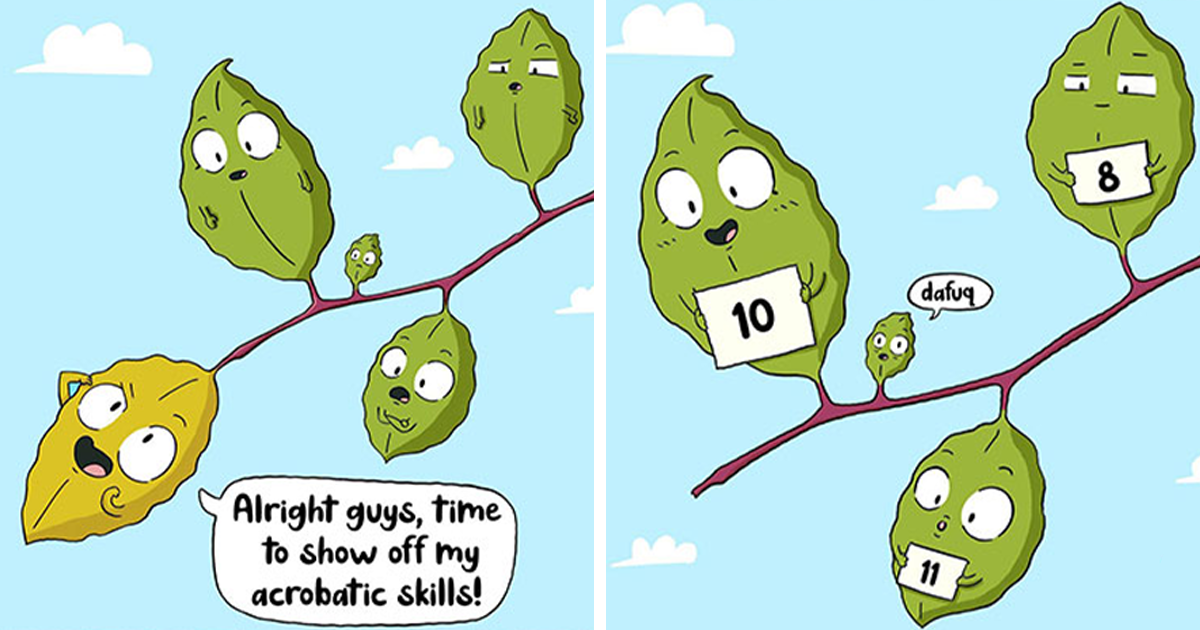
Some comics need superheroes, explosions, secret laboratories, and a villain with a cape long enough to trip over. Then there are Lazy Leaf Comics, where a planet can have an identity crisis, an animal can deliver a tiny emotional gut punch, and an ordinary object can suddenly feel more relatable than half the people in your group chat.
The charm of “Lazy Leaf Comics: 29 New Comics Featuring Animals, Planets, And Other Objects” lies in its simple but surprisingly powerful idea: give non-human things a voice, a feeling, or a problem, and suddenly the world looks softer, stranger, and much funnier. Created by Indian artist Adarsh, known online as Lazyleafcomics, the series is built around cute, colorful, wholesome illustrations that turn animals, planets, plants, food, household objects, and other unexpected characters into tiny storytellers.
What makes these comics work is not only the cuteness, although there is enough cuteness here to make a cactus consider hugging someone. It is the way the comics combine visual simplicity, gentle humor, puns, emotional timing, and a reader-friendly format. In a world where people scroll faster than a squirrel crossing a driveway, Lazy Leaf Comics knows how to stop the thumb for a second and say, “Hey, what if Jupiter had feelings?”
What Are Lazy Leaf Comics?
Lazy Leaf Comics is a webcomic-style illustration series by Adarsh, an artist who has shared that he enjoys creating funny and wholesome comics. His topics range from lighthearted jokes to deeper themes such as self-love, anxiety, depression, and emotional growth. That mix gives the work a special personality: soft on the eyes, quick in delivery, but often more thoughtful than it first appears.
The series has been featured in collections highlighting adorable, punny, and unexpected comics. Earlier works introduced readers to Adarsh’s love of giving life to everyday things. Later selections expanded the universe with more animals, planets, objects, and tiny conversations that feel like they wandered out of a cozy notebook and into the internet.
These are not comics that shout for attention. They politely tap you on the shoulder, offer you a cup of tea, and then hit you with a joke about the Moon needing personal space.
Why Animals, Planets, And Objects Make Great Comic Characters
The secret sauce behind Lazy Leaf Comics is anthropomorphism, which means giving human qualities to animals, plants, objects, weather, planets, or anything else that normally does not complain about Monday mornings. This technique has been used in fables, cartoons, children’s books, advertising, animation, and comic strips for generations because it does one important thing very well: it makes the unfamiliar feel familiar.
A dog with a nervous inner monologue instantly becomes more than a dog. A planet wearing a worried expression becomes a character instead of a science-class diagram. A glass of milk or a lonely sock can become the star of a miniature drama. By turning non-human things into emotional characters, the artist creates instant connection. Readers do not need a long backstory. They only need a face, a situation, and a punchline.
Animals Bring Built-In Personality
Animals are perfect for wholesome webcomics because readers already associate them with personality. Cats are dramatic. Dogs are enthusiastic. Turtles are patient. Birds are suspiciously organized for creatures that wake everyone up at 5 a.m. Lazy Leaf Comics can lean into those familiar ideas while also twisting them into something fresh.
For example, an animal character might be used to express loyalty, nervousness, jealousy, curiosity, or the joy of doing absolutely nothing. That emotional shorthand helps the joke land quickly. It also makes the comic feel warm instead of complicated.
Planets Make Cosmic Problems Feel Personal
Planets are funny because they are enormous, ancient, and majesticyet in a comic, they can be insecure, awkward, vain, tired, or confused. That contrast is comedy gold. When a planet behaves like a person, the scale becomes ridiculous in the best way. Suddenly, Jupiter is not just the largest planet in the solar system; it is a giant character with tiny feelings.
Space-themed comics also allow for clever visual jokes. Rings, moons, gravity, distance, heat, cold, and orbit can all become punchlines. A joke about Saturn’s rings, Earth’s mood swings, or Pluto’s complicated status can be simple enough for casual readers while still feeling smart.
Objects Are Surprisingly Emotional
Everyday objects are the quiet heroes of Lazy Leaf-style humor. A pencil, mug, leaf, lamp, battery, pillow, or phone charger can carry a whole story if the artist gives it eyes and a problem. Object-based comics work because everyone has projected feelings onto things at some point. Who has not apologized to a chair after bumping into it? That chair did nothing wrong. It was just standing there, emotionally unavailable.
When comics turn objects into characters, they make daily life feel magical without needing a complicated fantasy world. The desk becomes a stage. The kitchen becomes a society. The solar system becomes a family reunion with better lighting.
The Art Style: Cute, Clean, And Easy To Love
One of the most effective things about Lazy Leaf Comics is the art style. It is soft, colorful, expressive, and designed for quick readability. The characters often have simple shapes, clear emotions, and uncluttered compositions. That matters because webcomics live in a fast-scroll environment. A reader should understand the scene almost immediately.
The visual language is approachable. Round forms create softness. Big expressions make emotions readable. Minimal backgrounds keep the focus on the joke. This is the kind of art that looks simple until you try making it yourself and realize your “cute moon” looks like a potato having legal trouble.
Adarsh has mentioned working with digital tools such as Clip Studio Paint, a Wacom tablet, an iPad, and Procreate, switching between devices depending on the project. That flexibility fits the modern webcomic workflow, where creators often draw, edit, post, promote, and respond to audiences across multiple platforms.
Why These Comics Feel So Wholesome
Wholesome comics are not just “nice” comics. They create emotional relief. They give readers a short break from stress, bad news, deadlines, and the mysterious disappearance of all matching socks. Lazy Leaf Comics often does this by pairing humor with kindness. The jokes rarely feel cruel. The characters may be confused, embarrassed, or dramatic, but the emotional tone stays gentle.
This is important because many internet users are not only looking for jokes; they are looking for a small mood reset. A comic about an anxious planet or a supportive animal can be funny while also reminding readers that uncertainty, loneliness, and self-doubt are common experiences. In that way, the comics become tiny emotional snacks. Not a full therapy session, but maybe a warm cookie for the soul.
The Power Of Short-Form Webcomics
The internet has changed the way people read comics. Traditional comic strips were often printed in newspapers or collected in books. Today, many readers discover comics through Instagram, Pinterest, Reddit, Facebook, and other visual platforms. Short-form comics succeed because they are easy to share, easy to understand, and easy to enjoy in a few seconds.
Lazy Leaf Comics fits naturally into this environment. The idea is usually clear at a glance. The characters are visually memorable. The jokes do not require a long setup. That makes the comics ideal for mobile reading, where people may be scrolling during lunch, waiting in line, or pretending not to hear someone ask for help carrying groceries.
Simple Does Not Mean Shallow
One reason short comics are underestimated is that they look easy. A few panels, a cute character, a small jokehow hard can it be? Very hard, actually. Short comics demand precision. Every expression, pause, caption, and panel has to earn its space.
Lazy Leaf Comics often uses a compact setup and a gentle twist. The reader sees something familiar, then the comic turns it slightly sideways. That sideways turn is where the humor lives. A leaf might behave like a person. A planet might worry about being left out. A pet might reveal a surprisingly philosophical attitude toward snacks. The result is a quick laugh with a small afterglow.
Common Themes In Lazy Leaf Comics
Although the characters vary widely, several themes appear again and again in the world of Lazy Leaf Comics.
Self-Love And Emotional Honesty
Many wholesome comics use cute characters to talk about difficult feelings in a safe way. Lazy Leaf Comics can touch on self-acceptance, insecurity, emotional exhaustion, and the need for reassurance without making the tone heavy. A small object or animal can say something that might feel too direct coming from a human character.
This gives readers emotional distance. It is easier to smile at a worried planet than to immediately confront your own anxiety. But the message still lands.
Unexpected Friendship
Another recurring appeal is the idea that anything can be friends with anything. A moon and a planet. A dog and a houseplant. A spoon and a bowl. The combinations are silly, but they also create sweet little worlds where kindness is possible in unexpected places.
Puns And Wordplay
Puns are a natural fit for object and animal comics. When characters are based on things, their names, shapes, behaviors, and functions can become jokes. A planet with rings, a leaf that is “falling,” or a battery that feels drained can all turn into playful punchlines. Yes, puns are technically dad jokes, but on the internet, they have evolved. They now wear tiny glasses and call themselves “visual wordplay.”
Why Readers Connect With These 29 New Comics
The collection “29 New Comics Featuring Animals, Planets, And Other Objects” works because it offers variety while staying consistent in tone. Readers get different characters and scenarios, but the emotional flavor remains recognizable: cute, funny, and lightly reflective.
That variety matters for SEO and audience engagement as well. Comics featuring animals can attract readers searching for funny animal comics or cute webcomics. Planet-based strips appeal to fans of space humor and science jokes. Object comics connect with readers who enjoy personified everyday items. Together, these elements make the collection broad without feeling random.
The title itself is also effective because it tells readers exactly what to expect: Lazy Leaf Comics, a specific number of new comics, and a fun character mix. It is clear, searchable, and curiosity-driven. In other words, it does what a strong web headline should do without sounding like it was assembled by a robot wearing a marketing hat.
How Lazy Leaf Comics Fits Into Modern Comic Culture
Lazy Leaf Comics belongs to a larger movement of independent digital artists who use social platforms to share short, personality-driven comics. This movement has made comic creation more accessible. Artists no longer need a newspaper syndicate or a traditional publisher to find readers. A strong idea, consistent posting, and a recognizable style can build an audience over time.
This does not mean success is easy. Online creators must develop art skills, storytelling instincts, timing, branding, captions, posting strategies, and community engagement. They must also keep making work even when the algorithm behaves like a raccoon with a spreadsheet. Still, the webcomic space gives artists room to experiment, and Lazy Leaf Comics is a good example of how a simple visual concept can grow into a charming creative identity.
What Creators Can Learn From Lazy Leaf Comics
Artists, bloggers, and content creators can learn several useful lessons from the success of Lazy Leaf Comics.
Start With A Clear Emotional Hook
The best comics are not only about what happens. They are about what the reader feels. A joke about a planet is funnier when the planet’s emotion is recognizable. Is it lonely? Proud? Embarrassed? Jealous? Sleepy? The clearer the feeling, the stronger the connection.
Make Characters Easy To Read
Simple character design helps readers understand the comic quickly. Big eyes, clear expressions, and focused compositions work especially well for mobile screens. A character does not need complex details to be memorable. Sometimes two dots and a curved line can do more emotional acting than a blockbuster cast.
Use Humor With Warmth
Gentle humor has long-term appeal because it is easy to share. People send wholesome comics to friends, partners, siblings, coworkers, and anyone who needs a tiny boost. A comic that makes someone laugh without making anyone feel attacked has a better chance of traveling across platforms.
Experiences Related To Reading Lazy Leaf Comics
Reading Lazy Leaf Comics feels a bit like finding a tiny note tucked inside an ordinary day. You may open a comic expecting a quick joke, but then a small animal, planet, or object says something oddly personal. Suddenly, the comic is not just cute. It is a mirror with round cheeks.
One relatable experience is the way these comics make everyday objects feel less boring. After reading a few object-based comics, you might look at your coffee mug differently. Maybe it is tired of holding your third cup of coffee. Maybe your phone charger feels underappreciated. Maybe the lonely banana on the counter has been waiting all week for its dramatic monologue. This is the playful side effect of personified comics: they temporarily enchant the ordinary world.
Another experience is emotional surprise. Because the artwork is soft and friendly, readers lower their guard. Then a comic about a little creature or celestial body might touch on insecurity, burnout, or the need to be loved. The message arrives gently, which makes it easier to receive. Instead of saying, “You need to take care of yourself,” the comic might show a small character learning to rest. The meaning is clear, but the delivery feels warm rather than preachy.
These comics are also perfect for shared laughter. They are the kind of posts people send with a message like, “This is you,” or “Why is this literally me?” A planet with social anxiety? That is your friend before a party. A sleepy animal avoiding responsibilities? That is half the internet before Monday. A household object having an existential crisis? That is everyone who has opened their email inbox after a vacation.
For artists, Lazy Leaf Comics can be motivating because it shows that storytelling does not always require grand scenes. A small idea can become a complete comic if it has emotion, timing, and clarity. You do not need a dragon army. You can start with a leaf, a chair, a dog, a moon, or a slice of toast with suspiciously strong opinions.
For readers, the experience is comforting because the comics make the world feel friendlier. Animals are not just animals. Planets are not just planets. Objects are not just objects. Everything becomes a possible character, and every character has a chance to be funny, kind, confused, or brave. That is a lovely way to look at life, especially on days when reality seems determined to be as charming as a printer jam.
In the end, the best experience Lazy Leaf Comics offers is a change in perspective. It invites readers to notice the small, weird, emotional possibilities hiding in plain sight. A comic may only take a few seconds to read, but for those few seconds, the universe feels more alive. The planets have personalities, the animals have punchlines, and the objects on your desk might be quietly preparing their own spin-off series.
Conclusion
“Lazy Leaf Comics: 29 New Comics Featuring Animals, Planets, And Other Objects” is more than a cute collection of webcomics. It is a reminder that humor can be gentle, simple art can be expressive, and even the most ordinary things can become unforgettable characters when viewed through a playful imagination.
Adarsh’s work succeeds because it understands the emotional rhythm of modern readers. People want quick laughs, yes, but they also want warmth, relatability, and small moments of sincerity. Lazy Leaf Comics delivers all of that through adorable animals, cosmic personalities, talking objects, and punchlines that feel both light and thoughtful.
In a crowded digital world, that is no small achievement. Sometimes the internet does not need more noise. Sometimes it needs a tiny planet with feelings, a dog with excellent comedic timing, and a leaf that somehow understands your entire week.
Note: This article is an original, research-based editorial overview inspired by Lazy Leaf Comics and the broader tradition of wholesome webcomics. It does not reproduce or retell the individual comic panels.












