
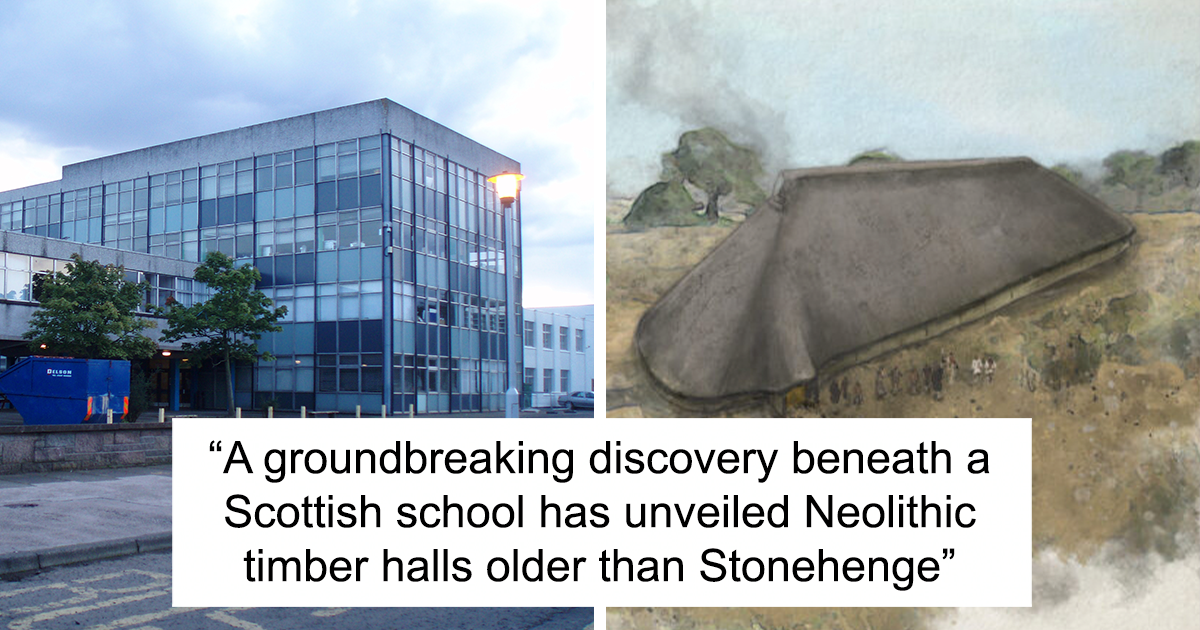
Sometimes history does not whisper from a museum case. Sometimes it pops up while people are trying to build football pitches. That is exactly what happened near Carnoustie High School in Angus, Scotland, where archaeologists uncovered the remains of monumental Neolithic timber halls that are older than Stonehenge. Yes, older than the prehistoric celebrity that has spent centuries photobombing calendars, documentaries, and every “ancient mysteries” TV special ever made.
The discovery, made during archaeological work connected to planned sports facilities, revealed one of the most important early farming sites ever found in Scotland. Beneath ground that was expected to become part of a modern school landscape, researchers identified the traces of a large timber hall dating to around 4000 BC. Nearby was another substantial hall, along with later evidence of Bronze Age settlement and an extraordinary metalwork hoard. In other words, this was not just “a few old postholes.” This was a prehistoric neighborhood with architectural ambition, seasonal gatherings, ritual behavior, and enough archaeological drama to make a trowel feel like a treasure map.
A School Field With a 6,000-Year-Old Secret
The site lies near Carnoustie High School on Balmachie Road in Angus. Before new outdoor football pitches could be built, archaeological excavation was required because the surrounding area was already known to contain prehistoric remains. That planning condition turned out to be a very good idea. Instead of finding only modest traces of the past, GUARD Archaeology uncovered evidence of a major early Neolithic settlement and gathering place.
The headline find was a massive timber hall, measuring about 35 meters long and 9 meters wide. For American readers, imagine a building longer than a basketball court is wide, built not with concrete, steel, or a helpful weekend hardware store run, but with oak posts, wattle-and-daub wall panels, and a roof supported by enormous paired timbers. This was not a temporary hut. It was a planned, permanent, sophisticated structure that required organization, carpentry skill, labor, and a shared purpose.
Archaeologists believe the hall was built by some of Scotland’s earliest farming communities. That detail matters because the Neolithic period brought a major change in how people lived. Earlier Mesolithic groups in Scotland were mainly hunter-gatherers. The arrival of farming introduced new food systems, new settlement patterns, new social relationships, and, apparently, some very serious timber architecture.
Why “Older Than Stonehenge” Is Such a Big Deal
Stonehenge is often treated as the ultimate prehistoric yardstick. If something is older than Stonehenge, people immediately pay attention. The Carnoustie halls date from near 4000 BC, while the earliest major earthwork phase at Stonehenge dates to about 3000 BC, and its famous stone circle was erected around 2500 BC. That places the Scottish timber halls roughly 1,000 years before the earliest major Stonehenge monument and around 1,500 years before the iconic stones.
This comparison does not mean Carnoustie was “better” than Stonehenge. Archaeology is not a prehistoric talent show, although the judges would definitely award points for oak engineering. Instead, the comparison helps modern readers understand the age and importance of the Scottish site. The Carnoustie discovery shows that large-scale, complex communal architecture was already appearing in Scotland at a very early stage of farming life.
The Larger Hall: Architecture With Authority
The larger Neolithic hall at Carnoustie was built of oak and designed with opposed doorways near one end. Its large roof was supported by paired massive timber posts, while its walls were made of wattle and daub panels. Inside, archaeologists found evidence that the space was subdivided by postholes and narrow channels, suggesting internal partitions.
That internal organization is important. It hints that the hall had more than one function or that activities inside it were structured in meaningful ways. Some areas may have been used for gatherings, storage, ritual activity, food preparation, leadership, or ceremonial display. Since prehistoric people did not leave helpful labels saying “meeting room,” “snack zone,” or “please remove muddy shoes,” archaeologists interpret the building through its layout, materials, deposits, and relationship to nearby features.
The result is a picture of a society that was far from simple. The people who built Carnoustie understood design, planning, and labor coordination. They selected timber, prepared the ground, raised large posts, formed walls, and maintained a structure big enough to dominate the surrounding landscape. For a farming community at the beginning of the fourth millennium BC, this was a serious statement.
The Smaller Hall: Domestic Life, Hearths, and Hazelnuts
Beside the larger hall was a smaller but still impressive companion building, measuring nearly 20 meters long and more than 8 meters wide. The presence of two large timber halls together is one of the reasons the Carnoustie site is considered exceptional. Other Neolithic halls in Scotland are usually found as solitary structures, so this pairing suggests a more complex settlement or gathering arrangement.
Excavation of the smaller hall revealed a large hearth with charred cereal grains and hazelnut shells. Those details may sound humble, but they are archaeological gold. Charred plant remains help researchers understand diet, farming, seasonality, and daily activity. Cereal grains point toward farming, while hazelnuts suggest seasonal gathering, especially in autumn.
That autumn clue is especially interesting. The halls may have been used during seasonal gatherings when people came together for food, exchange, ritual, celebration, and social bonding. Think less “quiet farmhouse” and more “prehistoric community festival,” except with fewer food trucks and more hazelnut shells.
Ritual Clues: Carefully Placed Stone Artifacts
The larger hall produced evidence that stone artifacts had been deliberately deposited. Some materials came from outside the immediate area, including Arran pitchstone and smoky quartz from the Highlands. These objects suggest connections between Carnoustie and wider regions of Scotland.
Long-distance materials do not automatically mean trade in the modern sense. They may reflect movement, gift exchange, pilgrimage, marriage ties, seasonal routes, or symbolic relationships between communities. In Neolithic life, a stone object could be more than a tool. It might carry memory, identity, status, or spiritual meaning.
When archaeologists find unusual objects placed deliberately inside or around a major structure, they ask why. Were these offerings? Foundation deposits? Tokens from visitors? Markers of alliance? The honest answer is that some mystery remains, but the pattern strongly suggests that the hall was not just a practical building. It likely had ceremonial and symbolic importance.
A Gathering Place for Scotland’s First Farmers
The Carnoustie halls were elevated and prominent in the landscape, likely positioned near routes where people naturally moved through the area. That location may have helped the site become a focal point for gatherings. Early farming communities needed places to meet, exchange goods, arrange relationships, share food, settle disputes, perform rituals, and reinforce shared identity.
In that sense, the halls may have worked like a social engine. They brought people together in a changing world. Farming was not just a new way to get dinner. It reshaped land ownership, seasonal schedules, labor, ancestry, and community organization. A monumental hall could help turn scattered families into a larger social group.
This is why the discovery under a school site feels so powerful. It connects modern community life with ancient community life. Today, a school field brings people together for games, practice, teamwork, and local pride. Six thousand years earlier, the same landscape may have drawn people together for feasts, ceremonies, and shared identity. Different shoes, same human habit: gather, eat, talk, celebrate, repeat.
The Bronze Age Surprise: Weapons, Textiles, and a Tiny Mouse
The Carnoustie site did not stop being interesting after the Neolithic. Much later, during the Late Bronze Age, the area was occupied again. Archaeologists found evidence of roundhouses and a rare metalwork hoard that included a bronze sword, a spearhead with gold decoration, and a long pin. Even more remarkable, some items were associated with organic materials such as textile, sheepskin, and a wooden scabbard.
Organic material usually does not survive well unless conditions are unusually favorable. Wood, leather, textile, and skin tend to decay, leaving archaeologists to sigh dramatically into their field notebooks. At Carnoustie, however, the survival of these materials provided rare insight into how objects were wrapped, stored, buried, and valued.
One charming detail from the investigation was the discovery that a small field mouse had apparently used the spearhead socket as a cozy home in the more recent past. Archaeology often deals with kings, rituals, monuments, and big theories, but sometimes the final tenant is a mouse with excellent taste in Bronze Age real estate.
What the Carnoustie Discovery Changes
The discovery of Neolithic halls older than Stonehenge adds depth to the story of prehistoric Scotland. It shows that early farming communities were capable of building large, complex structures soon after agriculture arrived. It also suggests that ceremonial and social life in Scotland developed with impressive speed and sophistication.
For a long time, public imagination has often centered on stone monuments: Stonehenge, stone circles, standing stones, and chambered tombs. Timber architecture is harder to visualize because wood usually disappears. What remains are postholes, stains in the soil, burnt material, and patterns that require expert interpretation. The Carnoustie halls remind us that prehistoric people built not only in stone but also in wood, earth, daub, and memory.
They also remind us that major discoveries can happen outside famous heritage zones. Carnoustie is known worldwide for golf, but the archaeology beneath its school landscape shows that Angus has a much deeper story. The past is not limited to postcard monuments. Sometimes it waits under a planned sports field, minding its own business for 6,000 years until someone files a construction application.
Neolithic Scotland Was More Connected Than We Thought
The presence of non-local materials at Carnoustie is especially valuable for understanding movement and connection. Arran pitchstone, Highland smoky quartz, and other distinctive materials suggest that people, objects, or ideas traveled across meaningful distances. These connections challenge the outdated image of isolated prehistoric communities.
Early farmers in Scotland were part of broader networks. They shared technologies, crops, animals, building practices, and beliefs. A monumental hall could have served as a stage where those networks became visible. People may have arrived carrying tools, food, stories, marriage ties, or symbolic objects from distant places.
That does not mean Carnoustie was a city or a marketplace in the modern sense. It means the site likely mattered beyond a single household. It may have been a place where identity was performed and renewed. In plain English: people came from elsewhere because something important happened there.
Why This Story Captivates Modern Readers
Part of the appeal of the Carnoustie discovery is the contrast. A modern school site and prehistoric halls do not seem to belong in the same sentence, yet they do. That collision between ordinary present and extraordinary past is what makes archaeology so exciting. It tells us that familiar places are layered with forgotten lives.
The story also works because it gives us a rare glimpse of early architecture. Stonehenge is dramatic because its stones still stand. Carnoustie is dramatic because its vanished timber halls can be reconstructed from traces in the ground. One is a monument of survival; the other is a monument of interpretation.
Both matter. Stonehenge shows what endurance looks like in stone. Carnoustie shows what organized human effort looked like before many of Britain’s most famous monuments existed. Together, they reveal a Neolithic world that was innovative, connected, ceremonial, and surprisingly ambitious.
Experiences Related to the Carnoustie Discovery
Discoveries like the Neolithic halls beneath a Scottish school change the way people experience everyday landscapes. Anyone who has walked across a school field, watched a match from the sidelines, or hurried past a construction fence can understand the surprise. The ground seems ordinary until it suddenly is not. Archaeology has a wonderful habit of turning “just a patch of land” into “please remain calm, this may rewrite regional prehistory.”
For students, this kind of discovery can make history feel alive instead of trapped inside a textbook. Imagine learning that the land near your school was once a meeting place for some of Scotland’s earliest farmers. That is not distant history. That is local history with muddy boots. It invites young people to ask better questions: Who lived here before us? What did they eat? What did they build? What did they believe? Why did they gather? And what might still be hidden under places we pass every day?
For local communities, the discovery creates a sense of shared pride. Carnoustie is already known internationally, but this find adds a deeper identity. It says the area was important not just in recent centuries, but thousands of years before written records. Local heritage becomes more than a signboard or a museum display. It becomes part of how residents understand their home.
For travelers, the discovery is a reminder to look beyond the famous attractions. Scotland has castles, lochs, islands, battlefields, and dramatic coastlines, but its prehistoric heritage is equally compelling. The Carnoustie halls show that some of the most fascinating stories are not always marked by towering ruins. Sometimes they survive as soil patterns, postholes, and carefully recovered fragments.
For writers, educators, and history lovers, the site offers a perfect example of how archaeology works. It is not only about finding shiny objects. It is about context. A charred hazelnut shell, a line of postholes, a patch of daub, or a stone from far away can become evidence for food, architecture, movement, ritual, and community. That is the magic of the discipline: small clues become big stories.
The Carnoustie discovery also encourages patience. The site was excavated years before the full publication brought the findings into wider public conversation. Archaeology often moves slowly because careful analysis matters. Radiocarbon dates, soil samples, artifact studies, material identification, conservation work, and academic review all take time. The result is a story that is stronger, richer, and more reliable.
Most of all, this discovery gives modern people a humbling experience. We like to think of ourselves as advanced because we have smartphones, satellites, and coffee machines that sound like small aircraft. But 6,000 years ago, people were already planning large buildings, coordinating labor, gathering communities, exchanging valued materials, and creating places filled with meaning. They did not have our technology, but they had intelligence, imagination, skill, and social complexity.
Standing on or near a site like Carnoustie, even in imagination, makes the past feel close. The people who built those halls were not background characters in a dusty timeline. They were builders, farmers, organizers, cooks, travelers, storytellers, and probably occasional complainers about the weather. In other words, they were human. That is why the discovery matters. It does not simply tell us that something old was found beneath a school. It tells us that long before Stonehenge rose on Salisbury Plain, communities in Scotland were already creating places where people gathered, celebrated, remembered, and belonged.
Conclusion
The groundbreaking discovery beneath the Carnoustie school site is more than an archaeological headline. It is a powerful reminder that prehistoric Scotland was innovative, connected, and socially complex. The Neolithic timber halls, dating to around 4000 BC, reveal a world in which early farmers built monumental structures, gathered for seasonal events, deposited meaningful objects, and shaped the landscape with intention.
Older than Stonehenge and unique in Scotland for the pairing of two substantial timber halls, the Carnoustie site gives researchers a rare window into the beginning of farming life in the region. Add the later Bronze Age settlement and remarkable hoard, and the site becomes a multi-layered record of human activity across thousands of years. Not bad for land once expected to become football pitches. The past, apparently, still knows how to make a dramatic entrance.
Note: This article is written as an original, web-ready synthesis based on publicly reported archaeological information from official council, archaeology, heritage, academic, and news sources. It avoids copied source wording and is prepared for publication in standard American English.













