
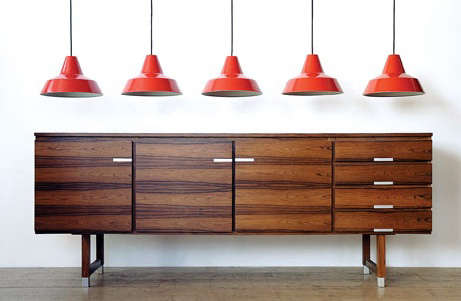
London has never been shy about turning shopping into theater. One minute you are examining a hand-thrown ceramic bowl; the next, you are standing beneath a sculptural pendant light wondering whether your dining room has been underdressed for years. The Modern Warehouse takes that familiar London experience and gives it an especially refined, Scandinavian accent.
Located in Hackney Wick in East London, The Modern Warehouse is a specialist showroom devoted to original 20th-century furniture, lighting, art, and decorative objects. This is not the sort of warehouse where you buy twelve rolls of paper towels and accidentally leave with a kayak. It is a carefully edited destination where a teak daybed, an abstract painting, and a wonderfully irregular wooden stool may share the same room without arguing.
For admirers of vintage Danish furniture, collectible design, and interiors that feel assembled rather than ordered from a catalog, the showroom offers a rewarding lesson in how old objects can remain strikingly modern.
What Is The Modern Warehouse?
The Modern Warehouse began attracting design attention well before midcentury furniture became an unavoidable presence on decorating feeds. A 2009 Shopper’s Diary feature described the London business as a specialist in midcentury furniture, lighting, and accessories. Its photographed selection included Louis Poulsen pendants, Charlotte Perriand seating, a Fog & Mørup “Semi” light, and a Danish rosewood desk.
A Time Out London listing published the following year highlighted pieces by Hans Wegner, Johannes Andersen, and Arne Jacobsen. It also identified owners Rob and David as knowledgeable specialists with a strong eye for Danish furniture and lighting. At that time, the business was listed near Victoria Park and operated by appointment.
The showroom has since developed into a broader design destination in Hackney Wick. Modern Shows describes it as London’s largest showroom dedicated to fine original Scandinavian design, with a frequently changing collection of vintage furniture, lighting, and accessories from the region’s most important design periods. The dealer also handles sourcing, restoration, reupholstery, local delivery, and international shipping.
A Warehouse That Feels More Like a Living Exhibition
The name suggests industrial shelving and forklifts performing an elaborate ballet. The reality is more atmospheric. A specialist design warehouse allows substantial furniture to breathe in a way that a compact city boutique cannot. Sofas can be viewed from several angles, tables can be appreciated at full scale, and lighting can be seen as part of an environment rather than as an isolated product thumbnail.
The Modern Warehouse’s current identity also reaches beyond the familiar midcentury furniture showroom formula. Its official website categorizes the collection under fine design, art and objects, and vernacular furniture. In July 2026, the site was promoting a newly updated collection, reinforcing the sense that the business operates as an evolving gallery rather than a fixed retail catalog.
That expanded approach matters. An immaculate designer chair becomes more interesting beside a rough country bench, an aged Japanese cabinet, or a contemporary ceramic vessel. The contrasts prevent a room from feeling like a historical reenactment of 1957. Unless your goal is to make every visitor whisper, “Excellent credenza,” a little tension is healthy.
Why Scandinavian Design Remains the Main Attraction
Scandinavian modern furniture has survived countless decorating cycles because it balances visual clarity with physical comfort. Cooper Hewitt has identified clarity, ease of use, and natural materials as defining qualities of mid-20th-century Scandinavian design. The Metropolitan Museum of Art similarly notes how Scandinavian designers combined traditional materials with modern technology, producing furniture that felt contemporary without becoming cold or mechanical.
Human-Centered Shapes
Many celebrated Nordic chairs are shaped around the body rather than around a rigid geometric theory. Curved backrests, carefully positioned arms, woven seats, and softened edges make the furniture approachable. The best pieces do not shout about ergonomics. They simply allow you to sit down without immediately negotiating with your spine.
Natural Materials Used With Precision
Teak, oak, rosewood, birch, leather, cane, wool, and linen appear frequently in Scandinavian furniture and textiles. These materials add warmth, but the effect is rarely rustic. Carefully controlled proportions, finely executed joints, and restrained detailing keep the pieces elegant.
Craftsmanship Meets Modern Production
Hans Wegner’s work demonstrates this balance particularly well. MoMA describes his furniture as rooted in cabinetmaking, sculptural thinking, and a deep commitment to wood. The Met’s description of his Wishbone Chair emphasizes craftsmanship, construction, comfort, and tactile materials as central to its human-centered appeal.
That combination explains why a vintage Scandinavian chair can look appropriate in a Victorian townhouse, a concrete apartment, a converted warehouse, or a suburban living room. It possesses a strong identity without demanding that everything around it wear a matching turtleneck.
Designers and Objects Worth Watching For
Hans Wegner
Wegner is one of the names most closely associated with Danish modern furniture. He designed hundreds of chairs, but his work rarely feels repetitive. Some models are almost architectural, while others are light, informal, and beautifully economical.
The Modern Warehouse has handled numerous Wegner designs over the years. Its online collection and archive have included lounge chairs, daybeds, sewing tables, Wishbone Chairs, a Cigar Chair, an AP 20 armchair, and a compact teak Cube Bar designed for Andreas Tuck.
Arne Jacobsen
Arne Jacobsen worked across architecture, furniture, lighting, flatware, textiles, and other interior elements. MoMA’s collection includes his Series 7 chair, Egg Chair, tables, school furniture, and flatware, illustrating the extraordinary breadth of his practice.
Vintage Jacobsen pieces can range from recognizable statement seating to quieter task chairs and tables. When shopping, examine not only the silhouette but also the manufacturer, production period, labels, alterations, and replacement components.
Børge Mogensen, Poul Kjærholm, and Bruno Mathsson
The Modern Warehouse’s recent online inventory has featured Mogensen sofas and tables, a Poul Kjærholm PK61-related coffee table, and furniture by Swedish designer Bruno Mathsson. It has also listed work by Alvar Aalto, Kaare Klint, Ib Kofod-Larsen, Hvidt & Mølgaard, Tove and Edvard Kindt-Larsen, and other notable Nordic designers.
Mogensen’s furniture often feels direct and structurally honest. Kjærholm frequently combined steel with leather, stone, or woven materials. Mathsson explored bent wood, webbing, and body-conscious forms. Seeing these approaches together reveals that Scandinavian modernism was never one uniform beige universe.
Vintage Lighting
Lighting deserves as much attention as the furniture. Historic selections associated with the showroom have included Louis Poulsen fixtures, Poul Henningsen designs, Fog & Mørup pendants, Danish teak lamps, and sculptural floor lighting. A good vintage fixture can transform a room without occupying much floor space, which is useful in London homes where square footage sometimes behaves like a luxury ingredient.
Before buying, ask whether the wiring has been inspected or replaced, whether the components are original, and whether the fixture is compatible with the electrical standards in its destination country.
More Than Famous Furniture
One of the most interesting aspects of the modern showroom is its willingness to place recognized design classics beside anonymous or vernacular objects. Current and archived listings have included primitive Windsor chairs, dugout bowls, work tables, Japanese cabinets, Swedish troughs, early coffers, woven carpets, ceramics, paintings, and sculptural mortars.
Vernacular furniture was generally created to serve a practical local need rather than to establish a designer’s reputation. Its appeal often comes from direct construction, repeated use, regional materials, and irregularities accumulated over time. Such pieces can soften the polished character of collectible modern furniture.
A pristine Scandinavian sofa paired with a battered farmhouse stool creates a conversation between precision and improvisation. Add an abstract painting and a hand-built ceramic vessel, and the room begins to feel personal rather than professionally “completed.” That is usually when an interior becomes most convincing.
How to Shop The Modern Warehouse Wisely
Measure the Room, Doorways, and Stairs
Measure the intended location before falling in love. Then measure entrances, hallways, elevator doors, stair turns, and any other obstacle between the delivery vehicle and the room. A sofa that fits the floor plan but not the staircase is not furniture; it is a very expensive lobby installation.
Ask About Attribution and Provenance
Request the designer’s name, manufacturer, model number, approximate production date, labels, stamps, ownership history, and available documentation. Attribution can affect both price and collectibility, and similar-looking pieces may have very different histories.
Architectural Digest’s authentication guidance recommends looking closely at identifying marks and supporting documentation, especially when buying remotely. Its vintage-shopping experts also stress the importance of evaluating condition systematically and purchasing from established dealers when authenticity matters.
Understand the Restoration
Restoration is not automatically good or bad. Sensitive repairs can return a chair or table to safe, attractive use. Heavy refinishing, altered dimensions, replacement veneers, incorrect hardware, or inappropriate upholstery may reduce historical integrity.
Ask what work has been completed, who performed it, and which materials were replaced. For upholstered furniture, clarify whether the foam, webbing, springs, fabric, or leather are new. A handsome chair should contain fewer mysteries than a detective novel.
Inspect Condition in Context
Minor scratches, fading, repaired joints, and softened edges may be reasonable on furniture that has served several generations. Structural weakness, active woodworm, unstable veneers, severe water damage, or unsafe electrical parts require more caution.
Condition should also be judged against rarity. A common chair with major damage may be easy to replace. A rare early production model can still be significant despite visible restoration, provided the price and description reflect its condition.
Consider Delivery Before Paying
The Modern Warehouse works with carriers for local, nationwide, and international delivery, but buyers should still request written information about packing, insurance, customs responsibilities, delivery access, and what happens if damage occurs in transit.
International buyers should also consider taxes, import duties, electrical conversion, and restrictions affecting certain materials. The cost of moving a large vintage cabinet across borders can be less charming than the cabinet itself.
The Modern Warehouse in London’s Design Landscape
London’s strongest design-shopping neighborhoods succeed by mixing old and new. Architectural Digest’s guide to the city describes areas such as Shoreditch, King’s Cross, Chelsea, Pimlico, Mayfair, and Notting Hill as destinations where historic dealers, experimental retailers, galleries, and contemporary design studios coexist.
Hackney Wick provides a fitting environment for The Modern Warehouse. The district’s industrial architecture and creative character suit furniture that was originally designed to unite everyday usefulness with artistic ambition. There is also something satisfying about examining beautifully engineered objects inside a working warehouse neighborhood rather than beneath the bright lights of a conventional luxury store.
The location turns shopping into a small design expedition. You are not simply comparing products. You are learning how different periods, countries, materials, and makers can share a space.
Who Will Enjoy Visiting?
The showroom is especially appealing to interior designers, architects, collectors, set decorators, hospitality professionals, and homeowners seeking one memorable piece rather than an entire matching suite.
Serious collectors can study makers, construction details, and production histories. First-time buyers can compare authentic vintage furniture with the countless reproductions that borrow its appearance. Casual visitors may simply discover that a well-made chair can be surprisingly entertaining.
The showroom is less suitable for anyone demanding unlimited stock, standardized finishes, next-hour delivery, and a return policy written for impulse purchases. Vintage design requires patience. Pieces arrive individually, condition varies, and the object you admire today may be living in someone else’s dining room tomorrow.
Planning a Visit
Modern Shows currently lists The Modern Warehouse in Hackney Wick and states that the showroom opens on Saturdays from 11 a.m. to 5 p.m., with visits at other times available by appointment. Because hours, access arrangements, and inventory can change, contact the showroom before making a special journey.
Reviewing the online collection beforehand is useful, but do not expect every item to remain available. The collection changes regularly, and some website entries may require a direct inquiry for current pricing or status.
Bring measurements, photographs of your room, material samples, and a short list of practical requirements. Sit in seating when permitted. Open drawers carefully. Examine the underside of tables and chairs. Furniture often reveals more about itself underneath than it does in the heroic front-facing photograph.
A Shopper’s Diary: What the Experience Can Feel Like
The first pleasure of entering a specialist warehouse is scale. Unlike a small boutique where every chair is tucked politely beneath a table, the pieces have enough room to display their personalities. A long teak sideboard stretches across one wall. Nearby, a low leather chair appears so relaxed that it seems to have cleared its calendar.
Your attention may initially go to the recognizable names. A Wegner chair has the visual confidence of an object that has already survived decades of changing taste. Its wooden frame looks simple until you move closer and notice how the back curves, how the joints meet, and how carefully every transition has been resolved.
Then the less famous pieces begin competing for attention. A roughly shaped stool carries marks from years of use. A deep wooden bowl has a surface no factory would deliberately reproduce. A Swedish rug introduces a quieter kind of geometry. Suddenly the showroom is no longer a greatest-hits album of modern furniture. It is a conversation about making, aging, repair, and use.
The lighting changes the mood as you move through the space. A layered pendant directs illumination downward while hiding the bulb. A sculptural table lamp turns an ordinary corner into a miniature stage. You begin mentally relocating every fixture to your own home, where the ceiling is probably lower and the electrical outlet is never in the helpful place.
The most useful part of the visit is comparison. Online, two dining chairs may appear nearly identical. In person, differences in weight, proportion, wood grain, joinery, and seat height become obvious. One chair feels upright and formal. Another invites a long dinner followed by an unnecessarily competitive board game.
A knowledgeable dealer can explain why similar pieces differ in value. One may be an early production example with the original manufacturer’s stamp. Another may have new upholstery but an excellent frame. A third may be attractive and practical without having a famous attribution. The best choice depends on whether you are building a collection, furnishing a family room, or searching for a single object with emotional impact.
It is also easy to underestimate the appeal of patina until several examples sit together. Perfectly restored furniture can look magnificent, but a lightly worn armrest or mellowed wood surface records the life of the piece. The challenge is distinguishing graceful aging from damage that will become tomorrow’s expensive repair.
By the end of the visit, your original shopping plan may have changed. You arrived searching for a desk but keep returning to a cabinet. You intended to buy something unmistakably Danish but have become attached to an anonymous English bench. This is the danger and delight of a well-curated showroom: it improves your taste while making your shopping list considerably less obedient.
Even without making a purchase, the experience can sharpen the way you evaluate interiors. You begin noticing whether furniture relates to the body, whether materials will age well, and whether every item in a room really needs to match. Most importantly, you leave with the reminder that good design does not have to feel precious. It can be touched, used, repaired, and allowed to become part of everyday life.
Conclusion
The Modern Warehouse offers a distinctly London approach to collectible design: informed but not stiff, international yet grounded in practical objects, and polished without erasing age. Its foundation in Scandinavian modern furniture remains central, but the addition of art, vernacular pieces, textiles, ceramics, and useful curiosities gives the showroom a richer voice.
For shoppers, the lesson is simple. Look beyond the famous silhouette. Ask about the maker, materials, condition, restoration, and history. Measure everything twice. Buy the piece that works in your life rather than the one that merely performs well in a photograph.
Note: Inventory, prices, visiting arrangements, and opening hours may change. Confirm current details directly with the showroom before traveling or arranging a purchase.












