
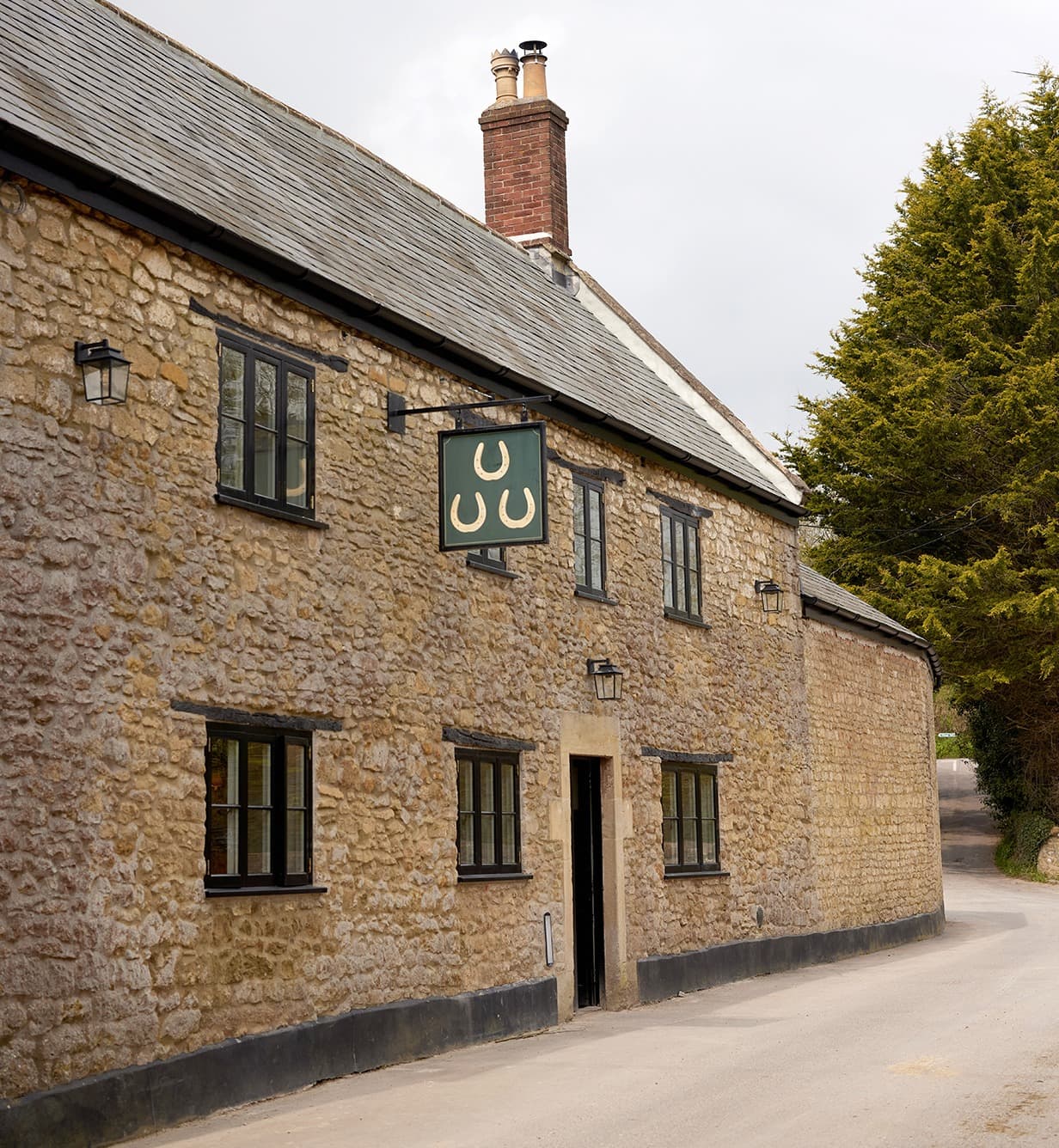
The Three Horseshoes in Batcombe is what happens when a celebrated London chef, a centuries-old village inn, and Somerset’s famously generous pantry decide to share a table. The result is neither a metropolitan restaurant disguised with a few decorative hay bales nor an old-fashioned pub preserved behind glass. It is a living, working country inn where local residents can order a pint at the bar, travelers can settle into one of five rooms, and serious diners can investigate exactly how much butter a properly made pie can carry before becoming a small architectural project.
Margot Henderson, best known for co-founding Rochelle Canteen in East London, oversees the food at this restored 17th-century pub. Opened at the end of April 2023, The Three Horseshoes marked Henderson’s first major restaurant venture outside London. It also placed her direct, seasonal cooking in a landscape capable of supplying much of what appears on the plate.
Opening date, configuration and location verified through the official inn website and contemporary opening coverage.
A Famous Chef Moves Into the Somerset Countryside
Henderson’s arrival in Batcombe was significant because her cooking has long been associated with a particular kind of London restaurant: confident but informal, fashionable without performing fashion, and deeply committed to ingredients that might frighten a diner who considers boneless chicken breast an adventurous weekend.
Born in New Zealand, Henderson became an influential figure in British food through work connected with landmark restaurants including The Eagle and The French House. She later established Rochelle Canteen with Melanie Arnold, building a loyal following around uncomplicated dishes, communal hospitality, seasonal produce, and a preference for flavor over decorative gymnastics.
At The Three Horseshoes, Henderson designs the menus and guides the culinary identity while dividing her time between Somerset and London. Head chef Nye Smith, whose experience includes kitchens connected to the same modern British tradition, handles much of the daily execution. This structure allows the Batcombe restaurant to carry Henderson’s recognizable philosophy without becoming a celebrity-chef museum where everyone whispers reverently at an unattended saucepan.
The project came together through Max Wigram, a former gallerist and art collector who purchased the pub and invited Henderson to oversee its food. Wigram’s background helps explain why the inn feels visually considered without looking as though an interior-design catalog exploded near the fireplace.
Henderson’s career, Max Wigram’s role and Nye Smith’s kitchen leadership are supported by Eater, House & Garden and Condé Nast Traveller reporting.
Why Batcombe Was the Right Setting
Batcombe is a small Somerset village near Bruton, surrounded by hills, farms, hedgerows, orchards, and lanes that seem specifically designed to make hurried drivers reconsider their personalities. The Three Horseshoes stands close to the Grade I-listed Church of St. Mary the Virgin, creating the classic village arrangement of church, pub, and community life within easy walking distance.
The wider area has become one of England’s most discussed rural food and culture destinations. Bruton’s galleries, restaurants, bakeries, farms, and design businesses have attracted visitors looking for an alternative to both city tourism and the polished country-house experience. The Three Horseshoes benefits from that audience, but its more important challenge is remaining useful to the village itself.
That balance matters. A rural pub can quickly become so stylish, expensive, or reservation-dependent that local residents feel like extras in someone else’s weekend. The Three Horseshoes attempts to avoid that fate by preserving a dedicated locals’ bar alongside its dining rooms, courtyard, terrace, lawn, and guest accommodations. Visitors may arrive for Henderson’s reputation, but the building still needs to function when the fashionable crowd has gone home and the weather is doing its best impression of a wet dishcloth.
Inside the Restored 17th-Century Inn
The restoration emphasizes the building’s original character rather than attempting to make an old pub look suspiciously new. Flagstone floors, exposed beams, open fires, white walls, antique wooden chairs, and low ceilings establish the atmosphere. The interiors feel spare but warm, relying on texture, proportion, art, and well-chosen furniture instead of themed decorations involving fake pheasants.
Interior designer Frances Penn helped shape the five bedrooms, combining antiques, patterned textiles, substantial beds, wooden furniture, and contemporary pieces. Artwork from Wigram’s collection appears throughout the property, giving the inn personality without turning each room into a gallery lecture.
Landscape designer Libby Russell worked on the outdoor areas, which include planted borders, old fruit trees, lawns, a courtyard, and a terrace for warm-weather eating and drinking. The garden is not merely a place to park picnic tables. It helps connect the restored inn to Batcombe’s agricultural surroundings and creates a softer transition between the building, churchyard, and countryside.
The effect is controlled but not stiff. Muddy boots do not look like a criminal offense here. Neither do dogs, pints, children, newspapers, or a guest who has temporarily lost the will to move after sticky toffee pudding.
Architectural character, bedroom design, art and landscaping are documented by Wallpaper*, House & Garden, Telegraph Travel, Remodelista and Condé Nast Traveller.
Margot Henderson’s Cooking Philosophy in Pub Form
The food at The Three Horseshoes is grounded in recognizable British and European traditions. Henderson does not hide ingredients beneath foams, powders, scented clouds, or speeches from the server. Instead, the kitchen focuses on seasoning, texture, good produce, careful sourcing, and dishes that look as though they were invented because someone was hungry.
Seasonal Menus Instead of Permanent Greatest Hits
The menu changes with the seasons and availability, so individual dishes cannot be treated as permanent fixtures. Opening menus and later reviews have mentioned deviled crab, Westcombe ricotta gnudi with sage and butter, chicken and tarragon pie, rabbit pie, grilled ox heart, pork chops, confit duck, smoked haddock with saffron mash, cottage pie, ham hock terrine, and ox cheek with pickled walnut.
These dishes reveal the restaurant’s operating language. Pies are allowed to be pies, complete with deeply flavored fillings and pastry intended to be eaten rather than photographed from six angles. Offal and lesser-used cuts appear naturally instead of being presented as culinary dares. Vegetables receive enough attention to stand on their own, while sauces and accompaniments provide acidity, richness, bitterness, or crunch where needed.
A diner can also choose simpler bar food, such as a toastie, pork pie, pâté, vegetables on toast, or Henderson’s well-known mince on toast. This flexibility is essential to the pub’s identity. Not every visit needs to become a three-hour gastronomic summit.
Somerset Ingredients With Actual Addresses
The Three Horseshoes is surrounded by an unusually strong network of growers, dairies, bakers, smokehouses, orchards, and small farms. Westcombe Dairy, located close to Batcombe, supplies cheese and dairy products. Brown & Forrest contributes smoked ingredients, while produce has been sourced from no-dig gardening pioneer Charles Dowding. Landrace Bakery has also supplied sourdough.
Local sourcing is most convincing when it affects the cooking rather than merely decorating the menu with place names. At The Three Horseshoes, Somerset produce shapes what can be served and when. Asparagus may appear when nearby growers have it. Orchard fruit can influence desserts. Local cheese becomes part of a dish rather than the subject of a marketing paragraph wearing rubber boots.
Traditional Desserts That Refuse to Apologize
Desserts reinforce the restaurant’s preference for familiar pleasures executed properly. Treacle tart attracted attention soon after the opening, while sticky toffee pudding, Bakewell tart, sherry trifle, and other classic sweets have appeared on menus and in reviews.
This is not the place to receive one raspberry, three mysterious dots, and a spoon the size of a canoe paddle. The puddings are recognizable, generous, and designed to finish a meal with satisfaction rather than a philosophical question.
Menu style, representative dishes and regional suppliers are supported by Michelin Guide, SquareMeal, Top 50 Gastropubs, Eater and Condé Nast coverage. Menus remain seasonal and may change.
A Restaurant, a Pub and Five Rooms Upstairs
The five en suite bedrooms turn The Three Horseshoes into a genuine pub with rooms rather than a restaurant that happens to own several pillows. Each room has its own proportions and decorative details, but the overall approach favors large beds, comfortable seating, natural materials, antiques, patterned fabrics, and spacious bathrooms.
Staying overnight changes the rhythm of the experience. Guests do not have to appoint a designated driver, negotiate a late taxi through rural Somerset, or stare accusingly at the last glass of wine. Dinner can end with a short walk upstairs, followed by breakfast and a day exploring Batcombe, Bruton, Frome, local dairies, walking routes, churches, galleries, or nearby countryside.
The inn does not offer a spa, gym, rooftop pool, or a wellness consultant named River. Its luxury comes from comfort, atmosphere, food, location, and the possibility of waking to village sounds rather than traffic. That simplicity is part of the proposition, although the historic architecture can create accessibility limitations that travelers should check before booking.
Why The Three Horseshoes Has Attracted So Much Attention
The restaurant has received national and international coverage, inclusion in the Michelin Guide, and recognition among notable British gastropubs and restaurant openings. Some of that attention is inevitable when a chef of Henderson’s reputation launches a rural project. The more interesting question is why the interest has continued.
One answer is coherence. The food, design, rooms, landscape, and service all express the same idea: a country pub can be ambitious without becoming formal. Another is timing. Diners increasingly value restaurants with a visible relationship to farms, seasons, and communities, particularly when that relationship produces better food rather than a lecture before the appetizer.
The Three Horseshoes also demonstrates how British pub cooking has evolved. A bowl of chips, a plate of kidneys on toast, a carefully made pie, and a locally sourced vegetable dish can belong to the same menu. Comfort and culinary intelligence are not competing teams. Sometimes the smartest thing a kitchen can do is leave a very good potato alone for a moment.
Recognition and critical reception are reflected in Michelin Guide, Condé Nast Traveler, The Times, Country Life and Top 50 Gastropubs coverage.
The Three Horseshoes Experience: What a Visit Can Feel Like
The best way to understand The Three Horseshoes is not as a checklist of famous names and local suppliers, but as a sequence of experiences. The following scene is an informed illustration based on the inn’s setting, layout, menus, accommodations, and published guest accounts rather than a claim of firsthand attendance.
Arriving in Batcombe
Your visit begins before anyone hands you a menu. The roads narrow, the landscape folds into green hills, and your phone’s navigation system develops the anxious tone of someone who has misplaced a village. Batcombe appears quietly, with stone buildings, hedges, the church tower, and the inn gathered around the center.
The Three Horseshoes does not announce itself like a luxury resort. It looks rooted in the village. Depending on the season, you might pass flowering borders, damp stone, apple trees, outdoor tables, or a courtyard fire. In winter, the promise is warmth. In summer, the lawn and terrace encourage the dangerous belief that one quick drink outside will not become an entire afternoon.
Beginning at the Bar
Entering through the pub rather than marching directly to a formal dining table changes the mood. There may be residents having drinks, dogs settling under chairs, travelers checking in, and diners studying the chalkboard. Exposed beams, flagstones, wooden furniture, and the fireplace provide atmosphere without forcing anyone to admire the atmosphere.
A strong opening move would be a local cider, beer, glass of wine, or classic cocktail accompanied by something from the bar menu. Mince on toast may sound modest, but that is precisely the point. When the meat is deeply seasoned, the toast properly crisp, and the juices soaked into the bread without destroying it, the dish becomes a reminder that luxury and complexity are not synonyms.
Settling Into Dinner
The dining experience works best when the table orders with curiosity rather than constructing individual fortresses around separate entrées. Begin with contrasting plates: perhaps seafood or cured fish, a terrine, seasonal vegetables, local cheese, or warm bread. Henderson’s food rewards sharing because the flavors are clear enough to remain distinct.
A pie is likely to become the table’s main event whenever one appears. Cutting into a well-made pie creates a brief silence, followed by the release of steam and the immediate realization that everyone should have ordered more vegetables to absorb the gravy. Alternatively, a grilled cut, confit duck, smoked fish, or offal dish may offer the same combination of rustic appearance and precise technique.
The meal should include something green, bitter, sharp, or pickled. Rich British cooking becomes exhausting when every plate behaves like a weighted blanket. Henderson’s menus typically create balance through herbs, mustard, cultured dairy, watercress, pickles, fruit, or carefully dressed vegetables.
Then comes dessert. Ordering treacle tart or sticky toffee pudding after pie may appear reckless, but the bedroom is nearby and history favors the brave. A spoonful of hot pudding with cold cream or ice cream provides the kind of uncomplicated happiness that restaurant critics occasionally disguise beneath several paragraphs.
Staying the Night
After dinner, the inn’s greatest practical luxury becomes obvious: there is no complicated departure. You can return to the bar, step into the garden, or walk upstairs. The bedrooms soften the pub’s harder architectural surfaces with rugs, upholstery, art, generous beds, and comfortable bathrooms.
Morning in Batcombe is slower. Church bells, birds, kitchen activity, or footsteps in the courtyard replace the usual urban alarm. Breakfast is likely to be concise rather than buffet-based, emphasizing good bread, eggs, bacon, fruit, yogurt, preserves, or whatever the kitchen has chosen to serve.
Afterward, you can walk through the village, visit nearby Bruton, seek out Westcombe Dairy, or simply remain at the inn long enough to wonder whether lunch would be an irresponsible decision. It probably would be. It might also be an excellent one.
Conclusion: A Country Pub With a Clear Point of View
The Three Horseshoes succeeds because it does not treat rural hospitality as a costume. Its historic building remains recognizable, the locals’ bar still matters, the rooms offer comfort without unnecessary spectacle, and the kitchen cooks food suited to both the landscape and the appetite.
Margot Henderson’s influence is visible in the confidence to keep dishes simple, use overlooked cuts, trust seasonal ingredients, and serve desserts that arrive with no interest in portion control. Max Wigram, Frances Penn, Libby Russell, Nye Smith, and the wider team have helped turn that culinary philosophy into a complete destination.
For diners interested in modern British cooking, Somerset produce, restored country inns, or restaurant weekends outside London, The Three Horseshoes in Batcombe offers a persuasive reason to follow the narrow roads. Just arrive hungry. The pie will not respect a timid schedule.
SEO Metadata
Research note: Factual details were synthesized from 13 established sources, including the official Three Horseshoes website, Michelin Guide, Condé Nast Traveler, Condé Nast Traveller, Eater, House & Garden, Wallpaper*, The Telegraph, The Times, Country Life, SquareMeal, Top 50 Gastropubs and Remodelista. No source language has been reproduced at length.











