
Somewhere on the internet, a perfectly ordinary fact is currently wearing a fake mustache and pretending to be a life-changing secret.
The headline probably says something like, “Doctors Are Speechless After Discovering What Happens When You Eat This Common Food.” After 11 paragraphs, four pop-ups, two autoplay videos, and an advertisement shaped suspiciously like a download button, the mysterious food is finally revealed. It is an apple. Doctors remain entirely capable of speech.
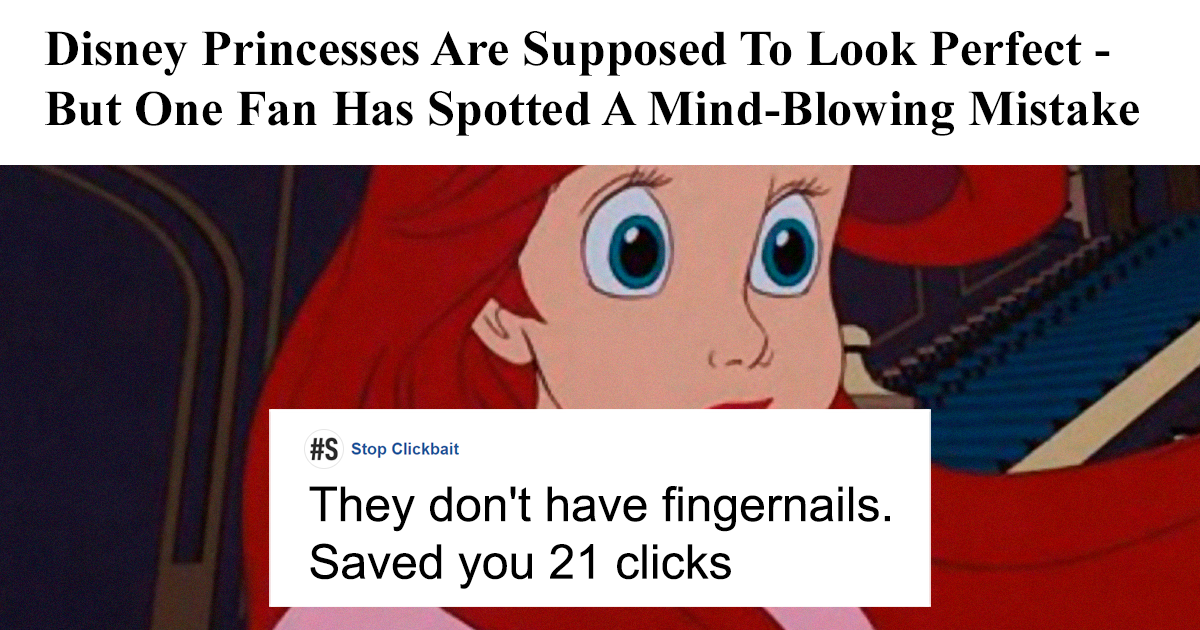
That is the problem the Stop Clickbait project set out to solve. Instead of allowing vague headlines to hold readers’ curiosity hostage, its contributors opened the articles, found the hidden answer, and posted a blunt summary. A dramatic promise that required an entire slideshow could suddenly be reduced to six words and a shrug.
Bored Panda reported that the project was started by advertising student Daniel Tuttle in 2016 and grew into an international effort built around one beautifully simple idea: reveal the answer so everyone else can keep scrolling.
The 30 examples below use original wording inspired by the same saved-you-a-click format. They illustrate the familiar tricks used in celebrity gossip, health stories, financial promotions, lifestyle articles, technology coverage, and those advertisements that insist one vegetable is quietly plotting against your family.
Why Clickbait Keeps Catching Us
Clickbait works by creating an information gap. The headline gives readers enough information to form a question but deliberately withholds the answer. That missing detail produces curiosity, and curiosity can feel like a mental itch that demands scratching. Research on headline concreteness has found that the effectiveness of this tactic depends on context, but excessively vague headlines can also backfire when readers recognize the manipulation.
Emotion provides the second hook. Fear, outrage, surprise, hope, and disgust encourage quick reactions before careful judgment arrives wearing its reading glasses. Stanford researchers have described how newsroom traffic measurements and audience analytics can pressure writers toward exaggerated framing, while newer discussions of rage bait show how anger has become another profitable form of engagement.
Platforms know audiences dislike the tactic. Meta has repeatedly adjusted Feed ranking to reduce headlines that withhold essential information or exaggerate what an article contains. Google has also strengthened policies against low-quality, unoriginal content created mainly to manipulate rankings.
Clear headlines do not have to be boring. Research summarized by Nieman Journalism Lab suggests that simple, understandable headlines can improve both clicks and recall. In other words, publishers can attract readers without behaving like a carnival barker guarding the identity of a household appliance.
30 Clickbait Headlines Hilariously Reduced to Their Actual Meaning
Celebrity Secrets That Were Barely Secrets
-
The bait: “Fans Cannot Stop Talking About What This Famous Actor Wore to the Airport.”
The saved-you-a-click answer: Sweatpants. The actor wore sweatpants while traveling, an activity frequently performed while wearing sweatpants.
-
The bait: “A Pop Star Finally Breaks Her Silence About the Rumor Shaking Hollywood.”
The answer: She said the rumor was false and asked people to stop discussing it. The article then discussed it for another 900 words.
-
The bait: “You Will Not Recognize This Beloved Television Star Today.”
The answer: The photograph was taken 25 years later. Time had occurred.
-
The bait: “The Real Reason This Celebrity Couple Left Dinner Early.”
The answer: One of them had an early flight. Romance survives another completely ordinary scheduling decision.
-
The bait: “The Internet Is Losing It Over a Singer’s Unexpected New Look.”
The answer: She changed her hair color. The internet has begun the long process of recovery.
Health Headlines Prescribing Panic
-
The bait: “Doctors Warn That This Common Morning Habit Could Be Ruining Your Health.”
The answer: Regularly sleeping only four hours is unhealthy. The secret habit was severe sleep deprivation, not putting milk in coffee.
-
The bait: “This One Fruit May Change the Way You Think About Digestion Forever.”
The answer: Prunes contain fiber. Grandparents have been sitting on this explosive intelligence for decades.
-
The bait: “Never Ignore This Surprising Sign Your Body Is Sending You.”
The answer: Persistent unexplained symptoms should be discussed with a qualified medical professional. A sensible point wrapped in emergency sirens.
-
The bait: “Nutritionists Reveal the Dinner Ingredient You Should Avoid at All Costs.”
The answer: The article recommends limiting excessive sodium. It does not identify salt as an escaped supervillain.
-
The bait: “A Two-Minute Trick Could Transform Your Sleep Tonight.”
The answer: Put your phone down and dim the lights. Unfortunately, the trick requires not reading 14 more articles about sleep tricks.
Health-related clickbait deserves particular caution because exaggerated claims can affect real decisions. The Federal Trade Commission emphasizes that advertising claims must be truthful and not misleading, especially when they concern health or consumers’ money.
Money Advice With a Dramatic Soundtrack
-
The bait: “Banks Hope You Never Discover This Simple Savings Method.”
The answer: Automatically transfer part of each paycheck into savings. Banks have, in fact, offered this feature for years.
-
The bait: “A Retired Teacher Used One Weird Trick to Cut Her Monthly Bills.”
The answer: She canceled subscriptions she no longer used. Streaming services have requested privacy during this difficult time.
-
The bait: “This Credit Card Secret Could Save You Hundreds.”
The answer: Paying the full balance on time prevents interest charges. The secret is reading the agreement before the agreement reads your wallet.
-
The bait: “Experts Say Homeowners Are Throwing Money Away Without Realizing It.”
The answer: Some households can reduce energy costs by sealing drafts and maintaining heating and cooling equipment.
-
The bait: “Millionaires Never Buy This Everyday Item.”
The answer: Several wealthy people interviewed said they avoid unnecessary impulse purchases. Others almost certainly buy the item.
Home and Lifestyle Revelations Nobody Requested
-
The bait: “Professional Cleaners Are Begging People to Stop Making This Mistake.”
The answer: Do not mix incompatible cleaning chemicals. This one is useful, although the cleaners were probably explaining rather than begging.
-
The bait: “The Household Object You Have Been Using Wrong Your Entire Life.”
The answer: A demonstration shows a slightly faster way to fold a fitted sheet. Your previous technique remains legally valid.
-
The bait: “Guests Notice This Immediately When They Enter Your Home.”
The answer: Strong odors are noticeable. Humanity celebrates another major sensory discovery.
-
The bait: “Designers Reveal the Paint Color That Is Officially Over.”
The answer: A few designers are currently tired of gray. Gray has declined to surrender.
-
The bait: “You Have Been Loading Your Dishwasher All Wrong.”
The answer: Avoid blocking the spray arms and follow the manufacturer’s instructions. Plates do not require an architectural degree.
Technology News Hiding Very Small Updates
-
The bait: “Phone Users Are Just Discovering This Hidden Feature.”
The answer: The feature has been in the settings menu for several years, where settings are traditionally stored.
-
The bait: “A New App Is Changing the Way People Communicate Forever.”
The answer: It sends short video messages. Forever remains under review.
-
The bait: “Internet Providers Do Not Want You to Know This Wi-Fi Trick.”
The answer: Moving the router away from thick walls and interference may improve coverage. The provider is unlikely to deploy a containment team.
-
The bait: “One Setting Could Double Your Phone’s Battery Life.”
The answer: Aggressive battery-saving mode can extend usage by disabling many features, including some reasons you bought the phone.
-
The bait: “The Shocking Truth About Incognito Mode.”
The answer: It mainly prevents local browsing history from being stored. It does not make you invisible to websites, employers, schools, or internet providers.
Animals, Food, and Other Innocent Victims
-
The bait: “A Farmer Looked Inside His Barn and Could Not Believe His Eyes.”
The answer: A goat had climbed onto a stack of hay. The goat believed its own eyes without difficulty.
-
The bait: “This Dog’s Reaction to Meeting a Baby Will Melt Your Heart.”
The answer: The dog sniffed the baby and wagged its tail. No cardiac melting was reported.
-
The bait: “Chefs Say Everyone Is Making the Same Pasta Mistake.”
The answer: Many people overcook pasta or forget to season the water. Italy has placed us on probation.
-
The bait: “Customers Are Obsessed With a Fast-Food Chain’s Secret Menu Item.”
The answer: It is a regular menu item with an extra sauce and a confident nickname.
-
The bait: “A Mysterious Creature Was Spotted in a Family’s Backyard.”
The answer: It was a wet opossum photographed at night. Mystery solved; dignity unavailable.
Why the Stop Clickbait Format Is So Funny
The humor comes from contrast. A clickbait headline inflates a tiny fact until it resembles an international emergency. The summary then removes every dramatic accessory and places the ordinary answer under fluorescent lighting.
“The scientific community is stunned” becomes “one small study produced an interesting result.” “Travelers are obsessed” becomes “several people recommended a suitcase.” “Nobody saw this coming” becomes “the television episode ended with a predictable cliffhanger.”
This compression does more than produce jokes. It exposes the economic structure behind the headline. Publishers often earn money when readers visit pages, view advertisements, continue through slideshows, or remain on a site. A headline that gives away the answer may generate fewer immediate visits, so the essential fact is treated like the last cookie at a family gathering: technically available, but carefully guarded.
The Stop Clickbait approach reverses that bargain. It gives the reader the useful information first. The publisher may lose a low-quality click, but the audience regains time, attention, and a small amount of faith in civilization.
Clickbait Is Not Always Fake News, but It Can Damage Trust
A clickbait article may contain accurate information. The problem is often the relationship between the headline and the story. A headline can exaggerate certainty, hide context, imply a stronger conclusion than the evidence supports, or promise an answer the article barely provides.
Professional journalism standards emphasize accuracy, context, transparency, and accountability. The Society of Professional Journalists advises journalists to verify information, provide context, correct mistakes, and clearly distinguish news from advertising. Those principles apply to headlines as much as to the paragraphs underneath them.
Disguised advertising creates an additional concern. The FTC warns that promotional material can be deceptive when it looks like independent editorial content and its commercial nature is not clearly disclosed. A sensational headline leading to a sales page is therefore not merely annoying when the sponsorship is hidden; it may also mislead consumers about who created the message and why.
Audience frustration is measurable. Pew Research Center has found that some Americans who consume news through social media specifically identify clickbait, low-quality reporting, and limited depth among the things they dislike about the experience.
How to Save Yourself a Click
Before opening a suspicious headline, identify the missing noun. What is “this ingredient”? Which “unexpected decision” did the celebrity make? What exactly is the “one mistake” homeowners supposedly commit?
Next, inspect the source. A trustworthy organization should provide an identifiable publisher, author information, publication date, corrections policy, and clear distinction between reporting and advertising. The News Literacy Project also recommends lateral reading: open another tab, investigate the source, and compare the claim with independent coverage instead of evaluating the page only by its own presentation.
Watch your emotional response. A headline that makes you instantly furious, terrified, or triumphant may be trying to convert emotion into engagement. Pause before sharing it, especially when the headline confirms something you already strongly believe.
Finally, search for the key phrase. Someone else may already have explained the answer in a sentence. You may discover that the forbidden vegetable is corn, the secret retirement strategy is spending less than you earn, and the celebrity’s devastating announcement is a new fragrance.
A Week of Refusing the Bait: A 500-Word Personal Experience
I once tried a simple experiment: for one week, I refused to click any headline that deliberately concealed its main fact. If a title said “this city,” “one food,” “a shocking reason,” or “what happened next,” I stopped and searched for the answer somewhere else.
The first thing I noticed was how automatic clicking had become. I did not always care about the subject. I simply disliked leaving the question unanswered. A headline about an actor I had never watched could still create an urgent need to know why he had supposedly “walked away from everything.” Usually, he had left a television series after his contract ended. Everything remained largely where it was.
Health stories were the hardest to ignore because they often combined secrecy with fear. One headline warned that a common kitchen habit might have “dangerous consequences.” The article’s conclusion was that raw meat should not touch ready-to-eat food. That advice is important, but disguising basic food-safety guidance as a terrifying discovery made the story feel less trustworthy, not more.
I also became more aware of time. A single click rarely consumed only the minute required to read an article. It led to recommendation boxes, related stories, comment sections, videos, and another mysterious headline waiting at the bottom. Ten minutes could disappear into content I had never intended to seek. The click was not merely an action; it was an entrance ramp.
Searching for direct answers changed the experience. Instead of opening “The One Thing Travelers Always Forget,” I searched the phrase with a few relevant keywords. The secret item was a portable phone charger. Useful? Certainly. A revelation capable of transforming modern transportation? Perhaps not.
The experiment also showed me that good headlines still attracted my attention. I clicked titles that clearly stated what happened, especially when they promised helpful analysis rather than artificial suspense. “How Sleep Loss Affects Concentration” was more appealing than “This Nighttime Mistake Is Destroying Your Brain” because the first headline respected my ability to decide whether the subject mattered.
By the end of the week, I had not become immune to curiosity. Nobody does. I had simply become better at noticing when curiosity was being manufactured. That small pause made browsing calmer and more intentional.
The funniest part was realizing how often the supposedly hidden answer could be guessed from the thumbnail. The “mystery animal” was clearly a raccoon. The “household product” was visibly baking soda. The “unexpected celebrity guest” had been tagged in the social media caption.
Stop Clickbait succeeds because it turns that realization into comedy. It does not tell people to stop being curious. It reminds them that curiosity should lead to information, not a maze of advertisements surrounding a fact that could have fit comfortably inside the headline.
Conclusion
Clickbait thrives by stretching the distance between a question and its answer. Stop Clickbait closes that distance with a sentence, a punchline, and occasionally the digital equivalent of a disappointed stare.
The project’s funniest summaries reveal an important truth about online publishing: readers do not hate interesting headlines. They hate being manipulated. A strong headline can create curiosity while remaining accurate, specific, and honest about what the article contains.
The next time a website claims that experts are speechless, neighbors are furious, travelers are obsessed, or the internet cannot handle an ordinary photograph, take a breath. Look for the missing fact. Check the source. Search for independent confirmation. There is a good chance someone has already opened the article and returned with the entire revelation:
It was baking soda.











