
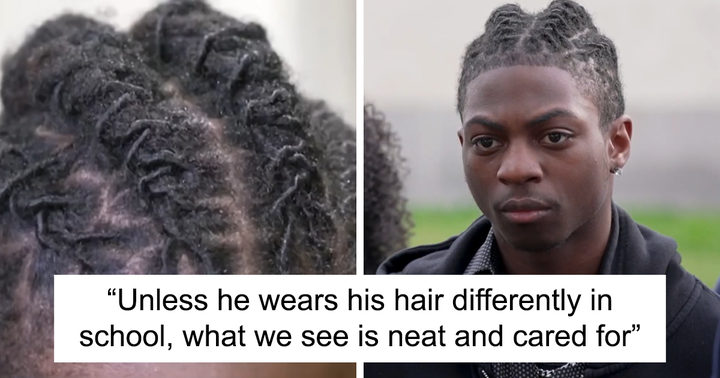
At first glance, this story sounds like one of those clean, tidy legal headlines that fits neatly inside a push alert: a Texas judge ruled that a Black student’s suspension over long hair was not discrimination. Boom. Case closed. Except it really was not that simple, and that is exactly why the story traveled so far, stirred so much anger, and kept showing up in conversations about race, schools, personal identity, and the limits of so-called “neutral” dress codes.
The case centered on Darryl George, a Black student in the Houston-area Barbers Hill Independent School District, who wore his hair in long locs. School officials argued that his hairstyle violated the district’s grooming policy for boys because the hair would extend below specific length limits if worn down. George and his supporters argued that the punishment clashed with the spirit, and the plain purpose, of Texas’ newly enacted CROWN Act, a law meant to ban race-based hair discrimination in schools, workplaces, and housing.
Then came the ruling that lit a match under the debate. A state judge sided with the school district, concluding that the discipline did not violate the law. The reasoning turned on a distinction that many critics found maddening: Texas law explicitly protects hair texture and protective hairstyles such as braids, locks, and twists, but the court accepted the district’s position that the statute does not specifically protect hair length. In other words, the hairstyle may be protected, but only up to the point where it becomes “too long” under a school’s policy. That legal parsing landed with all the grace of a brick through a salon window.
This article takes a closer look at what the judge ruled, why the decision drew such fierce criticism, what the school district argued in its defense, and why the case became much bigger than one student, one school, or one haircut policy. Because beneath the headline sits a more uncomfortable question: if a law bans hair discrimination, but schools can still punish the length required to wear a protected style, how much protection is really there?
What the judge actually ruled
The headline-friendly version is straightforward: the judge ruled that Barbers Hill ISD could discipline Darryl George without violating Texas’ CROWN Act. But the logic behind that outcome matters more than the headline itself.
Texas lawmakers passed the CROWN Act to prohibit discrimination based on hair texture and protective hairstyles commonly or historically associated with race. The law specifically mentions styles such as braids, locks, and twists. George’s supporters believed that settled the issue, or at least should have. He wore locs, which fit squarely inside the category the law was written to protect.
The district, however, framed the dispute differently. It said the problem was not that George wore locs. The problem, in the district’s telling, was that his hair was too long under a grooming code that applies different standards to male students. That rule said boys’ hair could not extend below the eyebrows, ear lobes, or the top of a T-shirt collar. The district argued that its policy regulated length, not race, and length, not hairstyle. The judge agreed.
That distinction had serious real-world consequences. George spent much of his junior year either in in-school suspension or in an off-site disciplinary program rather than attending regular classes with his peers. So while the legal argument sounded narrow, the educational fallout was anything but. This was not a minor disagreement over school photo day aesthetics. It was a months-long disruption of a student’s schooling over hair.
Why this case hit such a nerve
Hair has never been “just hair” in American public life, and certainly not for Black students. Hairstyles such as locs, braids, twists, and Afros have long been policed in schools and workplaces in ways that are often framed as neutral grooming standards, even when they disproportionately burden Black people. That is why CROWN Act laws were created in the first place: lawmakers and advocates recognized that old dress-code logic often works as a polished, bureaucratic version of cultural exclusion.
For many Black families, the George case did not read like a quirky dress-code dispute. It read like a familiar story. A policy claims to be about order. A school claims to be protecting standards. A student is told the rule applies to everyone. But the practical burden falls hardest on students whose hair carries cultural, historical, or protective significance.
That helps explain why the ruling triggered such strong reactions. Critics saw it as a loophole big enough to drive a marching band through. If the law protects locs, but a school can still punish the length necessary to wear locs in a meaningful, culturally recognizable way, then the law can start to look less like a shield and more like decorative trim.
And to make matters even more charged, this was not some random district stumbling into a legal gray area for the first time. Barbers Hill had already drawn national scrutiny in earlier long-hair disputes involving Black students. So by the time Darryl George’s case made headlines, plenty of observers were not asking, “Is this an isolated misunderstanding?” They were asking, “Why is this still happening here?”
The school district’s argument, in plain English
To understand why the judge ruled the way he did, it helps to look at the district’s defense without caricaturing it. Barbers Hill did not argue that Black hairstyles are bad. It argued that its dress code is lawful, facially neutral in structure, and designed to teach grooming, discipline, conformity, and standards that school leaders say prepare students for adult expectations.
The district’s published dress code describes grooming rules as part of maintaining order, minimizing disruption, and preserving a school image. Its hair policy for boys sets precise limits on how long hair may be and also bars certain accessories and ponytails on male students. In the district’s view, those rules are part of a broader framework that tells students school is a place with boundaries, expectations, and collective norms.
Supporters of that view often make a familiar argument: schools already regulate clothing, language, conduct, attendance, and behavior, so regulating hair length is simply another housekeeping measure. From that perspective, the issue is not race. It is rule-following. The district has also defended “traditional” standards as promoting safety, consistency, and academic focus.
Whether you find that convincing probably depends on whether you think schools exist partly to shape conformity or primarily to educate without unnecessarily punishing identity. And that is where this case stopped being about inches of hair and became a referendum on the philosophy hiding inside dress codes.
Why civil-rights advocates called it discrimination anyway
George’s supporters never bought the district’s “this is only about length” argument. Their response was simple: for protective styles like locs, length is not some random add-on. It is often part of the style itself. A law protecting locks while ignoring the length needed to wear them can become an empty promise fast.
That argument also had a practical edge. Protective hairstyles are not costume jewelry. They are often chosen to maintain healthy natural hair, reduce daily manipulation, and reflect cultural or family traditions. Telling a student he may technically wear locs, but only if he cuts or limits them to a district-approved length, struck critics as similar to saying you can express yourself as long as you do it in a way that no longer looks much like your expression.
Advocacy groups added another layer. They argued that long hair can carry cultural, ancestral, and even spiritual meaning for Black and Indigenous students. In friend-of-the-court filings and public statements, advocates emphasized that many schools still use dress and grooming policies to force students into norms shaped by outdated ideas about gender, race, and respectability. From that perspective, boys-only hair-length rules are not neutral. They are selective, gendered, and loaded with history.
One of the most striking criticisms came from people who helped shape the law itself. Supporters of the CROWN Act argued that the statute was obviously meant to stop exactly this kind of punishment. Their position was basically: if lawmakers went to the trouble of naming locks, twists, and braids, nobody should pretend they forgot that those styles often require length. That is not legal subtlety. That is legal dodgeball.
The CROWN Act’s loophole problem
The Darryl George case exposed a weakness in how anti-discrimination laws can function when statutory language is narrower than lived reality. On paper, Texas’ CROWN Act sounded like a clear win for students facing hair-based punishment. In practice, the George ruling showed that judges can still separate hairstyle from hair length if the text does not spell out that connection in unmistakable terms.
That matters beyond Texas. Around the country, debates over hair discrimination often turn on how institutions define “professional,” “neat,” or “appropriate.” These words sound harmless until you notice that they are frequently built around one visual baseline: hair that fits mainstream, traditionally Eurocentric expectations and often conventional gender norms. Once that baseline is treated as neutral, anything outside it can be labeled distracting, noncompliant, or unprofessional.
The George ruling also showed why legislation alone does not end a cultural fight. Passing a law is one thing. Interpreting it inside a courtroom packed with technical arguments is another. The law may aim at equity, but if it leaves enough room for institutions to say, “We are not banning the style, just the way you naturally wear it,” then the battle shifts from passing the law to decoding it.
That is why critics quickly started talking about legislative fixes. If courts are going to draw a bright line between hairstyle and length, lawmakers may need to erase that line explicitly. Otherwise, schools can keep insisting they welcome the style while regulating it out of practical existence.
Barbers Hill’s history made this feel bigger than one case
Part of the reason the George case drew such national attention is that Barbers Hill had already been associated with earlier legal battles over long hair and discrimination. In a 2020 lawsuit involving De’Andre Arnold and Kaden Bradford, civil-rights advocates challenged the district’s hair policy as racially and sexually discriminatory. A federal judge later issued a preliminary injunction in favor of one student, finding a substantial likelihood that some of his rights would be violated if the policy were enforced against him.
That earlier litigation matters because it turned Barbers Hill into more than a local district with a strict handbook. It became a symbol. To critics, the George case looked like a continuation of a pattern in which Black boys were repeatedly pushed to choose between education and culturally significant hair. To supporters of the district, it may have looked like a community standing by its rules under intense outside pressure. Either way, the district was no longer operating in obscurity.
The backstory also helps explain why the CROWN Act became law in Texas with such force behind it. This legislation did not emerge from thin air. It grew out of years of advocacy, repeated disputes, and public frustration over how dress codes could be used to sideline students over appearance rather than conduct. George’s case became the test of whether that legislative effort had real teeth.
What happened after the headline
Here is the part that often gets lost: the 2024 ruling was not the final word. It was the ruling that generated the headline, but the broader legal fight kept moving.
George’s dispute continued through appeals and related litigation. In early 2026, a Texas appellate court vacated the trial court’s judgment and dismissed the state appeal as moot after George had transferred and graduated, meaning the appellate court did not resolve the underlying CROWN Act question on the merits. That is an important wrinkle. The original ruling made national news, but later proceedings meant the state appellate court did not give Texas a definitive answer on whether this kind of policy truly complies with the law.
Separate federal litigation also kept the controversy alive. So the clean, dramatic headline about a judge ruling the suspension was not discrimination captures a major legal moment, but not a neat ending. The larger fight over race, sex discrimination, school grooming rules, and how far anti-hair-discrimination laws really reach has remained unsettled.
That is worth emphasizing for readers and publishers alike: headlines freeze a moment; law keeps walking.
What schools should learn from this mess
Schools do need rules. Nobody seriously disputes that. But rules are not automatically fair just because they are written in formal language and printed in a handbook. A policy can look neutral while landing in very non-neutral ways. That is especially true when it regulates appearance tied to race, culture, religion, or gender expression.
Smart school districts should take three lessons from this case. First, if a grooming policy is not tied to genuine safety or clear educational necessity, it should be reexamined. “Because we have always done it this way” is not a legal principle. It is a shrug in a necktie.
Second, boys-only hair rules deserve special scrutiny. They often rest on old assumptions about masculinity rather than actual school needs. If long hair is acceptable on one group of students but treated as disruptive on another, the district should be prepared to explain why with something stronger than habit and vibes.
Third, if lawmakers create protections for hairstyles associated with race, districts should not search for technical workarounds. That may win a courtroom skirmish, but it loses public trust. Schools are supposed to teach students how democracy works, not how loopholes work.
Experiences related to the topic: why cases like this stay with people
One reason the Darryl George story resonated so deeply is that many people saw their own experiences in it, even if they had never set foot in Texas. For Black students especially, school hair rules can feel like a quiet daily reminder that belonging is conditional. You can come to class, yes, but only after shrinking something about yourself into a version that makes authority comfortable. That message does not show up on a report card, but it sticks.
Imagine being a teenager who wakes up, gets dressed, and heads to school thinking about a math quiz, a game after class, or whether your crush will finally notice your new hoodie. Then an administrator stops you because of your hair. Not because you cursed at a teacher. Not because you skipped class. Not because you endangered anyone. Because of your hair. Suddenly the day is no longer about learning. It is about inspection. About compliance. About whether your appearance has crossed some invisible line between “acceptable” and “problem.”
Families often carry the burden too. Parents end up in meetings trying to explain that a hairstyle is protective, culturally meaningful, or simply part of how their child lives in the world. But institutions sometimes answer that with policy language, as though a handbook line can outweigh lived experience. That gap between personal meaning and bureaucratic response is where frustration turns into heartbreak. A parent is talking about identity; a school is talking about collar length.
There is also the isolation factor. Students punished under grooming rules are often removed from normal routines. They miss class time, lose access to peers, and start to feel marked. It can be deeply disorienting to learn that a school will separate you from your education over something tied to your body and identity. The lesson absorbed is ugly: conformity counts more than context.
And these experiences do not vanish when the suspension ends. Students may remember the embarrassment of being singled out, the pressure to alter their appearance, or the sense that adults in charge saw their culture as a disruption to be managed. Even classmates who are not directly targeted absorb a message about whose expression is treated as normal and whose must be negotiated.
That is why stories like George’s travel so far. They are not just about one student, one judge, or one district policy. They echo a broader American experience in which institutions claim neutrality while asking some people to do more editing of themselves than others. Readers respond because they recognize the pattern, even if the details change. Different city, same scissors.
Conclusion
The ruling that Barbers Hill ISD could punish Darryl George without violating Texas’ CROWN Act became national news because it seemed to answer a major question. In reality, it exposed a deeper one. If anti-discrimination law protects a hairstyle but not the length needed to wear it, then the law may not be reaching the real harm. That is why the case mattered, and why it kept mattering long after the first wave of headlines faded.
For supporters of the district, the case was about school rules and consistency. For George’s supporters, it was about whether schools can use dress codes to force assimilation under the banner of order. For lawmakers and educators, it should be a warning that vague or overly rigid grooming policies do not just create bad optics. They create real educational loss, real legal fights, and real damage to trust.
In the end, this was never just a story about long hair. It was a story about who gets to define respectability in public education, and how much of yourself you are expected to trim away before you are allowed to learn in peace.













