
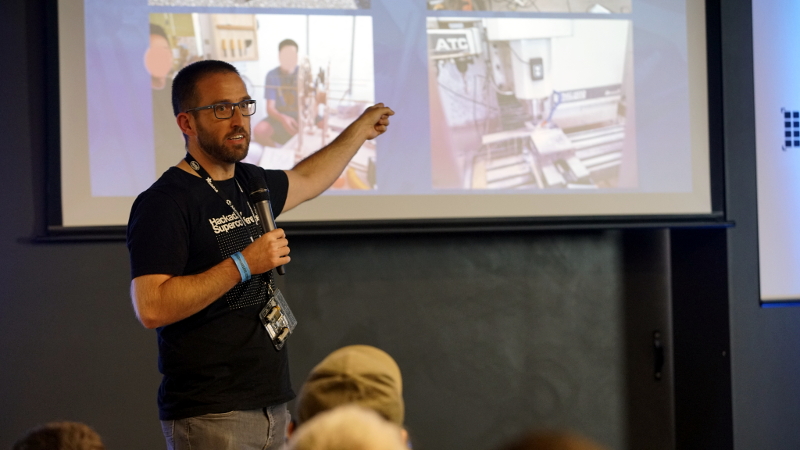
High voltage has a special talent for making even confident makers suddenly remember every safety rule they have ever heard. It hums, arcs, bites, and, if treated casually, can turn a clever weekend project into a very expensive lesson with smoke effects. That is why Scott Swaaley’s work and public talks on high-power line-voltage circuits remain useful for engineers, shop owners, educators, and curious hardware builders who want to understand the difference between “it works on the bench” and “it works safely around real people.”
The title “Scott Swaaley On High Voltage” points to Swaaley’s appearance in the maker and engineering community, especially his discussion of designing high-power line-voltage circuits for motor braking and machine safety. His story is not about chasing sparks for drama. It is about learning how AC mains, induction motors, braking circuits, relays, PCB spacing, certification, and human behavior all collide in the real world. In other words, it is about electricity leaving the comfort of the breadboard and entering the land of spinning blades, wall outlets, and liability paperwork.
Scott Swaaley is a licensed professional engineer, educator, maker, and founder of MAKESafe Tools, a company focused on machine safeguards such as motor braking, emergency stop systems, and accidental restart protection. His background includes electrical engineering, renewable energy, student makerspaces, and practical shop work. That combination matters because high-power electrical design is not just math. It is also judgment, training, product design, and respect for what happens when moving machinery refuses to stop quickly.
Who Is Scott Swaaley?
Scott Swaaley is best known in maker and industrial safety circles as the founder of MAKESafe Tools. Before that, his career blended engineering, education, and hands-on fabrication. He worked around electrical infrastructure, renewable energy projects, tool-filled learning spaces, and student engineering programs. That mix gave him a rare point of view: he understood both the technical side of electricity and the messy human side of workshops.
That human side is where many safety problems begin. A machine may be designed correctly, but a distracted user can still reach too soon, restart a tool unexpectedly, or assume a blade has stopped when it is still coasting. Swaaley’s work focuses on reducing that gap between what a machine is doing and what a person thinks it is doing. A bench grinder that spins for a minute after shutdown may seem harmless until someone changes position, reaches for a workpiece, or teaches a room full of students who are still developing safe habits.
Instead of treating safety as a warning sticker and a lecture, Swaaley approached it as an engineering problem. What if existing machines could be upgraded with plug-and-play safeguards? What if a tool could stop faster without replacing the entire machine? What if a small shop, school, makerspace, or factory could add emergency stop, restart prevention, and motor braking to equipment that was built long before modern expectations?
What “High Voltage” Means in This Conversation
Strictly speaking, many standards define high voltage above thresholds such as 1,000 volts AC or 1,500 volts DC. In everyday maker language, however, people often use “high voltage” to mean anything beyond low-voltage electronics: 120-volt or 240-volt AC mains, large capacitors, motor circuits, and power electronics that can deliver dangerous current. Swaaley’s topic is really high-power line-voltage design: circuits connected to the wall, controlling motors, handling stored energy, and surviving real loads.
That distinction is important for SEO readers and real-world builders alike. A microcontroller running at 3.3 volts can be forgiving. A breadboard jumper in the wrong hole may cause a reset, a hot chip, or a brief moment of embarrassment. A line-voltage motor-control circuit is different. It can shock a person, start a machine, weld contacts, throw sparks, or damage equipment. The energy available from the wall is not impressed by optimism.
This is the heart of Swaaley’s lesson: modern electronics has made low-voltage development wonderfully accessible, but that convenience can hide the old skills required for mains-powered design. Many makers can program a sensor, design a small PCB, and order parts overnight. Fewer have deep practice with creepage and clearance, relay contact ratings, inductive kickback, ground bonding, enclosure design, thermal behavior, certification, and fault testing.
The Problem That Started With a Bandsaw
One of the memorable parts of Swaaley’s story involves a school workshop and a bandsaw. A bandsaw does not become safe the instant the switch is turned off. The motor loses power, but the blade still has inertia. It keeps moving, sometimes long enough for a person to forget the danger. In a professional shop, that is a risk. In a school environment, where beginners are learning both technique and caution, it becomes an even bigger concern.
The obvious question was simple: can the machine stop faster? The engineering answer was not quite so simple. Stopping an induction motor requires dealing with moving mass, magnetic fields, heat, line voltage, switching devices, and the machine’s mechanical design. A braking system has to be effective without abusing the motor, loosening parts, damaging components, or creating a new hazard while solving the old one.
Motor braking is attractive because it addresses the “coast-down” problem directly. Instead of waiting for friction to slowly drain energy from a spinning tool, a braking circuit can help convert rotational energy into heat in a controlled way. But controlled is the key word. The braking current must be managed. The duty cycle matters. The machine must be compatible. The user must calibrate the device correctly. This is why Swaaley’s work is more interesting than a simple gadget story. It is a case study in engineering discipline.
Why AC Line Voltage Still Intimidates Smart People
AC mains voltage has become strangely invisible. Many modern projects run through USB adapters, battery packs, certified power bricks, and low-voltage modules. That is good for safety, but it also means many capable builders rarely touch the dangerous parts. They may understand Ohm’s law and still be underprepared for a board that switches an induction motor from a wall outlet.
Line-voltage circuits demand a different mindset. The design must consider what happens when a wire comes loose, a relay welds shut, a user plugs in the wrong machine, a motor stalls, a surge hits the input, or dust collects inside an enclosure. Failure modes are not theoretical. They are the real plot twists in electrical design, and they do not wait politely for a second revision.
For example, a relay that works on a resistive load may fail quickly when switching an inductive motor. A PCB trace that looks generous for a signal circuit may be unacceptable for current-heavy power paths. A small isolation gap that seems fine at 5 volts can become a shock or arc risk at mains voltage. The lesson is not “never build power electronics.” The lesson is “build them as though physics has a lawyer.”
Key Lessons From Swaaley’s High-Power Design Approach
1. Separate Low-Voltage Controls From Dangerous Power
Good motor-control design often divides the world into zones. On one side are buttons, sensors, logic circuits, and user interfaces. On the other side are relays, motor conductors, line voltage, and high current. The boundary between those worlds should be clear, intentional, and protected by proper isolation.
This is why galvanic isolation, optocouplers, isolated supplies, physical spacing, and careful PCB layout matter. A low-voltage control circuit should not become energized because a power-side failure found a convenient path across the board. The PCB is not a suggestion board; it is a safety-critical structure.
2. Respect Creepage, Clearance, and Air Gaps
One of the overlooked parts of high-power PCB design is the space between conductors. Clearance is the shortest distance through air. Creepage is the path along the surface of an insulating material. Both matter because voltage can jump, track, or arc when spacing is inadequate, especially in dirty, humid, or industrial environments.
Designers who come from low-voltage electronics may be tempted to pack everything tightly. That works beautifully until it does not. In mains-powered equipment, empty space is not wasted space. It is insulation doing its quiet, underappreciated job. Sometimes the safest feature on a circuit board is literally nothing.
3. Inductive Loads Are Sneaky
Motors, solenoids, transformers, and coils store energy in magnetic fields. When switched off, that energy has to go somewhere. If the designer does not provide a safe path, the circuit may create one through arcing contacts, voltage spikes, semiconductor failure, or electromagnetic noise.
This is why snubbers, suppression devices, properly rated relays, and thoughtful switching strategies are essential. A motor is not just a “thing that turns.” Electrically, it is a dynamic load with personality. Sometimes that personality is charming. Sometimes it throws a voltage spike across the room like a tiny electrical tantrum.
4. Braking Must Match the Machine
A motor brake is not magic. It must be compatible with the machine, motor type, voltage, horsepower, mechanical load, and duty cycle. A system that works well on a bench grinder may not be appropriate for every lathe, saw, or custom machine. Calibration matters because braking too aggressively can increase stress, while braking too weakly may not solve the safety problem.
Swaaley’s public comments and MAKESafe guidance emphasize practical limits: do not brake a machine faster than it starts, follow instructions, and consider the mechanical design. That is the difference between engineering and wishful thinking. A good safety device should reduce risk without pretending all machines are identical.
MAKESafe Tools and the Practical Side of Safety
MAKESafe Tools grew from a real problem: older machines are everywhere, and many still do useful work. Replacing every legacy tool is expensive, wasteful, and often unnecessary. But leaving those machines without modern safety features can expose users to avoidable hazards. Swaaley’s company targets that middle ground by offering safeguards that can be added to existing equipment.
The company’s power tool brake systems are designed to provide motor braking, emergency stop functionality, and accidental restart protection for compatible stationary machines. The value is not only that the machine stops faster. It is that the system helps address multiple failure scenarios. A machine should not restart unexpectedly after a power interruption. A stop button should be easy to hit. A spinning cutter should not coast forever while everyone pretends patience is a safety strategy.
For schools, makerspaces, and small shops, this approach has obvious appeal. These environments often contain mixed skill levels, older equipment, and busy schedules. A safety upgrade that installs without rebuilding the machine can be far more realistic than a complete equipment replacement plan. It also reinforces a culture where safety is built into the system instead of taped to the wall in 14-point font.
How OSHA, UL, and Real-World Standards Fit In
Electrical safety is not only about good instincts. In workplaces, it is shaped by standards, regulations, inspections, and accepted best practices. OSHA’s lockout/tagout rules address the control of hazardous energy during service and maintenance. OSHA electrical work-practice rules also emphasize de-energizing exposed live parts unless specific exceptions apply. These concepts matter because machines can hurt people not only while running, but also while being adjusted, serviced, or unexpectedly energized.
UL standards and Nationally Recognized Testing Laboratory evaluation add another layer. For industrial control equipment, listing and certification are not decorative badges. They help verify that a product has been evaluated for safety-related construction, ratings, temperature, spacing, enclosures, and abnormal conditions. For a company building motor-control equipment, that process can be demanding, but it is part of moving from clever prototype to responsible product.
This is where Swaaley’s story is especially useful for entrepreneurs. Many hardware founders can build a working prototype. Fewer understand what it takes to make a product that can be sold, installed, trusted, and supported in industrial or educational settings. High-power hardware is not a software app with a nicer enclosure. It has to survive users, inspectors, dust, heat, vibration, and the occasional person who thinks instructions are a personality test.
Why This Topic Matters for Modern Makers
“Scott Swaaley On High Voltage” remains relevant because the maker movement has matured. People are no longer only blinking LEDs and printing small plastic brackets. They are building CNC machines, electric vehicles, robotic systems, shop tools, battery systems, solar projects, and automation equipment. The energy levels are rising, and the safety expectations must rise with them.
There is nothing wrong with learning by building. In fact, that is one of the best ways to learn. But line voltage and high-power circuits require humility. A good builder asks uncomfortable questions early: What happens if this relay fails closed? Is the enclosure grounded? Can a user touch a live part? What rating does this connector actually have? How will the circuit behave with a stalled motor? What happens after five years of dust?
Swaaley’s example encourages builders to bridge the gap between curiosity and competence. Watch talks. Read standards. Ask experienced electricians and engineers. Use listed components. Test under realistic conditions. Do not assume that a circuit is safe because it worked once. A toaster also works once if you plug it in underwater, but that is not a design philosophy.
Specific Examples: From Bench Grinder to Band Saw
Consider a bench grinder. After shutdown, the wheels may keep spinning. If the user assumes the machine is safe and reaches too soon, the hazard remains. A braking system can shorten that coast-down period, while an emergency stop gives the operator a clearer way to command the machine to stop. Add restart protection, and the grinder is less likely to come back to life unexpectedly after a power interruption.
Now consider a band saw in a school shop. The blade is long, exposed at the cutting zone, and intimidating for beginners. The instructor can repeat “wait until it stops” all day, but a faster stop provides a stronger safety margin. The machine still requires guarding, training, supervision, and good procedures, but engineering controls make the safe behavior easier to maintain.
A disc sander offers another example. Large rotating mass can store energy, and users often work close to the abrasive surface. A motor brake that is properly selected and calibrated can reduce waiting time and lower exposure after shutdown. In a busy shop, shaving down coast time can also improve workflow. Safety and productivity are not enemies; they are often the same idea wearing different hard hats.
Common Mistakes When Working With High-Power Circuits
Using Underrated Components
A switch rated for one type of load may not be suitable for another. AC ratings, DC ratings, resistive loads, inductive loads, horsepower ratings, and contact life all matter. The label on a component is not fine print. It is a warning from future you.
Ignoring Heat
High current creates heat, and heat changes everything. It affects wire insulation, relay contacts, semiconductor performance, enclosure temperature, and long-term reliability. A prototype that survives a short test may still fail under repeated braking cycles or continuous industrial use.
Treating Grounding as Optional
Grounding and bonding are not decorative. They help provide a fault path and reduce shock risk. Metal enclosures, exposed conductive parts, strain relief, and protective earth connections deserve careful attention.
Skipping Documentation
Safe equipment needs clear instructions, ratings, maintenance guidance, warning labels, and compatibility information. A brilliant circuit with confusing instructions can still be dangerous. Humans are part of the system, and humans are famously creative at misunderstanding things.
Experience-Based Lessons Related to Scott Swaaley On High Voltage
One practical experience that reflects Swaaley’s topic is the moment a builder moves from small electronics to a real shop machine. On a low-voltage project, the workbench feels friendly. A multimeter, a USB cable, a few jumper wires, and a cup of coffee can carry the day. With line-voltage machinery, the mood changes. The first time you open a control box and see heavy-gauge conductors, contactors, strain reliefs, grounding lugs, and warning labels, you realize the project has entered grown-up territory. The coffee may remain, but it is no longer the most dangerous liquid in the room.
In a typical makerspace, the difference between theory and reality appears quickly. A bench grinder may look simple: switch on, wheels spin, sparks fly, switch off. But watch new users and you notice the awkward seconds after shutdown. Some step away safely. Some lean in. Some start cleaning the area while the wheel is still moving. That is where engineering controls become more persuasive than speeches. A brake does not replace training, but it reduces the window in which a normal human mistake becomes an injury.
Another lesson comes from troubleshooting. Suppose a motor-control prototype works perfectly on the bench with a test lamp. Then someone connects an induction motor, and suddenly the relay chatters, the board resets, or a voltage spike causes strange behavior. That experience teaches a builder that motors are not lamps. They have inrush current, inductive energy, mechanical load, and electrical noise. The fix may involve better suppression, improved layout, a different relay, stronger isolation, or a complete redesign. It is humbling, but useful. High-power circuits are excellent teachers because they grade instantly.
Documentation also becomes more important with experience. In a shared shop, nobody remembers the designer’s assumptions. Users need labels that explain voltage, horsepower limits, compatible machines, calibration steps, and emergency procedures. Maintenance staff need to know what can be serviced and what must be replaced. Instructors need to know how to teach the system without turning every class into an electrical engineering seminar. A safe product is not only a box with components. It is a complete communication system.
Finally, Swaaley’s topic highlights the value of humility. The smartest person in the room is often the one who says, “Let’s check the standard,” “Let’s ask a qualified electrician,” or “Let’s test that failure mode before shipping it.” High voltage and high-power line-voltage circuits reward patience. They punish assumptions. The best experience a maker can gain is not fear, but respect: respect for energy, respect for standards, respect for users, and respect for the fact that machines do not care how clever the schematic looked at midnight.
Conclusion
Scott Swaaley’s high-voltage story is really a story about responsible making. It begins with a practical workshop problem: machines keep moving after the switch is off. It grows into a deeper lesson about AC line voltage, motor braking, safety controls, PCB design, certification, and the gap between a working prototype and a trustworthy product. For engineers, educators, shop managers, and makers, the message is clear: power deserves respect, and safety deserves design time.
The best part is that this is not a gloomy warning against building ambitious projects. It is the opposite. Swaaley’s work shows that serious electrical design can make old machines safer, classrooms better, and workshops more productive. High-power circuits are challenging, but with proper isolation, spacing, ratings, testing, documentation, and humility, they can solve real problems. The sparks may get the attention, but the engineering keeps the fingers attached. That is a pretty good trade.












