
Hollywood loves a good rewrite. A superhero needs a better joke. A spy thriller needs a bigger explosion. A monster movie needs more monster and slightly fewer people explaining monster insurance. But sometimes the notes do not come from a studio executive in sunglasses. Sometimes they come from a government office, a military liaison, an intelligence agency, or a foreign censorship board holding the world’s least fun red pen.
The result is one of the strangest behind-the-scenes traditions in modern movies: government-requested movie changes. These can be tiny, like swapping a line of dialogue. They can be enormous, like digitally changing an entire invading army. And they can be hilarious in a bureaucratic way, like asking a blockbuster to clarify who exactly a fictional spy organization reports to when aliens attack Manhattan.
To be clear, not every government note is censorship in the same form. The U.S. Department of Defense often offers access to bases, aircraft, ships, uniforms, and technical advisers in exchange for script review. The CIA and FBI have also worked with entertainment productions to influence how their agencies appear. Meanwhile, countries with formal film censorship systems can require edits before a movie reaches local theaters. Different systems, same basic message: “Nice movie you’ve got there. Shame if the paperwork got complicated.”
Here are 12 weird, real, and very revealing changes governments asked for in movies.
1. Top Gun: The Navy Helped Turn a Rule-Breaking Romance Into a Regulation-Friendly One
Top Gun is often treated as the ultimate movie-military partnership: jets, carriers, aviator sunglasses, and Tom Cruise smiling like he personally invented Mach speed. But that access came with script influence from the U.S. Navy.
One of the odder changes involved Maverick’s love interest. Earlier versions reportedly had him involved with a female enlisted member of the Navy. That created a problem because officer-enlisted relationships violate military rules. So the character became Charlotte “Charlie” Blackwood, a civilian contractor and instructor. In other words, the movie kept the romance but filed off the fraternization violation. Romance: saved. Regulations: less angry.
The Navy also influenced other details, including moving hostile action away from Cuba and toning down parts of the script that made naval operations look sloppy or unsafe. The final movie still features plenty of recklessness, but it is the glamorous kind of recklessness: the sort where everyone has perfect hair and the aircraft carrier looks like a floating recruitment poster.
2. Top Gun: Maverick: The Bar Could Not Be Called “Captain’s Mast”
Decades later, Top Gun: Maverick also received detailed Navy feedback. Some of it was practical aviation realism. Some of it was pure military vocabulary policing, which is somehow funnier.
In an early version, the pilots’ hangout was reportedly called “The Captain’s Mast.” To civilians, that sounds like a rugged nautical bar where someone named “Moose” sells wings. To sailors, however, captain’s mast is a disciplinary proceeding. It is not where you go to flirt, play pool, and sing at emotionally vulnerable pilots. It is where you go when the Navy is unhappy with you.
Navy advisers suggested changing the name, and the bar became The Hard Deck. They also pushed back on locker-room scenes because post-flight locker-room bonding was not considered realistic for naval aviation. The change is wonderfully specific: the Navy was willing to let Tom Cruise fly through cinematic insanity, but it drew a line at inaccurate locker-room vibes.
3. Independence Day: Remove Area 51, Please
The 1996 alien-invasion classic Independence Day feels like exactly the kind of movie the U.S. military would love: brave pilots, patriotic speeches, and aliens getting introduced to American airpower with extreme prejudice. Yet the Department of Defense reportedly pulled back support because the filmmakers refused to remove references to Area 51.
The government’s position was essentially: yes to aliens, yes to fighter jets, yes to saving Earth, but please stop talking about the secret desert base associated with UFO lore. The filmmakers declined, and the movie kept its Area 51 storyline, complete with preserved alien bodies and a cranky scientist who seems like he has been living on caffeine and classified documents.
The irony is delicious. A movie about giant spacecraft vaporizing major cities apparently became too sensitive when it suggested the government might not be fully transparent about extraterrestrial weirdness. Apparently, aliens are fine. Bureaucratic embarrassment? Now that is dangerous.
4. Zero Dark Thirty: The CIA Asked for Torture-Scene Adjustments
Zero Dark Thirty, Kathryn Bigelow’s film about the hunt for Osama bin Laden, became controversial partly because of its depiction of interrogation and torture. Behind the scenes, CIA communications showed that agency representatives had input on elements of the script.
Among the requested changes: the protagonist Maya was reportedly shifted from actively participating in an early waterboarding scene to observing it. A scene involving a dog used in interrogation was also removed from the shooting script. These may sound like small staging changes, but they affect how audiences interpret moral responsibility. Is a character doing something? Watching something? Objecting? Learning? In a movie about national security, those differences are not tiny; they are the whole ethical battlefield.
The weirdness here is not that an intelligence agency cared about its image. Of course it did. The weirdness is watching a spy agency become, in effect, a script consultant on how spy-agency behavior should look in a prestige drama. Somewhere, a screenwriting professor just spilled coffee.
5. Tomorrow Never Dies: A Vietnam War Joke Had to Go
James Bond movies are not documentaries, unless British intelligence really does solve global crises with tuxedos, exploding pens, and one-liners delivered during property damage. Still, the Pentagon has cared about Bond scripts when U.S. military cooperation was involved.
In Tomorrow Never Dies, a line connected to Bond’s parachute jump into Vietnam reportedly created discomfort. The original dialogue suggested, with dark humor, that if things went wrong, it might mean war againand “maybe this time” the United States would win. The Pentagon did not find this cute. The line was removed.
It is a strange example because Bond is a British fantasy franchise, not a U.S. military drama. But the note shows how sensitive official advisers can be about historical memory. Even in a movie where a media billionaire tries to engineer World War III for ratings, a Vietnam punchline was apparently a bridge too far.
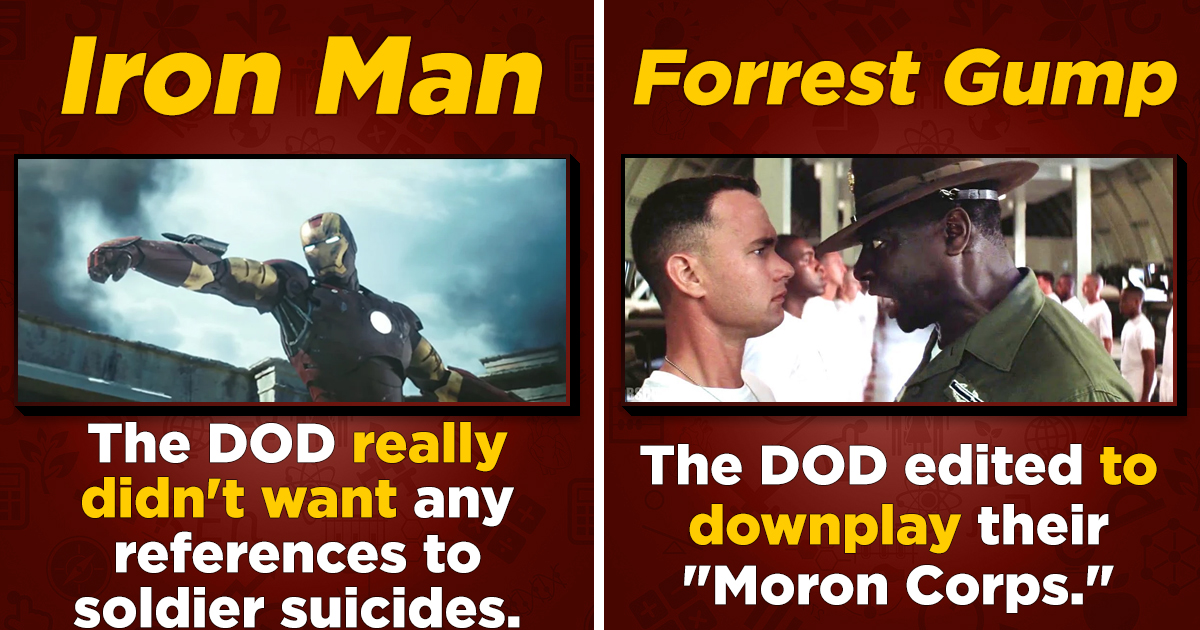
6. Iron Man: The Pentagon Objected to a Dark Line About Opportunity
Iron Man helped launch the Marvel Cinematic Universe, and it also benefited from U.S. military cooperation. Real bases, aircraft, uniforms, and procedures gave the film a polished military texture. In exchange, the script went through the Pentagon’s review process.
One reported issue involved a line during scenes at Edwards Air Force Base. A military officer says people would “kill themselves” for the opportunities Tony Stark has. Pentagon liaison Phil Strub reportedly objected, and the line did not survive in that form. It is a small edit, but it shows how carefully official reviewers watch tone. The military can appear tough, sarcastic, and occasionally annoyed at Tony Starkbut not casually associated with suicide as a throwaway joke.
The funny part is that Iron Man is about a billionaire weapons maker who builds a flying armored suit in a cave, then starts a one-man foreign policy program. But even in that comic-book thunderstorm, one awkward line was too much paperwork.
7. Eagle Eye: Add an Air Force Investigator, Make the Drone Look Cool
The 2008 techno-thriller Eagle Eye involves surveillance, terrorism scares, artificial intelligence, and Shia LaBeouf being chased by nearly everything except student loans. The Pentagon provided access to the MQ-9 Reaper drone, and Air Force representatives were involved in shaping parts of the production.
One notable result was the development of Special Agent Zoe Perez, played by Rosario Dawson, an Air Force Office of Special Investigations character. Air Force officials described helping with story development, dialogue, wardrobe, training, and authenticity. The character helped present the Air Force as actively involved in counterterrorism and national security work.
That is not a tiny prop note. That is a character-level image note. The government did not merely say, “The badge goes on the left.” It helped build a role that positioned the Air Force inside the movie’s hero machinery. Subtle? Not exactly. Effective? Absolutely.
8. The Avengers: The Pentagon Needed to Know Who S.H.I.E.L.D. Worked For
Of all government movie disputes, this one may be the nerdiest. The Pentagon reportedly stopped cooperating with Marvel’s The Avengers because it could not reconcile the chain of command around S.H.I.E.L.D., the fictional organization led by Nick Fury.
Was S.H.I.E.L.D. American? International? Above governments? Working with the military? Supervising it? Borrowing aircraft without asking? The Pentagon wanted clarity. Marvel had superheroes, gods, a flying helicarrier, and a rage monster in purple pants, but the Department of Defense hit the brakes over organizational bureaucracy.
This is deeply funny and also revealing. Government cooperation is not only about whether tanks look heroic. It is also about institutional hierarchy. Even in a comic-book universe, official agencies want to know: who answers to whom, who gets credit, and who looks like the adult in the room when the sky opens and aliens fall out.
9. Red Dawn: China Became North Korea After the Movie Was Shot
The Red Dawn remake originally imagined a Chinese invasion of the United States. Then commercial reality arrived wearing a censor’s badge. To avoid angering China and to preserve hopes for international marketability, the filmmakers changed the villains from Chinese to North Korean in post-production.
This was not a simple script tweak. It required digital changes to flags, symbols, dialogue, and visual details. The actors remained the same, but the geopolitical identity of the invading force was swapped out like a suspiciously expensive Halloween costume.
The change is one of Hollywood’s most infamous examples of China-related self-censorship. It also produced a plot that made far less strategic sense. China as a superpower invasion threat was politically sensitive. North Korea invading and occupying large parts of America was, generously, a stretch requiring the audience to put logic in airplane mode.
10. Mission: Impossible III: Shanghai Laundry Was Too Embarrassing
Mission: Impossible III included Shanghai scenes designed to give the film international spectacle. But Chinese censors reportedly objected to imagery that made the city look backward or unflattering, including laundry hanging outdoors.
Yes, in a movie about secret weapons, kidnappings, masks, and Tom Cruise sprinting with the urgency of a man who left his oven on, the objection was laundry. The concern was not that Ethan Hunt was doing impossible spy things in China. It was that viewers might see clotheslines and think Shanghai lacked polish.
This is the kind of censorship note that sounds tiny until you realize what it represents. National image management can operate at the level of flags, politics, military history, and yes, underwear drying in the background. Cinema is visual, and governments know it. A skyline can sell modernity. A clothesline can apparently start a meeting.
11. Men in Black 3: Chinese Aliens and Memory Wipes Had to Disappear
In the Chinese release of Men in Black 3, censors cut scenes involving aliens disguised as Chinese restaurant workers, along with a moment in which Chinese bystanders are “neuralyzed,” meaning their memories are erased.
On the surface, the edits removed potentially offensive imagery. But local commentary also suggested the memory-wipe gag could be read as a touchy metaphor for censorship or social control. That is a remarkable fate for a Will Smith alien comedy. One minute you are making a joke about space weirdos in Chinatown; the next, the joke is too close to a political theory seminar.
The altered version shows how comedy can become risky when symbols collide with national identity. A scene meant as slapstick may look different to censors trained to ask, “Could this be interpreted as an insult, criticism, or meme?” In authoritarian media systems, even a sci-fi gadget can become suspicious.
12. Skyfall: Bond Could Not Kill a Chinese Guard on Chinese Screens
James Bond finally got a major China release with Skyfall, but Chinese censors altered several elements. A scene in which a hitman kills a security guard in Shanghai was reportedly cut. References to prostitution in Macau were removed or softened, and subtitles were changed around politically sensitive dialogue involving torture by Chinese security agents.
These edits did not destroy the movie, but they did change its texture. Skyfall is partly about damaged agents, institutional secrets, and the moral cost of intelligence work. Removing uncomfortable local references makes the world feel cleaner and less dangerous in precisely the places where the film wanted shadows.
It is also classic Bond irony. The franchise has spent decades imagining international intrigue, corrupt officials, and secret violence. But when the fictional danger touched real-world political sensitivities, even 007 had to surrender a few minutes at the border.
Why Governments Care So Much About Movie Details
Government-requested movie changes can look silly one by one. A bar name here. A laundry shot there. A line about Vietnam deleted before Bond can make it awkward. But together, they reveal a serious truth: movies are not just entertainment. They are image machines.
For the U.S. military, Hollywood offers something recruiting ads cannot always deliver: emotional glamour. A two-hour blockbuster can make a jet, a uniform, or a mission feel heroic in a way no brochure can match. That is why access to real equipment matters. A real aircraft carrier is expensive, powerful, and persuasive. If filmmakers want it, the government gets leverage.
For intelligence agencies, the stakes are different but related. The CIA, FBI, and similar agencies live in a fog of secrecy, scandal, mythology, and public suspicion. If a movie portrays them as competent, ethical, and essential, that helps shape public imagination. If a movie portrays them as reckless or cruel, officials may push back. Sometimes the agency wants accuracy. Sometimes it wants reputation management. Often, it wants both, preferably with flattering lighting.
For foreign censorship boards, the goal is frequently national image control. A government may object to crime, sex, LGBTQ content, political criticism, supernatural themes, historical references, or anything that makes the country look weak, poor, corrupt, divided, or insufficiently majestic. In that environment, a movie is not just a movie. It is a diplomatic object wearing popcorn butter.
Experience Section: Watching Movies After You Know the Government Had Notes
Once you learn how often official agencies have nudged, polished, trimmed, or redirected movies, watching blockbusters becomes a different experience. You start noticing the seams. A military character is not just “the military character” anymore. You wonder whether that line sounded more cynical in an earlier draft. You notice when a government agency is heroic but never institutionally messy. You notice when a fictional country is named vaguely, when a villain’s nationality feels oddly convenient, or when a movie seems terrified of offending a market larger than its own courage.
The strangest part is that many of these changes are not obvious during a casual viewing. A viewer watching Top Gun may not think, “Ah yes, this romance has been carefully modified to avoid officer-enlisted fraternization.” They just see chemistry, motorcycles, and beach volleyball with the intensity of an Olympic event. A viewer watching Mission: Impossible III probably does not pause to wonder whether the laundry in Shanghai survived a censorship review. They are too busy watching Tom Cruise sprint through frame like cardio has become a religion.
But these invisible edits matter because they shape what becomes normal. If the military is almost always shown as professional, brave, and self-correcting, audiences absorb that. If intelligence agencies are portrayed as troubled but ultimately necessary guardians, that impression sticks. If foreign markets can encourage Hollywood to avoid Tibet, Taiwan, Chinese villains, LGBTQ relationships, or politically sensitive dialogue, then global viewers receive a cleaner, safer, more commercially engineered version of reality.
That does not mean every government-assisted movie is propaganda or every censored release is artistically worthless. Some filmmakers use official help and still make thoughtful work. Some technical advisers genuinely improve realism. A pilot explaining cockpit procedure can save a scene from looking ridiculous. A military consultant can prevent a uniform mistake that would make veterans groan into their popcorn. Accuracy has value.
The problem begins when “accuracy” quietly becomes “image control.” There is a difference between saying, “That aircraft does not operate that way,” and saying, “Please remove the scene where our institution looks bad.” There is also a difference between translating a movie for another culture and cutting out anything that might make a powerful government uncomfortable. One improves communication. The other gives politics a pair of scissors.
For writers, critics, and movie fans, the best response is not paranoia. It is curiosity. Ask who provided access. Ask what the filmmakers received. Ask what changes were made, rejected, or hidden. Ask why a scene feels oddly sanitized. Ask why a villain changed nationality. Ask why a movie can show aliens destroying cities but somehow cannot show a piece of laundry in Shanghai.
Movies are collaborative by nature. Directors, studios, actors, advertisers, investors, governments, and international markets all tug on the final product. That does not make cinema less fascinating. It makes it more fascinating. A blockbuster is not only a story on screen; it is a negotiation behind the screen. Sometimes that negotiation produces better realism. Sometimes it produces a North Korean invasion of America that makes less sense than a microwave with a Twitter account.
So the next time a movie feels unusually polished in its portrayal of power, remember: somebody may have sent notes. Maybe the studio. Maybe the Navy. Maybe the CIA. Maybe a censorship board. Maybe all of them, standing around the script like it is a suspicious package. And somewhere, some poor screenwriter had to decide whether the alien invasion was worth losing the aircraft carrier.
Conclusion
The weirdest government-requested movie changes are funny because they are so specific, but they are important because they expose how entertainment, politics, and money quietly work together. A changed bar name, a deleted torture detail, a softened subtitle, a swapped villain, or a vanished piece of laundry can reveal an entire system of influence.
Hollywood sells fantasy, but governments understand fantasy very well. They know that movies help define heroes, villains, institutions, nations, and history in the public imagination. That is why the battle over small details can become surprisingly intense. In cinema, a line of dialogue can be a diplomatic problem. A costume patch can be a geopolitical signal. A background clothesline can be a national-image crisis. Weird? Absolutely. Accidental? Not even close.
Note: This article is based on publicly documented reporting, official statements, production accounts, and censorship records related to government involvement in film development, review, and release decisions.











