
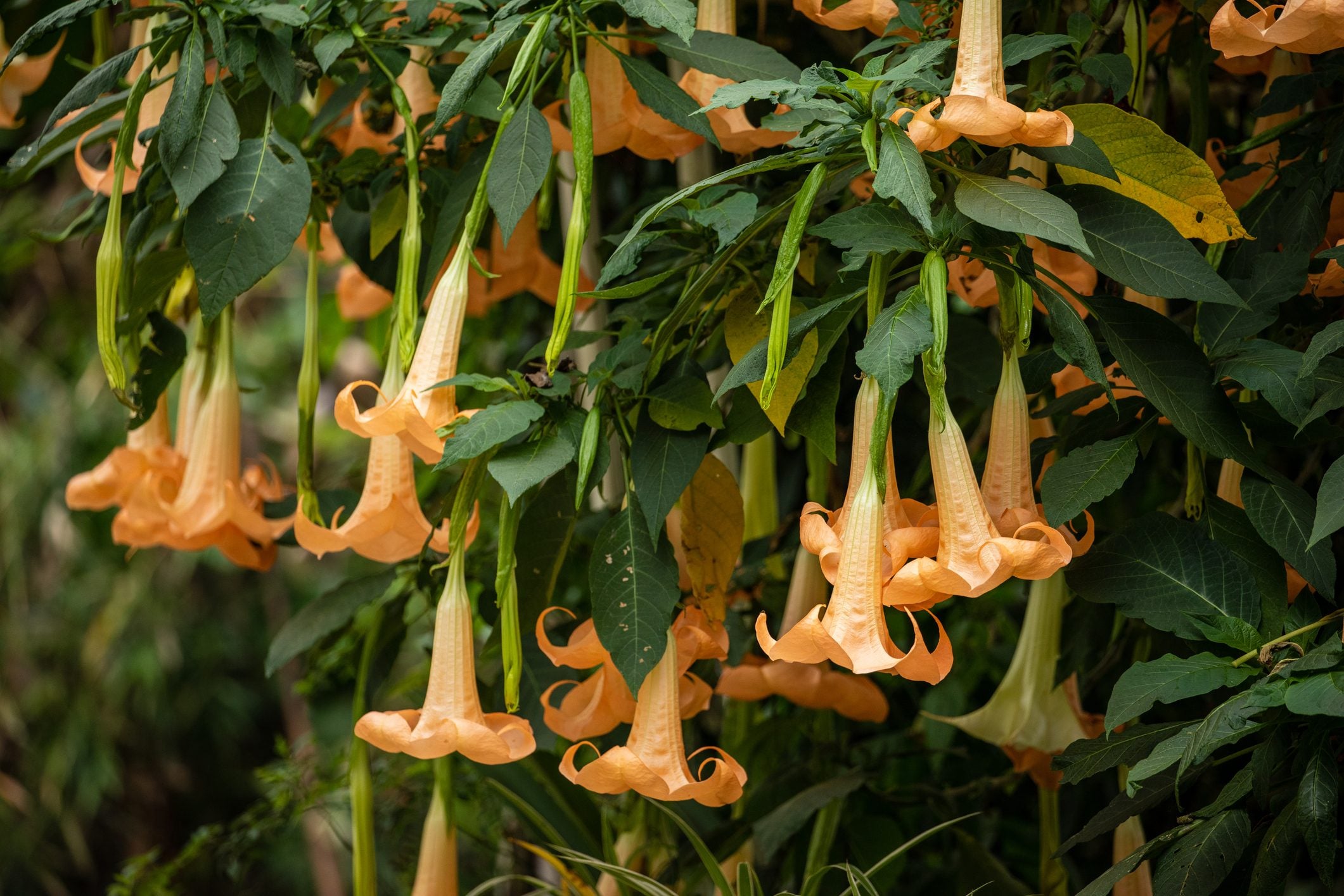
Some plants are tasteful. Some are elegant. Others appear to have escaped from an illustrated book after ignoring several firm instructions from the editor.
They grow pom-pom flowers, twist themselves into botanical corkscrews, disguise themselves as rocks, and balance enormous purple spheres on stems that seem far too skinny for the assignment. These unusual plants prove that nature does not always design with a ruler. Sometimes, it apparently grabs a box of crayons, invents three new shapes, and sees what happens.
The comparison with Dr. Seuss is especially fitting because his fictional landscapes often reflected real ecological forms. Researchers have even suggested that the spindly Truffula trees in The Lorax may have been influenced by East African whistling thorn acacias. Scientists have also described a roughly 350-million-year-old fossil tree with such an unusual crown that it earned a “Dr. Seuss tree” nickname. Reality, as usual, was already being weird before fiction arrived.
Why Do Some Plants Look So Fantastical?
Strange plant shapes are rarely strange just for decoration. A bizarre silhouette may help a species conserve water, collect fog, discourage hungry animals, attract a particular pollinator, survive strong coastal winds, or blend into rocky ground. What looks like botanical comedy to us is often a serious survival strategy.
That does not make these plants any less delightful. From fuzzy pink groundcovers to ancient desert oddities, here are ten plants that look as though nature hired a children’s-book illustrator.
1. Powderpuff Mimosa
Mimosa strigillosa
If Truffula trees had tiny cousins that preferred crawling across lawns, they might look exactly like powderpuff mimosa. This low-growing native groundcover produces round pinkish-purple flowers that resemble miniature pompoms, fuzzy fireworks, or cotton candy served on very short sticks.
Each puff is actually composed of numerous stamens dusted with yellow pollen. Bees regularly visit the flowers, making the plant more than a visual novelty. Its delicate green leaflets also fold when touched and close naturally in the evening, adding a small theatrical performance to an already playful appearance.
Powderpuff mimosa is native to the Gulf Coast and parts of the southern United States. It spreads along the ground rather than developing into the invasive mimosa tree with which it is sometimes confused. In suitable warm climates, it can function as a low-maintenance groundcover while supporting pollinators. Essentially, it is a living pink carpet that occasionally applauds itself.
2. Giant Coreopsis
Leptosyne gigantea
Giant coreopsis looks like a bouquet that grew legs, moved to the California coast, and decided never to explain itself. Its thick, branching stems rise from the ground like pale wooden plumbing pipes. At their tips sit shaggy clusters of green foliage, often crowned with cheerful yellow flowers.
The plant is associated with California’s Channel Islands and coastal bluffs. It grows during the cooler, wetter part of the year and typically enters dormancy as summer conditions become dry. When dormant, its bare structure can look even strangera wiry sculpture waiting for somebody to switch the leaves back on.
California State University Channel Islands describes giant coreopsis as looking like something Dr. Seuss might have drawn, which is probably the highest possible honor for an eccentric coastal perennial. Its architecture also demonstrates how plants in seasonally dry environments can concentrate foliage where it is most useful and then shut down when conditions become unfavorable.
3. Monkey Puzzle Tree
Araucaria araucana
The monkey puzzle tree resembles a prehistoric umbrella assembled from green bottle brushes, armored cables, and the tail of an imaginary reptile. Its stiff branches emerge in organized tiers, while overlapping, sharply pointed leaves cover the stems so completely that the tree appears to be wearing chain mail.
Native to the Andes of Chile and Argentina, this evergreen conifer is sometimes called a living fossil because of its ancient lineage and primitive-looking form. Young trees tend to be pyramidal, while mature specimens develop broader, umbrella-like crowns. They can eventually reach substantial heights, so planting one beside a tiny suburban patio may be less “whimsical garden” and more “long-term infrastructure decision.”
The tree’s edible, nutlike seeds have traditionally been gathered by Indigenous communities in its native region. Despite its comical common name, the species has serious cultural and conservation importance. Its wonderfully rigid silhouette simply happens to look as if it should be inhabited by creatures wearing striped hats.
4. Dragon Tree
Dracaena draco
Most trees form branches. The dragon tree appears to construct a giant green mushroom cloud, one slow-motion fork at a time.
Its bare limbs divide repeatedly and support dense clusters of sword-shaped leaves, eventually creating a wide umbrella crown. The ridged trunk can resemble a scaly animal leg, while cuts in the bark may release a dark red resin traditionally called dragon’s blood. With a name, shape, and resin like that, this tree was never going to be described as “pleasantly ordinary.”
Dragon trees grow slowly. According to the San Diego Zoo, a tree may take approximately 30 years to reach maturity, with flowering and branching occurring at long intervals. That gradual pattern produces the species’ dramatic, symmetrical canopy.
The tree is native to parts of Macaronesia and northwestern Africa, including the Canary Islands. Wild populations face habitat pressure, although the species is also cultivated as a landscape and container plant. It is the ideal tree for gardeners who want something legendary and possess the patience of a minor geological formation.
5. Welwitschia
Welwitschia mirabilis
Welwitschia looks like a giant green ribbon dropped in the desert after losing an argument with a ceiling fan. It is wrinkled, shredded, sprawling, and unquestionably alive despite appearing to have spent several centuries refusing assistance.
The plant is native to the Namib Desert of Namibia and Angola. After producing its seed leaves, it develops only two true foliage leaves. Those same leaves continue growing from their bases throughout the plant’s life. Wind, sand, age, and physical damage split them into multiple straps, creating the illusion of many leaves.
Some specimens may survive for more than 1,000 years. Welwitschia is a gymnosperm related to conifers and cycads, producing cones rather than conventional flowers. Separate male and female plants occur, and insects contribute to pollination.
Its endlessly growing leaves can trap moisture from coastal fog, while its root system helps it exploit water in one of the driest landscapes on Earth. It may look like an exhausted salad, but it is actually a masterpiece of desert endurance.
6. Living Stones
Lithops species
Lithops are plants pretending to be pebbles, and they are alarmingly good at the job. Each plant usually consists of a pair of thick leaves separated by a narrow fissure. Colors and patterns vary from gray and beige to reddish brown, often matching the surrounding gravel almost perfectly.
The name comes from Greek words meaning “stone” and “appearance.” In their native habitats in southern Africa, this camouflage helps protect the small succulents from animals searching for moisture. Most of the plant remains close to or beneath the soil surface, reducing exposure to intense sun and dry air.
Then, just when the pebble performance seems completely convincing, a daisy-like flower emerges from the central crack. It is the botanical equivalent of a rock opening its mouth and singing.
Lithops can be grown indoors, but their watering schedule must reflect their natural growth cycle. Excess moisture is a far greater danger than occasional dryness. Loving them enthusiastically with a watering can is one of the fastest ways to turn a living stone into a former living stone.
7. Boojum Tree
Fouquieria columnaris
The boojum tree looks like an upside-down carrot covered in tiny branchesor perhaps a green candle that became nervous and started growing hair.
Native primarily to Mexico’s Baja California Peninsula, the boojum develops a tall, tapering trunk lined with short horizontal branches. Many specimens grow upright, but others lean, bend, loop, or branch into peculiar silhouettes. The Arizona-Sonora Desert Museum calls it one of Baja California’s strangest plants, which is impressive in a region already crowded with botanical oddballs.
The English name comes from the imaginary “boojum” in Lewis Carroll’s The Hunting of the Snark. Explorer Godfrey Sykes reportedly applied the name after encountering these bizarre plants in the early twentieth century.
Boojums are related to ocotillos and are adapted to seasonal desert conditions. Some become extraordinarily tall, although growth is generally slow. Their narrow shape minimizes the broad, leafy surface area associated with water loss. Their appearance minimizes the chance that anyone will walk past without taking a photograph.
8. Medusa’s Head Euphorbia
Euphorbia caput-medusae
Medusa’s head euphorbia appears to be part plant, part octopus, and part bowl of green noodles left unattended during a lightning storm. Numerous cylindrical branches radiate from a thick central base, twisting and overlapping as they spread.
The long, knobby stems resemble snakes, inspiring the reference to Medusa, the figure from Greek mythology whose hair consisted of serpents. Some cultivated hybrids take on shapes reminiscent of sea stars or small octopuses, proving that even horticulturists occasionally look at an already strange plant and think, “This could be stranger.”
Like other euphorbias, this species produces latex sap that can irritate skin and eyes. It should therefore be handled carefully and kept away from curious children and pets. The plant prefers bright conditions and fast-draining soil, making it better suited to dry gardens or containers than soggy beds.
It may resemble a friendly alien pet, but it should be admired without hugging.
9. Red Hot Poker
Kniphofia species and hybrids
Red hot poker sends up tall flower spikes that look like flaming torches, striped popsicles, or bottle brushes being heated for reasons nobody has adequately explained.
The genus contains roughly 70 species, most native to regions of Africa. Plants generally form clumps of narrow, straplike leaves. Their upright flower spikes carry many small tubular blossoms, often transitioning from red or orange at the top to yellow or cream below. The changing colors create the illusion that each spike is glowing.
These unusual flowers are useful as well as dramatic. Their tubular form attracts nectar-feeding wildlife, including hummingbirds in American gardens. Many varieties bloom during summer, when their upright shapes provide strong contrast against rounded shrubs and softer perennials.
Red hot poker usually performs best in sun and well-drained soil. Poor drainage, especially during cold weather, can damage the crown. Give it the right site, however, and the plant will stand in the border like a row of tiny ceremonial torches welcoming visitors to Whoville.
10. Giant Allium
Allium giganteum
Giant allium produces a perfectly round purple flower head at the end of a tall, mostly bare stalk. It looks less like a conventional flower and more like a microphone designed for giants, a garden-sized lollipop, or a planet being held up by the thinnest possible orbit.
This ornamental onion grows from a bulb and can reach approximately three to five feet tall. In late spring, hundreds of small star-shaped flowers assemble into a dense globe that may measure five or six inches across. The leaves begin declining around flowering time, leaving the dramatic sphere and its stem to dominate the scene.
Giant alliums grow best in sunny locations with well-drained soil. Their stems benefit from shelter against strong wind, which can turn an elegant purple globe into a very disappointed horizontal globe.
Although the foliage and stalks may smell onion-like when bruised, this species is grown as an ornamental rather than a kitchen crop. Its purpose is clearly to make the garden look as though several fuzzy purple moons have landed for the weekend.
How to Use Whimsical Plants in a Real Garden
A garden full of unusual plants can be memorable, but collecting every strange species available may create less of a design and more of a botanical yard sale. The most effective approach is to let one or two sculptural plants become focal points.
Match the Plant to the Climate
Lithops and Medusa’s head euphorbia need dry, sharply drained conditions. Powderpuff mimosa prefers warm regions and room to spread. Monkey puzzle trees need substantial long-term space, while giant alliums require a winter climate appropriate for their bulbs. A plant can look magical in photographs and miserable in the wrong backyard.
Contrast Strange Shapes With Simple Planting
Round allium flowers look even more dramatic above low grasses or restrained groundcovers. A red hot poker becomes visually stronger when surrounded by plants with rounded leaves. Sculptural succulents are often most effective against gravel, stone, or plain containers rather than competing patterns.
Buy Rare Plants Responsibly
Some unusual plants are threatened in their natural habitats. Purchase nursery-propagated specimens from reputable sellers rather than plants collected from the wild. A whimsical garden should support conservation, not become the final stop in an international plant-smuggling adventure.
What It Is Like to Grow, See, and Photograph Seussian Plants
The first practical lesson of encountering these plants is that scale changes everything. A close-up photograph of a Lithops may resemble an enormous alien boulder split by an earthquake. In person, the entire plant might be smaller than a cookie. Giant allium creates the opposite surprise: its familiar round flower becomes wonderfully absurd when floating several feet above the ground.
Botanical gardens are among the best places to experience the larger or slower-growing species. A mature dragon tree or monkey puzzle tree communicates far more in person than it does in a tightly cropped photograph. You can see the repeating branch patterns, the space beneath the canopy, and the way an unusual silhouette changes the surrounding landscape. The plant stops being a novelty and becomes architecture.
Growing small oddities at home teaches a different kind of appreciation. Lithops reward restraint. Owners accustomed to watering leafy houseplants may initially feel neglectful, but these succulents are adapted to long dry periods. Watching a new leaf pair slowly replace the old one is more like observing a seasonal transformation than caring for a conventional houseplant.
Flowering perennials provide faster gratification. Red hot poker and giant allium can transform an ordinary bed almost overnight when their spikes emerge. They also demonstrate why placement matters. One purple globe may look sophisticated; twenty can look like an extremely formal invasion. Repetition creates rhythm, but a little empty space allows each unusual shape to register.
Powderpuff mimosa offers another experience entirely. Its charm is discovered at ground level, especially when bees are moving from one fuzzy flower to another. The folding leaflets encourage closer observation and can help children understand that plants respond actively to their surroundings. The garden suddenly feels less like decoration and more like a community of living organisms.
Some equally Seussian plants narrowly miss the main list. Bee balm produces shaggy flower heads composed of numerous tubular blossoms and attracts insects as well as hummingbirds. Many bromeliads create stiff rosettes and vividly colored flower structures that can remain attractive for months. Both are more accessible to home gardeners than ancient desert giants, yet they deliver plenty of visual mischief.
Photographing unusual plants is easiest when their silhouettes are kept clear. A low camera angle can make a giant allium appear even taller, while side lighting emphasizes the ridged trunk of a dragon tree or the twisted stems of a Medusa’s head euphorbia. For Lithops, a nearby object or wider environmental image helps communicate scale; otherwise, viewers may reasonably assume they are looking at a canyon on another planet.
The most rewarding experience, however, is learning why each plant looks the way it does. The humor remains, but it gains context. Living stones are not merely cute pebbles. Welwitschia is not simply a pile of battered ribbons. Their strange forms are records of drought, wind, hungry animals, pollinators, fog, fire, and millions of years of adaptation.
Once you understand that, a whimsical plant becomes something more impressive than a visual joke. It becomes evidence that evolution is an endlessly inventive designerone that values survival but is apparently not opposed to making a garden look completely ridiculous along the way.
Conclusion
Plants do not need faces, voices, or striped hats to become memorable characters. Powderpuff mimosa performs with touch-sensitive leaves. Welwitschia drags two ancient leaves across the desert. The boojum rises like a giant inverted root vegetable, while living stones hide in plain sight until flowers reveal their secret.
These strange plants remind us that the natural world is not limited to tidy roses and symmetrical shade trees. It contains snake-haired succulents, purple flower planets, armored conifers, and trees that seem designed for mythical animals. Whether grown at home or admired in a botanical collection, they make people pause, smile, and look more closelyand that may be their most Seussian quality of all.












